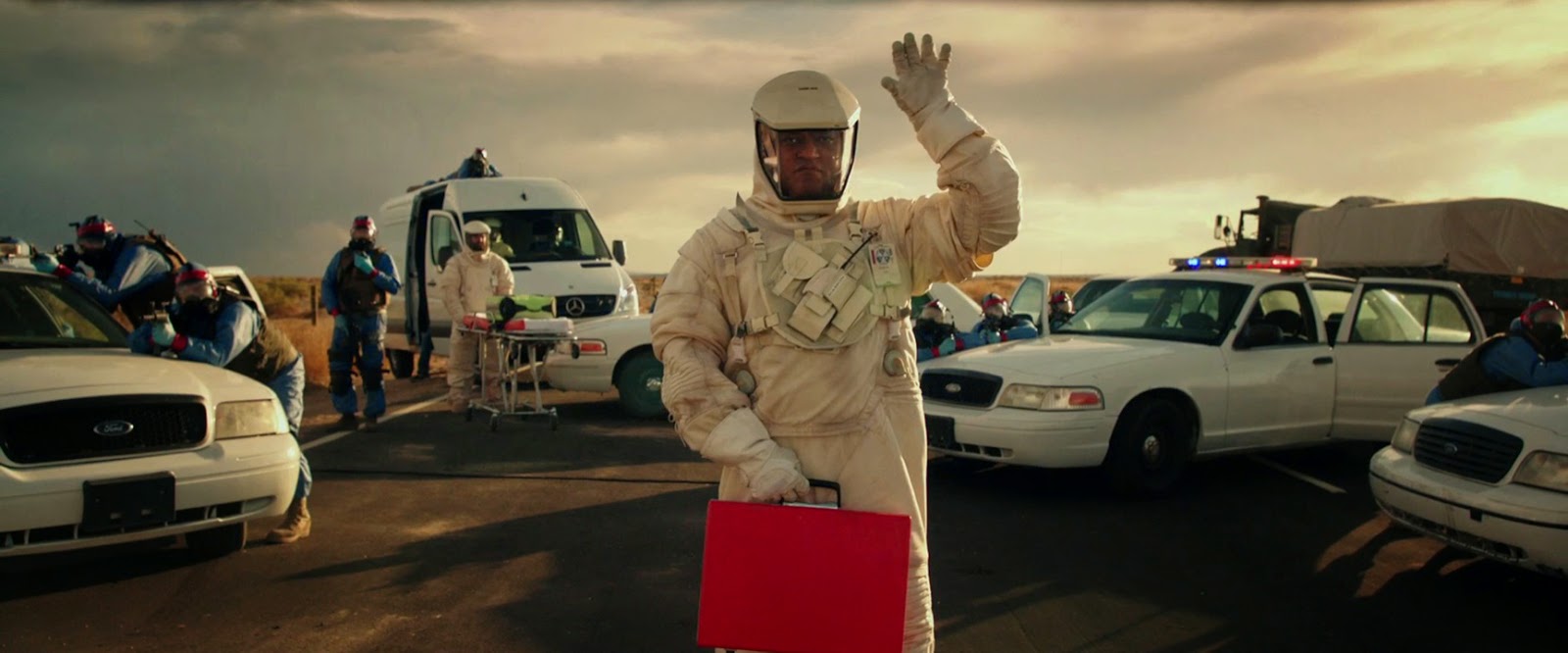
Creep (2014)
dir: Patrick Brice
SIFF 2014 Film #27
This year's SIFF proves that Found Footage horror is still going strong. After the success of V/H/S, we're starting to see a revitalization of the genre (despite what the producers of Beneath discovered). Creep is the best of the ones I saw this year, which took the same approach to the rules of found footage as Willow Creek, but didn't resort to redoing a well-worn plot line. Instead, Creep is original and founded in modern day fears, like Catfish. In fact, much like Catfish and the earlier The Signal, Creep is asking what happens when you respond to a stranger.
Patrick Brice stars as Aaron, an amateur videographer who responds to an ad from Josef, a guy who wants to make a My Life style video for his kid. Josef's dying of cancer, and he has a kid on the way, but he only has a few months to live and doesn't believe that he will see the kid being born. But, Josef starts out the film disarmingly and disconcertingly positive and just gets creepier from there.
Did I mention that it's a black horror comedy? Mark Duplass as Josef just gets creepier and creepier with his broadly grinning mug, as Patrick Brice just keeps trusting way too much. From the first scene that Josef wants filmed, where he strips naked and gets in the tub to have "tubby time" with his not-yet-born son, you just want Aaron to get the fuck out of there. This guy is weird. But, at the same time, he could just be a really weird guy who doesn't know social norms. Is he a creeper? Will he kill Aaron? Drug him or other things? Or, is he just overly strange without knowing typical limits.
The number of times that Josef freaks Aaron out in the opening sequences as a joke puts the audience at unease from the get go, but at the same time he's hilarious and charming. And, it's Duplass' acting that sells the whole movie. Most of the audience has probably met the weirdo character that Josef is playing. Maybe he wants to sell a mattress. Maybe he asked you on a date on OK Cupid or Grindr or whatever. Maybe he works at your movie theater. Maybe he's a Steve Buscemi character. Creep plays on our trust that people are good at heart, even if they're creeping us the fuck out, as long as they don't hurt us. Without Duplass' winning grin, the movie would probably fall apart like so many houses of cards.
Duplass and Brice stripped the found footage genre to the barest minimum. All music is in scene. All sound it in scene. There is only the one video camera used (though, one shot does seem rather without cause, and it bugged the shit out of me). You may be annoyed at Aaron for going along with Josef as far as he does, but these characters aren't out to ANNOY you. Even Josef is a winning character who is just intended to creep you the fuck out.
With a bullet-train short running time of 82 minutes, Creep will hit you like a ton of bricks. This is a movie that constantly sets you on edge, even if you're laughing your way through it. It's completely playful approach to the horror genre makes Creep genuinely well...creepy. This is a blast of a movie, and I wish it well in it's journey. Because, it's an amazing ride.
Showing posts with label horror. Show all posts
Wednesday, July 2, 2014
Monday, June 30, 2014
The Babadook (2014): Motherhood is hard
The Babadook (2014)
dir: Jennifer Kent
SIFF 2014 Film #25
Raising a kid is hard. Raising a kid as a grief-stricken single mother is harder. Harder still is when your kid is going through a violently hyperactive strange phase and doesn't mesh well with the other kids, causing you to be isolated from all the social groups you used to belong to.
Such is the premise of the new Australian horror movie, The Babadook, a film about the things that go bump in the night in your head. The Babadook is a genuinely creepy horror movie from first-time director, Jennifer Kent, which completely takes you by surprise and can make you freak out yourself. The young guy behind me was crying and practically hyperventilating by the end of the movie, and the audience I saw it with was pretty much enraptured in the movie. The less you know about The Babadook, the better it is. It's not gory, and is one of those old-school horror movies with a slow burn like The Omen (attention Ti West, this is how it's actually done), and once you feel the film's icy grip wrap around you, it doesn't let go until it's almost over. It's not slick or even all that polished, but it works all the better for it. Stop Reading. Now. Go see it.
You've been warned.
Amelia is a single mother frequently plagued by nightmares of the car crash she was in on her way to the hospital which took the life of her husband. Now, her son's birthday is the same as the anniversary of her husband's death, thus ensuring that her son is a constant reminder of her dead husband. Seven years later, Amelia's son, Samuel, is guilty of being a hyperactive boy with an overactive imagination. He has nightmares about the things that goes bump in the night, creates weapons to protect him and his mother, has screaming temper tantrums, and otherwise acts out to test his boundaries. When his school needs to further isolate Sam from his peers due to a homemade weapon he brings to school, his mother has to pull him out of school and keep him at home, fighting to keep her job as a nurse at a nursing home.
Further complicating measures is Amelia's sister, Claire, who is increasingly tired of Claire's depression and inability to deal with the death of her husband. "It's been seven years," Claire semi-justly observes regarding Amelia's feelings. Claire's daughter had been born close enough to Samuel's birthday to have joint parties, but far enough to be distanced from the memory of Amelia's husband.
One night, at bedtime, Samuel discovers a book called Mister Babadook, which seems like a well drawn pop-up children's story in the vein of Edward Gorey. The Babadook is a dark figure which comes knocking at the door, then haunts whoever denies that it exists. Mister Babadook gives Sam nightmares, and he believes that The Babadook exists even talking to thin air when it's not around. Amelia tries destroying the book, but it keeps returning to haunt her and her son.
First-time director Jennifer Kent is wise enough to know that what scares us in the middle of the night isn't the scary things that go bump, but the things that run through our head. Whether its the death of a husband, the fear that we're not able to provide for our family, or that we're not good enough, smart enough, popular enough, rich enough, all of these things fully take hold in our subconscious as we lay ourselves to sleep. These are the fears which, if strong enough, can keep somebody up at night. By making a monster movie where the monster is a pure metaphorical manifestation of the character's insecurities and aggression, Kent has made a horror movie that resonates with everybody.
Kent has also taken the extra step of making Samuel as annoying as possible. He isn't lovable. He is as annoying as all of the people say he is. Amelia isn't delusional about Samuel. Neither is anybody else. He's a child that would drive anybody to their wits end. When Amelia starts lashing out at Samuel, the audience feels she's justified because of Samuel's terrible behavior. When she lashes out at anybody she interacts with, it's because they're acting rather badly themselves. The Babadook is able to put you in the isolated mindset of Amelia who has refused to deal with her grief by putting on a strong face and praying for the best. Better still, Samuel isn't just an annoying brat, he's somebody who is starting to realize the full weight of the absence of his father. He starts wanting to know who his father is, something that has been denied to him by Amelia because she still hasn't dealt with her own loss, and is unable to broach the subject without breaking down.
The best horror is rooted in real-life tragedy. The Babadook has that in spades. It's a brilliant, frightening, intelligent horror movie that should hopefully make it's mark in the horror landscape.
Wednesday, June 18, 2014
Beneath (2014): Losing Your Way
Beneath (2014)
dir: Ben Ketai
SIFF 2014 Film #17
The absolutely non-descript title of Beneath is the least of the problems for this low-rent rip-off of The Descent.
Beneath opens with a title card saying that this was inspired by a true story. It's not. It claims that this is what happened when a bunch of miners were trapped in a Colorado collapse. It's not. That's just crass capitalization on a national tragedy, which marks how Beneath is a crass capitalization on The Descent and other national fears.
The first scene of Beneath introduces us to Samantha Marsh, who is collecting video tributes to her father, George, after hours in a miner bar. George, played by the calmly intense Jeff Fahey, is going to retire from his long-term job, and Sam is back in town after getting a degree in environmental law, intent on taking on the dirty coal industry (among others) to make a cleaner way of life. At the bar, the guys challenge her to come do a day's hard labor before her dad retires and she returns to her white collar life.
The next day, Sam heads down with the guys, and the mine collapses. There are injuries abound. But, then things start to be heard and seen. Two of the other miners are missing, probably still trapped deeper in the mine, but while Sam and the rest of the guy are staying in a holding room, the sounds convince them that the two missing miners are around. Everybody goes exploring, and...yeah, you know where this is going.
There are a number of problems with Beneath, and many of them stem from the changes that the producers made to the original script. The original script had Sam being a journalist doing a report on the miners, and was originally in a found footage format. The original script was also completely supernatural in nature, being about hauntings and possessions. But, the final version reworks the script to be a movie about people possibly going crazy, but doesn't entirely drop the supernatural elements of the original script, balancing between the two. Which undercuts both elements. The supernatural begins to make no sense, and the insanity really begins to make no sense.
In fact, the changes also make Samantha become less of a capable heroine and more of just a crazy stupid out-of-control woman. The film focuses mainly on her experience, but she is either confronted by the supernatural (sane) or goes completely crazy for no reason other than a mere few hours in a holding cell with a bunch of dudes.
The large topics that Beneath brings up get dropped fairly quickly. That topics of blue-collar vs white-collar, male vs female, and environmentalist vs miner are all dropped in the first half and never addressed again. The movie could become a metaphor about the coal workers vs the enviornmentalists, but it would be a really really asshole metaphor.
Does Beneath work as a horror movie? That depends on who you are. I was whelmed by the stupidity of the lead character, and the insanity doesn't have a believable build up for me. But, the cinematograhy and the pacing is nice. The woman in front of me screamed at many of the jump scenes. Other people in my audience seemed to really like Beneath, but the guy next to me walked out on it and many others seemed not happy with it. If you're susceptible to claustrophobic horror, you'll probably like it. Because, Beneath looks fairly nice, but it's kind of really dumb.
Monday, June 16, 2014
Willow Creek (2014): Correcting The Blair Witch Project
Willow Creek (2014)
dir: Bobcat Goldthwait
SIFF 2014 Film #15
The found footage genre has a lot of inherent problems to it, 2/3 of them are related to "how did this shot even happen" and the other 1/3 are related to "Why did somebody edit this, nevertheless like this?" In reviewing V/H/S, Film Crit Hulk at Badass Digest wrote about these problems with some pretty intelligent reasoning to why these problems exist and what the problems actually are, and where they stem from. Bobcat Goldthwait seems to agree whole heartedly with Film Crit Hulk, and decided to fix all of the problems by attempting to make a closer-to-reality found footage movie. This time, centered around the search for Bigfoot.
Kelly and Jim are a young couple on the hunt for Bigfoot, intent on making a documentary about the Patterson-Gimlin film, a famous film with supposed sightings of Sasquatch. They travel to the town of Willow Creek, CA which is near the location of the filming of the footage and has made a name for themselves by capitalizing on the Bigfoot fame. They have Bigfoot motels and Bigfoot statues, and home of the Bigfoot burger. Willow Creek is a real town created for fans/believers of Bigfoot.
Kelly and Jim spend the first half of Willow Creek creating footage for their documentary by pointing out city signs, interviewing the locals, eating burgers, and listening to the locals state their opinions of the Bigfoot mythology. But, they're warned not to go to the site of the Bigfoot footage, yet they go there anyways. The second half of Willow Creek is a mini-recreation of The Blair Witch Project that runs through the gamut of found footage cliches.
Willow Creek runs a blessedly short 77 minutes, and is created like an actual found footage tape. The edits are all from the camera starting and stopping, with everything filmed in single takes. The sound is all completely diegetic. There is no art to the style of Willow Creek except that the no art style is exactly the purpose of Willow Creek, thus making it an art of its own. It plays like a home video.
But, it's only 77 minutes. Since we spend half of that time exploring the weird world of Willow Creek, CA, that only gives about 40 minutes to build the tension from 0, and ratchet it up to screaming. The too short running time keeps the tension from building as sufficiently as it should. Much of the built tension focuses on a central set piece that's actually far cornier than it should be, which builds into the question of whether this is satire or not.
Bobcat plays Willow Creek for keeps. The first half is all gentle humor and a bit of "I love these strange people living their life in Willow Creek, CA." But, the second half is all played as if it is genuine horror like The Blair Witch Project. If it doesn't entirely work as a horror movie unto itself, Willow Creek kind of works as a critique of The Blair Witch Project, and simultaneously points to how easy and how hard it is to make a sufficiently good horror movie.
I liked the movie as a mental exercise enough, but the borrowed plot points from The Blair Witch Project really kept me from enjoying it as a horror movie, plus the movie was too short to really pull me out of the distanced first half into the fully engaged second half. It's a miss, but it's a narrow miss that I can easily see would be polarizing between the "This was stupid and corny and pointless crowd" and the "this was genuinely scary" crowd.
Friday, June 13, 2014
Dead Snow 2: Red Vs Dead (2014): Nazi Zombies - Excessive Edition
Dead Snow 2: Red Vs Dead
dir: Tommy Wirkola
SIFF 2014 Film #14
Dead Snow 2: Red Vs Dead is the sequel to the Nazi zombie cabin-in-the-woods horror comedy out of Scandanavia. Dead Snow was a clever meta take on the genre, which poked loving fun at the cabin in the woods formulas as well as the zombie formula, all the while maximizing the horror, the comedy and the gore. Dead Snow was clever, hilarious, and witty, especially since it came before Cabin in the Woods (unlike Zombeavers).
Dead Snow 2: Red Vs Dead smartly abandons everything that made Dead Snow what it was. A straight continuation from the final moments of Dead Snow, Dead Snow 2 moves out of the mountains and into the lowlands. The lone survivor, Martin, now down one arm, is chased by the Nazi zombies who cling to his car. But, because he had a spare coin in his pocket, they come after him again. And, in a series of incidents, Herzog (the lead Nazi) also loses his right arm, before Martin's car goes flying off a cliff into the hinterlands.
The hospital that found Martin attached Herzog's arm to Martin, and Herzog attached Martin’s severed arm, thus forming the basis for the feud. With Herzog's zombie arm, Martin achieves zombie super strength, and both have the ability to resurrect dead people to form zombie armies. To further complicate matters, Martin is joined by the Zombie Squad, a group of adult geeks whose whole life is wrapped up in the zombie culture, and they desire to kill zombies.
Herzog had initially been on a task from Hitler to take over a town, now is going to finish up his mission and march on the town again. Stopping by a museum to grab a tank and some weapons, he continues on his march. Martin, however, also hit the museum, and decides to resurrect Russians to combat the Nazis, thus recreating WWII in zombie terms. You have the Americans, you have the Russians, the locals, and the Nazis.
The wit in Dead Snow 2 isn't in the reuse or meta parody of horror or horror comedy tropes. The wit stems from Dead Snow 2’s willingness to go as far as possible as frequently as possible. There are instances of comedic cruelty to zombies, and the violence and gore factor of Dead Snow 2 is constantly as far over the top as you can imagine. From dead kids to smashed heads to intestines a plenty, Dead Snow 2 never says no to a drop of blood in the film.
Coming in at 100 minutes, Dead Snow 2 doesn't feel bloated at all. Just about the time you’re wanting the final battle to kick in, the final battle does kick in. The developments and pacing come in swift, and Dead Snow 2 feels more like an ode to Peter Jackson originality than Sam Raimi parody. Dead Snow 2 has more in common with Dead Alive than with Evil Dead, even keeping the sardonic cruel wit that Peter Jackson brought to his early work.
Dead Snow 2 isn't a dumb movie. It’s smart and witty and trashy and just about the perfect midnight movie. It doesn't run too long. It doesn't let its pacing drag, keeping the audience from falling asleep. The violence and gore factor are over the top. It's quite brilliant in how clever it actually is.
Required Viewing.
Thursday, June 5, 2014
The Strange Colour of Your Body's Tears (2013): Avant Garde Giallo
The Strange Colour of Your Body’s Tears (2013)
dir: Helene Cattet, Bruno Forzani
SIFF 2014 Film #8
In the follow-up to 2009’s Amer, Helene Cattet and Bruno Forzani created another psychedelic cinescape of sensory overload. The Strange Colour of Your Body’s Tears is a 100 minute avant-garde experiment that tests the boundaries of storytelling and film itself. By using the visual and aural overload cues of 1970s giallo, Cattet and Forzani have concocted a singularly unique film.
Dan Kristenssen is returning home to his gorgeous apartment after a week away and discovers his wife has gone missing. Adding to the mystery, the door was chained from the inside. While investigating the disappearance, Dan discovers that his apartment building has plenty of mysteries and mysterious tenants.
But, besides a couple of twists that happen midway through, much of the movie’s plot and meaning is kept vague to the audience. Unlike with Amer, Cattet and Forzani aren't intent on creating a simply plotted story that captures what it means to be a young woman blossoming. This time around, they’re exploring a general Giallo-inspired plot, but the complications upon complications means that The Strange Colour remains completely vague.
Those looking for something direct or even coherent might be better served looking at different pastures. The Strange Colour isn't going to provide you any direct answers. It isn't going to give you an easy A-B-C plot that tells you something is the direct something is the direct something. It is a mood piece that intends to overpower the audience instead of making a coherent statement on its own.
However, The Strange Colour is excellent in creating atmospheres of a certain feeling. The atmosphere is moody and grotesque and psychedelic and overpowering in intensity. The overamping of sounds like leather rubbing against leather, doors creaking open, blood splattering, tile breaking, and even blades going *SHINNK* creates a sensory overload that pulls you in and pushes you out in a pulsing fashion.
The lack of coherence that's conveyed through the atmosphere does point to a certain student film-esque quality. The atmosphere for atmosphere’s sake, the sound, the cinematography and the editing are all top notch, but the lack of purpose seems so amateur. There is a drilling re-use of an S&M scene involving a knife of at least 5-6 times where you kind of get the point and nothing new is revealed in any of the later repetitions. There are spinning kaleidoscopic reflections upon reflections of stained glass windows and geometric balconies and doorways that are neat to look at, but sometimes it is little more than “Look what I can do with After Effects!!”
The Strange Colour feels less like a final film and more like an experiment that will lead to the next film in Cattet and Forzani’s career. The film seems to be about the walls we build up between our self and our past. It explores our general abandoning of our history in order to deal better with our present. By creating the sense of horror, Cattet and Forzani have made the exploration compelling. But, without saying anything new that hasn't been said in other, more superior, films, The Strange Colour ends up being little more than a fun and amusing diversionary lark of an avant-garde film.
Labels:
2013,
Avant Garde,
Belgium,
Bruno Forzani,
Female Director,
Foreign,
France,
Helene Cattet,
horror,
Review,
SIFF,
SIFF 2014,
SIFForty,
The Other Films,
The Strange Colour of Your Body's Tears
Wednesday, June 4, 2014
The Signal (2014): Ideas Spurting Everywhere
![]() |
| No, this is not a Beekeeper's outfit. There are no bees in this movie. |
dir: William Eubank
SIFF 2014 Film #7
William Eubank's 2011 film Love was a low-fi indie film that was a semi-hit on the festival circuits due to it's amazing visuals, but was ultimately hindered by its content, or lack thereof. The visuals were frequently stunning and gorgeous, especially on the gigantic screen at the Egyptian theater (a single house palace in Seattle), but it didn't hold up in terms of being bout anything or anything substantial. Still, it was an ambitious and accomplished first feature for a director in search of an idea.
Eubank's latest feature is The Signal, an ambitious film for which he ended up using 8x the budget of Love, costing about $4mil. The visuals are frequently stunning, again, this time delving into horror tropes then Gerry tropes and also the twee style of fuzzy focus and narrow depth of field close ups. It's the very in style right now. Eubanks' style is great in the moments, but as a whole it falls apart.
The Signal follows three geeks from MIT - Nic, Haley, and Jonah - as they move Haley to go to school at CalTech. Nic has a degenerative disease which has caused him to lose strength in his legs. No reason is given, just that he'll be continually crippled and eventually die. He is dating Haley, but breaks up with her rather early in the film.
There is also a plot about MIT being hacked by an outside hacker NOMAD, taking down servers, but the blame is laid upon Nic and Jonah. On the road, NOMAD reestablishes contact with them using the line Are You Agitated, and hacks into Haley's computer. They track the hack to an address in Arizona, and they find an abandoned house when all hell breaks loose.
I put the essentials of The Signal first because to discuss The Signal is to spoil The Signal. On the other hand, The Signal needs some serious unpacking that I'm telling you now that there are spoilers going forward. So, SPOILERS AHEAD, you've been warned, etc etc etc.
When Nic and Jonah are exploring an abandoned house in the middle of the night, one wonders why they didn't just wait until daylight. Other than, it's creepier this way. And, when the boys explore the house, you wonder why they're exploring late at night, and why they split up, and why they leave Haley in the car. When they hear Haley scream, they know something is up, and then...bam, she flies into the air and the screen goes black.
The rest of the movie follows Nic as he wakes up in a facility with no windows that seems like a government experiment. He's strapped in a wheelchair, and is asked strange questions like "What planet are you from" by Laurence Fishburne in a hazmat suit. The movie seems to be implying that Nic was abducted by space aliens, and then sent back to Earth.
He discovers that he has new mechanical legs, and has to learn how to walk with them. He discovers that Haley is in a coma. He grabs her and escapes, to find that he's in a bunker that was miles below the surface of a desert. He and Haley run into Jonah, who now has super arms, and they try to make their way out of what they believe to be Area 51, but in the final twist discovers that they are actually on a gigantic alien spaceship on a floor that has been designed to test them.
Eubank crams so many ideas into one film that nothing is developed. Is it a story about love and dealing with your own rejection? Not really...that story line is abandoned in the first act and barely pops up in the third. Is it a story about determination and willpower? Kind of, but mainly with the help of super limbs. Is it a superhero origin story? Kind of, but he doesn't do anything super with it. Is it a space alien story? Not really, because that's dropped for the most part.
The Signal is so ADD in it's intentions - it's Catfish, no it's Fire in the Sky, no it's Area 51, no it's a government superhero origin, no it's actually an alien film - that it never develops anything to any extent. The only idea that he develops is self preservation and will power. But, that's even kind of a pussy theme for this strange of a movie.
A really REALLY bad thing about The Signal is that the girl isn't given any superpowers. She has a chip of the material used to make the boys' limbs in her back, but she doesn't get to do anything with it. She just becomes The Princess in the Castle. Which is a completely lousy trope. They have a great female character, and she is reduced to being a trophy. At the Q&A, Eubank was called on it, and he sort of evaded saying "She COULD have super powers...maybe in the DVD Extras." Which...really?
Another is that Eubank hasn't really thought up the intentions of the aliens. Why abduct somebody and give them super powers, if you're just going to kill them? They give Jonah super arms, but they kill him in a big shootoff. Which...why?! Why abduct somebody, give them a power, then kill them? I guess to test them, but really? And, the intents of the aliens is never really discovered. Why test humans? Why develop human technology at all?
In any event, the individual scenes in The Signal are fantastic. When it is Catfish, it's amazingly moody, and the burn is perfect. When the movie is the government testing facility, Eubank is on point with having witty and direct dialogue, and creating intrigue both visually and with subject. When it's Area 51, or a superhero origin story, it's surprisingly good at all those too. But, it adds up to jack shit in the end. Even more than Love, the sum of the parts do not add up to the whole. That is the ultimate disappointment.
And, as a note to Eubank...if you're going to make a semi-decent female...fucking USE HER. Don't just make her out to be a trophy to be rescued. God fucking dammit, I'm so sick of that. She literally does nothing..and...ugh!!! So wrong.
Tuesday, June 3, 2014
Zombeavers (2014): When Horror Comedy is Facile and Expected
Zombeavers (2014)
dir: Jordan Rubin
SIFF 2014 Film #6
All of the problems with Zombeavers stems from it being made for an audience of which I am not part of. The director and co-writer of Zombeavers is Jordan Rubin, who had previously written on The Man Show, The Late Late Show with Craig Kilborn, and the mid 2000s prank phone call show, Crank Yankers. If you're a fan of these three shows, you'll be in LOVE with Zombeavers as it is made specifically for you. Basically, whatever your stance on The Man Show and Crank Yankers, you'll probably have the same stance toward Zombeavers.
Rubin opens Zombeavers with two truck drivers (Bill Burr and John Mayer) ranting about sex in a masculinist way that also doesn't include homophobia. The opening requisite gay joke was that one guy had a boyfriend that was basically like having another guy friend but with blowjobs before a not panicky "I don't think of you that way" retort. It was kind of funny, and I was all strapped down for something subversive. YAY subverting the gay jokes, lets get see what happens next! The truckers end up hitting a deer, and releasing a barrel of toxic waste into the stream and hitting a beaver dam where it sprays all over. It's Return of the Living Dead Pt 2.
The next part is three nubile co-eds are on vacation at a cousin's cabin in the middle of the woods. There's the blond one who's just been cheated on (the Virgin), the one with glasses whose cousin owns the cabin and is also the organizer of the trip (the Brains), and the other dark-haired one who's really crass and takes her top off at the beach for a full extended sequence of boobies (the Bitch). The original vacation had been for the girls to get with the guys and them to have a big old-fashioned sexy-time weekend when the blonde's boyfriend had a picture taken of him making out with a girl and posted to Facebook.
The three guys make a renegade trip up, including the tall and large Joker who is dating The Bitch, the blond Jock who is dating The Brains, and the cute hairy one who is the Cheater formerly dating The Virgin. They're all trying to make sense of how to get The Cheater and The Virgin back together when they're all attacked by the Zombie Beavers.
The movie then proceeds through many of the usual tropes of Cabin in the Woods movies, and thinks its undermining the formula by having The Brains also be kind of a bitch. Or, having The Bitch be kind of moral. Or, The Cheater be seen as being the sleazy one. It's not that original. It's nice, but it comes way too soon after the formula busting Cabin in the Woods.
When Zombeavers is on, it's hilarious. There are some amazing changes that happen when the people turn, as is required by the Rule of Zombies. Some of the scene inversions are kind of awesome (including a knee to the balls scene), and some of the death scenes are pretty hilarious.
But, about 85% of the movie feels like the type of cheap and easy television humor that was Rubin's bread and butter is not in a movie that has SyFy Original Movie levels of effects. Not to mention, the film spends a lot of time gazing at the women, but not much preening over the men. In fact, there's one scene where it would have been better to have had it played fully naked for the man, but Rubin gives the guy underwear, thus cheapening the effect and making the preceding scene even cheaper.
And, the rest of it is full of masked and not-so-masked references to other films you rather wished you were watching. The formula is strong in this one, and Rubin isn't subverting the formula or using it in a particularly clever way. He's just using it to hang a bunch of jokes on. He does it well enough, but the whole thing is rather easy and facile. The audience I was with seemed to find it hilarious, but I just found myself being all "And...?"
Wednesday, May 28, 2014
The Midnight After (2013): The Best Philip K Dick Adaptation that Wasn't
The Midnight After (2013)
(aka Lost on a Red Minibus to Taipo)
dir: Fruit Chan
SIFF 2014: Film 2
This is the second film I’ve seen that came from a web story/novel, the first being the rather insane John Dies at the End, which was a novel originally published as a web serial. The Midnight After is based on a web novel by Mr. Pizza on the internet forum HKGolden. And, yes, it’s as insane and episodic as John Dies at the End.
The Midnight After is a Hong Kong take on Philip K Dick’s book Ubik, with a lot of changes. A group of 17 people on a minibus go through a tunnel late at night and end up in a world totally devoid of humans except themselves. As they realize something might be amiss, suddenly they start dying strange deaths. A lot of spoilery things happen, including a spectacular musical number set to a famous David Bowie song. But, I don’t want to give away much more than that.
Half of the fun of The Midnight After is trying to figure everything out. But, ironically, if you find it fun, you’ll also find the final scenes incredibly frustrating. The other half of the fun is the batshit insanity that is in The Midnight After. The characters include a spiritual psychic who sells insurance, a constantly bickering married couple, a couple of young punks named Airplane and Crazy Glue, and a druggie who is constantly on cocaine. They ping off each other, come back together, and gather to meet.
I found The Midnight After to be a helluva ride. I wanted more. The ending leaves you wanting more, in fact. It’s drama and science fiction and comedy and horror and musical and everything you could ever want in a movie all thrown in for a single experience. At 120 minutes, it almost runs a little long, and to be fair the movie could have a couple of minor edits where about 5 minutes might be removable. But, to niggle on 5 minutes when the rest of the movie is just a powerhouse rocket where the pacing ebbs and flows with a psychotic mastery seems petty at best.
The Midnight After doesn’t say anything deeper about life other than “Life can move pretty fast sometimes, and if you don’t appreciate it, you might miss it” and “Be good to each other.” But, that doesn’t matter because the film is all about the experience. It’s a blast, it’s fun, it’s something rather interesting, and gives you some stuff to chew on as you’re watching, so you won’t be bored. Puzzled, sure…but who doesn’t like a good puzzle?
Labels:
2013,
comedy,
Drama,
Foreign,
Fruit Chan,
Hong Kong,
horror,
Lost on a Red Minibus to Taipo,
Musical,
Review,
Science Fiction,
SIFF,
SIFF 2014,
SIFForty,
The Midnight After,
The Other Films,
Thriller
Thursday, May 8, 2014
1313: Frankenqueen (2012): DeCoteau Goes Meta
1313: Frankenqueen (2012)
dir: David DeCoteau
The 1313 series is one of the best series on the internet to hatewatch. It's not good. It's not good for you. And, it certainly isn't all that watchable. But, the series is completely compelling because it's mysterious for why these movies even exist, nevertheless exist on Netflix. These are the streaming equivalent of straight-to-video VHS tapes in the 1980s that were made on the cheap and sold in bulk to fill the store shelves while the studios were trying to adapt.
With the second to last entry in the 1313 series, DeCoteau seems like he's had enough with making serious films, and decided to go meta. Because, Frankenqueen is all about the creation of a 1313 movie, or at least seems like it.
There is a half-story to 1313: Frankenqueen, as usual. A group of guys have been invited to a mansion (the DeCoteau mansion in Santa Barbara) by Victoria, a famous plastic surgeon. She wants to do tests on them and will pay them handsomely for it. But, one character, the smart one, is there to get some sort of laser that Victoria's late husband had been working on.
However, Victoria is there to watch the guys do whatever. Eat food, take showers, do workouts, roughhouse, etc. She also does tests on them and insults them periodically. And, she constantly talks about the boys like they're actually going to be sold as slaves or something. But, in the end, she is really creating the perfect guy with an amalgamated brain made from everybody and her dead husband. At least I think it's an amalgamated brain, and not body because there are no stitches anywhere.
Victoria is not unlike the audience watching the traditional 1313 film, especially as defined by the final film 1313: UFO Invasion. We sit, and watch a bunch of guys allergic to shirts walk around the mansion, do workouts, take showers, pose, walk some more, occasionally speak some dialogue, and then get bloodlessly murdered while we make fun of the characters and actors for being terrible. Victoria even talks about the characters like chattel, calling them "product." Which is odd because she isn't really selling them or their body parts.
The 1313 series, it has been rumored, isn't really meant to be a series of films at all, but a casting calling card of sorts for both DeCoteau, a talent agency, and the actors in the films. In the case of Frankenqueen, the acting is above the usual standard, and even the dialogue is a little better written than usual. Victoria actually gets in some decent one liners, and the acting for the boys' ham-handed dialogue is at least above boredom.
In the end, the 1313: Frankenqueen boys are generically nice to look at. They're all relatively cute, like flipping through an All American Boy catalog. But, that's always the case with the 1313 series. The metaness of the film actually gives you a little something extra to bite onto, much like Night of the Widow, DeCoteau's other actually not terrible entry. Is it good? No. But, it's not offensively bad (even when Victoria is scanning their bodies with a booklight), and it's kind of funny in an stock but intentional way this time.
Previously reviewed in series: Bigfoot Island, and Night of the Widow
Tuesday, May 6, 2014
Axed (2012): Half-thoughts on the economy
Axed (2012)
dir: Ryan Lee Driscoll
One of the dangers of shoehorning social commentary into your movie is that you might get tired of the commentary, or lose your way and finish your movie with a bunch of cliches. It's happened to directors good and bad, on all types of budget. You think you're going in for something entertaining, then you get asked to think about something, and then the movie never finishes its thought.
This is the problem with Axed, a British horror movie which seems like its going to attempt to be about the economic landscape and ends up being a slasher horror movie. By the end of Axed, it loses its way.
But, I'm getting ahead of myself.
The central figure of Axed is Kurt Wendell, a married father of 2 who is fired in the opening scene before throwing a temper tantrum of despair in the parking garage. After being fired, he takes his family to the countryside in order to kill them.
This sounds promising. A man who could possibly be at the end of his financial ropes decides that it would be easier to kill his family than to try getting another job. It's happened in real life. It's a devastating reality that focuses on the everyday stress of regular working stiffs. The disappearing middle class.
But, Ryan Lee Driscoll tacks on a lot of extra baggage. Kurt Wendell is an overbearing abusive tyrant of a father and husband. He mocks his son for being bullied and beaten at school. He yells at his daughter for wearing a semi-revealing dress. He admonishes his wife for not teaching the children how to behave. And, that's all at the breakfast table. Kurt is an abusive man to begin with, and the whole family's behavior acknowledges this.
When Kurt unexpectedly takes the family on a countryside vacation that day, the day after he is fired, his family goes along with it to not make him mad, and they constantly walk on eggshells to try not to upset him. By the time we get to the country house, we can tell that Kurt was an asshole well before he got fired, and that he should have been ditched long ago.
Driscoll then adds on a lot of games to the movie. Kurt has already kidnapped and tied up his former boss, whom has been sleeping with Kurt's wife. He then plays cutesy abusive games with the family foretelling that the home life isn't so peachy keen after all. The financial burden of losing his job is just a final straw, and is barely mentioned outside of a couple conversations. The rest is just on a Funny Games esque scenario.
The biggest problem with Axed is namely follow-through. Driscoll has a dynamite concept about everyday finance that he abandons for family game playing that he abandons for slasher movie tropes that we've seen a million times. Even the small details of Axed lack follow-through. For example, Kurt collects everybody's cell phone, but the daughter has a spare for some reason, and uses it to call her boyfriend, but not the police. This lack of follow-through with a concept is just plain silly at best.
Another big problem is that the acting is pumped up to 11, though with the dialogue and scenario there's not much more that you can do to make it believable. Jonathon Hansler's Kurt Wendell is like a psychotic John Cleese, crying and falling apart constantly while storming around full of self-righteous anger. It's kind of fun watching him do it, but there is no ramp up. It starts at 11 and he has nowhere to go, really. Pretty much everybody stays on the same volume for the whole movie, and it's really just that nobody has much of an arc.
I do hope somebody remakes Axed. It's a concept that deserves far better treatment than this. It's not scary, it's been done before, and it isn't as fun as it thinks it is.
Monday, May 5, 2014
Beyond the Valley of the Dolls (1970): Using camp to dissect the woman's picture
Beyond the Valley of the Dolls (1970)
dir: Russ Meyer
Boobs.
I think every review of a Russ Meyer film should begin with a word about breasts. Tits, mammaries, gazongas, huge tracts of land. Because, if there is one thing that Russ Meyer is obsessed with, it's breasts. Ok, well, two things because they do frequently travel in pairs.
However, to say Russ Meyer is obsessed with breasts is not to admonish him, nor to diminish his work as purely misogynistic exploitation. Far from it. Russ Meyer frequently enhances his love of the large chest with an equal love of the strong woman. His movies simultaneously exploit women in order to lust over their bodies and hold up women as stronger than life human beings who are very capable of surviving life without a man.
After the commercial success of Valley of the Dolls in 1967, 20th Century Fox commissioned Jacqueline Susann to write a sequel to the film, and she titled it Beyond the Valley of the Dolls. She had written the original novel, but had not written the screenplay...and both of her scripts failed to get published. Then, Fox looked to Russ Meyer and Roger Ebert to develop the film.
Ebert and Meyer didn't set out to make a straight-up drama like Valley of the Dolls was. Instead, they used the concept of camp in order to deconstruct Hollywood tropes that existed and would continue to exist in some fashion throughout. They're not subtle either. Making a sexy horror comedy musical drama that is also a satire, they just threw it all in and stirred.
Beyond the Valley of the Dolls is a film about a female rock group from the sticks who go out to Hollywood in order to find success. As they become successful, they succumb to the various trappings of Hollywood, and everything crumbles and turns to shit.
That description is simultaneously an exact overview of the film and a vast oversimplification. All of the trappings of Hollywood they succumb to are generic stock scenarios that usually come with the woman's pictures.
The central rock band is initially called The Kelly Affair, named after the lead singer. The film opens with them playing at a prom, then taking a break to smoke some grass in their van in the parking lot. They come up with the idea to go to Hollywood to find Kelly's estranged Aunt Susan. Well, really, we find out that Kelly's mother was actually the black sheep of the family and was written out of her mother's will, leaving Aunt Susan to inherit the family fortune.
Aunt Susan is actually the editor of some high profile fashion magazine, and is into a really wild party scene. She invites the Kelly Affair to a party at Ronny "Z-Man" Bartell's pad. Z-Man is a rock producer, and takes the Kelly Affair under his wing, renaming them The Carrie Nations, and makes them famous.
Kelly ditches her boyfriend for the love of a muscled surf actor. Aunt Susan tries to give Kelly half of the fortune, but her lawyer really wants the money and tries to stop that from happening. One bandmate falls in love with a law student, cheats on him with a boxer who then beats up the law student. Kelly's boyfriend is seduced by a porn star, gets heavily into drugs and tries to kill himself but becomes a paraplegic. Another bandmate, sleeps with Kelly's first boyfriend, gets pregnant, an abortion, succumbs to drugs, and becomes a depressed lesbian.
The specifics could really have been filled any number of ways, but the result would be the same. The Carrie Nations all succumb to the horrors of their new locale and lose themselves before figuring out that true happiness isn't found in drugs or materialism, but in love. The details are only significant in how they take specific tropes and turn them on their head.
Roger Ebert was, at the time, a relatively new film critic out of Chicago. He had only been working for a couple of years, and seemed a strange choice for a million dollar sequel. But, there had been a shift brewing in Hollywood at the time.
From the 1930s through the 1960s, Hollywood had been working under the Motion Picture Production Code, or the Hays Code, which monitored what content it deemed appropriate for wide release. Depictions of out-of-wedlock sexuality, any homosexuality, cursing, violence, and a whole litany of questionable moral judgments were not allowed by the Hays Code. But, by the late 1960s, the code was getting more and more lax in its enforcement to the point where Hollywood came up with a new system entirely.
In 1968, the MPAA ratings system was born with G, M (which would become GP and then PG), R, and X. 20th Century Fox was eager to test the system, as the public was demanding more and more mature offerings, and hired the breast-obsessed Russ Meyer and the film critic Roger Ebert. At the time, Fox was losing money, and trying out some experimental films. In 1970, it released M*A*S*H*, Beyond the Valley of the Dolls, and Myra Breckenridge. All experimental films, especially for studio product. BVD and Myra were Fox's June releases, even.
With Fox being embroiled in bitter power struggles, Ebert and Meyer were able to do whatever the hell they wanted. In essence, Ebert and Meyer made the ultimate movie to close out one era of film history and usher in the next. They smashed together the psychedelic genre of the 1960s with the woman's soap opera of the 1950s and the fame picture of all the time, and then added in sex, drugs, violence, alcohol, and even queer sexualities...all amped up to 11. The movie opens with a scene from the finale where a girl is woken up by a gun being thrust into her mouth by an unknown assailant. And, the smash cut to the beginning is from the trigger being pulled.
Ebert and Meyer were satirizing what had come before, and ushering the new cynical genre that would come in the 1970s, as also shown by the X-rated Myra Breckenridge, which would come out the week after. The darkness of the media conglomerates selling false truths were to be explored and openly mocked, through the use of camp.
There is a direct contrast to Beyond the Valley of the Dolls with Mahogany, as both of them use the same formula to different ends, but both ending up in camp. Mahogany doesn't realize it is going through camp, but ends up there due to the Sirkian subtexts that Berry Gordy consciously, or unconsciously, added in. Beyond the Valley of the Dolls actively subverts and mocks the formula with an intentionally campy tone inviting the viewer to actively dissect what they're watching as they're watching it.
Beyond the Valley of the Dolls makes little sense to most people who don't actively have a sense of its origins. Those who haven't witnessed the tropes, nor seen the formulas, may think that BVD is just a bad movie without realizing it is intentionally over-the-top. However, Beyond the Valley of the Dolls persists to this day as an deep track for those who stumble across its titillating content.

dir: Russ Meyer
Boobs.
I think every review of a Russ Meyer film should begin with a word about breasts. Tits, mammaries, gazongas, huge tracts of land. Because, if there is one thing that Russ Meyer is obsessed with, it's breasts. Ok, well, two things because they do frequently travel in pairs.
However, to say Russ Meyer is obsessed with breasts is not to admonish him, nor to diminish his work as purely misogynistic exploitation. Far from it. Russ Meyer frequently enhances his love of the large chest with an equal love of the strong woman. His movies simultaneously exploit women in order to lust over their bodies and hold up women as stronger than life human beings who are very capable of surviving life without a man.
After the commercial success of Valley of the Dolls in 1967, 20th Century Fox commissioned Jacqueline Susann to write a sequel to the film, and she titled it Beyond the Valley of the Dolls. She had written the original novel, but had not written the screenplay...and both of her scripts failed to get published. Then, Fox looked to Russ Meyer and Roger Ebert to develop the film.
Ebert and Meyer didn't set out to make a straight-up drama like Valley of the Dolls was. Instead, they used the concept of camp in order to deconstruct Hollywood tropes that existed and would continue to exist in some fashion throughout. They're not subtle either. Making a sexy horror comedy musical drama that is also a satire, they just threw it all in and stirred.
Beyond the Valley of the Dolls is a film about a female rock group from the sticks who go out to Hollywood in order to find success. As they become successful, they succumb to the various trappings of Hollywood, and everything crumbles and turns to shit.
That description is simultaneously an exact overview of the film and a vast oversimplification. All of the trappings of Hollywood they succumb to are generic stock scenarios that usually come with the woman's pictures.
The central rock band is initially called The Kelly Affair, named after the lead singer. The film opens with them playing at a prom, then taking a break to smoke some grass in their van in the parking lot. They come up with the idea to go to Hollywood to find Kelly's estranged Aunt Susan. Well, really, we find out that Kelly's mother was actually the black sheep of the family and was written out of her mother's will, leaving Aunt Susan to inherit the family fortune.
Aunt Susan is actually the editor of some high profile fashion magazine, and is into a really wild party scene. She invites the Kelly Affair to a party at Ronny "Z-Man" Bartell's pad. Z-Man is a rock producer, and takes the Kelly Affair under his wing, renaming them The Carrie Nations, and makes them famous.
Kelly ditches her boyfriend for the love of a muscled surf actor. Aunt Susan tries to give Kelly half of the fortune, but her lawyer really wants the money and tries to stop that from happening. One bandmate falls in love with a law student, cheats on him with a boxer who then beats up the law student. Kelly's boyfriend is seduced by a porn star, gets heavily into drugs and tries to kill himself but becomes a paraplegic. Another bandmate, sleeps with Kelly's first boyfriend, gets pregnant, an abortion, succumbs to drugs, and becomes a depressed lesbian.
The specifics could really have been filled any number of ways, but the result would be the same. The Carrie Nations all succumb to the horrors of their new locale and lose themselves before figuring out that true happiness isn't found in drugs or materialism, but in love. The details are only significant in how they take specific tropes and turn them on their head.
Roger Ebert was, at the time, a relatively new film critic out of Chicago. He had only been working for a couple of years, and seemed a strange choice for a million dollar sequel. But, there had been a shift brewing in Hollywood at the time.
From the 1930s through the 1960s, Hollywood had been working under the Motion Picture Production Code, or the Hays Code, which monitored what content it deemed appropriate for wide release. Depictions of out-of-wedlock sexuality, any homosexuality, cursing, violence, and a whole litany of questionable moral judgments were not allowed by the Hays Code. But, by the late 1960s, the code was getting more and more lax in its enforcement to the point where Hollywood came up with a new system entirely.
In 1968, the MPAA ratings system was born with G, M (which would become GP and then PG), R, and X. 20th Century Fox was eager to test the system, as the public was demanding more and more mature offerings, and hired the breast-obsessed Russ Meyer and the film critic Roger Ebert. At the time, Fox was losing money, and trying out some experimental films. In 1970, it released M*A*S*H*, Beyond the Valley of the Dolls, and Myra Breckenridge. All experimental films, especially for studio product. BVD and Myra were Fox's June releases, even.
With Fox being embroiled in bitter power struggles, Ebert and Meyer were able to do whatever the hell they wanted. In essence, Ebert and Meyer made the ultimate movie to close out one era of film history and usher in the next. They smashed together the psychedelic genre of the 1960s with the woman's soap opera of the 1950s and the fame picture of all the time, and then added in sex, drugs, violence, alcohol, and even queer sexualities...all amped up to 11. The movie opens with a scene from the finale where a girl is woken up by a gun being thrust into her mouth by an unknown assailant. And, the smash cut to the beginning is from the trigger being pulled.
Ebert and Meyer were satirizing what had come before, and ushering the new cynical genre that would come in the 1970s, as also shown by the X-rated Myra Breckenridge, which would come out the week after. The darkness of the media conglomerates selling false truths were to be explored and openly mocked, through the use of camp.
There is a direct contrast to Beyond the Valley of the Dolls with Mahogany, as both of them use the same formula to different ends, but both ending up in camp. Mahogany doesn't realize it is going through camp, but ends up there due to the Sirkian subtexts that Berry Gordy consciously, or unconsciously, added in. Beyond the Valley of the Dolls actively subverts and mocks the formula with an intentionally campy tone inviting the viewer to actively dissect what they're watching as they're watching it.
Beyond the Valley of the Dolls makes little sense to most people who don't actively have a sense of its origins. Those who haven't witnessed the tropes, nor seen the formulas, may think that BVD is just a bad movie without realizing it is intentionally over-the-top. However, Beyond the Valley of the Dolls persists to this day as an deep track for those who stumble across its titillating content.
Wednesday, April 9, 2014
Screamtime (1984): How low budget can tickle
Screamtime (1984)
dir: Michael Armstrong, Stanley A. Long
The straight to video market in the 80s was infamous for having a whole slew of no budget horror movies that were done by amateurs meant to fill up the video shelves. Growing up in the 1980s, you come to know that you might have to dig deep into the wells for the gems that would periodically perk up. These videos disappeared to the annals of time for a good long period of time, until Netflix, criticized for having no selection, picked up a whole bunch of these no budget British films for their streaming service.
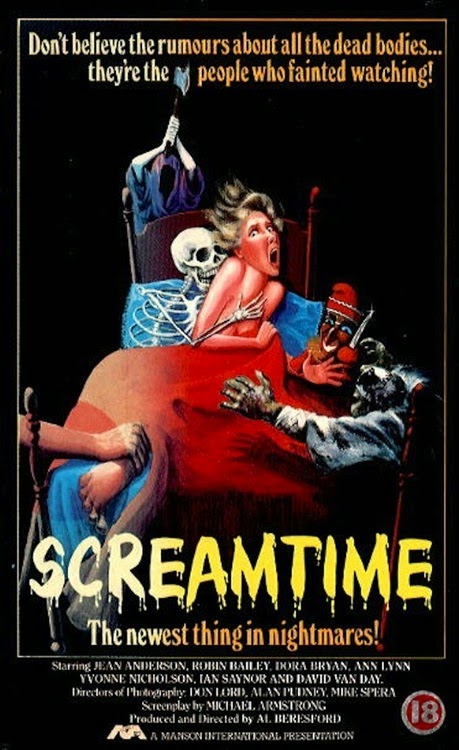
The original VHS cover was surprisingly not inaccurate for the movie within the box. This is an anthology movie about Punch and Judy, a mass murderer, and garden gnomes and buried zombie ghosts. Sure, they're all in different stories, but at least they're all in the movie.
While this is a British film, the framing device is in New York City, where two jerks steal three videos from the local store, and then go over to a girl's apartment, eat her food, make her miss her date, and they watch three British horror movies of negligible quality back to back. They are total jerks. I'm really surprised that the girl invites one of them to sleep with her in between the second and third movie.
The first movie they watch is about an old puppeteer who is doing his passion by doing Punch & Judy shows at the waterfront. He lives in a nice house with his wife in England. They have a son who has finished school (high school or college, it doesn't say). They know a couple of people who are successful in Canada. But, his wife hates the puppets and demands that he gives everything up and goes with her to live in Canada with her son. You know, after she rabidly insults him and calls him a loser for following his passion. The son is also bitter and a punk who berates him at the dinner table. When the son burns down the Punch & Judy stand, all hell breaks loose.
The second movie is about a newlywed couple who move into a house given to them by their father who apparently deals in real estate. The wife starts having increasingly crazy visions beginning with a boy on a bicycle in the yard, moving to happy guys bounding around with knives (blink and you'll miss it), and then to the actual recreation of a multiple murder scenario, driving her to insanity, because one doesn't hallucinate murder scenarios without going a wee bit crazy,
The third film regards a kid who wants to buy a car, so gets a second job as a gardener at a old posh house with two old ladies who love telling stories about their garden. They say there are fairies in it, and they take the manifestation of the garden gnomes who protected their previous owner. The previous owner was a woman who loved having affairs with young men, who would then die and their souls would be slaves of the gnomes.
While the movie is most definitely what it is: a no-budget not-that-shocking horror movie which would have a PG rating except for a single shot of gratuitous nudity as the girl in the framing device steps out of the shower. You know, kind of what you expect from straight-to-VHS 80s horror. There's some horrendously unbelievable violence, and my favorite part is that a the gardener kid gets crucifies like Jesus when he dies.
This movie is hilarious at times. The mother of the newlywed tells her daughter-in-law, "I don't even know why I had a son. Take my advice, and stick with girls." The high pitched Punch sounds during the murders of the first movie are hysterical. And, the two old biddies in the final story really make the movie. I'm not even kidding.
Thusly, Screamtime is actually better than its humble origins as a straight-to-video VHS but not by much. There are aspects that make this a cheesetastic success, and it has elements in the camp style. It almost feels like you're not laughing at it, but laughing with it. It knows it can't elevate itself past the no budget, so it spends its time winking at you. Dream House gets in a bit of tension despite its trappings, but the other two are loaded with cheeky jokes and insane storylines.
Which raises the question: when is a bad movie bad enough to be good? If a movie winks at you throughout, is it good enough to be entertaining? These are the types of questions one must ask for themselves. It is a different formula for everybody that tickles you. I am tickled by an old man chasing a girl with a big orange square of wood while shrieking "Beat the Wife!" in a high pitched squeak that is past a falsetto. I'm tickled by two old ladies gleefully talking about souls that become enslaved to the garden gnomes. I'm tickled by a guy eating fried chicken and sitting 3 ft from the tv screen commenting "It's British. I can tell by the way they talk."
Other people, however, may be bored and with good reason. The pacing in the first story is way off, and if you're not into a bit of humor, the third story will be irritating. Still, this one is worth a watch if you're bored and have nothing better to do, are sick and need something easy on the mind, or something. It's not really ultraviolent, though each of the three have slasher elements to it. It's somewhat sexist, but not overly done. I enjoyed myself, but it's not good. And, it's better than just middling. So, if you don't mind being tickled by low budget horror that makes you laugh more than scream and isn't designed for the gore or breast hounds, this is a good choice.
Friday, March 28, 2014
House (1977): When the Kitchen Sink technique works
House (aka Hausu) (1977)
dir: Nobuhiko Obayashi
In a traditional sense, nothing about House should work. It's a horror movie for kids that is all about love, loss and vampirism. As a film, it uses every single technique that had been invented by that time, and created new ones just for its own humor. It never really holds its attention on any one topic for any length of time, yet creates a hallucinatory throughline story. Yet, House is one of the craziest, most entertaining, balls-out films that works on weird hallucinatory levels as well as ridiculously high camp.
House tells the story of Gorgeous, whose father is about to remarry years after her mother passed away. Because he botched the introduction of his daughter and new wife, his daughter rebels and decides to spend her vacation with her aunt in some far off town. Her 6 friends have also recently learned they cannot go to a training camp due to a pregnant innkeeper, and choose to go with her.
Her aunt, living all alone in the middle of the country, greets them with open arms. Except that she is a vampiric witch, and employs both the house and all of the objects within it, in order to kill any unmarried females who dare to step within its walls. Auntie feeds off their life, and exchanges bodies and spirits so that she has possession of their identity as well.
What would normally be a relatively straightforward story of girls in peril, with a tragic backstory, turns into a child-like hallucinatory horror movie that comes off like a nightmare version of Sesame Street on acid. Much like Sesame Street's shorts, Obayashi uses everything under the sun to convey a child's heightened emotionality as well as blunter sense of the world. There's split frames, frames within frames, irises, deep focus, natural settings, matte backgrounds, blue screen, silent film, black and white, stop motion, practical effects, frame coloring, drawing on the frame, animation, slow motions, speed-ups, smash cuts, musical numbers...the list of everything that is in House is practically a compendium of cinematic techniques that were available at the time. A use of a few of those techniques go a long way, but House dares to include all of them.
That's not to say that the effects were all successful. Obayashi intended for the movie to look like a child's playtime machinations, with a sense that this isn't a mature adult making mature a movie for adults but a child communicating a child's experience. This child is explaining that she has a fear of a variety of things, including futons, pianos, clocks, reflections, cats, adults, and watermelons.
In order to properly enter this world, and take it as it wants to be taken, the viewer must turn himself into a child and turn off their preconceived notions of what a film actually should be like. Watching the film as an adult expecting a straightforward horror movie filled with adult creeping terrors around the corner is quickly obliterated by the opening, where a blue line outlines a box in the frame, and the cartoonish title treatment speaks the name "House" before eating you.
This type of whimsy continues through an opening scene where our heroine, Gorgeous, meets her stepmother. The scene seems like it is in the balcony of a spacious and stylish apartment with a matte painting backdrop of a setting sun makes it more 1980s Moonlighting than actually resembling a realist movie set. Any pretense at being realistic is dropped soon after when her new stepmother floats in from the side, with an invisible wind making her hair and her scarf trail her. It's heightened drama and setting, but it's so effective at setting a dreamy atmosphere that when we get to the schoolyard scenes that follow, the realism is drastically jarring. The school scenes are filmed in a style most reminiscent of any 1970s back to school special.
Given Obayashi's background in advertising, it's no surprise that House is as impeccable as it is inconceivable. The framing of the scene from the left with a giant pair of lips haunting the girls is stunning and amateur both. It's just off center, with the lips being the center of a frame that seems to have moved off to the left. The various odd sources of lighting are too hot in certain areas (notably the girl's butt), but still dramatic and creepy in the realm of the classical noirs. Compare that to the earlier frame of the head in the well, where the matte painting background gives everything an illusion of deepest focus, and the whole frame is lit and filmed like a classical watercolor painting. Which looks completely different to the neo-realist schoolyard scenes which feature no matte paintings and seem to even use a different film stock. Etc. But, they're all impeccably used, in an amateurish manner.
House doesn't have any pretense about being anything other than a film about 7 young girls in danger. Sure, it has some cultural allusions WWII and the bomb, and how the older generation is trying to cope with a younger generation who knows absolutely nothing about that earlier war and the destruction that was wrecked upon Japan as a result. From a child's perspective, though, that means nothing and the real source of fear are in the odd objects of the house. This is an art object. It's an experience. You're meant to laugh with it, and be scared by it. It's comedic, horrific, childlike and silly. But, most of all, it's different. This is primarily for experiencing something you haven't experienced since Sesame Street, put into a horror movie. It's an astounding film.
Tuesday, March 25, 2014
The Visitor (1979): Wackiness foiled by pacing
The Visitor (1979)
dir: Guilio Paradisi
When I was a child, I used to be fascinated by the horror movie VHS art in the aisles. Some of them completely frightened me, like the original are for Fright Night, which had the clouds over a house turning into a vampire about to descend onto the suburban home. Whoever did that poster deserves an award for making me frightened of its contents.
Other notable VHS horror art were Black Roses (which had dimensional bubble art), April Fools Day, Gothic, TerrorVision, and today's featured film, The Visitor (shown at right). What's notable for The Visitor is the the strange absurdity of the art: a giant eyeball floating over a large city with two monster hands holding a bloody wire pulled taut between thrm. Add in the lightning strikes, and this is probably the origins of my personal fascination of using eyeballs in marketing imagery. They're fascinating, visually stunning, full of meaning, and generally kind of hypnotizing. Other people think they're creepy, but that's only when the eyeball comes in pairs, and with eyelids.
I hadn't actually gotten around to watching The Visitor because I believe the film was removed from the shelves by the time I was old enough to rent it. This year, in 2014, Alamo Drafthouse has released a remastered high-def extended full length version of The Visitor and revealed that, for all of its crazy psychotic beauty, the key art for The Visitor has almost nothing to do with the Italian ripoff content within.
The Visitor is but one in a long line of European ripoff films that featured riffs on a variety of original American titles. The horror genre was especially intent on focusing on Rosemary's Baby, The Exorcist, and The Omen. Some movies would throw one or two of these films into a blender and see what comes out. Beyond the Door was The Exorcist meets Rosemary's Baby. The Devil Within Her was mainly It's Alive combined with Rosemary's Baby and would predate The Omen.
The Visitor, however, wasn't content to rip off just the four American films about. It would also include The Birds, Carrie, THX1138, Close Encounters of the Third Kind, and The Holy Mountain. Basically it takes all 8 films and throws them haphazardly into a blender so you get a mismashed slurry that comes out the end.
The film opens on a Jodorowsky-esque surreal landscape that tells some story of an evil demon/spirit/God that was destroyed by a good evil/spirit/God through the use of some birds that would peck its brains out. The evil spirit also turned into a bird to kill the other birds. Though, the evil spirit died, he was able to copulate with humans, Zeus style, leaving bits of his spirit to continue popping up in random human wombs.
All of this exposition is relayed by a Jesus figure who is also the leader of a cult of bald children in some form of extraterrestrial white room. Suddenly, another figure pops his head in and says that they found the next vessel, and she JUST TURNED 8!! Duh DUH!!!
Fairly soon, the movie then turns into a cross between The Omen, Carrie, and Rosemary's Baby, with the story of an executive trying to marry a single mother whose kid is the aforementioned vessel. The executive is under the guise of some evil outfit who is working for some evil spirit. The single mother is pregnant with another kid, who she feels is evil and is harassed into keeping the spawn. The 8-year-old, however, is an evil spirit who can make things happen with her mind just to spite everybody. But, she's also the biggest, most foul-mouthed brat in the world, even telling Shelley Winters, her new nanny, that she shoved her birthday present up her ass. Not in a The Exorcist foul-mouthed demonic way, but in a Fuck You, I'm A Spoiled Brat kind of way.
There's also a story where the second adult figure from the Jesus white room is tracking down the kid and the demon spawn in order to defeat them before they release evil into the world or something. And, a police officer is also tracking down the kid, after a birthday present bird became a gun that shot her mother, paralyzing her from the waist down.
With all of this going on, one is tempted to say this is would be a fantastic piece of gonzo trashiness, but in the Drafthouse release the pacing of The Visitor is more languid than any of its brethern. With a runtime of 109 minutes, The Visitor's crazy non-sequitorness doesn't hold up to sustained watching, instead feeling like the ultimate party movie rather than a real film. One you can talk through and then look up and see somebody get shot, or a kid swearing and then continue the conversation without having missed much because there isn't much to miss.
And, while some of the visuals are stunning (especially the opening sequences and the one featuring a discotheque lighted airport runway. It isn't sustained for too terribly long. It's a competent film that just doesn't rise to the occasion of the early and closing sequences. While individual sequences of randomness are
Overall, The Visitor suffers from too much bluster without anything substantial to connect the threads. One could easily argue that none of the other knock off blender films have much substance either, but most of those either have a strong throughline, or keep their running time blessedly short. The constant throwing of random scenes from other films does nothing to help keep the viewer compelled to see what's next when half of the film is rendered with a slow, languorous pacing that lulls the viewer toe distraction. Yet, at a party, this is a feature not a flaw.
Is it a success? No. It's an archival piece of weirdness that should be treasured, but it doesn't live up to the trashy camp highs and lows that Drafthouse's cult has built up around it. There's a reason its cult status never followed through on creating a following.
Friday, March 14, 2014
Kiss of the Damned (2012): Sexy Vampire Women, updated
Kiss of the Damned (2012)
dir: Xan Cassavetes
From the 1960s and into the 1970s, there was a whole genre of erotic vampire movies, with a fair amount from Jess Franco, director of Venus in Furs and Female Vampire. They were lush, languid, filled with sexy bodies, and had plots that were largely inconsequential. With Kiss of the Damned, Xan Cassavetes is trying to recapture that feeling of the purposeless vampire movie without devolving into the maudlin vampire genre that was created in Twilight.
Kiss of the Damned focuses on the relationship of a Paolo, a screenwriter, who falls in love with a hot vampire woman, Djuna, and then is turned by her. Later, as they're nesting, Djuna's sister Mimi reappears from Amsterdam following a tumultuous whatever, and creates chaos simply by being present, and by not killing her victims and leaving them around to be resurrected.
Apparently, in the mythos of Kiss of the Damned, if a vampire doesn't decapitate their victims, the victims have a chance of randomly resurrecting. No blood exchange needed. Djuna's problem with Mimi is that she claims that Mimi doesn't properly protect her victims, whereas Mimi and Paolo always decapitate their victims.
Djuna also has a problem with Mimi's periodically wild party lifestyle. This is shown by a threesome with a random couple in the gigantic mansion Djuna has. Everybody snipes at each other, people die, and the movie ends.
What Cassavetes captures with Kiss of the Damned is the languid pacing that came with the arthouse erotic horror film, as well as the inconsequential plots. With all of the fancy camera work, however, Cassavetes somehow misses the completely lush gorgeous look that those old films actually captured. Maybe it was in color selection, fabrics and shapes that were en vogue, or just a general aesthetic of color choice, camera angles, lighting and film stock. But, Cassavetes misses the mark in a fully transformative experience.
Cassavetes also seems to be attempting to turn Twilight inside out by deconstructing a couple of the central ideas from the novel, but putting them into an erotic old-school movie genre. She includes the fight between Mimi and Djuna about Djuna's turning Paolo into a vampire. There is discussion of the morality of humans and vampires. There is discussion about the larger groupings of vampirism, with Djuna and Mimi being sisters from the same mother. Cassavetes is simultaneously exposing these discussions to be as silly and morally relative as they are.
Cassavetes also tones down the rampant, gratuitous, nudity that dominated the Jess Franco vampire movies. In some of his more notorious movies, like Vampyros Lesbos, Franco would essentially fill the movie wall to wall with beautiful naked vampire women, and the movies would be a classy excuse to see a blue movie because it was a Spanish movie, and therefore have more cultural currency. Cassavetes has little interest in keeping everybody naked, though does frequently indulge in shirtless displays of Milo Ventimiglia (Paolo).
The experiment that is Kiss of the Damned is, ultimately, a mild success. It does succeed in deconstructing and mocking Twilight without being overt about its intentions. It only half succeeds in recreating the atmosphere of the original vampire erotic genre. And, it isn't nearly as over the top as it should be. It's entertaining in fits, but ultimately it is brought down by the lack of anything going on.
Tuesday, March 4, 2014
Female Vampire (1973)
dir: Jesus Franco
Jesus Franco was, at one point, king of the low-rent Spanish erotic horror genre. He created films that combined eroticized females and supernatural elements, mostly to craft an atmospheric mood piece with a lot of breasts in it. Some of Franco's movie are coherent movies, some are pieces of incoherent psychedelia, and some are pure softcore exploitation films.
Female Vampire exists as three versions. An R-rated horror movie, an X-rated softcore edition, and a XXX hardcore version. Somewhat surprisingly, the softcore version of Female Vampire has made it to DVD and to Netflix under the title Female Vampire, while the hardcore version still is out of print. But, really, what would Female Vampire be without the softcore sex? A 30-minute shorter movie about a vampiress who is stalking some European town.
What Female Vampire actually is about is a mute vampiress who is a descendant of Dracula, who kills people by giving them orgasms through oral sex. It could be man or woman, but she drinks their sexual essence and ultimately they die in the midst of their orgasms. Le Petit Mort becomes Le Grand mort. There are also some people hunting her, but that's mildly incoherent as it never really sticks to any of these storylines.
The story isn't what makes Female Vampire so good. I mean, it has something to do with it. But, the true qualities of Female Vampire are in the details. Franco is fascinated by the female body, as he is in every one of his other films. His camera leers over the female body in the most hilariously perverse ways. The opening credits play over our female vampire walking naked, save for a cape, belt and go go boots, in a forest. She stops, and the camera zooms in to give full screen breasts, bush, lips, and pans slowly up and down her body. Then, she walks into the camera, hitting it with her face.
The next scene, she walks into somebody's backyard, whose response to seeing a naked mute woman is "Can I help you? What do you want?" Of course, then she gives him a blowjob and kills him, after which she flies away by flapping her arms to transform into a bat, which, by the way, you never see. The closest you get to seeing a bad is an awesome bat ornament on a fancy car whose wings flap as you drive. I WANT THAT HOOD ORNAMENT.
Along the way, the vampiress, who is a mute, is interviewed by a woman and then kills her by oral sex. She also violates a bed and a headboard pillow. She writhes around in a bathtub full of bloody water. The fabrics are all in the ornate rococo gothic styles that one associates with European castles. Yet, she frequently has those moon boots that were so prevalent in the 1960s.
The voiceovers during the flying bat ornament scenes express a melancholy debate over how she is cursed to love people even though she will kill them, which is re-emphasized by the somewhat solemn elevator muzak that is in every Eurotrashy '70s sleazy film. Female Vampire has this heightened feeling of regret for the sex that it indulges in, but it actually is to just give the whole affair a bit of class, and actually succeed in taking the edge off what would be a women kill through sexuality plot.
Jesus Franco has never really cared much about anything other than leering over the female body. And, it shows in Female Vampire. But, it is so much fun for indulging in all of the cliches that you would expect from a 1970s eurotrashy film. Sultry voiceovers, moustache trimming, rococo fabrics, bad lighting, terrible focus, extreme closeups, 1970s era bush, soft muzak, and hilariously ornate details. As long as you don't take Female Vampire seriously, it is a serious load of fun.
Friday, February 14, 2014
The Devil's Carnival (2012): Aesop's Fables for Goths
The Devil's Carnival (2012)
dir: Darren Lynn Bousman
At a certain point in The Devil's Carnival, I thought "this would be awesome, if I were watching a community of amateurs doing this for free in a tent in the desert." Frequently, it seems like director Darren Lynn Bousman (Saw 2-4) called his group together to say "Can you guys come help with this? It'll be fun! Not much money in it though. But, really, I won't take much of your time."
The whole genre of The Devil's Carnival fits Bousman's last film Repo! The Genetic Opera. Bousman's motley group consists of goth-industrial "singers," comic book artists, non-singing actors and actresses, and probably some array of actual burlesque and carnival folks. He had used many of this cast in Repo!, but had more success with the different singers at the focus of Repo!, including the now absent Sarah Brightman. But, without that powerhouse, we're left to listen to a bunch of non-singers warble their way through atonal circus-inspired carnival musical songs.
The Devil's Carnival is merely an excuse to string together three of Aesop's Fables. There is The Dog and His Reflection, The Scorpion and the Frog, and Grief and His Due. Since Aesop's Fables are generally short and to the point, we have to fill time with framing device.
In the real world, there are three characters who are about to die, and actually do die, each representing the three different stories. The first is a guy who locks himself in a bathroom, depressed, and then slits his wrists mourning his son. The second is a woman who is being chased by the cops. And, the third is a woman who is being beaten by her boyfriend. When they all die, they get transported to Hell, where they have to suffer through a short couple of songs based around their respective fables.
The woman being chased by the cops is a thief and always looking for material goods. Her story chases after bigger and bigger jewels, and when she sees a person in a mirror with a large amount of jewels, she dies. The woman being beaten goes from bad boy to bad boy, always trusting even though it doesn't benefit her. And the guy is looking for his dead son, but ultimately finds redemption.
Ultimately, in this movie, women are actually evil. Both women suffer through punishment for their transgressions. The greedy gold digger is also a liar. She doesn't escape. The habitually abused spouse is blamed because she trusts too easily, and her boyfriends are never punished for being bad boys (which, actually, goes against The Scorpion and the Frog, where the Scorpion stings the frog midway across the pond and they both die). But, the suicidal father is forgiven. So, no men are ever punished.
Besides the hideous streak of misogynistic patriarchal moralism, The Devil's Carnival is only passable in flashes. Sometimes, especially when Terrance Zdunich, Nivek Ogre, or Ivan L Moody are on screen, the carnival singing and music actually are sonically acceptable. They have a professional knowledge of tonality and atonality that the rest of the movie seems to not be able to reach with its non-professional singers. The sets are great for an amateur-style setup, creating more of a stagey feeling to it.
Which brings us to the question of "how much community feeling is acceptable?" In my review of Go Fish, I gave a lot of lee-way to the amateur community nature of Go Fish because it felt like a low-budget film that needed to be by a community. Sure actors flubbed lines, probably unintentionally, but it felt more home-style. Yet, for The Devil's Carnival, the amateur but we're trying nature grated on my nerves. Perhaps, it is because I enjoyed Repo! The Genetic Opera on an actual sonic level as well as on an entertainment level, thus my expectation levels were higher. Or, maybe the production levels of low-budget have gotten so professional looking that movies which would have previously looked like Go Fish (in black and white 16mm) now look pseudo-professional. Or, maybe its because I expect more from a director of 8 other films.
But, in any case, I can't get past that feeling like Bousman wants us to forgive the mistakes or off singing in order to really like this community film. It's a really high hurdle. Combine that with the misogyny of the film which condemns all females to hell, and you have a short film that is a bit toxic, and not in the good way.
Thursday, February 13, 2014
Strange Circus (2005): The Circus of your Mind
Strange Circus (2005)
dir: Sion Sono
Readers of Japanese Manga should be used to the type of subject matter contained within this film. Watchers of Takeshi Miike might even be used to it. But, Strange Circus will be no less shocking to those who think they should be accustomed to the content.
What is in Strange Circus? Incest, rape, murder, violence, dismemberment, paralysis, and psychosis. You know? Disney fun for the whole family. And, it's handled with all the subtlety and sensitivity that any Japanese over-the-top movie brings to the screen.
Strange Circus opens with a carnival/circus where a drag queen invites a 14 year old girl to be executed on the stage guillotine. The girl accepts his offer, and comments, in voice over, that she thinks this is where she was born. But, the carnival is only a metaphorical framing device of the story within the film. The story is about a daughter who accidentally sees her parents having sex, gets caught by her father, then is molested, and raped by her father. Her father grooms her in grotesque ways, like locking her in a cello case with eyes cut out to watch her father have sex with her mother.
The story is disconnected and dreamy, with the mother and daughter frequently interchanging positions. The mother is jealous of the daughter's new sexual position in the family. The daughter accidentally kills the mother during one of the mother's jealous rages over an earring.
But, all of this is the latest manuscript of an author, played by the same actress who plays the mother in the stories. In this reality, the author is attended by a new editor from her publishing house who waits on her hand and foot while also reading through her manuscript.
You'd be more than a little forgiven if you thought this has the same types of themes as Miike's Audition, which is also about a father figure who auditions young girls to be his lover, only to be tortured for his abuse of the system and falling into the lamentable pattern of seeing women as objects for his sex or love. And, really, that movie was one of Miike's first films that seems to be a nuclear weapon aimed by the new generation of Japan at the old cultures of Japan. It seemed to rip open the old school ideas of sex and dominance, while forcing its own values on the screen.
Sono's Strange Circus, participates in the same knee-jerk cinema that also seems to be about how the old customs of Japan fucked up the new generation. Especially with it's conclusion, which doesn't exactly come out of left field but reaches a fever pitch normally seen in anime and manga. Sono seems to be saying "look at how you raped and fucked up Japan, assholes." Though, at times, one also checks in with the Natural Born Killers-esque question of "Can you condemn without also indulging?" Sono lingers over the various sexual abuses quite frequently and, while not completely and penetratively graphic, still graphic enough to be disturbing. It's still almost on a Showgirls rape scene level graphic. Which led to the question, is he indulging as he's condemning, or is he only indulging for entertainment, or only condemning? And, does it even matter?
The long form continuation of rape in this movie is really squeamish, and also leads to one wondering if this is almost a normalization of rape. Even if it is disturbing, the sheer amount of it almost has a numbing effect, even if Sono ultimately condemns it.
As a piece of shock cinema, however, Strange Circus certainly is shocking. It is also a frequently beautiful film. Sono makes the film look as lush and gorgeous as he can. The lushness takes away from the impact that a more raw, less stylized film would take, for better or worse. If you like shock cinema, this is one of the entries that you may need to watch. But, it will push your buttons, and maybe for no real reason.
Subscribe to:
Posts (Atom)