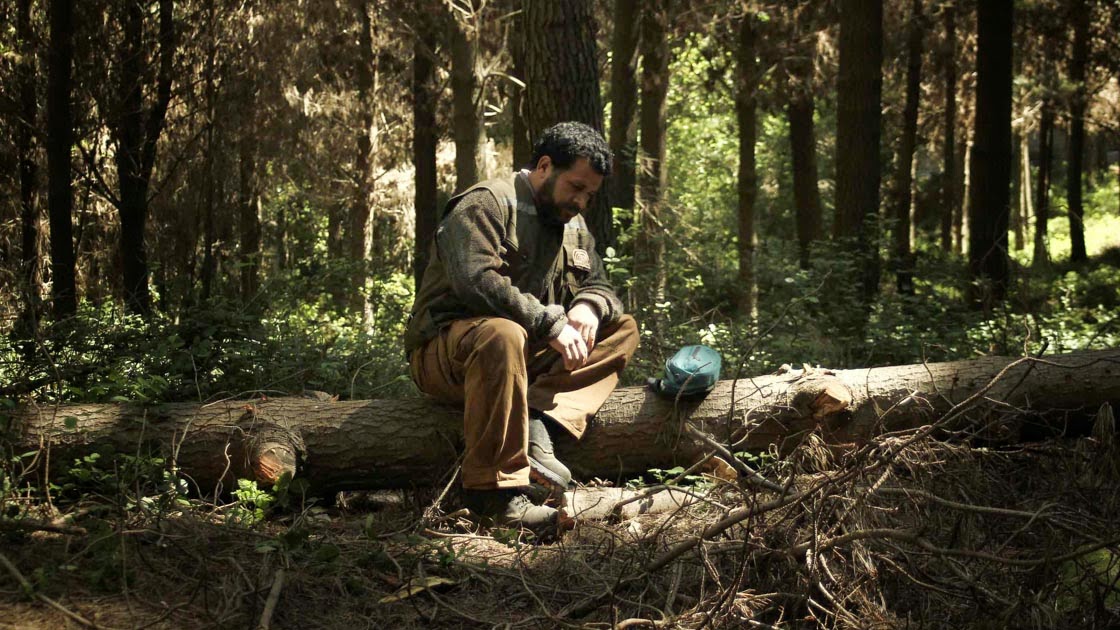
Manuscripts Don't Burn (2014)
dir: Mohammad Rasoulof
SIFF 2014 Film #29
In 2011, Mohammad Rasolulof, an already accomplished director, was arrested and had a 20-year ban from making any films imposed on him by the Iranian government. In secret, Rasoulof broke that government-ban and made Manuscripts Don't Burn, a film which is an indictment of the Iranian government, and it's attempts at intellectual censorship. The end result is a harrowing indictment of not only censorship but also cultural manipulation and how the whole system is set up against everybody's best interest.
The main characters of Manuscripts are not the intellectuals, but a pair of Iranian government assassins who are chasing after a manuscript. The assassins aren't rich or even paid all that well, as one of the two assassins has a sick child who is trying to gain admission to a hospital, but he doesn't have the money to pay for the stay. The assassin is constantly calling their government bosses to try to get the finances transferred to his account so he can prove he can afford for his son to have whatever surgery is needed.
The manuscript is written by a wheelchair-bound intellectual poet who had written a book that was essentially an anti-government screed that had over 100 instances of censorship inflicted upon it. One of the major instances is a story about a group of poets on a bus trip to Armenia, which was supposed to be driven off a cliff in the middle of the night. They intervened and survived, but were warned to be silent about it. The uncensored manuscript is put to a small circle of intellectuals for safe keeping, and the Iranian government is trying to keep it repressed.
The saying of "Manuscripts don't burn" means, essentially, that while the government can censor all they want, they actually don't have the power to remove memories. Until they do. The assassins aren't just going to destroy the manuscripts, but destroy all of the memories of the manuscript from those who have read it, wrote it, and remember it. At this point in their career, murder and death are second nature to the assassins. They even delude themselves to the reasoning they kill, with the father of the sick child questioning whether he's actually doing a good service, or if he's just doing something more immoral.
While the general frame of Manuscripts Don't Burn is a traditional assassin story, the details and the government prescience adds a presence that otherwise would be absent in this rather slow and pondering execution of the usual story. The ponderings of religion and God, and the intersection of religion and government, duty and manipulation of the poor, plus the responsibilities of rebels to try to promote the truth in a lying government, makes Manuscripts more detailed and pointed than the usual generic stories we get.
Rasoulof filmed Manuscripts in secret, and even eliminated all names except his own from the credits. The cast and crew have gone unnamed in the movie in order to prevent them from legal action by the government. But, the secrecy shows. There are some questionable filming choices that seem more rudimentary than thought out, and the pacing is a little erratic even in its heavily plodding pace. However, given the circumstances, one can forgive those technical details over the thoughtful content within the film itself.
Manuscripts Don't Burn isn't an "enjoyable" experience. But, not all cinema should be enjoyable. They should be thought provoking, and Manuscripts Don't Burn has that in spades. Being an anti-government screed, Manuscripts is an important movie, even if it isn't technically amazing.
Showing posts with label SIFForty. Show all posts
Friday, July 4, 2014
Thursday, July 3, 2014
La Mia Classe (2013): Going Meta-Overboard
La Mia Classe (2013)
(aka My Class)
dir: Daniele Gaglianone
One of my traditionally favorite formulas is the story by proxy formula. In this formula, it's generally a group setting, and in one remote location. The story, we learn, is happening off stage, and we're learning about it piece by piece through the dialogue only. Generally, this works best on radio or on stage, and it helps to have only a handful of stories progressing at any one point. But, the action only sometimes interrupts the on-stage/screen action, with most climaxes happening off screen as well.
This formula must fascinate Gaglianone as well, as La Mia Classe uses the formula, then makes meta-commentary on the meta-formula, thus making everything meta squared.
Gaglianone is tackling some heavy, hefty, issues with La Mia Classe that affect a broad range of people, namely that of immigration and treatment of immigrants in the country of Italy. He sets La Mia Classe as a cinema verite style peek inside an Italian as Second Language class for immigrants. He fills the classroom with a wide variety of immigrants from a variety of places - Egypt, India, Libya, etc - and with a variety of reasons for not wanting to remain in their own country: money problems, cultural pressures, etc. Through the language exercises, we learn what these situations are, and the struggles that happens because of their being an immigrant.
But, Gaglianone also poses La Mia Classe as a documentary about the making of the narrative feature La Mia Classe and also a behind the scenes of the making of that documentary. He opens the film with the students testing their various microphones before the shooting is supposed to begin. But, before that, we explore the halls of an empty school into an empty room, as if the class had happened long ago in a different time period. At one point in the film, a student walks up to the teacher saying he has problems with his residential status papers, but then at another point, a student walks up to a producer with the same problems creating a hullabaloo. At yet another point, the film is documenting the setting up of a shot for a student to sleep in a park, and then filming the sleeping in the park.
Gaglianone goes overly meta to get the point across that this isn't your traditional poor weepy, but this stuff actually happens, but he loses the point of going meta by making his meta narrative kind of wishy-washy in its status as a non-fiction fictional narrative, and thus making everything seem faker and less urgent than it may actually be in that country.As a counter-example, Interior. Leather Bar. is a meta-narrative where the whole thing is scripted, but it's scripted as if it is a documentary, and doesn't half-ass or confuse any of the scenes. Thus, the scenes in Interior. Leather Bar. while climbing up its own ass still, seem more real than the scenes in La Mia Classe.
The missed opportunity is great here, because when La Mia Classe is on, it's really on. And, when it's off, it's really off. It's a point blank disappointment that's greater because it was reaching for the stars and burnt out before it reached it's destination. The acting didn't help because most of the students seemed to be able to speak Italian with great ease, and the mistakes also seemed scripted. But, what do I know? It's not my language. Nor my country.
(aka My Class)
dir: Daniele Gaglianone
One of my traditionally favorite formulas is the story by proxy formula. In this formula, it's generally a group setting, and in one remote location. The story, we learn, is happening off stage, and we're learning about it piece by piece through the dialogue only. Generally, this works best on radio or on stage, and it helps to have only a handful of stories progressing at any one point. But, the action only sometimes interrupts the on-stage/screen action, with most climaxes happening off screen as well.
This formula must fascinate Gaglianone as well, as La Mia Classe uses the formula, then makes meta-commentary on the meta-formula, thus making everything meta squared.
Gaglianone is tackling some heavy, hefty, issues with La Mia Classe that affect a broad range of people, namely that of immigration and treatment of immigrants in the country of Italy. He sets La Mia Classe as a cinema verite style peek inside an Italian as Second Language class for immigrants. He fills the classroom with a wide variety of immigrants from a variety of places - Egypt, India, Libya, etc - and with a variety of reasons for not wanting to remain in their own country: money problems, cultural pressures, etc. Through the language exercises, we learn what these situations are, and the struggles that happens because of their being an immigrant.
But, Gaglianone also poses La Mia Classe as a documentary about the making of the narrative feature La Mia Classe and also a behind the scenes of the making of that documentary. He opens the film with the students testing their various microphones before the shooting is supposed to begin. But, before that, we explore the halls of an empty school into an empty room, as if the class had happened long ago in a different time period. At one point in the film, a student walks up to the teacher saying he has problems with his residential status papers, but then at another point, a student walks up to a producer with the same problems creating a hullabaloo. At yet another point, the film is documenting the setting up of a shot for a student to sleep in a park, and then filming the sleeping in the park.
Gaglianone goes overly meta to get the point across that this isn't your traditional poor weepy, but this stuff actually happens, but he loses the point of going meta by making his meta narrative kind of wishy-washy in its status as a non-fiction fictional narrative, and thus making everything seem faker and less urgent than it may actually be in that country.As a counter-example, Interior. Leather Bar. is a meta-narrative where the whole thing is scripted, but it's scripted as if it is a documentary, and doesn't half-ass or confuse any of the scenes. Thus, the scenes in Interior. Leather Bar. while climbing up its own ass still, seem more real than the scenes in La Mia Classe.
The missed opportunity is great here, because when La Mia Classe is on, it's really on. And, when it's off, it's really off. It's a point blank disappointment that's greater because it was reaching for the stars and burnt out before it reached it's destination. The acting didn't help because most of the students seemed to be able to speak Italian with great ease, and the mistakes also seemed scripted. But, what do I know? It's not my language. Nor my country.
Wednesday, July 2, 2014
Creep (2014): Found Footage Done Creepy
Creep (2014)
dir: Patrick Brice
SIFF 2014 Film #27
This year's SIFF proves that Found Footage horror is still going strong. After the success of V/H/S, we're starting to see a revitalization of the genre (despite what the producers of Beneath discovered). Creep is the best of the ones I saw this year, which took the same approach to the rules of found footage as Willow Creek, but didn't resort to redoing a well-worn plot line. Instead, Creep is original and founded in modern day fears, like Catfish. In fact, much like Catfish and the earlier The Signal, Creep is asking what happens when you respond to a stranger.
Patrick Brice stars as Aaron, an amateur videographer who responds to an ad from Josef, a guy who wants to make a My Life style video for his kid. Josef's dying of cancer, and he has a kid on the way, but he only has a few months to live and doesn't believe that he will see the kid being born. But, Josef starts out the film disarmingly and disconcertingly positive and just gets creepier from there.
Did I mention that it's a black horror comedy? Mark Duplass as Josef just gets creepier and creepier with his broadly grinning mug, as Patrick Brice just keeps trusting way too much. From the first scene that Josef wants filmed, where he strips naked and gets in the tub to have "tubby time" with his not-yet-born son, you just want Aaron to get the fuck out of there. This guy is weird. But, at the same time, he could just be a really weird guy who doesn't know social norms. Is he a creeper? Will he kill Aaron? Drug him or other things? Or, is he just overly strange without knowing typical limits.
The number of times that Josef freaks Aaron out in the opening sequences as a joke puts the audience at unease from the get go, but at the same time he's hilarious and charming. And, it's Duplass' acting that sells the whole movie. Most of the audience has probably met the weirdo character that Josef is playing. Maybe he wants to sell a mattress. Maybe he asked you on a date on OK Cupid or Grindr or whatever. Maybe he works at your movie theater. Maybe he's a Steve Buscemi character. Creep plays on our trust that people are good at heart, even if they're creeping us the fuck out, as long as they don't hurt us. Without Duplass' winning grin, the movie would probably fall apart like so many houses of cards.
Duplass and Brice stripped the found footage genre to the barest minimum. All music is in scene. All sound it in scene. There is only the one video camera used (though, one shot does seem rather without cause, and it bugged the shit out of me). You may be annoyed at Aaron for going along with Josef as far as he does, but these characters aren't out to ANNOY you. Even Josef is a winning character who is just intended to creep you the fuck out.
With a bullet-train short running time of 82 minutes, Creep will hit you like a ton of bricks. This is a movie that constantly sets you on edge, even if you're laughing your way through it. It's completely playful approach to the horror genre makes Creep genuinely well...creepy. This is a blast of a movie, and I wish it well in it's journey. Because, it's an amazing ride.
dir: Patrick Brice
SIFF 2014 Film #27
This year's SIFF proves that Found Footage horror is still going strong. After the success of V/H/S, we're starting to see a revitalization of the genre (despite what the producers of Beneath discovered). Creep is the best of the ones I saw this year, which took the same approach to the rules of found footage as Willow Creek, but didn't resort to redoing a well-worn plot line. Instead, Creep is original and founded in modern day fears, like Catfish. In fact, much like Catfish and the earlier The Signal, Creep is asking what happens when you respond to a stranger.
Patrick Brice stars as Aaron, an amateur videographer who responds to an ad from Josef, a guy who wants to make a My Life style video for his kid. Josef's dying of cancer, and he has a kid on the way, but he only has a few months to live and doesn't believe that he will see the kid being born. But, Josef starts out the film disarmingly and disconcertingly positive and just gets creepier from there.
Did I mention that it's a black horror comedy? Mark Duplass as Josef just gets creepier and creepier with his broadly grinning mug, as Patrick Brice just keeps trusting way too much. From the first scene that Josef wants filmed, where he strips naked and gets in the tub to have "tubby time" with his not-yet-born son, you just want Aaron to get the fuck out of there. This guy is weird. But, at the same time, he could just be a really weird guy who doesn't know social norms. Is he a creeper? Will he kill Aaron? Drug him or other things? Or, is he just overly strange without knowing typical limits.
The number of times that Josef freaks Aaron out in the opening sequences as a joke puts the audience at unease from the get go, but at the same time he's hilarious and charming. And, it's Duplass' acting that sells the whole movie. Most of the audience has probably met the weirdo character that Josef is playing. Maybe he wants to sell a mattress. Maybe he asked you on a date on OK Cupid or Grindr or whatever. Maybe he works at your movie theater. Maybe he's a Steve Buscemi character. Creep plays on our trust that people are good at heart, even if they're creeping us the fuck out, as long as they don't hurt us. Without Duplass' winning grin, the movie would probably fall apart like so many houses of cards.
Duplass and Brice stripped the found footage genre to the barest minimum. All music is in scene. All sound it in scene. There is only the one video camera used (though, one shot does seem rather without cause, and it bugged the shit out of me). You may be annoyed at Aaron for going along with Josef as far as he does, but these characters aren't out to ANNOY you. Even Josef is a winning character who is just intended to creep you the fuck out.
With a bullet-train short running time of 82 minutes, Creep will hit you like a ton of bricks. This is a movie that constantly sets you on edge, even if you're laughing your way through it. It's completely playful approach to the horror genre makes Creep genuinely well...creepy. This is a blast of a movie, and I wish it well in it's journey. Because, it's an amazing ride.
Tuesday, July 1, 2014
Intramural (2014): Yet Another Sports Parody Film
Intramural (2014)
dir: Andrew Disney
SIFF 2014 Film #26
One of the hardest things about reviewing small ambitionless movies is trying to decide how to say that these small, tiny, independent movies which have no hard feelings towards anybody are not very good. Or, worse, that they're merely OK, but that the movie itself is well worn subject matter that has been tackled time and again.
And, so it is with Intramural, a movie that parodies sports movies and college movies in ways that you've seen 10 times already. In Intramural, Caleb Fuller is about to marry some rich daughter of a powerful law firm in order to shore up a job prospect. Suddenly, he has a crisis where he wants to make up an Intramural team one last time before he goes off to live his pre-determined life path. So, he has to get the band back together, run through the usual sports movie tropes, including the now requisite parody of sports movie tropes, to win the big game and get the other, better for him, girl.
We've seen it 100 times before, but, as with improv shows, where these movies are supposed to shine are in the freshness of the jokes. Unfortunately, Intramural isn't all that fresh either. Bradley Jackson's script for Intramural relies heavily on well-worn treads of having a jock fraternity, a ragtag team, and a well-meaning coach in a wheelchair straight out of Upright Citizens Brigade. Periodically, Intramural has some gem moments, such as the coach coming up with the nonsensical advice "You've got to shit on the ceiling," and then actually having the team help Caleb to shit on the ceiling. Or, a particularly clever sports movie parody montage. And, the two guys who hang around the bleachers being sub-ESPN sports announcers for the teams are particularly genius. But, beyond these few moments, much of Intramural is rather expected and dull, kind of like a Saturday Night Live episode. And, I'm not talking about the good ones.
I suspect that if you were drunk or stoned and particularly liked the sports movie parody genre, you could do worse than Intramural. People in the audience seemed to enjoy the easy going SNL-inspired humor of the genre. And, if you like late-era SNL, you may actually enjoy Intramural. But, really, the only truly original part of it was the gay stereotyped character who also wanted to be a magician. Despite the semi-stereotype (gay, goth magician), he wasn't the butt of any gay jokes, or even the butt of the stereotype jokes...which is something I guess. He was funny. Yay progress!
On the other hand, the women are reduced to 2 character, one being an annoying whiny rich bitch, and the other being the epitome of the trophy trope. And, yet again, there is a team of butch women who call themselves Manhaters and are the butch lesbian bull dyke stereotypes. All of which is, "Yawn." Seriously, guys? Move on...
All in all, though, Intramural is far too lazy of a movie to fully enjoy. It's probably best as one of those movies you'll pull up late night on a Friday or Saturday still drunk or high with a couple of your friends and you don't want to watch anything that will make you go, "Whoa!" It's silly enough to make you get the high giggles, and will otherwise entertain your easily entertained friends. But, watching it sober in the middle of the day is a chore.
dir: Andrew Disney
SIFF 2014 Film #26
One of the hardest things about reviewing small ambitionless movies is trying to decide how to say that these small, tiny, independent movies which have no hard feelings towards anybody are not very good. Or, worse, that they're merely OK, but that the movie itself is well worn subject matter that has been tackled time and again.
And, so it is with Intramural, a movie that parodies sports movies and college movies in ways that you've seen 10 times already. In Intramural, Caleb Fuller is about to marry some rich daughter of a powerful law firm in order to shore up a job prospect. Suddenly, he has a crisis where he wants to make up an Intramural team one last time before he goes off to live his pre-determined life path. So, he has to get the band back together, run through the usual sports movie tropes, including the now requisite parody of sports movie tropes, to win the big game and get the other, better for him, girl.
We've seen it 100 times before, but, as with improv shows, where these movies are supposed to shine are in the freshness of the jokes. Unfortunately, Intramural isn't all that fresh either. Bradley Jackson's script for Intramural relies heavily on well-worn treads of having a jock fraternity, a ragtag team, and a well-meaning coach in a wheelchair straight out of Upright Citizens Brigade. Periodically, Intramural has some gem moments, such as the coach coming up with the nonsensical advice "You've got to shit on the ceiling," and then actually having the team help Caleb to shit on the ceiling. Or, a particularly clever sports movie parody montage. And, the two guys who hang around the bleachers being sub-ESPN sports announcers for the teams are particularly genius. But, beyond these few moments, much of Intramural is rather expected and dull, kind of like a Saturday Night Live episode. And, I'm not talking about the good ones.
I suspect that if you were drunk or stoned and particularly liked the sports movie parody genre, you could do worse than Intramural. People in the audience seemed to enjoy the easy going SNL-inspired humor of the genre. And, if you like late-era SNL, you may actually enjoy Intramural. But, really, the only truly original part of it was the gay stereotyped character who also wanted to be a magician. Despite the semi-stereotype (gay, goth magician), he wasn't the butt of any gay jokes, or even the butt of the stereotype jokes...which is something I guess. He was funny. Yay progress!
On the other hand, the women are reduced to 2 character, one being an annoying whiny rich bitch, and the other being the epitome of the trophy trope. And, yet again, there is a team of butch women who call themselves Manhaters and are the butch lesbian bull dyke stereotypes. All of which is, "Yawn." Seriously, guys? Move on...
All in all, though, Intramural is far too lazy of a movie to fully enjoy. It's probably best as one of those movies you'll pull up late night on a Friday or Saturday still drunk or high with a couple of your friends and you don't want to watch anything that will make you go, "Whoa!" It's silly enough to make you get the high giggles, and will otherwise entertain your easily entertained friends. But, watching it sober in the middle of the day is a chore.
Monday, June 30, 2014
The Babadook (2014): Motherhood is hard
The Babadook (2014)
dir: Jennifer Kent
SIFF 2014 Film #25
Raising a kid is hard. Raising a kid as a grief-stricken single mother is harder. Harder still is when your kid is going through a violently hyperactive strange phase and doesn't mesh well with the other kids, causing you to be isolated from all the social groups you used to belong to.
Such is the premise of the new Australian horror movie, The Babadook, a film about the things that go bump in the night in your head. The Babadook is a genuinely creepy horror movie from first-time director, Jennifer Kent, which completely takes you by surprise and can make you freak out yourself. The young guy behind me was crying and practically hyperventilating by the end of the movie, and the audience I saw it with was pretty much enraptured in the movie. The less you know about The Babadook, the better it is. It's not gory, and is one of those old-school horror movies with a slow burn like The Omen (attention Ti West, this is how it's actually done), and once you feel the film's icy grip wrap around you, it doesn't let go until it's almost over. It's not slick or even all that polished, but it works all the better for it. Stop Reading. Now. Go see it.
You've been warned.
Amelia is a single mother frequently plagued by nightmares of the car crash she was in on her way to the hospital which took the life of her husband. Now, her son's birthday is the same as the anniversary of her husband's death, thus ensuring that her son is a constant reminder of her dead husband. Seven years later, Amelia's son, Samuel, is guilty of being a hyperactive boy with an overactive imagination. He has nightmares about the things that goes bump in the night, creates weapons to protect him and his mother, has screaming temper tantrums, and otherwise acts out to test his boundaries. When his school needs to further isolate Sam from his peers due to a homemade weapon he brings to school, his mother has to pull him out of school and keep him at home, fighting to keep her job as a nurse at a nursing home.
Further complicating measures is Amelia's sister, Claire, who is increasingly tired of Claire's depression and inability to deal with the death of her husband. "It's been seven years," Claire semi-justly observes regarding Amelia's feelings. Claire's daughter had been born close enough to Samuel's birthday to have joint parties, but far enough to be distanced from the memory of Amelia's husband.
One night, at bedtime, Samuel discovers a book called Mister Babadook, which seems like a well drawn pop-up children's story in the vein of Edward Gorey. The Babadook is a dark figure which comes knocking at the door, then haunts whoever denies that it exists. Mister Babadook gives Sam nightmares, and he believes that The Babadook exists even talking to thin air when it's not around. Amelia tries destroying the book, but it keeps returning to haunt her and her son.
First-time director Jennifer Kent is wise enough to know that what scares us in the middle of the night isn't the scary things that go bump, but the things that run through our head. Whether its the death of a husband, the fear that we're not able to provide for our family, or that we're not good enough, smart enough, popular enough, rich enough, all of these things fully take hold in our subconscious as we lay ourselves to sleep. These are the fears which, if strong enough, can keep somebody up at night. By making a monster movie where the monster is a pure metaphorical manifestation of the character's insecurities and aggression, Kent has made a horror movie that resonates with everybody.
Kent has also taken the extra step of making Samuel as annoying as possible. He isn't lovable. He is as annoying as all of the people say he is. Amelia isn't delusional about Samuel. Neither is anybody else. He's a child that would drive anybody to their wits end. When Amelia starts lashing out at Samuel, the audience feels she's justified because of Samuel's terrible behavior. When she lashes out at anybody she interacts with, it's because they're acting rather badly themselves. The Babadook is able to put you in the isolated mindset of Amelia who has refused to deal with her grief by putting on a strong face and praying for the best. Better still, Samuel isn't just an annoying brat, he's somebody who is starting to realize the full weight of the absence of his father. He starts wanting to know who his father is, something that has been denied to him by Amelia because she still hasn't dealt with her own loss, and is unable to broach the subject without breaking down.
The best horror is rooted in real-life tragedy. The Babadook has that in spades. It's a brilliant, frightening, intelligent horror movie that should hopefully make it's mark in the horror landscape.
dir: Jennifer Kent
SIFF 2014 Film #25
Raising a kid is hard. Raising a kid as a grief-stricken single mother is harder. Harder still is when your kid is going through a violently hyperactive strange phase and doesn't mesh well with the other kids, causing you to be isolated from all the social groups you used to belong to.
Such is the premise of the new Australian horror movie, The Babadook, a film about the things that go bump in the night in your head. The Babadook is a genuinely creepy horror movie from first-time director, Jennifer Kent, which completely takes you by surprise and can make you freak out yourself. The young guy behind me was crying and practically hyperventilating by the end of the movie, and the audience I saw it with was pretty much enraptured in the movie. The less you know about The Babadook, the better it is. It's not gory, and is one of those old-school horror movies with a slow burn like The Omen (attention Ti West, this is how it's actually done), and once you feel the film's icy grip wrap around you, it doesn't let go until it's almost over. It's not slick or even all that polished, but it works all the better for it. Stop Reading. Now. Go see it.
You've been warned.
Amelia is a single mother frequently plagued by nightmares of the car crash she was in on her way to the hospital which took the life of her husband. Now, her son's birthday is the same as the anniversary of her husband's death, thus ensuring that her son is a constant reminder of her dead husband. Seven years later, Amelia's son, Samuel, is guilty of being a hyperactive boy with an overactive imagination. He has nightmares about the things that goes bump in the night, creates weapons to protect him and his mother, has screaming temper tantrums, and otherwise acts out to test his boundaries. When his school needs to further isolate Sam from his peers due to a homemade weapon he brings to school, his mother has to pull him out of school and keep him at home, fighting to keep her job as a nurse at a nursing home.
Further complicating measures is Amelia's sister, Claire, who is increasingly tired of Claire's depression and inability to deal with the death of her husband. "It's been seven years," Claire semi-justly observes regarding Amelia's feelings. Claire's daughter had been born close enough to Samuel's birthday to have joint parties, but far enough to be distanced from the memory of Amelia's husband.
One night, at bedtime, Samuel discovers a book called Mister Babadook, which seems like a well drawn pop-up children's story in the vein of Edward Gorey. The Babadook is a dark figure which comes knocking at the door, then haunts whoever denies that it exists. Mister Babadook gives Sam nightmares, and he believes that The Babadook exists even talking to thin air when it's not around. Amelia tries destroying the book, but it keeps returning to haunt her and her son.
First-time director Jennifer Kent is wise enough to know that what scares us in the middle of the night isn't the scary things that go bump, but the things that run through our head. Whether its the death of a husband, the fear that we're not able to provide for our family, or that we're not good enough, smart enough, popular enough, rich enough, all of these things fully take hold in our subconscious as we lay ourselves to sleep. These are the fears which, if strong enough, can keep somebody up at night. By making a monster movie where the monster is a pure metaphorical manifestation of the character's insecurities and aggression, Kent has made a horror movie that resonates with everybody.
Kent has also taken the extra step of making Samuel as annoying as possible. He isn't lovable. He is as annoying as all of the people say he is. Amelia isn't delusional about Samuel. Neither is anybody else. He's a child that would drive anybody to their wits end. When Amelia starts lashing out at Samuel, the audience feels she's justified because of Samuel's terrible behavior. When she lashes out at anybody she interacts with, it's because they're acting rather badly themselves. The Babadook is able to put you in the isolated mindset of Amelia who has refused to deal with her grief by putting on a strong face and praying for the best. Better still, Samuel isn't just an annoying brat, he's somebody who is starting to realize the full weight of the absence of his father. He starts wanting to know who his father is, something that has been denied to him by Amelia because she still hasn't dealt with her own loss, and is unable to broach the subject without breaking down.
The best horror is rooted in real-life tragedy. The Babadook has that in spades. It's a brilliant, frightening, intelligent horror movie that should hopefully make it's mark in the horror landscape.
Friday, June 27, 2014
Wetlands (2014): Women can be vulgar too
Wetlands (2014)
(aka Feuchtgebiete)
dir: David Wnendt
SIFF 2014: Film #24
Wetlands is about to change a game. One of the major complaints is that there aren't enough (read, virtually any) female-driven gross out comedies. These comedies have generally been the realm of men, and delegated to phallo-centric film making. And, when women try to get in on the game, frequently they turn out either polarizing (Dirty Love), too sensitive (Bridesmaids), or too immoral (Bachelorette). Finally, I think the blend is just right for a completely unabashedly vulgar teen gross out sex comedy that's also female driven.
Wetlands, referring to a woman's vagina, centers on Helen, a just over teenage girl who also has hemorrhoids. How do we know she has hemorrhoids? She tells us in the opening scene as she's skateboarding barefoot. Then, she walks, barefoot, into the most disgusting public toilet in all of Germany, that's got 2" of standing water in it, where she proceeds to put hemorrhoid cream in her anus. After which, she spots a dry urine stain on the toilet rim, and we zoom into the public hair going into a microbial representation of the hair as the title credits play.
The most disgusting public toilet in Germany visually has a direct recollection of Trainspotting's most disgusting toilet, intentionally. The surreality of Trainspotting is a heavy influence in this film about a teenager trying to conquer her ass problems via surgery while also trying to pick up her hot male nurse and get her parents back together. Wetlands isn't linear, straight-forward, or polite, frequently covered in bodily fluids of all kinds, both male and female. Nothing is taboo in this call for Helen to fully embrace her body and her sexuality.
Wetlands sees the line it shouldn't cross, and gleefully runs past it at rocket speed and ends up about 20 miles away from it. Right from the start, it doesn't want to be polite, and it's punk girl aesthetic informs you that this isn't your "I'm going to be a polite, behaved woman" type comedy. Helen doesn't care about societal norms, and instead goes after what she wants. Indeed, the male nurse she unabashedly seduces is treated as a trophy that is torn between Helen and his kinda-ex-girlefriend Valery, a student doctor in the same hospital. Wetlands is a girl power film in the full sense of embracing a previously male-dominated genre.
While Wetlands is hilarious and crude, like the best gross out films, it actually has a heart to make you care about the story behind all the gross out gags. Not only does it show you a finger going into a butt, it makes you care about the person who possesses that butt. Helen comes off as a crude, slightly confused teenager who needs to figure things out, and needs somebody to love. Everything she says is meant to provoke a reaction in all of her audiences, on screen and off. Wnendt makes sure that we don't think that Helen is a completely immoral degenerate, but merely a girl who needs to provoke her way through to maturity.
I've been waiting for Wetlands for ages. I have been wanting a female-driven gross out that's hilarious, takes-no-prisoners, and doesn't care about being polite about anything. Helen never apologizes for being who she is, and neither does the film. Which is exactly the type of entitlement that is endearing in male gross out comedies. Helen is a perfect gross out character, and Wetlands is an exemplary insertion in this genre.
(aka Feuchtgebiete)
dir: David Wnendt
SIFF 2014: Film #24
Wetlands is about to change a game. One of the major complaints is that there aren't enough (read, virtually any) female-driven gross out comedies. These comedies have generally been the realm of men, and delegated to phallo-centric film making. And, when women try to get in on the game, frequently they turn out either polarizing (Dirty Love), too sensitive (Bridesmaids), or too immoral (Bachelorette). Finally, I think the blend is just right for a completely unabashedly vulgar teen gross out sex comedy that's also female driven.
Wetlands, referring to a woman's vagina, centers on Helen, a just over teenage girl who also has hemorrhoids. How do we know she has hemorrhoids? She tells us in the opening scene as she's skateboarding barefoot. Then, she walks, barefoot, into the most disgusting public toilet in all of Germany, that's got 2" of standing water in it, where she proceeds to put hemorrhoid cream in her anus. After which, she spots a dry urine stain on the toilet rim, and we zoom into the public hair going into a microbial representation of the hair as the title credits play.
The most disgusting public toilet in Germany visually has a direct recollection of Trainspotting's most disgusting toilet, intentionally. The surreality of Trainspotting is a heavy influence in this film about a teenager trying to conquer her ass problems via surgery while also trying to pick up her hot male nurse and get her parents back together. Wetlands isn't linear, straight-forward, or polite, frequently covered in bodily fluids of all kinds, both male and female. Nothing is taboo in this call for Helen to fully embrace her body and her sexuality.
Wetlands sees the line it shouldn't cross, and gleefully runs past it at rocket speed and ends up about 20 miles away from it. Right from the start, it doesn't want to be polite, and it's punk girl aesthetic informs you that this isn't your "I'm going to be a polite, behaved woman" type comedy. Helen doesn't care about societal norms, and instead goes after what she wants. Indeed, the male nurse she unabashedly seduces is treated as a trophy that is torn between Helen and his kinda-ex-girlefriend Valery, a student doctor in the same hospital. Wetlands is a girl power film in the full sense of embracing a previously male-dominated genre.
While Wetlands is hilarious and crude, like the best gross out films, it actually has a heart to make you care about the story behind all the gross out gags. Not only does it show you a finger going into a butt, it makes you care about the person who possesses that butt. Helen comes off as a crude, slightly confused teenager who needs to figure things out, and needs somebody to love. Everything she says is meant to provoke a reaction in all of her audiences, on screen and off. Wnendt makes sure that we don't think that Helen is a completely immoral degenerate, but merely a girl who needs to provoke her way through to maturity.
I've been waiting for Wetlands for ages. I have been wanting a female-driven gross out that's hilarious, takes-no-prisoners, and doesn't care about being polite about anything. Helen never apologizes for being who she is, and neither does the film. Which is exactly the type of entitlement that is endearing in male gross out comedies. Helen is a perfect gross out character, and Wetlands is an exemplary insertion in this genre.
Thursday, June 26, 2014
To Be Takei (2014): It's OK to be Takei's Autobiography
To Be Takei (2014)
dir: Bill Weber, Jennifer M Kroot
SIFF 2014 Film #23
George Takei is one of those stars who has known how to continually adapt and build his brand. He has changed several times over the years, and his brand has always seemed to be honest, which makes him one of the best, most ingenious, stars of our generation. To Be Takei commemorates George Takei in all his fabulous glory, and it's almost exactly what you'd expect from one of the biggest stars on Facebook.
Takei's life began as a kid in California, when at a very young age his whole family was sent to a Japanese internment camp during WWII. From those humble beginnings, Takei made his way into Hollywood, starred in a beloved tv series, became a politician, became a movie star, became an internet star, then became the producer and writer of a musical about the Japanese internment camp. To Be Takei tackles all of these subjects taking us behind the scenes of the brand of George Takei to give us a bit more of the personal than we usually get, just like in most of these commemorative films.
To Be Takei serves as a life chronicle, a career retrospective, a commercial for Takei's new musical Allegiance, a bit of life with George and Brad (George Takei's husband), and a call for gay rights. Crammed into 90 minutes, To Be Takei never really delves too deeply to penetrate much more than the surfaces of anything, including the Japanese internment (for that, you'll have to see Allegiance), but does pass the time aimably enough. Even the warts and all approach amounts to George ribbing everybody about their weight, and Brad semi-adorably worrying and kvetching about everything in order to keep the brand happy and rolling. Brad serves as George's manager as well as lover, and he seems happy about that.
It's hard to be disappointed in To Be Takei as it has so many topics to cover, and does it all entertainingly, but the surface-level lack of depth to any of the topics still disappoints, especially when it comes to either of the really tough topics: internment camps and coming out. Takei didn't publicly come out until after Prop 8 in 2008, but had been dating Brad since 1989(ish). Yet, he doesn't delve into how he stayed in the closet for so long, what he thought of that, and how it affected him. The gay rights topic gets about as much time as the Shatner "feud." The bulk of the film seems to be the internment camp, but much of it is as more informational than completely emotional. It's also separated out into sections as a recurring thread throughout the film, thus never breaking out into a full-on weepy section of depth.
If you really want to know what's on Takei's mind in what he wants to project to the world, To Be Takei is like an OK star-autobiography. Not that long, slightly self-effacing, no real dirt on anybody, and a good summary of a life, but not deep enough to truly get to know the subject (or, alternately, for the star to bury themselves in). It's crowd-pleasing and winning, just like Takei himself, but can I help it if I really wanted more?
dir: Bill Weber, Jennifer M Kroot
SIFF 2014 Film #23
George Takei is one of those stars who has known how to continually adapt and build his brand. He has changed several times over the years, and his brand has always seemed to be honest, which makes him one of the best, most ingenious, stars of our generation. To Be Takei commemorates George Takei in all his fabulous glory, and it's almost exactly what you'd expect from one of the biggest stars on Facebook.
Takei's life began as a kid in California, when at a very young age his whole family was sent to a Japanese internment camp during WWII. From those humble beginnings, Takei made his way into Hollywood, starred in a beloved tv series, became a politician, became a movie star, became an internet star, then became the producer and writer of a musical about the Japanese internment camp. To Be Takei tackles all of these subjects taking us behind the scenes of the brand of George Takei to give us a bit more of the personal than we usually get, just like in most of these commemorative films.
To Be Takei serves as a life chronicle, a career retrospective, a commercial for Takei's new musical Allegiance, a bit of life with George and Brad (George Takei's husband), and a call for gay rights. Crammed into 90 minutes, To Be Takei never really delves too deeply to penetrate much more than the surfaces of anything, including the Japanese internment (for that, you'll have to see Allegiance), but does pass the time aimably enough. Even the warts and all approach amounts to George ribbing everybody about their weight, and Brad semi-adorably worrying and kvetching about everything in order to keep the brand happy and rolling. Brad serves as George's manager as well as lover, and he seems happy about that.
It's hard to be disappointed in To Be Takei as it has so many topics to cover, and does it all entertainingly, but the surface-level lack of depth to any of the topics still disappoints, especially when it comes to either of the really tough topics: internment camps and coming out. Takei didn't publicly come out until after Prop 8 in 2008, but had been dating Brad since 1989(ish). Yet, he doesn't delve into how he stayed in the closet for so long, what he thought of that, and how it affected him. The gay rights topic gets about as much time as the Shatner "feud." The bulk of the film seems to be the internment camp, but much of it is as more informational than completely emotional. It's also separated out into sections as a recurring thread throughout the film, thus never breaking out into a full-on weepy section of depth.
If you really want to know what's on Takei's mind in what he wants to project to the world, To Be Takei is like an OK star-autobiography. Not that long, slightly self-effacing, no real dirt on anybody, and a good summary of a life, but not deep enough to truly get to know the subject (or, alternately, for the star to bury themselves in). It's crowd-pleasing and winning, just like Takei himself, but can I help it if I really wanted more?
Wednesday, June 25, 2014
Long Distance (2014): The Illusion of Closeness
Long Distance (2014)
(aka 10.000 km)
dir: Carlos Marques-Marcet
SIFF 2014 Film #22
Maybe you've been in a relationship where one side had to go abroad for a year. Maybe you know somebody who has. Most proponents of temporarily long-term long-distance separations frequently say that with the new technology, it will almost be like living with your significant other. You can Skype across the world for next to nothing, and stay intimate via cyber sex. You can talk on the phone, text, e-mail, send photos, converse...it'll be like living at home!
Carlos Marques-Marcet's cinematic debut closely examines the claims that a relationship will be able to sustain the same intimacy over a long period separation. Sergei is a student who is hoping to become a teacher in Barcelona. Alexandra is a photographer who was chosen for a year-long residency in Los Angeles. We meet Sergei and Alex in an opening 17-minute single shot of a morning in Barcelona, where they discuss having a baby before Alex discovers she was selected for Los Angeles. The camera captures the intimacy and familiarity of the couple as they wake up and perform their routines together, as their harmony is never broken up by the force of the editing.
The remaining 90 minutes is following the couple as they cling to each other, and then start to discover life outside each other until life apart has changed them in ways to the point where communication is more difficult than ever. Sergei and Alex believe that the modern wonders of the world - Phone, Texting, Facebook, Skype - will keep them close to each other, and that their relationship can sustain the long-term absence. Marques-Marcet denotes each subsequent scene with the number of days into the separation they are, constantly making us aware of the toll that time takes, even when technology is presenting the illusion of closeness.
To tie in the message of technology being illusory, Alex's project is all about the presence of technology in life. She begins by taking photos of hidden antennae in plain sight, such as in elephant statues. Later, she moves on to a more obvious comparison when she films car rides through city streets, and places them side by side with Google Maps going through the same path, hammering home the point that technology brings us the illusion of being worldly, but it really is all fake.
Sergei and Alex are but mere ciphers for the audience. Marques-Marcet doesn't put much to their character beyond their history together and their career ambitions. Sergei's big dominant characteristic is that he's a Spanish man who has a little bit of a machismo issue, where he dreams that his career is the most important. Alex is a modern woman striving to live her own life and have her own career. Beyond that, we learn little about these characters, and that's almost the point. Technology has a similar effect on all relationships, when we can leave the screen and be absent at our leisure. When we can edit and re-edit e-mails instead of speaking from the heart.
While Long Distance may be working in broader strokes than a movie about a specific relationship, it's important to realize that it's not really about this specific couple. Marques-Marcet is more interested in how technology affects us, and how it deceives us. If you let it, Long Distance will make you question your own reactions, and you will look at whether their reactions will be similar to your own. Or, maybe you'll have a different response. Maybe you'll be frustrated at one character or the other. But, Long Distance is full of questions and insights that I haven't seen tackled yet. Original, dramatic, and entertaining, Long Distance captures what technology actually represents.
(aka 10.000 km)
dir: Carlos Marques-Marcet
SIFF 2014 Film #22
Maybe you've been in a relationship where one side had to go abroad for a year. Maybe you know somebody who has. Most proponents of temporarily long-term long-distance separations frequently say that with the new technology, it will almost be like living with your significant other. You can Skype across the world for next to nothing, and stay intimate via cyber sex. You can talk on the phone, text, e-mail, send photos, converse...it'll be like living at home!
Carlos Marques-Marcet's cinematic debut closely examines the claims that a relationship will be able to sustain the same intimacy over a long period separation. Sergei is a student who is hoping to become a teacher in Barcelona. Alexandra is a photographer who was chosen for a year-long residency in Los Angeles. We meet Sergei and Alex in an opening 17-minute single shot of a morning in Barcelona, where they discuss having a baby before Alex discovers she was selected for Los Angeles. The camera captures the intimacy and familiarity of the couple as they wake up and perform their routines together, as their harmony is never broken up by the force of the editing.
The remaining 90 minutes is following the couple as they cling to each other, and then start to discover life outside each other until life apart has changed them in ways to the point where communication is more difficult than ever. Sergei and Alex believe that the modern wonders of the world - Phone, Texting, Facebook, Skype - will keep them close to each other, and that their relationship can sustain the long-term absence. Marques-Marcet denotes each subsequent scene with the number of days into the separation they are, constantly making us aware of the toll that time takes, even when technology is presenting the illusion of closeness.
To tie in the message of technology being illusory, Alex's project is all about the presence of technology in life. She begins by taking photos of hidden antennae in plain sight, such as in elephant statues. Later, she moves on to a more obvious comparison when she films car rides through city streets, and places them side by side with Google Maps going through the same path, hammering home the point that technology brings us the illusion of being worldly, but it really is all fake.
Sergei and Alex are but mere ciphers for the audience. Marques-Marcet doesn't put much to their character beyond their history together and their career ambitions. Sergei's big dominant characteristic is that he's a Spanish man who has a little bit of a machismo issue, where he dreams that his career is the most important. Alex is a modern woman striving to live her own life and have her own career. Beyond that, we learn little about these characters, and that's almost the point. Technology has a similar effect on all relationships, when we can leave the screen and be absent at our leisure. When we can edit and re-edit e-mails instead of speaking from the heart.
While Long Distance may be working in broader strokes than a movie about a specific relationship, it's important to realize that it's not really about this specific couple. Marques-Marcet is more interested in how technology affects us, and how it deceives us. If you let it, Long Distance will make you question your own reactions, and you will look at whether their reactions will be similar to your own. Or, maybe you'll have a different response. Maybe you'll be frustrated at one character or the other. But, Long Distance is full of questions and insights that I haven't seen tackled yet. Original, dramatic, and entertaining, Long Distance captures what technology actually represents.
Tuesday, June 24, 2014
Helicopter Mom (2014): Overbearing Your Child
Helicopter Mom (2014)
dir: Salome Breziner
SIFF 2014 Film #21
With one film, Nia Vardalos made a name for herself, and also became a personality that nobody can stand. She is a dominating, embarrassing, loud, brassy personality who seems to actually have little knowledge that she comes off as annoying and brash. So, it is with refreshing admiration that she used her persona to maximal effect in Helicopter Mom, the new LGBTQ coming out movie by Salome Breziner.
Helicopter Mom is, ostensibly, about Lloyd (Jason Dolley), a 17-year-old senior in high school in Venice, CA. But, in actuality, much as the title intones, Helicopter Mom is actually about Lloyd's mom, Maggie (Vardalos), who has no knowledge of her son's boundaries and frequently goes to extreme lengths to try to make her son happy but ends up making his life miserable. One such example is Maggie putting a silk scarf and floppy bright orange sun hat on her son, and then pushing him onto the Venice boardwalk, right into a big bunch of bikers. At the start of the picture, Lloyd's father has been long out of the picture.
Lloyd, a slim bookish nerdy type, desires to go to NYU in order to be away from his mother. But, Maggie, being a single mother, can't afford it on her own. But, when she gets the idea that Lloyd might be gay due to nasty rumor mill PTA parents, and semi-verified by Lloyd's late sexual development (no boyfriends, no girlfriends, no sex talk, etc), she brings Lloyd's father Max (Mark Boone Junior) back into the picture, and also signs him up for an out gay scholarship.
While the plot points are totally sitcom worthy (bringing the father back into the picture, a zany gay scholarship, setting Lloyd on dates without telling him, etc), the actual movie feels fresh because Salome doesn't actually care about making Maggie being adorably zany. In the (extremely terrible) opening credits, the title is initially Hell Mom until a cartoon helicopter drops in to change the word to "Helicopter." Nia's completely abrasive and obnoxious role as an overbearing mother from hell cuts through the usual treacle to create a good mix of grating and funny.
There are some also amazing points to Helicopter Mom, some of which haven't been seen since But I'm A Cheerleader. Lloyd's debate isn't fueled by self-hatred, and is actually a genuine debate between being gay or straight or bi. The conversations Lloyd has with his father about his sexuality are scripted extremely well and actually sound like mature dissections of modern sexuality. Even though the whole plot is aimed for the Prom, the climax at the prom is more interesting than typical boy kisses object of affection.
If there is one major complaint about Helicopter Mom it would be that Lloyd gets put on the back burner for the first half of the movie. Maggie pretty much owns the first half of the movie, and it's only when Max is introduced to hold Maggie back does Lloyd (and Jason) get some valuable screen time. Part of this is also due to the script being more about Nia than Lloyd until Lloyd comes around.
Helicopter Mom feels like a modern coming out movie appropriate for 13-year-olds on up. Despite an unnecessary and cheeky diagram of penis, Helicopter Mom is appropriate for teenagers and great for saying that struggling with your sexuality is OK, a modern message. With a lack of nudity (there is a brief scene of shirtless guys playing soccer, and Venice beach shirtlessness) and lascivious lusting, Helicopter Mom keeps it all about personality and tastes and not about body parts, a commendable feat. The sitcom tonality fits in with the age appropriateness of the film, and the originality of the content makes Helicopter Mom the best teen LGBTQ film of the festival.
dir: Salome Breziner
SIFF 2014 Film #21
With one film, Nia Vardalos made a name for herself, and also became a personality that nobody can stand. She is a dominating, embarrassing, loud, brassy personality who seems to actually have little knowledge that she comes off as annoying and brash. So, it is with refreshing admiration that she used her persona to maximal effect in Helicopter Mom, the new LGBTQ coming out movie by Salome Breziner.
Helicopter Mom is, ostensibly, about Lloyd (Jason Dolley), a 17-year-old senior in high school in Venice, CA. But, in actuality, much as the title intones, Helicopter Mom is actually about Lloyd's mom, Maggie (Vardalos), who has no knowledge of her son's boundaries and frequently goes to extreme lengths to try to make her son happy but ends up making his life miserable. One such example is Maggie putting a silk scarf and floppy bright orange sun hat on her son, and then pushing him onto the Venice boardwalk, right into a big bunch of bikers. At the start of the picture, Lloyd's father has been long out of the picture.
Lloyd, a slim bookish nerdy type, desires to go to NYU in order to be away from his mother. But, Maggie, being a single mother, can't afford it on her own. But, when she gets the idea that Lloyd might be gay due to nasty rumor mill PTA parents, and semi-verified by Lloyd's late sexual development (no boyfriends, no girlfriends, no sex talk, etc), she brings Lloyd's father Max (Mark Boone Junior) back into the picture, and also signs him up for an out gay scholarship.
While the plot points are totally sitcom worthy (bringing the father back into the picture, a zany gay scholarship, setting Lloyd on dates without telling him, etc), the actual movie feels fresh because Salome doesn't actually care about making Maggie being adorably zany. In the (extremely terrible) opening credits, the title is initially Hell Mom until a cartoon helicopter drops in to change the word to "Helicopter." Nia's completely abrasive and obnoxious role as an overbearing mother from hell cuts through the usual treacle to create a good mix of grating and funny.
There are some also amazing points to Helicopter Mom, some of which haven't been seen since But I'm A Cheerleader. Lloyd's debate isn't fueled by self-hatred, and is actually a genuine debate between being gay or straight or bi. The conversations Lloyd has with his father about his sexuality are scripted extremely well and actually sound like mature dissections of modern sexuality. Even though the whole plot is aimed for the Prom, the climax at the prom is more interesting than typical boy kisses object of affection.
If there is one major complaint about Helicopter Mom it would be that Lloyd gets put on the back burner for the first half of the movie. Maggie pretty much owns the first half of the movie, and it's only when Max is introduced to hold Maggie back does Lloyd (and Jason) get some valuable screen time. Part of this is also due to the script being more about Nia than Lloyd until Lloyd comes around.
Helicopter Mom feels like a modern coming out movie appropriate for 13-year-olds on up. Despite an unnecessary and cheeky diagram of penis, Helicopter Mom is appropriate for teenagers and great for saying that struggling with your sexuality is OK, a modern message. With a lack of nudity (there is a brief scene of shirtless guys playing soccer, and Venice beach shirtlessness) and lascivious lusting, Helicopter Mom keeps it all about personality and tastes and not about body parts, a commendable feat. The sitcom tonality fits in with the age appropriateness of the film, and the originality of the content makes Helicopter Mom the best teen LGBTQ film of the festival.
Monday, June 23, 2014
The Circle (2014): The History of Gay, Swiss Edition
The Circle (2014)
(aka Der Kreis)
dir: Stefan Haupt
SIFF 2014 Film #20
I'm guilty of being America-centric when it comes to my knowledge of gay history. I know a lot about the history of being gay in America, including pre-Stonewall, and I know about Germany's infamous Paragraph 175 (which has a good documentary, btw). But, I had never heard about Der Kreis (The Circle), a magazine of gay fiction/erotica and photography that also served as a communication underground.
In Switzerland, being gay wasn't illegal. But, it was still frowned upon. Being outed as a homosexual could end your career, and also bring around harassment. But, still, one could distribute material in plain brown envelopes, as long as it passed the censors, and one could throw big gay balls that were seasonal gay megaparties.
To give the history of The Circle a human element, and also to demonstrate how this is not the complete story, Haupt infused the movie with a romance between two men, Rapp and Ostertag, who met at a ball one night, where Rapp was performing as a drag queen. They fell in love, and their relationship sustained the years as they're the characters telling the story in modern times.
Haupt made The Circle with a structure of blending docudrama recreations and actual modern day interviews of Rapp and Ostertag, filling in some of the holes with other interviews of journalists, family members and ex lovers of people who were part of The Circle. The recreations take up the bulk of the film, but the interviews are fascinating, especially since Rapp and Ostertag are two of the cutest 80-year-old gay men you could ever meet.
The Circle goes through the full story of The Circle, from how it was started all the way through how it was destroyed by constant harassment from the police after a series of murders rocked the gay community. While there is probably a certain amount of dramatic license taken, Haupt wisely uses the interviews to keep the maudlin dramatics grounded in reality. There are police beatings, and suicides, and harassment, all of which are representative of larger movements in the gay lifestyle at the time.
The balance between the modern talking heads and the maudlin dramatics really gives The Circle a freshness that few docudramas and period pieces have ever reached. The importance of The Circle is highlighted by the tale of survival of the two talking heads. The weight of the situation is balanced by the sweetness. But, really, the interview/re-enactment format is taken to new levels in The Circle, feeling like the an answer to the new dilemma of Fact/Fiction/Faction in the documentary genre.
(aka Der Kreis)
dir: Stefan Haupt
SIFF 2014 Film #20
I'm guilty of being America-centric when it comes to my knowledge of gay history. I know a lot about the history of being gay in America, including pre-Stonewall, and I know about Germany's infamous Paragraph 175 (which has a good documentary, btw). But, I had never heard about Der Kreis (The Circle), a magazine of gay fiction/erotica and photography that also served as a communication underground.
In Switzerland, being gay wasn't illegal. But, it was still frowned upon. Being outed as a homosexual could end your career, and also bring around harassment. But, still, one could distribute material in plain brown envelopes, as long as it passed the censors, and one could throw big gay balls that were seasonal gay megaparties.
To give the history of The Circle a human element, and also to demonstrate how this is not the complete story, Haupt infused the movie with a romance between two men, Rapp and Ostertag, who met at a ball one night, where Rapp was performing as a drag queen. They fell in love, and their relationship sustained the years as they're the characters telling the story in modern times.
Haupt made The Circle with a structure of blending docudrama recreations and actual modern day interviews of Rapp and Ostertag, filling in some of the holes with other interviews of journalists, family members and ex lovers of people who were part of The Circle. The recreations take up the bulk of the film, but the interviews are fascinating, especially since Rapp and Ostertag are two of the cutest 80-year-old gay men you could ever meet.
The Circle goes through the full story of The Circle, from how it was started all the way through how it was destroyed by constant harassment from the police after a series of murders rocked the gay community. While there is probably a certain amount of dramatic license taken, Haupt wisely uses the interviews to keep the maudlin dramatics grounded in reality. There are police beatings, and suicides, and harassment, all of which are representative of larger movements in the gay lifestyle at the time.
The balance between the modern talking heads and the maudlin dramatics really gives The Circle a freshness that few docudramas and period pieces have ever reached. The importance of The Circle is highlighted by the tale of survival of the two talking heads. The weight of the situation is balanced by the sweetness. But, really, the interview/re-enactment format is taken to new levels in The Circle, feeling like the an answer to the new dilemma of Fact/Fiction/Faction in the documentary genre.
Friday, June 20, 2014
Boys (2014): Yet Another Coming Of Age Gay Film
![]() |
| Note the shallow depth of field, and the out of focus trees. |
(aka Jongens)
dir: Mischa Kamp
SIFF 2014 Film #19
I know I was just complaining about The Way He Looks for falling into the cliche traps of all the coming-of-age, coming-out gay teen movies, but Boys makes that movie seem like a masterpiece.
Boys is a new coming-out film from the Netherlands where the defining characteristic of the central boy is he's a track star. Sieger, the 15-year-old track star, gets promoted to the next level of track with his friend Stef. While competing on that level, he meets Marc, a boy who seems to be a little more free and is already accepting of his gay status. Marc and Sieger start a covert relationship, while Sieger struggles between his gay identity and his hetero identity, having a new girlfriend Jessica, whose friend Kim is dating Stef. Torn between Jessica and Marc, Sieger must confront his new found sexuality.
Since that's about enough of a plot for a 30 minute after school special, Boys adds in the extra complication of Eddy, Sieger's rebellious older brother. Eddy likes to ride a moped, though his father has forbidden it for some reason. Eddy also has problems at the lumber mill, and does all sorts of rebellious behaviors.
Mischa Kamp fills Boys wall to wall with dreamily out of focus shots, slow-motion, and super closeups to pad the running time. If you want to play a deadly drinking game with Boys it's drink every time there's an extreme close-up of anything, from a hand tugging at the leg of shorts, to a shoe to two lips kissing. Extra hardcore edition is when there's a super narrow depth of field and everything outside of the focus is blurry and stylish. This is the new status quo and I am now really tired of it. It kind of fits the overly sweet and shallow topic matter of Boys, but it's so overused here that it becomes ridiculous.
Not to mention, Eddy's story line makes absolutely no sense. The final scene with Eddy is completely dumb. And, this is the second movie with a scene which shows gay boys bonding by tandem riding bikes, standing one behind the other. The other one being The Way He Looks. No, I'm not making that up. It just shows how generic these two movies actually are.
There is absolutely no intentional humor in Boys. Unlike The Way He Looks, Boys doesn't regard being a teen as fun, but as a series of emotionally sweet scenes which are all out of a melodrama with no humor injected into them. These boys barely laugh in this film. It's all smiles and furtive looks. It's just such a serious drama.
As mentioned in the review for The Way He Looks, Boys utilizes the new trope of not actually telling the parents that you're gay. Which is more fucked up here than in The Way He Looks because Sieger actually pussyfoots his gay identity around his father and brother, and that coming out isn't regarded as important even though the father figures heavily into the film
Boys is a pretty but shallow film about another teenager discovering his sexuality. There is no best female friend in this movie (surprise!), and the boy seems overly normal and rather sporty. Which is nice for a change. But, it's just so dry and cliche that these new innovations pale in comparison to the downfalls of the rest of the movie. Skip it.
Thursday, June 19, 2014
Palestine Stereo (2013): Subverting Politics
Palestine Stereo (2013)
dir: Rashid Masarawi
SIFF 2014 Film #18
Palestine Stereo is a light-hearted episodic comedy about living under Israeli Occupation, using the episodic comedy as a vehicle to communicate the various absurdities of Palestian life and easy-to-swallow messages of Pro-Palestinan morality. Masarawi has turned down the irony to make a film that is more directly piercing, almost to the point of being heavy handed, and made a film that lightly documents the injustices of occupation.
Samy and Stereo are the movie's central characters who are trying to escape Palestine in order to seek asylum and a life of sanity in Canada. Stereo's apartment, pre-film, had been bombed by Israeli forces while he was out singing at a wedding, and while Samy was there to fix the electrical. The bombing killed Stereo's wife, and left Samy deaf and mute, a pointed allegory for how Israeli occupation strives to if not destroy Palestine, then keep it from communicating effectively with the outside world. Devastated by the disaster, the sane decision is to flee Palestine and go live among the calm. But, Samy's fiancee, representing the call of the Palestinian nation, tries to keep Samy from fleeing to Canada, saying essentially that fleeing is a cowardly act.
However, Samy and Stereo need to have $10,000 in a bank before they can be approved for Canadian citizenship. Their scheme is to buy a shoddy ex-ambulance that's been riddled with bullet holes, and borrow a stereo setup in order to make the money so they can leave. This allows them to go around Palestine setting up audio equipment everywhere it is needed. They go to protest rallies against Israeli occupation when the occupation moves to bulldoze olive trees or other such movements. They go to political conferences and rallies where the politicians make the same pro-Palestine speeches over and over and over again to the point that Stereo knows what they're going to say. They go to weddings and celebrations. It's all a documentation of the variety of life under occupation.
Though Palestine Stereo is a bit direct, it's easy-to-swallow capsule makes the direct messaging go down smoothly. It's a political allegory through and through, while also noting the various absurdities that Masarawi perceives to be part of life in general. Religion is blind while Palestine is deaf and mute. And, Stereo is our observer of all of this.
Masarawi's light comedy touch to even the heavily political scenarios makes Palestine Stereo a required viewing to see the dissection of Palestinian politics in a way that both indirectly challenges its own government while also challenging the occupation while also dealing in its own sloganeering. It's clever in the way it masks its intent in order to deliver a message that might be considered unpopular or even criminal.
dir: Rashid Masarawi
SIFF 2014 Film #18
Palestine Stereo is a light-hearted episodic comedy about living under Israeli Occupation, using the episodic comedy as a vehicle to communicate the various absurdities of Palestian life and easy-to-swallow messages of Pro-Palestinan morality. Masarawi has turned down the irony to make a film that is more directly piercing, almost to the point of being heavy handed, and made a film that lightly documents the injustices of occupation.
Samy and Stereo are the movie's central characters who are trying to escape Palestine in order to seek asylum and a life of sanity in Canada. Stereo's apartment, pre-film, had been bombed by Israeli forces while he was out singing at a wedding, and while Samy was there to fix the electrical. The bombing killed Stereo's wife, and left Samy deaf and mute, a pointed allegory for how Israeli occupation strives to if not destroy Palestine, then keep it from communicating effectively with the outside world. Devastated by the disaster, the sane decision is to flee Palestine and go live among the calm. But, Samy's fiancee, representing the call of the Palestinian nation, tries to keep Samy from fleeing to Canada, saying essentially that fleeing is a cowardly act.
However, Samy and Stereo need to have $10,000 in a bank before they can be approved for Canadian citizenship. Their scheme is to buy a shoddy ex-ambulance that's been riddled with bullet holes, and borrow a stereo setup in order to make the money so they can leave. This allows them to go around Palestine setting up audio equipment everywhere it is needed. They go to protest rallies against Israeli occupation when the occupation moves to bulldoze olive trees or other such movements. They go to political conferences and rallies where the politicians make the same pro-Palestine speeches over and over and over again to the point that Stereo knows what they're going to say. They go to weddings and celebrations. It's all a documentation of the variety of life under occupation.
Though Palestine Stereo is a bit direct, it's easy-to-swallow capsule makes the direct messaging go down smoothly. It's a political allegory through and through, while also noting the various absurdities that Masarawi perceives to be part of life in general. Religion is blind while Palestine is deaf and mute. And, Stereo is our observer of all of this.
Masarawi's light comedy touch to even the heavily political scenarios makes Palestine Stereo a required viewing to see the dissection of Palestinian politics in a way that both indirectly challenges its own government while also challenging the occupation while also dealing in its own sloganeering. It's clever in the way it masks its intent in order to deliver a message that might be considered unpopular or even criminal.
Wednesday, June 18, 2014
Beneath (2014): Losing Your Way
Beneath (2014)
dir: Ben Ketai
SIFF 2014 Film #17
The absolutely non-descript title of Beneath is the least of the problems for this low-rent rip-off of The Descent.
Beneath opens with a title card saying that this was inspired by a true story. It's not. It claims that this is what happened when a bunch of miners were trapped in a Colorado collapse. It's not. That's just crass capitalization on a national tragedy, which marks how Beneath is a crass capitalization on The Descent and other national fears.
The first scene of Beneath introduces us to Samantha Marsh, who is collecting video tributes to her father, George, after hours in a miner bar. George, played by the calmly intense Jeff Fahey, is going to retire from his long-term job, and Sam is back in town after getting a degree in environmental law, intent on taking on the dirty coal industry (among others) to make a cleaner way of life. At the bar, the guys challenge her to come do a day's hard labor before her dad retires and she returns to her white collar life.
The next day, Sam heads down with the guys, and the mine collapses. There are injuries abound. But, then things start to be heard and seen. Two of the other miners are missing, probably still trapped deeper in the mine, but while Sam and the rest of the guy are staying in a holding room, the sounds convince them that the two missing miners are around. Everybody goes exploring, and...yeah, you know where this is going.
There are a number of problems with Beneath, and many of them stem from the changes that the producers made to the original script. The original script had Sam being a journalist doing a report on the miners, and was originally in a found footage format. The original script was also completely supernatural in nature, being about hauntings and possessions. But, the final version reworks the script to be a movie about people possibly going crazy, but doesn't entirely drop the supernatural elements of the original script, balancing between the two. Which undercuts both elements. The supernatural begins to make no sense, and the insanity really begins to make no sense.
In fact, the changes also make Samantha become less of a capable heroine and more of just a crazy stupid out-of-control woman. The film focuses mainly on her experience, but she is either confronted by the supernatural (sane) or goes completely crazy for no reason other than a mere few hours in a holding cell with a bunch of dudes.
The large topics that Beneath brings up get dropped fairly quickly. That topics of blue-collar vs white-collar, male vs female, and environmentalist vs miner are all dropped in the first half and never addressed again. The movie could become a metaphor about the coal workers vs the enviornmentalists, but it would be a really really asshole metaphor.
Does Beneath work as a horror movie? That depends on who you are. I was whelmed by the stupidity of the lead character, and the insanity doesn't have a believable build up for me. But, the cinematograhy and the pacing is nice. The woman in front of me screamed at many of the jump scenes. Other people in my audience seemed to really like Beneath, but the guy next to me walked out on it and many others seemed not happy with it. If you're susceptible to claustrophobic horror, you'll probably like it. Because, Beneath looks fairly nice, but it's kind of really dumb.
dir: Ben Ketai
SIFF 2014 Film #17
The absolutely non-descript title of Beneath is the least of the problems for this low-rent rip-off of The Descent.
Beneath opens with a title card saying that this was inspired by a true story. It's not. It claims that this is what happened when a bunch of miners were trapped in a Colorado collapse. It's not. That's just crass capitalization on a national tragedy, which marks how Beneath is a crass capitalization on The Descent and other national fears.
The first scene of Beneath introduces us to Samantha Marsh, who is collecting video tributes to her father, George, after hours in a miner bar. George, played by the calmly intense Jeff Fahey, is going to retire from his long-term job, and Sam is back in town after getting a degree in environmental law, intent on taking on the dirty coal industry (among others) to make a cleaner way of life. At the bar, the guys challenge her to come do a day's hard labor before her dad retires and she returns to her white collar life.
The next day, Sam heads down with the guys, and the mine collapses. There are injuries abound. But, then things start to be heard and seen. Two of the other miners are missing, probably still trapped deeper in the mine, but while Sam and the rest of the guy are staying in a holding room, the sounds convince them that the two missing miners are around. Everybody goes exploring, and...yeah, you know where this is going.
There are a number of problems with Beneath, and many of them stem from the changes that the producers made to the original script. The original script had Sam being a journalist doing a report on the miners, and was originally in a found footage format. The original script was also completely supernatural in nature, being about hauntings and possessions. But, the final version reworks the script to be a movie about people possibly going crazy, but doesn't entirely drop the supernatural elements of the original script, balancing between the two. Which undercuts both elements. The supernatural begins to make no sense, and the insanity really begins to make no sense.
In fact, the changes also make Samantha become less of a capable heroine and more of just a crazy stupid out-of-control woman. The film focuses mainly on her experience, but she is either confronted by the supernatural (sane) or goes completely crazy for no reason other than a mere few hours in a holding cell with a bunch of dudes.
The large topics that Beneath brings up get dropped fairly quickly. That topics of blue-collar vs white-collar, male vs female, and environmentalist vs miner are all dropped in the first half and never addressed again. The movie could become a metaphor about the coal workers vs the enviornmentalists, but it would be a really really asshole metaphor.
Does Beneath work as a horror movie? That depends on who you are. I was whelmed by the stupidity of the lead character, and the insanity doesn't have a believable build up for me. But, the cinematograhy and the pacing is nice. The woman in front of me screamed at many of the jump scenes. Other people in my audience seemed to really like Beneath, but the guy next to me walked out on it and many others seemed not happy with it. If you're susceptible to claustrophobic horror, you'll probably like it. Because, Beneath looks fairly nice, but it's kind of really dumb.
Tuesday, June 17, 2014
The Internet's Own Boy (2014): Aaron Swartz, Internet icon
The Internet's Own Boy (2014)
dir: Brian Knappenberger
SIFF 2014 Film #16
Aaron Swartz, one of the rebel heroes of the internet. He's probably best known for being a co-founder of Reddit, and walking away from his job after Conde-Nast purchased it. But, he's so much more than just a co-founder of a very popular populist-seeming website.
The Internet's Own Boy, a new profile crossed with agitprop documentary, documents Swartz's life from his prodigy youth beginnings to his online blossoming to his later activism and the trial, ending with notes of hope about the influence that Swartz had on the internet and internet rebellion. Knappenberger, who previously directed We Are Legion: The Story of the Hacktivists, created a vast documentary gaining the participation of Swartz's family, his friends, lovers, and collaborators. Being constructed in a year following Swartz's death, The Internet's Own Boy is surprisingly thorough and enjoyable.
Swartz started as a child prodigy in Highland Park, and worked on developing the base RSS code as a teenager. By 15 he had also found his way into the W3C and working on the Creative Commons programs. After working on Reddit, he would found Watchdog.net and then Demand Progress. Swartz also got in trouble for downloading a lot of JStor's academic journals from MIT, and was going to be the "example" by the US government who were throwing the book at him with 35 years in jail plus millions of dollars in fines. Swartz died by hanging in an apparent suicide in January 2013.
The interviews with Swartz's peers and family are enlightening, and knowing that Swartz will be dead by the end of the movie really brings out the suddenness of the death as he was still ongoing with some of his projects. The urgency of The Internet's Own Boy is told in the dates. Swartz died less than 18 months ago. As the dates start to come up 2007, 2010, 2011, 2012, and the names Daniel Issa and Elisabeth Warren pop up, and then SOPA comes through...the knowing audience begins to realize that this isn't a movie in the past. This is NOW. All this happened in the past decade and a half, essentially. This is, frankly, amazing.
Knappenberger isn't out to make a new form of documentary. But, using the traditional form of documentary, he really straightens out a lot of story lines into a straight-forward non-confusing narrative that keeps the praise focused on Swartz's accomplishments and the rage focused on the injustices he was fighting and faced with. There are many story lines that Knappenberger has to weave together while some of them were already ongoing before Swartz entered into their subsequent story, and he does it well.
It's worth seeing this film if only just to learn about the stuff that the internet is doing and why it is important and how it affects you. Swartz was an icon to a lot of people, being a figurehead to many people along the way. He's influential and possibly a bit polarizing. But, to ignore him would be stupid. He was a key person of the underground, and he will be sorely sorely missed.
dir: Brian Knappenberger
SIFF 2014 Film #16
Aaron Swartz, one of the rebel heroes of the internet. He's probably best known for being a co-founder of Reddit, and walking away from his job after Conde-Nast purchased it. But, he's so much more than just a co-founder of a very popular populist-seeming website.
The Internet's Own Boy, a new profile crossed with agitprop documentary, documents Swartz's life from his prodigy youth beginnings to his online blossoming to his later activism and the trial, ending with notes of hope about the influence that Swartz had on the internet and internet rebellion. Knappenberger, who previously directed We Are Legion: The Story of the Hacktivists, created a vast documentary gaining the participation of Swartz's family, his friends, lovers, and collaborators. Being constructed in a year following Swartz's death, The Internet's Own Boy is surprisingly thorough and enjoyable.
Swartz started as a child prodigy in Highland Park, and worked on developing the base RSS code as a teenager. By 15 he had also found his way into the W3C and working on the Creative Commons programs. After working on Reddit, he would found Watchdog.net and then Demand Progress. Swartz also got in trouble for downloading a lot of JStor's academic journals from MIT, and was going to be the "example" by the US government who were throwing the book at him with 35 years in jail plus millions of dollars in fines. Swartz died by hanging in an apparent suicide in January 2013.
The interviews with Swartz's peers and family are enlightening, and knowing that Swartz will be dead by the end of the movie really brings out the suddenness of the death as he was still ongoing with some of his projects. The urgency of The Internet's Own Boy is told in the dates. Swartz died less than 18 months ago. As the dates start to come up 2007, 2010, 2011, 2012, and the names Daniel Issa and Elisabeth Warren pop up, and then SOPA comes through...the knowing audience begins to realize that this isn't a movie in the past. This is NOW. All this happened in the past decade and a half, essentially. This is, frankly, amazing.
Knappenberger isn't out to make a new form of documentary. But, using the traditional form of documentary, he really straightens out a lot of story lines into a straight-forward non-confusing narrative that keeps the praise focused on Swartz's accomplishments and the rage focused on the injustices he was fighting and faced with. There are many story lines that Knappenberger has to weave together while some of them were already ongoing before Swartz entered into their subsequent story, and he does it well.
It's worth seeing this film if only just to learn about the stuff that the internet is doing and why it is important and how it affects you. Swartz was an icon to a lot of people, being a figurehead to many people along the way. He's influential and possibly a bit polarizing. But, to ignore him would be stupid. He was a key person of the underground, and he will be sorely sorely missed.
Monday, June 16, 2014
Willow Creek (2014): Correcting The Blair Witch Project
Willow Creek (2014)
dir: Bobcat Goldthwait
SIFF 2014 Film #15
The found footage genre has a lot of inherent problems to it, 2/3 of them are related to "how did this shot even happen" and the other 1/3 are related to "Why did somebody edit this, nevertheless like this?" In reviewing V/H/S, Film Crit Hulk at Badass Digest wrote about these problems with some pretty intelligent reasoning to why these problems exist and what the problems actually are, and where they stem from. Bobcat Goldthwait seems to agree whole heartedly with Film Crit Hulk, and decided to fix all of the problems by attempting to make a closer-to-reality found footage movie. This time, centered around the search for Bigfoot.
Kelly and Jim are a young couple on the hunt for Bigfoot, intent on making a documentary about the Patterson-Gimlin film, a famous film with supposed sightings of Sasquatch. They travel to the town of Willow Creek, CA which is near the location of the filming of the footage and has made a name for themselves by capitalizing on the Bigfoot fame. They have Bigfoot motels and Bigfoot statues, and home of the Bigfoot burger. Willow Creek is a real town created for fans/believers of Bigfoot.
Kelly and Jim spend the first half of Willow Creek creating footage for their documentary by pointing out city signs, interviewing the locals, eating burgers, and listening to the locals state their opinions of the Bigfoot mythology. But, they're warned not to go to the site of the Bigfoot footage, yet they go there anyways. The second half of Willow Creek is a mini-recreation of The Blair Witch Project that runs through the gamut of found footage cliches.
Willow Creek runs a blessedly short 77 minutes, and is created like an actual found footage tape. The edits are all from the camera starting and stopping, with everything filmed in single takes. The sound is all completely diegetic. There is no art to the style of Willow Creek except that the no art style is exactly the purpose of Willow Creek, thus making it an art of its own. It plays like a home video.
But, it's only 77 minutes. Since we spend half of that time exploring the weird world of Willow Creek, CA, that only gives about 40 minutes to build the tension from 0, and ratchet it up to screaming. The too short running time keeps the tension from building as sufficiently as it should. Much of the built tension focuses on a central set piece that's actually far cornier than it should be, which builds into the question of whether this is satire or not.
Bobcat plays Willow Creek for keeps. The first half is all gentle humor and a bit of "I love these strange people living their life in Willow Creek, CA." But, the second half is all played as if it is genuine horror like The Blair Witch Project. If it doesn't entirely work as a horror movie unto itself, Willow Creek kind of works as a critique of The Blair Witch Project, and simultaneously points to how easy and how hard it is to make a sufficiently good horror movie.
I liked the movie as a mental exercise enough, but the borrowed plot points from The Blair Witch Project really kept me from enjoying it as a horror movie, plus the movie was too short to really pull me out of the distanced first half into the fully engaged second half. It's a miss, but it's a narrow miss that I can easily see would be polarizing between the "This was stupid and corny and pointless crowd" and the "this was genuinely scary" crowd.
dir: Bobcat Goldthwait
SIFF 2014 Film #15
The found footage genre has a lot of inherent problems to it, 2/3 of them are related to "how did this shot even happen" and the other 1/3 are related to "Why did somebody edit this, nevertheless like this?" In reviewing V/H/S, Film Crit Hulk at Badass Digest wrote about these problems with some pretty intelligent reasoning to why these problems exist and what the problems actually are, and where they stem from. Bobcat Goldthwait seems to agree whole heartedly with Film Crit Hulk, and decided to fix all of the problems by attempting to make a closer-to-reality found footage movie. This time, centered around the search for Bigfoot.
Kelly and Jim are a young couple on the hunt for Bigfoot, intent on making a documentary about the Patterson-Gimlin film, a famous film with supposed sightings of Sasquatch. They travel to the town of Willow Creek, CA which is near the location of the filming of the footage and has made a name for themselves by capitalizing on the Bigfoot fame. They have Bigfoot motels and Bigfoot statues, and home of the Bigfoot burger. Willow Creek is a real town created for fans/believers of Bigfoot.
Kelly and Jim spend the first half of Willow Creek creating footage for their documentary by pointing out city signs, interviewing the locals, eating burgers, and listening to the locals state their opinions of the Bigfoot mythology. But, they're warned not to go to the site of the Bigfoot footage, yet they go there anyways. The second half of Willow Creek is a mini-recreation of The Blair Witch Project that runs through the gamut of found footage cliches.
Willow Creek runs a blessedly short 77 minutes, and is created like an actual found footage tape. The edits are all from the camera starting and stopping, with everything filmed in single takes. The sound is all completely diegetic. There is no art to the style of Willow Creek except that the no art style is exactly the purpose of Willow Creek, thus making it an art of its own. It plays like a home video.
But, it's only 77 minutes. Since we spend half of that time exploring the weird world of Willow Creek, CA, that only gives about 40 minutes to build the tension from 0, and ratchet it up to screaming. The too short running time keeps the tension from building as sufficiently as it should. Much of the built tension focuses on a central set piece that's actually far cornier than it should be, which builds into the question of whether this is satire or not.
Bobcat plays Willow Creek for keeps. The first half is all gentle humor and a bit of "I love these strange people living their life in Willow Creek, CA." But, the second half is all played as if it is genuine horror like The Blair Witch Project. If it doesn't entirely work as a horror movie unto itself, Willow Creek kind of works as a critique of The Blair Witch Project, and simultaneously points to how easy and how hard it is to make a sufficiently good horror movie.
I liked the movie as a mental exercise enough, but the borrowed plot points from The Blair Witch Project really kept me from enjoying it as a horror movie, plus the movie was too short to really pull me out of the distanced first half into the fully engaged second half. It's a miss, but it's a narrow miss that I can easily see would be polarizing between the "This was stupid and corny and pointless crowd" and the "this was genuinely scary" crowd.
Wednesday, June 11, 2014
Lilting (2014): Posthumously Gay
Lilting (2014)
dir: Hong Khaou
SIFF 2014 Film #12
Chinese traditionalism meets English modernism in Lilting, a movie exploring death and homosexuality in the face of conservative parental figures.
Junn, the matriarchal figure of Lilting recently lost her son Kai. In the opening scene, she fantasizes having an ideal joyous conversation with Kai in the nursing home. She wishes she could live with Kai, except that she hates his “best friend,” Richard, whom she detests because she doesn’t understand how Richard and Kai fit together.
The complication of Lilting is that Junn never learned English. She speaks 6 separate dialects of Chinese-based language, but never picked up English. When Richard comes to visit Junn for the first time, they can’t communicate across the language barrier. Junn can only communicate with her new boyfriend, Alan, through intimate behaviors, and not through actual speaking. Richard, however, employs Vann in order to communicate.
Complicating matters further is that Kai had never come out to Junn. She was under the understanding that Richard was just a “friend” and not Kai’s long-term boyfriend. They lived together for years. They have a nice but small loft. When Junn had to move into a nursing home, she couldn’t understand why she couldn’t live with Kai, and resented Richard for the decisions.
Lilting is complicated, original, and tragic enough to move the heartstrings. When Richard struggles with Kai’s loss, but has to mask the depth of his loss to Kai’s mother while also trying to reach her across the void, it’s a genuinely moving emotion that isn’t played for the rafters, nor is it fine tuned to pull the heart strings. Sure, Lilting is suffering from shoegazing cinematic techniques, as it has an overuse of a bland color palette, soft focus, lens flares, and blurry imagery (just to name a few of its borrowed techniques), but the tender subject matter of debating whether or not to posthumously out your dead lover to his mother while also struggling with the desire to not leave her behind actually makes the whole film work.
Ben Wishaw (Richard), Pei-Pei Cheng (Junn) and Naomi Christie have a chemistry that emphasizes the complicated emotions and simmering tensions between the characters. Their work together fills the screen with complexity and raw emotion. But, the other triangle between Peter Bowles (Alan), Pei-Pei, and Naomi doesn’t work nearly as well, and it doesn’t resolve as neatly. The story feels almost as an emphasis for Junn’s stubbornness, and the difficulty that she has even with people she likes, though this could have been better communicated through more scenes with Junn and Kai.
The tragedy and sadness that permeates Lilting is what separates Lilting from all of the other LGBTQ films which are all celebrations of the lifestyle. Lilting is barely about the gay lifestyle, but instead about dealing with the closet as an adult. Its emphasis about conservative stances stemming from traditional behaviors, stubbornness, and a desire to keep everything as it was out of security. Lilting confronts the nature of the need for an adult closet, and how it obscures everything in life. Lilting is about marrying into family, even if they don’t like it. It's about all of these things and it hits all of its marks.
dir: Hong Khaou
SIFF 2014 Film #12
Chinese traditionalism meets English modernism in Lilting, a movie exploring death and homosexuality in the face of conservative parental figures.
Junn, the matriarchal figure of Lilting recently lost her son Kai. In the opening scene, she fantasizes having an ideal joyous conversation with Kai in the nursing home. She wishes she could live with Kai, except that she hates his “best friend,” Richard, whom she detests because she doesn’t understand how Richard and Kai fit together.
The complication of Lilting is that Junn never learned English. She speaks 6 separate dialects of Chinese-based language, but never picked up English. When Richard comes to visit Junn for the first time, they can’t communicate across the language barrier. Junn can only communicate with her new boyfriend, Alan, through intimate behaviors, and not through actual speaking. Richard, however, employs Vann in order to communicate.
Complicating matters further is that Kai had never come out to Junn. She was under the understanding that Richard was just a “friend” and not Kai’s long-term boyfriend. They lived together for years. They have a nice but small loft. When Junn had to move into a nursing home, she couldn’t understand why she couldn’t live with Kai, and resented Richard for the decisions.
Lilting is complicated, original, and tragic enough to move the heartstrings. When Richard struggles with Kai’s loss, but has to mask the depth of his loss to Kai’s mother while also trying to reach her across the void, it’s a genuinely moving emotion that isn’t played for the rafters, nor is it fine tuned to pull the heart strings. Sure, Lilting is suffering from shoegazing cinematic techniques, as it has an overuse of a bland color palette, soft focus, lens flares, and blurry imagery (just to name a few of its borrowed techniques), but the tender subject matter of debating whether or not to posthumously out your dead lover to his mother while also struggling with the desire to not leave her behind actually makes the whole film work.
Ben Wishaw (Richard), Pei-Pei Cheng (Junn) and Naomi Christie have a chemistry that emphasizes the complicated emotions and simmering tensions between the characters. Their work together fills the screen with complexity and raw emotion. But, the other triangle between Peter Bowles (Alan), Pei-Pei, and Naomi doesn’t work nearly as well, and it doesn’t resolve as neatly. The story feels almost as an emphasis for Junn’s stubbornness, and the difficulty that she has even with people she likes, though this could have been better communicated through more scenes with Junn and Kai.
The tragedy and sadness that permeates Lilting is what separates Lilting from all of the other LGBTQ films which are all celebrations of the lifestyle. Lilting is barely about the gay lifestyle, but instead about dealing with the closet as an adult. Its emphasis about conservative stances stemming from traditional behaviors, stubbornness, and a desire to keep everything as it was out of security. Lilting confronts the nature of the need for an adult closet, and how it obscures everything in life. Lilting is about marrying into family, even if they don’t like it. It's about all of these things and it hits all of its marks.
Tuesday, June 10, 2014
Pierrot Lunaire (2014): A Woman Playing A Man Playing A Woman Playing A Man
Pierrot Lunaire (2014)
dir: Bruce LaBruce
SIFF 2014 Film #11
(Best of Festival)
Pierrot Lunaire is the Bruce LaBruce that you’ve come to know, expect, and love. But, it’s not mere political statement with hardcore sexuality. Pierrot Lunaire is a full frontal assault on your sensabilities that doesn’t ever let you get comfortable as you’re watching for its full 51 minute run time.
Did I just say 51 minutes? Yes I did. Being under an hour, Pierrot Lunaire barely counts as a film in length, but starts addressing so many different ideas in those 51 minutes that you can’t call it anything but. By the time, Pierre Lunaire is over, the audience will be overstimulated and exhausted.
Pierrot Lunaire is originally a series of 50 French poems by Albert Giraud published in 1884. These poems were translated into the German by Erich Hartleben. In 1912, Arnold Shoenberg created Three Times Seven Poems from Albert Giraud’s “Pierrot Lunaire”, an atonal musical “melodrama” that used speech-singing and a minimal chamber-esque group of musicians. And, finally, Bruce LaBruce decided to completely subvert that whole work in this short-ish film, which uses the Shoenberg work as his foundation, in as much as a subversive work can be further subverted.
Bruce LaBruce reimagined the main character, Pierrot, as a transsexual, a woman pretending to be a man. I say pretending because it's unclear if Pierrot identifies as a woman but dresses as a man because lesbians were generally not accepted, or if Pierrot truly identifies as a man. Pierrot has a female lover, Columbine, who believes that Pierrot is a man. When Pierrot meets Columbine’s patrician father, the father figures out that Pierrot is a girl posing as a man, and prevents them from seeing each other. As a result, Pierrot embarks on a journey to covet and gain a real live penis for himself.
LaBruce tells the story in a manner similar to the intent of the original stagings of the play. The film is divided into the 21 different poems, each with a title. Each section of 7 poems are divided by modern old school club techno that sounds straight out of a German leather bar. In addition, LaBruce tells the story of Pierrot in two different stagings that he edits together: a cabaret-esque live stage staging, and a traditionally cinematic staging. LaBruce uses a variety of silent film techniques (a la Guy Madden) to pull all of the sections into a semi-cohesive whole, and even has title cards detailing the action on screen, while the poems undercut the action of the film because they have little to do with the onscreen action…or maybe they have everything to do with the action. I'm not entirely sure.
To say that I fully understand Pierrot Lunaire after a single screening would be to lie. This is a film that assaults you on multiple fronts. The music is old-school atonal classical with multi-chromatic poems being read/sang in a variety of tones that ranges from whispering to shrieking. The aural sensibilities never get adjusted from the deep bass of the techno that opens to the atonal apocalypse of the main music. Then trying to process the music and the poems with the multi-level on-screen action, plus having silent-film title cards. It’s a crime on your brain.
For me, Pierrot Lunaire will probably stand up on rewatches. Or, it may possibly fall apart under its own pretension. I don’t know. I know that I will enjoy figuring out what it means. It’s a puzzle box of an arthouse film. I’m not sure if LaBruce is saying something vast about gender, or just fucking with us (are we ever sure of that?). Even if this movie is all style with little substance, it will still be fun as hell to watch and rewatch.
Best of Festival.
dir: Bruce LaBruce
SIFF 2014 Film #11
(Best of Festival)
Pierrot Lunaire is the Bruce LaBruce that you’ve come to know, expect, and love. But, it’s not mere political statement with hardcore sexuality. Pierrot Lunaire is a full frontal assault on your sensabilities that doesn’t ever let you get comfortable as you’re watching for its full 51 minute run time.
Did I just say 51 minutes? Yes I did. Being under an hour, Pierrot Lunaire barely counts as a film in length, but starts addressing so many different ideas in those 51 minutes that you can’t call it anything but. By the time, Pierre Lunaire is over, the audience will be overstimulated and exhausted.
Pierrot Lunaire is originally a series of 50 French poems by Albert Giraud published in 1884. These poems were translated into the German by Erich Hartleben. In 1912, Arnold Shoenberg created Three Times Seven Poems from Albert Giraud’s “Pierrot Lunaire”, an atonal musical “melodrama” that used speech-singing and a minimal chamber-esque group of musicians. And, finally, Bruce LaBruce decided to completely subvert that whole work in this short-ish film, which uses the Shoenberg work as his foundation, in as much as a subversive work can be further subverted.
Bruce LaBruce reimagined the main character, Pierrot, as a transsexual, a woman pretending to be a man. I say pretending because it's unclear if Pierrot identifies as a woman but dresses as a man because lesbians were generally not accepted, or if Pierrot truly identifies as a man. Pierrot has a female lover, Columbine, who believes that Pierrot is a man. When Pierrot meets Columbine’s patrician father, the father figures out that Pierrot is a girl posing as a man, and prevents them from seeing each other. As a result, Pierrot embarks on a journey to covet and gain a real live penis for himself.
LaBruce tells the story in a manner similar to the intent of the original stagings of the play. The film is divided into the 21 different poems, each with a title. Each section of 7 poems are divided by modern old school club techno that sounds straight out of a German leather bar. In addition, LaBruce tells the story of Pierrot in two different stagings that he edits together: a cabaret-esque live stage staging, and a traditionally cinematic staging. LaBruce uses a variety of silent film techniques (a la Guy Madden) to pull all of the sections into a semi-cohesive whole, and even has title cards detailing the action on screen, while the poems undercut the action of the film because they have little to do with the onscreen action…or maybe they have everything to do with the action. I'm not entirely sure.
To say that I fully understand Pierrot Lunaire after a single screening would be to lie. This is a film that assaults you on multiple fronts. The music is old-school atonal classical with multi-chromatic poems being read/sang in a variety of tones that ranges from whispering to shrieking. The aural sensibilities never get adjusted from the deep bass of the techno that opens to the atonal apocalypse of the main music. Then trying to process the music and the poems with the multi-level on-screen action, plus having silent-film title cards. It’s a crime on your brain.
For me, Pierrot Lunaire will probably stand up on rewatches. Or, it may possibly fall apart under its own pretension. I don’t know. I know that I will enjoy figuring out what it means. It’s a puzzle box of an arthouse film. I’m not sure if LaBruce is saying something vast about gender, or just fucking with us (are we ever sure of that?). Even if this movie is all style with little substance, it will still be fun as hell to watch and rewatch.
Best of Festival.
Monday, June 9, 2014
To Kill A Man (2014): Responsibility and Latin Masculinity
To Kill A Man (2014)
dir: Alejandro Fernandez Almendras
SIFF 2014 Film #10
The intersection of masculinity, violence, ego, and protection has been a topic covered for years in cinema. Sam Peckinpah’s 1971 classic Straw Dogs, for example, examines what happens when a wimpy rich guy moves with his wife into his wife’s family's old house in the country, and then is confronted by the countrymen who seek to challenge his masculinity to his breaking point. This was revisited in 2003’s Cold Creek Manor, and again in the remake of Straw Dogs.
Chile finally made its own edition of this formula, adding the Latin culture view of masculinity into the mix. To Kill A Man examines what happens when an educated but effete working man is incessantly harassed by a poor gangster living in the projects. Jorge, the working man, is a researcher in the Santa Julia Research Forest. He takes the bus to work, he is married with 2 teenage kids, a son and daughter, lives in a modest house. He is surviving, but isn't exactly rich. On his way home, after picking up a cake for Jorgeito's 18th birthday, he is harassed by a gang of low-level street hoodlums led by Kalule. When he goes back out to pick up some alcohol for the party, he’s essentially mugged by the group who even stoop to taking his diabetic kit!
This is just another step in an ongoing feud, but one that starts to have serious consequences as Jorgeito mans up and goes to confront Kalule. Kalule shoots Jorgeito. As a result of everything, Jorge’s wife demands a divorce, and when Kalule is released, he’s out for revenge.
To Kill a Man asks a more unique question than the previous films. To Kill A Man asks how far do things have to go before it is OK to take the law into your own hands. Unlike most of the films of this ilk, the police start on the side of Jorge. Jailing and imprisoning Kalule. But, when the feud heats back up, the police start to act more and more impotent, for some reason. Despite the family having a protective order, the police don't arrest Kalule for any of the harassing incidents that he perpetuates. Marta, Jorge’s wife, berates Jorge for not being able to protect his family when their daughter ends up in the hospital. And, so…what does a man do?
Even though this move is full of clichés, it at least runs through them at a very clipping pace, running only a short 82 minutes. There’s little bloat here, instead leaving most of the movie to the main scenes and keeping the scene lengths to be long enough to hold the emotions of the movie. A longer movie would have dragged its ass to a sluggish pace, especially since the way through the movie is fairly well-trodden up until the final 15 minutes.
The final 15 minutes bring up a topic that isn't really addressed in any of the other movies: Responsibility. I’m not going to tell you what happens, but at what point is a person responsible for their actions? What is permissible, and how does conscience figure in? To Kill a Man does manage to ask these questions, even if it doesn't answer them for you personally. The sign of an interesting movie is that it asks you to think what you would do, but doesn't pass any of the moral judgments about your decisions, instead asking you to make them for the movie. It points you to various possibilities but doesn’t say which is right or wrong.
Holding To Kill a Man back from greatness or significance is a pedestrian style it thinks is a conscious choice. It feels like the post-Traffic Mexican films of the 00s, full of browns and greens without a full color palette, and full of seemingly boring cinematography. This is a shame because the movie itself is full of interesting ideas and acting, even if it runs though clichés. It’s a movie that deserves better than the visuals it is given.
dir: Alejandro Fernandez Almendras
SIFF 2014 Film #10
The intersection of masculinity, violence, ego, and protection has been a topic covered for years in cinema. Sam Peckinpah’s 1971 classic Straw Dogs, for example, examines what happens when a wimpy rich guy moves with his wife into his wife’s family's old house in the country, and then is confronted by the countrymen who seek to challenge his masculinity to his breaking point. This was revisited in 2003’s Cold Creek Manor, and again in the remake of Straw Dogs.
Chile finally made its own edition of this formula, adding the Latin culture view of masculinity into the mix. To Kill A Man examines what happens when an educated but effete working man is incessantly harassed by a poor gangster living in the projects. Jorge, the working man, is a researcher in the Santa Julia Research Forest. He takes the bus to work, he is married with 2 teenage kids, a son and daughter, lives in a modest house. He is surviving, but isn't exactly rich. On his way home, after picking up a cake for Jorgeito's 18th birthday, he is harassed by a gang of low-level street hoodlums led by Kalule. When he goes back out to pick up some alcohol for the party, he’s essentially mugged by the group who even stoop to taking his diabetic kit!
This is just another step in an ongoing feud, but one that starts to have serious consequences as Jorgeito mans up and goes to confront Kalule. Kalule shoots Jorgeito. As a result of everything, Jorge’s wife demands a divorce, and when Kalule is released, he’s out for revenge.
To Kill a Man asks a more unique question than the previous films. To Kill A Man asks how far do things have to go before it is OK to take the law into your own hands. Unlike most of the films of this ilk, the police start on the side of Jorge. Jailing and imprisoning Kalule. But, when the feud heats back up, the police start to act more and more impotent, for some reason. Despite the family having a protective order, the police don't arrest Kalule for any of the harassing incidents that he perpetuates. Marta, Jorge’s wife, berates Jorge for not being able to protect his family when their daughter ends up in the hospital. And, so…what does a man do?
Even though this move is full of clichés, it at least runs through them at a very clipping pace, running only a short 82 minutes. There’s little bloat here, instead leaving most of the movie to the main scenes and keeping the scene lengths to be long enough to hold the emotions of the movie. A longer movie would have dragged its ass to a sluggish pace, especially since the way through the movie is fairly well-trodden up until the final 15 minutes.
The final 15 minutes bring up a topic that isn't really addressed in any of the other movies: Responsibility. I’m not going to tell you what happens, but at what point is a person responsible for their actions? What is permissible, and how does conscience figure in? To Kill a Man does manage to ask these questions, even if it doesn't answer them for you personally. The sign of an interesting movie is that it asks you to think what you would do, but doesn't pass any of the moral judgments about your decisions, instead asking you to make them for the movie. It points you to various possibilities but doesn’t say which is right or wrong.
Holding To Kill a Man back from greatness or significance is a pedestrian style it thinks is a conscious choice. It feels like the post-Traffic Mexican films of the 00s, full of browns and greens without a full color palette, and full of seemingly boring cinematography. This is a shame because the movie itself is full of interesting ideas and acting, even if it runs though clichés. It’s a movie that deserves better than the visuals it is given.
Sunday, June 8, 2014
SIFF 2014 Memories
Ah, SIFF...that weird time in Seattle when suddenly we throw a 25 day film festival at a whole bunch of theaters and then go indoors. Some years, that is totally earned as the weather is sometimes cloudy and wet and all you want to do is go inside and hunker down with something strange. But, other years (like this year), the weather is all sunshine and warmth and flowers.
This year, SIFF had 6 regular theaters - 3 at the Uptown, and one each at Pacific Place, Egyptian, and the Harvard Exit - running for all 25 days with no more than 2 showings each in the main theaters. They also had a floating 7th theater running outside of Seattle, at Lincoln Square, Kirkland Performance Center, Everett, and Cinerama. These would sometimes show a third screening of something mainstream or popular. In fact, Lincoln Square is where I caught The Signal.
All in all, I caught 30 movies, and only walked out of 1. Alex of Venice was the walkout, and it wasn't terrible, but I was so over it's tired worn out white indie dramaness with a rehashed plot of How Stella Got Her Groove Back, but lamer, that I couldn't finish it. Sorry, Chris Messina. It wasn't bad. It was just old hat. It won't get a review.
In fact, retreading the worn, or reviving the old, seemed to be a theme of my screenings this year. Pierrot Lunaire revived the old by making a movie out of a 21 poem cycle from the early 1900s, and using a lot of techniques from the silent film era. Willow Creek retreaded Blair Witch Project to limited results (in my opinion). And, the found footage genre is keep on keeping on as both Willow Creek and Creep used it to different effects.
The gay coming of age movie is still going strong, with three separate gay teen films this year. Both Boys and The Way He Looks retreads old patterns of the gay teen film, while Helicopter Mom explored a different focus of telling it, namely from the perspective of the parent.
My favorites were, as usual, the ones that provoked a reaction in me. From the extremely vulgar Wetlands to the avant-garde Pierrot Lunaire to the society spoofing Palestine Stereo, these were films that made me think rather than giving me #extrafeels, as the campaign from The Fault in Our Stars so crassly puts it.
Of the Best of SIFF that is rerunning next weekend, the only film I saw during the festival was 10,000 km aka Long Distance, which ended up being really good. But, I'm really bummed by the Best Of selections this year. Most of the selections seem to be #extrafeels type movies that hold little interest for me, with the one exception being Borgman, a Drafthouse film. I'm bummed that The Congress isn't on the list, and I'm not surprised but also bummed that Another isn't there as a Worst Of feature (which I would totally go see). But, Boyhood is coming back, so yay for that...
So, another SIFF come and gone. The midnight adrenaline was fun as usual. Reviews from SIFF run into July on this site as regular reviews. A list of all my SIFF films can be found at Letterboxd, ranked from best to worst.
See you next year.
This year, SIFF had 6 regular theaters - 3 at the Uptown, and one each at Pacific Place, Egyptian, and the Harvard Exit - running for all 25 days with no more than 2 showings each in the main theaters. They also had a floating 7th theater running outside of Seattle, at Lincoln Square, Kirkland Performance Center, Everett, and Cinerama. These would sometimes show a third screening of something mainstream or popular. In fact, Lincoln Square is where I caught The Signal.
All in all, I caught 30 movies, and only walked out of 1. Alex of Venice was the walkout, and it wasn't terrible, but I was so over it's tired worn out white indie dramaness with a rehashed plot of How Stella Got Her Groove Back, but lamer, that I couldn't finish it. Sorry, Chris Messina. It wasn't bad. It was just old hat. It won't get a review.
In fact, retreading the worn, or reviving the old, seemed to be a theme of my screenings this year. Pierrot Lunaire revived the old by making a movie out of a 21 poem cycle from the early 1900s, and using a lot of techniques from the silent film era. Willow Creek retreaded Blair Witch Project to limited results (in my opinion). And, the found footage genre is keep on keeping on as both Willow Creek and Creep used it to different effects.
The gay coming of age movie is still going strong, with three separate gay teen films this year. Both Boys and The Way He Looks retreads old patterns of the gay teen film, while Helicopter Mom explored a different focus of telling it, namely from the perspective of the parent.
My favorites were, as usual, the ones that provoked a reaction in me. From the extremely vulgar Wetlands to the avant-garde Pierrot Lunaire to the society spoofing Palestine Stereo, these were films that made me think rather than giving me #extrafeels, as the campaign from The Fault in Our Stars so crassly puts it.
Of the Best of SIFF that is rerunning next weekend, the only film I saw during the festival was 10,000 km aka Long Distance, which ended up being really good. But, I'm really bummed by the Best Of selections this year. Most of the selections seem to be #extrafeels type movies that hold little interest for me, with the one exception being Borgman, a Drafthouse film. I'm bummed that The Congress isn't on the list, and I'm not surprised but also bummed that Another isn't there as a Worst Of feature (which I would totally go see). But, Boyhood is coming back, so yay for that...
So, another SIFF come and gone. The midnight adrenaline was fun as usual. Reviews from SIFF run into July on this site as regular reviews. A list of all my SIFF films can be found at Letterboxd, ranked from best to worst.
See you next year.
Friday, June 6, 2014
3-Mile Limit (2014): Perpetuating the Baby Boomer Rebel Mythos
3-Mile Limit (2014)
dir: Craig Newland
SIFF 2014 Film #9
Stop me if you've heard this one. Some people want to push a new musical development. But, they face an oppressive dominant force who wants to use all their power to shut them down. They battle for the freedom to do what they want...and you can probably figure everything out.
3-Mile Limit is the latest to use this formula, placing Richard Davis in the leading role as a journalist who is determined to bring rock and roll to New Zealand, even though the New Zealand government refuses to play it. Davis is up against Minister Willis, who is a minister of both Radio and the oceans. Davis' idea is to get a boat and an illegal transmitter and broadcast off the coast of New Zealand, in international waters.
Yes, it's the New Zealand edition of Pirate Radio (aka The Boat That Rocked). But, this one is supposed to be based on the story of a real radio station, Radio Hauraki. That should be loosely based, because Richard Davis is a fictitious creations specifically for the movie, and the movie condenses what was originally a 2-year endeavor into what seems like a handful of months, especially because it is constantly an election year for Minister Willis.
The fictionalization of the Radio Hauraki story is really facile, obeying the usual formula to a T. There's even a few love interests that are inserted to have a female character that isn't just a secretary (this was 1966, after all). But, the love story feels too easy and completely fitting with the formula that we've followed before.
Craig Newland doesn't bring anything new to the table. The movie is lightly witty, lightly tense, and just plain pedestrian. It isn't visually interesting. It isn't paced in an original manner. It doesn't have any powerhouse performances or characters. It just sort of exists, like oatmeal. It's safe and easy.
What 3-Mile Limit really does is serve to pacify old people into believing that they were the original rebels for listening to rock n roll. OMG, it was completely against government! We were so bold! And, we forced the government to change to us! It really is the baby boomers completely filling themselves up with tales of their past rebelliousness, and saying they're justified in ruling the world because they rebelled so hard!
Which makes 3-Mile Limit tripe. Complete and utter FICTIONAL tripe.
dir: Craig Newland
SIFF 2014 Film #9
Stop me if you've heard this one. Some people want to push a new musical development. But, they face an oppressive dominant force who wants to use all their power to shut them down. They battle for the freedom to do what they want...and you can probably figure everything out.
3-Mile Limit is the latest to use this formula, placing Richard Davis in the leading role as a journalist who is determined to bring rock and roll to New Zealand, even though the New Zealand government refuses to play it. Davis is up against Minister Willis, who is a minister of both Radio and the oceans. Davis' idea is to get a boat and an illegal transmitter and broadcast off the coast of New Zealand, in international waters.
Yes, it's the New Zealand edition of Pirate Radio (aka The Boat That Rocked). But, this one is supposed to be based on the story of a real radio station, Radio Hauraki. That should be loosely based, because Richard Davis is a fictitious creations specifically for the movie, and the movie condenses what was originally a 2-year endeavor into what seems like a handful of months, especially because it is constantly an election year for Minister Willis.
The fictionalization of the Radio Hauraki story is really facile, obeying the usual formula to a T. There's even a few love interests that are inserted to have a female character that isn't just a secretary (this was 1966, after all). But, the love story feels too easy and completely fitting with the formula that we've followed before.
Craig Newland doesn't bring anything new to the table. The movie is lightly witty, lightly tense, and just plain pedestrian. It isn't visually interesting. It isn't paced in an original manner. It doesn't have any powerhouse performances or characters. It just sort of exists, like oatmeal. It's safe and easy.
What 3-Mile Limit really does is serve to pacify old people into believing that they were the original rebels for listening to rock n roll. OMG, it was completely against government! We were so bold! And, we forced the government to change to us! It really is the baby boomers completely filling themselves up with tales of their past rebelliousness, and saying they're justified in ruling the world because they rebelled so hard!
Which makes 3-Mile Limit tripe. Complete and utter FICTIONAL tripe.
Subscribe to:
Posts (Atom)