Showing posts with label Thriller. Show all posts

Friday, July 4, 2014

Manuscripts Don't Burn (2014): Scathing on the Fly

Manuscripts Don't Burn (2014)
dir: Mohammad Rasoulof

SIFF 2014 Film #29

In 2011, Mohammad Rasolulof, an already accomplished director, was arrested and had a 20-year ban from making any films imposed on him by the Iranian government. In secret, Rasoulof broke that government-ban and made Manuscripts Don't Burn, a film which is an indictment of the Iranian government, and it's attempts at intellectual censorship. The end result is a harrowing indictment of not only censorship but also cultural manipulation and how the whole system is set up against everybody's best interest.

The main characters of Manuscripts are not the intellectuals, but a pair of Iranian government assassins who are chasing after a manuscript. The assassins aren't rich or even paid all that well, as one of the two assassins has a sick child who is trying to gain admission to a hospital, but he doesn't have the money to pay for the stay. The assassin is constantly calling their government bosses to try to get the finances transferred to his account so he can prove he can afford for his son to have whatever surgery is needed.

The manuscript is written by a wheelchair-bound intellectual poet who had written a book that was essentially an anti-government screed that had over 100 instances of censorship inflicted upon it. One of the major instances is a story about a group of poets on a bus trip to Armenia, which was supposed to be driven off a cliff in the middle of the night. They intervened and survived, but were warned to be silent about it. The uncensored manuscript is put to a small circle of intellectuals for safe keeping, and the Iranian government is trying to keep it repressed.

The saying of "Manuscripts don't burn" means, essentially, that while the government can censor all they want, they actually don't have the power to remove memories. Until they do. The assassins aren't just going to destroy the manuscripts, but destroy all of the memories of the manuscript from those who have read it, wrote it, and remember it. At this point in their career, murder and death are second nature to the assassins. They even delude themselves to the reasoning they kill, with the father of the sick child questioning whether he's actually doing a good service, or if he's just doing something more immoral.

While the general frame of Manuscripts Don't Burn is a traditional assassin story, the details and the government prescience adds a presence that otherwise would be absent in this rather slow and pondering execution of the usual story. The ponderings of religion and God, and the intersection of religion and government, duty and manipulation of the poor, plus the responsibilities of rebels to try to promote the truth in a lying government, makes Manuscripts more detailed and pointed than the usual generic stories we get.

Rasoulof filmed Manuscripts in secret, and even eliminated all names except his own from the credits. The cast and crew have gone unnamed in the movie in order to prevent them from legal action by the government. But, the secrecy shows. There are some questionable filming choices that seem more rudimentary than thought out, and the pacing is a little erratic even in its heavily plodding pace. However, given the circumstances, one can forgive those technical details over the thoughtful content within the film itself.

Manuscripts Don't Burn isn't an "enjoyable" experience. But, not all cinema should be enjoyable. They should be thought provoking, and Manuscripts Don't Burn has that in spades. Being an anti-government screed, Manuscripts is an important movie, even if it isn't technically amazing.

Monday, June 9, 2014

To Kill A Man (2014): Responsibility and Latin Masculinity

To Kill A Man (2014)
dir: Alejandro Fernandez Almendras

SIFF 2014 Film #10

The intersection of masculinity, violence, ego, and protection has been a topic covered for years in cinema. Sam Peckinpah’s 1971 classic Straw Dogs, for example, examines what happens when a wimpy rich guy moves with his wife into his wife’s family's old house in the country, and then is confronted by the countrymen who seek to challenge his masculinity to his breaking point. This was revisited in 2003’s Cold Creek Manor, and again in the remake of Straw Dogs.

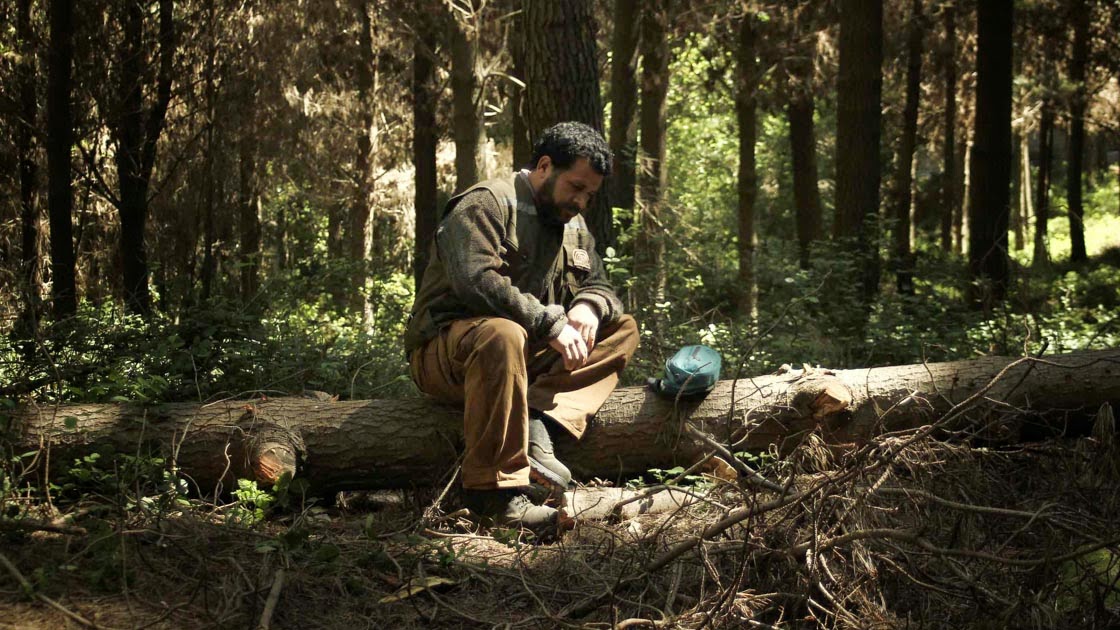
Chile finally made its own edition of this formula, adding the Latin culture view of masculinity into the mix. To Kill A Man examines what happens when an educated but effete working man is incessantly harassed by a poor gangster living in the projects. Jorge, the working man, is a researcher in the Santa Julia Research Forest. He takes the bus to work, he is married with 2 teenage kids, a son and daughter, lives in a modest house. He is surviving, but isn't exactly rich. On his way home, after picking up a cake for Jorgeito's 18th birthday, he is harassed by a gang of low-level street hoodlums led by Kalule. When he goes back out to pick up some alcohol for the party, he’s essentially mugged by the group who even stoop to taking his diabetic kit!

This is just another step in an ongoing feud, but one that starts to have serious consequences as Jorgeito mans up and goes to confront Kalule. Kalule shoots Jorgeito. As a result of everything, Jorge’s wife demands a divorce, and when Kalule is released, he’s out for revenge.

To Kill a Man asks a more unique question than the previous films. To Kill A Man asks how far do things have to go before it is OK to take the law into your own hands. Unlike most of the films of this ilk, the police start on the side of Jorge. Jailing and imprisoning Kalule. But, when the feud heats back up, the police start to act more and more impotent, for some reason. Despite the family having a protective order, the police don't arrest Kalule for any of the harassing incidents that he perpetuates.  Marta, Jorge’s wife, berates Jorge for not being able to protect his family when their daughter ends up in the hospital. And, so…what does a man do?

Even though this move is full of clichés, it at least runs through them at a very clipping pace, running only a short 82 minutes. There’s little bloat here, instead leaving most of the movie to the main scenes and keeping the scene lengths to be long enough to hold the emotions of the movie. A longer movie would have dragged its ass to a sluggish pace, especially since the way through the movie is fairly well-trodden up until the final 15 minutes.

The final 15 minutes bring up a topic that isn't really addressed in any of the other movies: Responsibility. I’m not going to tell you what happens, but at what point is a person responsible for their actions? What is permissible, and how does conscience figure in? To Kill a Man does manage to ask these questions, even if it doesn't answer them for you personally. The sign of an interesting movie is that it asks you to think what you would do, but doesn't pass any of the moral judgments about your decisions, instead asking you to make them for the movie. It points you to various possibilities but doesn’t say which is right or wrong.

Holding To Kill a Man back from greatness or significance is a pedestrian style it thinks is a conscious choice. It feels like the post-Traffic Mexican films of the 00s, full of browns and greens without a full color palette, and full of seemingly boring cinematography. This is a shame because the movie itself is full of interesting ideas and acting, even if it runs though clichés. It’s a movie that deserves better than the visuals it is given.

Wednesday, June 4, 2014

The Signal (2014): Ideas Spurting Everywhere

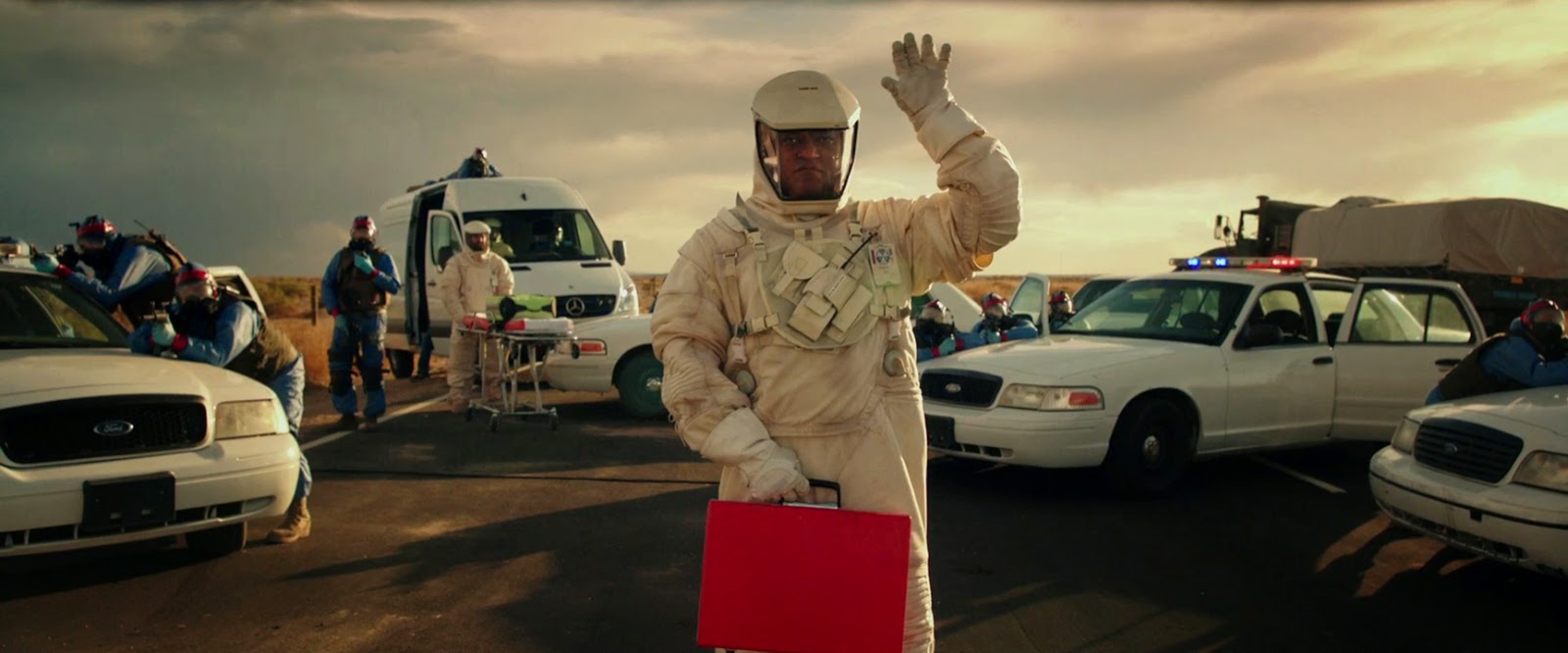
No, this is not a Beekeeper's outfit. There are no
bees in this movie.
The Signal (2014)
dir: William Eubank

SIFF 2014 Film #7

William Eubank's 2011 film Love was a low-fi indie film that was a semi-hit on the festival circuits due to it's amazing visuals, but was ultimately hindered by its content, or lack thereof. The visuals were frequently stunning and gorgeous, especially on the gigantic screen at the Egyptian theater (a single house palace in Seattle), but it didn't hold up in terms of being bout anything or anything substantial. Still, it was an ambitious and accomplished first feature for a director in search of an idea.

Eubank's latest feature is The Signal, an ambitious film for which he ended up using 8x the budget of Love, costing about $4mil. The visuals are frequently stunning, again, this time delving into horror tropes then Gerry tropes and also the twee style of fuzzy focus and narrow depth of field close ups. It's the very in style right now. Eubanks' style is great in the moments, but as a whole it falls apart.

The Signal follows three geeks from MIT - Nic, Haley, and Jonah - as they move Haley to go to school at CalTech. Nic has a degenerative disease which has caused him to lose strength in his legs. No reason is given, just that he'll be continually crippled and eventually die. He is dating Haley, but breaks up with her rather early in the film.

There is also a plot about MIT being hacked by an outside hacker NOMAD, taking down servers, but the blame is laid upon Nic and Jonah. On the road, NOMAD reestablishes contact with them using the line Are You Agitated, and hacks into Haley's computer. They track the hack to an address in Arizona, and they find an abandoned house when all hell breaks loose.

I put the essentials of The Signal first because to discuss The Signal is to spoil The Signal. On the other hand, The Signal needs some serious unpacking that I'm telling you now that there are spoilers going forward. So, SPOILERS AHEAD, you've been warned, etc etc etc.

When Nic and Jonah are exploring an abandoned house in the middle of the night, one wonders why they didn't just wait until daylight. Other than, it's creepier this way. And, when the boys explore the house, you wonder why they're exploring late at night, and why they split up, and why they leave Haley in the car. When they hear Haley scream, they know something is up, and then...bam, she flies into the air and the screen goes black.

The rest of the movie follows Nic as he wakes up in a facility with no windows that seems like a government experiment. He's strapped in a wheelchair, and is asked strange questions like "What planet are you from" by Laurence Fishburne in a hazmat suit. The movie seems to be implying that Nic was abducted by space aliens, and then sent back to Earth.

He discovers that he has new mechanical legs, and has to learn how to walk with them. He discovers that Haley is in a coma. He grabs her and escapes, to find that he's in a bunker that was miles below the surface of a desert. He and Haley run into Jonah, who now has super arms, and they try to make their way out of what they believe to be Area 51, but in the final twist discovers that they are actually on a gigantic alien spaceship on a floor that has been designed to test them.

Eubank crams so many ideas into one film that nothing is developed. Is it a story about love and dealing with your own rejection? Not really...that story line is abandoned in the first act and barely pops up in the third. Is it a story about determination and willpower? Kind of, but mainly with the help of super limbs. Is it a superhero origin story? Kind of, but he doesn't do anything super with it. Is it a space alien story? Not really, because that's dropped for the most part.

The Signal is so ADD in it's intentions - it's Catfish, no it's Fire in the Sky, no it's Area 51, no it's a government superhero origin, no it's actually an alien film - that it never develops anything to any extent. The only idea that he develops is self preservation and will power. But, that's even kind of a pussy theme for this strange of a movie.

A really REALLY bad thing about The Signal is that the girl isn't given any superpowers. She has a chip of the material used to make the boys' limbs in her back, but she doesn't get to do anything with it. She just becomes The Princess in the Castle. Which is a completely lousy trope. They have a great female character, and she is reduced to being a trophy. At the Q&A, Eubank was called on it, and he sort of evaded saying "She COULD have super powers...maybe in the DVD Extras." Which...really?

Another is that Eubank hasn't really thought up the intentions of the aliens. Why abduct somebody and give them super powers, if you're just going to kill them? They give Jonah super arms, but they kill him in a big shootoff. Which...why?! Why abduct somebody, give them a power, then kill them? I guess to test them, but really? And, the intents of the aliens is never really discovered. Why test humans? Why develop human technology at all?

In any event, the individual scenes in The Signal are fantastic. When it is Catfish, it's amazingly moody, and the burn is perfect. When the movie is the government testing facility, Eubank is on point with having witty and direct dialogue, and creating intrigue both visually and with subject. When it's Area 51, or a superhero origin story, it's surprisingly good at all those too. But, it adds up to jack shit in the end. Even more than Love, the sum of the parts do not add up to the whole. That is the ultimate disappointment.

And, as a note to Eubank...if you're going to make a semi-decent female...fucking USE HER. Don't just make her out to be a trophy to be rescued. God fucking dammit, I'm so sick of that. She literally does nothing..and...ugh!!! So wrong.

Wednesday, May 28, 2014

The Midnight After (2013): The Best Philip K Dick Adaptation that Wasn't

The Midnight After (2013)
(aka Lost on a Red Minibus to Taipo)
dir: Fruit Chan

SIFF 2014: Film 2

This is the second film I’ve seen that came from a web story/novel, the first being the rather insane John Dies at the End, which was a novel originally published as a web serial. The Midnight After is based on a web novel by Mr. Pizza on the internet forum HKGolden. And, yes, it’s as insane and episodic as John Dies at the End.

The Midnight After is a Hong Kong take on Philip K Dick’s book Ubik, with a lot of changes. A group of 17 people on a minibus go through a tunnel late at night and end up in a world totally devoid of humans except themselves. As they realize something might be amiss, suddenly they start dying strange deaths. A lot of spoilery things happen, including a spectacular musical number set to a famous David Bowie song. But, I don’t want to give away much more than that.

Half of the fun of The Midnight After is trying to figure everything out.  But, ironically, if you find it fun, you’ll also find the final scenes incredibly frustrating. The other half of the fun is the batshit insanity that is in The Midnight After. The characters include a spiritual psychic who sells insurance, a constantly bickering married couple, a couple of young punks named Airplane and Crazy Glue, and a druggie who is constantly on cocaine. They ping off each other, come back together, and gather to meet.

I found The Midnight After to be a helluva ride. I wanted more. The ending leaves you wanting more, in fact. It’s drama and science fiction and comedy and horror and musical and everything you could ever want in a movie all thrown in for a single experience. At 120 minutes, it almost runs a little long, and to be fair the movie could have a couple of minor edits where about 5 minutes might be removable. But, to niggle on 5 minutes when the rest of the movie is just a powerhouse rocket where the pacing ebbs and flows with a psychotic mastery seems petty at best.

The Midnight After doesn’t say anything deeper about life other than “Life can move pretty fast sometimes, and if you don’t appreciate it, you might miss it” and “Be good to each other.” But, that doesn’t matter because the film is all about the experience. It’s a blast, it’s fun, it’s something rather interesting, and gives you some stuff to chew on as you’re watching, so you won’t be bored. Puzzled, sure…but who doesn’t like a good puzzle?

Monday, May 19, 2014

Die Screaming, Marianne (1971): Why Murder?

Die Screaming, Marianne (1971)
dir: Peter Walker

I'm going to say this up front. The whole review here is one big spoiler given the way that Peter Walker structured this movie so oddly that you have no idea what is actually happening for just about an hour. Things happen, more things happen, explanations and dialogue happens...but then you get the plot an hour into the movie. If you don't want to even know the basics, back out now because there is no way to talk about the movie without giving away the spoilers.

Die Screaming, Marianne opens with a hotel that has a sign out front. The sign has Marianne's name and face on it, as if she is a performer. This seems to be occurring some morning in Spain. Marianne has already realized she has to hightail it out of the hotel, and there are a couple of guys that are coming to look for her. She has to leave her lover of the night and leaves out a window in time to get away by running down a road, and a steep hillside, and almost getting run over by some guy, whom she then picks up.

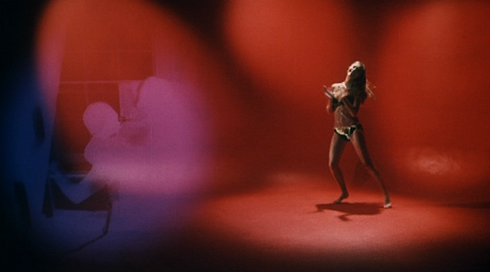
There are no explanations given, this is just the pre-credits scene explaining that Marianne is on the run and has met some English guy with a sports car in Spain. After a credits sequence of Marianne as a go-go dancer, Marianne is then being forced into marrying Sebastian, the guy she met two weeks ago in a sports car, with his friend Eli and a flower lady as their witness. But, she gives the magistrate Eli's name, and so now she is legally wed to Eli. And, as she packs up and leaves Sebastian's place (with whom she had been living for two weeks), she tells him that his attempt was a really lousy attempt.

Eventually we learn that Sebastian is really hooking up with some girl named Hildegard and the Judge (who are living together), and everybody is out to get Marianne for some reason that is left semi-unexplained. It's vaguely about money. Marianne, now shacking up with Eli, tells him that they're both in danger but won't tell him or us what the hell is going on. Even after Eli has had an attempt on his life, and Marianne has run away to continue her career as a go-go dancer, and then returned to Eli, she still refuses to say what is going on.

Around the hour mark (give or take a few minutes), when Marianne and Eli have been invited to The Judge's house in Portugal, we finally learn that Marianne is the daughter of The Judge, and Hildegard is her half-sister. Marianne is wealthy because her recently-deceased mother was wealthy and left her a lot of money in a trust fund not to be touched until she is 21. Marianne is about to turn 21 in a few days, and will receive the money as well as a bunch of documents that will incriminate The Judge for some legal wrong doing. It's all explained in about 5 minutes, because even though this provides the whole basis of the movie, the movie is all about trying to kill Marianne for no good reason.

The plot of Die Screaming, Marianne seems to be an experiment to negate the need for the MacGuffin, but really emphasizes the need for purpose. By dropping the audience into the middle of an ongoing story, Walker is asking us to care about the welfare for this seemingly street smart and also seemingly perpetually chased young woman simply because she is being chased. Additionally, the MacGuffin in the middle of the movie is one of importance and one of non-import. Not only is the prize for killing Marianne just additional money for the rich people (non-import), but it is also one of self-preservation for the Judge and other people of power with the incriminating documents. One is a silly reason for murder but the other seems reasonable, and Walker seems to be asking "Is there a good justification for murder? If so, what is a good justification for murder?" His answer, by placing the MacGuffin in the middle, seems to be that there is no reason to kill this girl, and we should care about anybody in trouble simply because they don't deserve to be in trouble.

The final 45 minutes of Die Screaming, Marianne is taken up by various people trying to kill each other. Hildegard tries to kill Sebastian by taking out the brakes on his car, but the Judge takes it instead. Hildegard and Sebastian try to kill Marianne in various ways. Eli and Marianne try to kill Hildegard and Sebastian to save their life. It's all just a big jumble of who's killing who in what way. Although, I should note that this is now my earliest instance of death or torture by sauna.

Because the structure of Die Screaming, Marianne is so mixed up, the audience spends the majority of the first hour not quite knowing who they should be rooting for. It seems like we should be rooting for Marianne, but she acts like an overly street smart cold woman who doesn't care much for anybody but herself. But, we don't know if she's somebody on the lam or a mob girl or a squealer or what. She could have killed the wrong person, but we don't know. However, after the revelations start coming, then we figure out that we can root for Marianne and Eli and actually support their survival.

Which led me to wonder, "why do people watch movies with titles like Die Screaming, Marianne?" Not even as a judgment, because I watched it, but as a sort of thought game. Do we want to see somebody named Marianne die or just attempted to be killed? Do we want her to die because of some sort of character retribution and she deserves it? Or, do we want her to die because she's innocent? Or, do we just want to see her saved?

Die Screaming, Marianne is marketed as a horror movie, but it isn't a horror movie. It's a drama/thriller with all the pacing constantly cut off at its pass. It's all cat and mouse and who will survive. The meta questions that Die Screaming, Marianne are far more interesting than the movie itself, which is otherwise a poorly-paced, underacted, mundane movie of people trying to kill each other while wearing the worst of 1970s fashions and hairstyles. But, the questions it asks may be ones you might not know the answers to.

Wednesday, May 14, 2014

Odd Thomas (2014): The Infection of YA

Odd Thomas (2014)
dir: Stephen Sommers

Have you ever watched a film while knowing it was an adaptation of a book, but then wondered what the original book was actually like? That's the experience I had with Odd Thomas, a movie based on a book series by Dean Koontz. While watching the film Odd Thomas, I couldn't help but wonder if Dean Koontz, once a heavy hitter in the adult thriller section, had delved into the financially lucrative YA realm like so many had before him.

Oddly, this is a wrong assumption. Odd Thomas is an adult thriller, complete with rape and murder, that Koontz made into a series. Adult thriller/detective series are common now, and also lucrative, but the tonality and subject matter in the film Odd Thomas has been crafted to mimic a sort of ABC Family/Disney-esque show which feels like a backlot kids show rather than an adult thriller.

Odd Thomas, the title character, is a short-order cook who is also a psychic junior detective whose mother went insane and committed to a ward. He dates a girl whom everybody calls Stormy who also is a manager at the mall ice cream parlor. Odd's psychic ability is known to the police captain and to Stormy, but he keeps it a secret so he doesn't get locked away. That secret? He has psychic premonitions in his dreams, and he also sees dead people, and he also sees weird creatures called Bodachs, who apparently hang around the world anytime they smell an evil death.

Odd lives in a tiny town where everybody knows everybody else it seems. I don't know how else to explain the opening scene where Odd is haunted by a ghost who has been murdered by her boyfriend. Then Odd goes wandering around and runs into the boyfriend in his shiny old Chevelle and they both know each other, before Odd reveals he knows what happened. How do they know each other? I don't know. The movie barely explains because it is too busy revealing the psychic ability of Odd before making him chase the murderer through the neighborhood, crashing a pool party and knocking him out cold.

This is a scene of brevity because it has nothing to do with the plot other than serving as an introduction to Odd's psychic abilities and his relations to the police chief, who comes to clean up the mess. The real movie starts when Odd, while working as a cook, sees a man with fungus in his hair. Or something. Really, it looks like a goofy knit yarn cap. But, it's supposed to be fungus. This fungus man is Bob Robertson, whom they then dub Fungus Bob, and he's being followed by a LOT of bodachs because something bad is going to happen.

So, the main characters so far are Odd, Stormy, Bob "Fungus Bob" Robertson, and Police Chief Wyatt Porter. Later, we'll meet Ozzie P. Boone (for one scene). Throughout the movie there are many shootings, dreams of shootings, dreams of blood, and plenty of goofiness, and such...but the majority of the violence is toned way way down compared to normal thrillers. This is a movie which is toned for television. No swearing. Stormy, though she shows up in her panties, doesn't have sex with Odd, but they go on picnics. Backstories of strippers and drug-using ex husbands are glossed over in mere sentences. Odd Thomas the film has been sanitized for your pleasure...

...except for the finale. So, if you don't want to know the ending, skip the rest of this as there is some real world discussion that needs to happen with the finale. Just know, that Odd Thomas is a sanitized almost PG-rated version of a Dean Koontz novel. If you want that, then you might like it. If that's not what you wanted, then it's awful.

The whole plot of Odd Thomas revolves around a mass murder of some kind that Odd must find out based on a dream of a bunch of people in bowling shirts who carry Odd while they get shot. It turns out, that there is a satanic cult in this sleepy burg, and they were going to blow up the mall after shooting it up, because apparently if you shoot up a mall, the security locks all the doors or something? I'm not really sure about that logic, but what the finale does is prey on real life situations in recent past.

One whole part of Odd Thomas feels like an NRA recruiting video. One of the mall gunmen has an automatic weapon which he uses to kill a few people, but is killed by Odd firing a handgun at the gunman's head. This leads to the thought process of guns have the potential to do good and bad. The moral of this section of the finale is that the police don't have the time to get to the mall to have any real impact on the murders which happen quickly, so regular citizens could stop it to stem the actual number of deaths. Just as Odd, who isn't really a police officer, does.

But, Odd doesn't save Stormy, who is a casualty of the shooting. But, he shacks up with her ghost for a few days before his friends come and rescue him. The rescue and reveal of Stormy's death feels a bit tacked on to say that guns can actually kill the people we love, even if we think we stopped it in time.

Odd Thomas is directed by Stephen Sommers, who had helmed the first three entries of The Mummy reboot, before succumbing to Van Helsing and the first G.I. Joe film. Which is to say, Sommers loves family movies, and he loves guns. He loves family movies with guns. And, he made a family thriller out of an adult thriller with an emphasis on loving guns. Which kind of sums up the movie.

Odd Thomas is a family thriller that loves guns made out of an adult thriller that might have also loved guns. The darker and grungier material of a typical Koontz novel are worn away to give a more holistically wholesome feel to the character and, hopefully, garner more cash if the movie made it to the box office. But, it doesn't work. The movie has been worn down too far to give it much punch (there are a couple of goofily fun scenes with Fungus Bob), but the overall impact feels too clean for a movie that's about mass murder.

Friday, March 21, 2014

Stranger By The Lake (2013): Blood in the Sand

Stranger By The Lake (2013)
dir: Alain Guiraudie

For the largest part of the 20th century and earlier, gay men have tended to live in secret. They also fucked in secret. A lot of this was because just the simple act of fucking, even in your own private home, was considered illegal and a prosecutable crime. In many parts of the world homosexuality still is an illegal act. In the cases of some countries (in 2014), the laws are regressing to make it more illegal and even punishable by death.

Even through the 70s, it was difficult to find places which would allow you to congregate in anonymity. The closet was rampant, sex had to be fleeting actions with no names or phone numbers attached. Closeted men needed a place to go where they couldn't be traced. Bathhouses were an option, but you generally had to pay to go in, plus ID checking, and they're just soooo...gay. Bars were too public, especially because they were raided frequently.

In this atmosphere, the public cruising culture developed. Cruising happens in public, in the open, in an area where it is generally acceptable for gay people to be, except you can feign ignorance if you're spotted there...unless you're caught with your pants down. It was originally meant for anonymous hookups to get your rocks off in order to sustain your otherwise straight life back at home with the wife and kids. Or, to have anonymous no-strings-attached sex with other men, because men are biologically driven to stick it everywhere in order to spread their own genes.

Cruising is generally restricted to dedicated areas, where most straight people can wander in, but either know not to or don't notice much of anything happening. A furtive glance, a walking past somebody, unspoken gestures...this is all the signal it takes for the public cruise to happen. And then it is taken to a more secluded area, in the bushes, where you can delight in transgressive public man-on-man sex without a word having ever been spoken. Nobody knows your name, your address, your phone number. No credit card information is on record. You're not on security video. Your image only exists in the mind of the man you hooked up with.

Stranger By The Lake is steeped in cruising culture. It takes place on a beach where nudity is accepted by the powers that be. That area of the beach is also attached to the woods where men cruise and participate in anonymous sex. This beach can only be reached by a small access road leading to a tiny parking lot followed by a long jaunt through the forest onto the beach, separated by rocky cliffs or structures on either side. This is a highly accurate description of most of the areas where one can cruise. Difficult to find without prior knowledge, hard to get to with the knowledge, and secluded from most prying eyes.

On this section of beach, we meet Franck, our protagonist. A middle-aged man, probably mid-30s, Franck had been a regular at the beach in previous seasons, and is just now coming back to the beach. But, there is a new guy on the beach, Henri. Well, not ON the beach. He sits on the rocky bluff that sits on one side of the beach.

Henri is a definitive character in gay culture. He's a closeted bisexual (if not a closeted gay). He claims to have been with a girlfriend or wife for a few years, before he had sex with a generous talented guy. Now, Henri doesn't fit in with the straight crowd anymore, so he sits back near the gay crowd. But, there's something else that separates him from the gay culture. He's fat. Not just overweight, but fat. Which, in gay culture, means he's a pariah from the normal gays. In modern times, there is the bear culture, but that doesn't really cross over much into the cruising culture due to body issues.

Gay men are shallow. Well, most of them. They are also cliquish. Well, most of them. It's been a problem for years, and everybody knows of these problems and there have been thinkpieces and yadda yadda yadda. Even the newly developed bear culture became cliquish, to the point where I heard about one heavyset guy who hooked up with a thinner guy, and the thinner guy was like "I know I'm not large like you, but I just really like heavy guys? Is that so wrong?" It was really telling about not only body issues within the gay culture, but also the demand that like stick with like, as well as the hardwiring that we all have with who we are physically attracted to.

All of this gay neuroses and body issues come to a head in cruising culture, where men feel free to shun those whom they aren't attracted to based on their physical appearance. It's just sex, and you're attracted to who you're attracted to, the old adage goes. Well, in general, that has traditionally left the fat men to deal with the body issues that have plagued them since forever. They're left in isolation.

That is how we meet Henri. Wearing sandals, shorts and a shirt next to a nude beach, while fondly looking at the naked men frolicking. He watches, observes and understands that most men won't approach him, and he's developed his own walls of protective mentalities in order to deal with that. Yet, he also knows the score that many people there are ostensibly straight men leading straight lives who go home to their girlfriends. Even if Franck, and several other men present, are gay men who lead gay lives, and some of them are cruising or watching with their boyfriends, husbands, significant others, whatevers.

While hanging out with Henri, Franck spots the third major character of Stranger By The Lake comes onto the scene, Michel. Michel is a throwback creature to the 1970s, as signified by his hair and '70s porn stache. Really, that's the only major signifiers most of these people have. Their looks, and their clothes. Michel immediately becomes the focus of Franck, who immediately dumps Henri in order to chase Michel into the woods hoping for a good fuck, but is derailed when Michel already found another partner, in whose ass he buries his face.

The next day, Franck actually manages to talk to Michel, but is interrupted by the fourth character of Stranger By The Lake, Michel's then boyfriend. There is one more character in Stranger By The Lake, that of Inspector Damroder. Which should tell you what happens next.

The thing Stranger By The Lake doesn't do is hold your hand. All of the above 11 paragraphs in which I haven't told you much of anything about the actual plot of Stranger By The Lake is information that is left to be deduced by the audience. This isn't a movie made for a straight audience in order to help them understand the gay lifestyle. This isn't a movie for gays who are just now coming out of the closet to try to help them understand their role in the world. There is a LOT of knowledge that is in Stranger By The Lake, and it's presented in almost a documentary style, but without the David Attenborough voice over.

That isn't to say that Stranger By The Lake isn't accessible. There is such craft and detail given by Guiraudie that many straights can start to piece together the behaviors of gay men just by pure transposition of the bits of information that the straight men have collected from the world around them. The behaviors of the gay men in the wild is recognizable as the same behaviors that are used in clubs, bars, workplaces, gyms, and other public venues around the world. There's just more penis and public sex.

And there is a lot of penis. PENISES EVERYWHERE. The only person who never shows his penis is Henri, the fat man. When Franck gets naked to Henri, Henri stays in his shorts and keeps his arms futilely crossed over his body simultaneously trying to hide his fatness, but also re-emphasizing it. Guiraudie made Stranger by the Lake so explicit in a reaction to gay films like I'm So Excited! and the 1313 series which even hid the gay sex in queer filmmaking. Of course, by "so explicit" I mean there's a big screen ejaculation, and some penetration, all done by body doubles. This is all part of a newer queer movement to get sex back on screen in gay film making, with the likes of Weekend, Keep the Lights On, Interior. Leather Bar., Concussion, and Homme Au Bain (Man At Bath) leading the charges. Most of this movement has origins in 2006's Shortbus. It's an Equal Sex Film Movement, or something. I'll leave the coining to somebody else.

The thing that makes Stranger By The Lake so different from its other brethren is its ties to the 1970s. Guiraudie made a film that is a smashing of the 1970s and modern times, and has made a film that throws back to the original gay porn films, most strikingly the first segment of Wakefield Poole's Boys in the Sand. Both have gorgeous shots of men walking out of a lake to hookup with their object of obsession. Both have explicit sex in sun-dappled areas of a forest, and both are completely sex based without wasting much time on words between the characters who do have sex.

Of course, Stranger By The Lake isn't just a porn film. And, it doesn't exactly let the cruising culture off the hook. After a murder happens after hours, their towel and sneakers remain in the same spot for days. Their car remains parked in the parking lot for days. Nobody notices. Nobody calls the cops. The person just disappeared. The only reason the cops come in the first place is that the body turns up outside of the cruising area. But, there is such a need for secrecy and a desire for privacy that people only stop going to the beach for a day. The next day, the cruisers start coming back to the area.

Guiraudie has made a film that is steeped in knowledge of a small subsect of a small culture that lies outside the mainstream culture. This is a queer film, steeped in queer knowledge, made for queer people by queer people, that offers no easy insight for the straight community that would lie outside the community this film was made for. It's also a commentary on that subsect of a counter culture. And, it is keenly observant.

What I'm not going to do is tell you that this is a thriller, that it is Hitchcockian, or even evoking of Patricia Highsmith. There really is no mystery in the movie, though there is tension. The final 5-10 minutes are the most baffling and disappointing of the movie. Where this movie excels is setting the scene, and also in the characters. We get to know these characters through their idle conversations with other people, as well as their behaviors. The varieties of sex, both unsafe and ultra-safe. The risk of HIV. Everything seems to be observed and documented. If you were to have asked me as a closeted teenager who hadn't watched a gay film in his life, "what would a gay movie be like?", I would have described something that would have very much like Stranger By The Lake.

Required Viewing.

Thursday, March 13, 2014

Plush (2013): The Male Stalker, updated

Plush (2013)
dir: Catherine Hardwicke

The crazy male stalker is a genre that has been around for ages. One of the definitive crazy male relationship movies of anybody who was a teenager in the 90s was 1996's Fear, where Marky Mark was trying to launch his acting career with Reese Witherspoon and Alyssa Milano. But, Fear is only good for nostalgia value for its ridiculous over-the-top nature.

Of course, that was 17 years ago (can you believe that?!), and Fear has largely been left to the dusty video bins. And, Lifetime Original Films haven't been doing their duty filling the gap with a full litany of woman-in-trouble films lately, instead doing things like remaking Flowers in the Attic. The obvious solution is to update it, make it a bit punkier, and to hire a teenage-familiar director for the job.

Fortunately/unfortunately for us, that director is Catherine Hardwicke, director of the first installment of Twilight. Luckily, she didn't bring any of the bored distanced nature that she gave to that Twilight film. Hardwicke, instead, creates a mildly compelling. if ultimately ridiculous, film that also adds a bit of bisexual panic to the film.

Hardwicke, with Arty Nelson, wrote a story about a faux goth rock sibling-led band, where the brother dies, and the sister hires then fucks a new guitarist. Enzo, the new guitarist, initially, is presented as gay, but that's passed off as "what is gay?" when he finally fucks Hayley, the lead singer whose brother died. They write a new hit song, and fuck along the tour.

When Hayley returns home to her husband and kids, Enzo promptly starts inserting himself in her life, and she fucks him in the home...because he's so seductive or something. But, then she finds out she's preggers with Enzo's kid, and all hell breaks loose.

What makes Plush different from Fear is that Hayley is a 25-year-old rock star instead of a teenager, and she also has a pair of walking-talking kids with hunky 31-year-old Cam Gigendet. She started her family life really early, especially for a rock star. And, there is 100% fewer decapitated dogs.

Really, Plush has an end run sexual assault, much like Fear had a couple end run sexual assaults. Hayley saves herself with a method as equally ridiculous as killing somebody with a carnival peace pipe. All of the murders actually happen off screen. There is actual sexings that happens on screen, though the nudity is also minimal. Really, Plush is Fear but aged a few years.

Hardwicke isn't giving us anything new. She's not subverting anything. She's merely re-wrapping an old trope in new clothing. It's more of a feminist trope, for sure. And, the woman of the movie is actually a breadwinner, even though she had married a journalist and author. It's well-made enough, though the ending is extremely condensed. The switch from Enzo's in love personality to his crazy personality is sudden and drastic, filled with ridiculous quirks and hilarious acting. Hardwicke is not a subtle director. Mildly stylish, somewhat ridiculous, semi-entertaining, but not subtle. Which, I think is a good descriptor of this movie as of any other movie she has directed.

Tuesday, March 11, 2014

Passion (2012): The high risk culture of Advertising

Passion (2012)
dir: Brian DePalma

The title of this movie practically screams sex. There is plenty of sex in Passion. But, it's all so dispassionate, that Passion becomes an ironic title.

DePalma, one of the kings of the erotic thriller genre, returns to the erotic thriller after a decade away to create the very cold and distancing Passion, filled to the brim with polysexual ice queens and credulous imbeciles. And, while it is very much a DePalma film, he seems to be lost swimming in the modern modern milieu of corporate backstabbing and high-tech corruption.

Noomi Rapace and Rachel McAdams star as Isabelle and Christine, two a-list power players in the rough and tumble world of marketing who play the game of mentor/mentee while also besting each other. McAdams, as Christine, is the high-powered account executive who takes the somewhat bisexual Isabelle under her wing to leverage Isabelle's ideas for a new campaign to score a job in New York. When Christine takes charge, fucks Christine's boyfriend, and takes credit for her ideas, Isabelle declares war with the boyfriend haplessly being used as a football between the two.

The main difference that separates Passion from most of the other films of the ilk is that we largely take Isabelle's point of view, instead of the point of view of a male. Passion seems to be a response to the feminist assessment/complaints launched at movies like Fatal Attraction and Disclosure, where powerful women are largely the big scary man-eating criminal who victimizes men in order to move up the corporate ladder. Then, in those movies, the male character, with whom the audience is asked to identify, always defeats the evil intentions of the powerful women in order to restore the patriarchy.

Passion is the male response saying, "well, what if we replaced the man with a woman?" What does happen to the film?

*SPOILERS FROM HERE ON OUT* Well, the woman we're identifying with ends up as the killer, is the answer. It's never the man that's a killer. The men in Passion are too feckless to care about such trampy bitchy ongoings. But, the woman we're watching kills her mentor in an emotional fit of cold calculation. What does that say about the sexual politics of Passion? Well, the movie is still very much "bitches be crazy." Christine is seen as a cold soulless man-eater who even fucks Dirk, her boyfriend, with a strap-on while making him wear a mask which looks like her. Isabelle is a cold, calculating woman who kills her mentor. Isabelle's assistant is a lesbian who has a crush on Isabelle, and lets Isabelle kill Christine in order to blackmail Isabelle into being the assistant's lover.

The lesson of Passion is that most men who make the erotic thriller genre will still make demeaning movies that mark all women as crazy. Especially old, pervy men, like DePalma.

But, the main problem with Passion isn't its regressive sexual politics, in a misguided attempt to be progressive. That kind of comes part and parcel with the erotic thriller genre. The main problem with Passion is DePalma. DePalma has severe tonal shifts that are as jarring as they are terrible, he indulges in neo-noir style camerawork that frequently seems like a film student is imitating both DePalma and Verhoeven's Basic Instinct, and he spends a huge amount of time in the tense world of high-stakes marketing.

The first two acts of Passion are spent watching Christine and Isabelle try to one-up each other while also trying to survive the emotional devastation that they inflict on each other. It's not just dull, it's boring after awhile. The ludicrousness of some of the humiliation adds to how little we, the audience, actually care about the film. Add to it that little of it ultimately matters in the outcome, and that it seems to go on forever, Passion becomes passionless. All the no-nudity-claused Rachel McAdams in sexy outfits and dispassionate sexings, all the displays of kinky toys, and all the Noomi Rapace having awkward sex and in tight outfits, can't make the ongoings any more interesting.

Ultimately, Passion is a late-era DePalma failure. In an attempt to reclaim his former glory of Dressed to Kill or Sisters, while also very consciously trying to not imitate Hitchcock, DePalma created a brief slog of an erotic thriller. Is it terrible? No. There are far more inept films that exist. But, it's merely serviceable, and coming from the hands of somebody who can be as great as DePalma, that's a shame.

Wednesday, February 26, 2014

The Canyons (2013): Aging Out

The Canyons (2013)
dir: Paul Schrader

There's a fleeting moment in the opening scene in The Canyons where you suspect that it is going to be a zesty ironic takedown of youth culture and sexuality. This scene has Christian (James Deen) showing Tara (Lindsay Lohan) hookup profiles on some hookup app, while talking to Gina (Amanda Brooks) and Ryan (Nolan Funk) about Ryan's normative sexuality. Gina is Christian's assistant, and Ryan is the actor in Christian's current film project that nobody cares about.

If this scene was truly witty, Christian would have been checking out Ryan's profile on the hookup app, even as Ryan was pronouncing his true faith to Gina, with whom he barely has a connection. But, this is latter year Bret Easton Ellis, and this moment is passed up for a dull examination of boredom and the death of the...multiplex?

The Canyons credits overlays a bunch of still images which show movie houses and multiplexes in various states of decrepitude. Schrader and Ellis are mourning the death of the cinema, in some way, shape or form. But, what they're saying about the death of film is barely hinted at in the subtext. At one point during a conversation, Ellis stops the movie cold to ask "Do you still go to the movies?" He seems to be pointing to a culture where film is seen as a product rather than an art form, and the dull-as-dishwater drama that happens behind the scenes is probably more important than what actually ends up on the screen.

Hell, the behind-the-screen story of The Canyons makes this movie the pomo case study for that exercise itself. With Bret Easton Ellis' fawning over James Deen's cock, the Kickstarter-style non-personal-responsibility funding, the hiring of tabloid darling Lindsay Lohan, Paul Schrader doing his first movie in 5 years, and just a lot of hullabaloo including articles in the New York Times, the behind-the-scenes of The Canyons became more substantial and salacious than the actual movie itself.

The movie itself is mainly our five characters, including the actress cum yoga instructor/fuck buddy Cynthia, having romantic interludes and fits of jealousy over the course of three days. They're all shallow jaded shells of characters, even for Bret Easton Ellis. Which would be fine or something, except they're all written as late 30/early-40 something jaded characters. These characters are empty before their age, even for LA.

Bret Easton Ellis is generally well known for writing for characters his own age. But, with Ellis pushing 50, and Schrader pushing 70, writing for characters half his age is unnatural at best. These characters are mid-30s, at least, and the oldest actor is 32. Though, Lohan does look like she's in her mid-30s at the tender age of 27, this emptiness doesn't befit her.

Why should you care? You shouldn't. Ellis isn't at the top of his game here, merely proving his own facile thesis that that the back story was more interesting than the film. Maybe he's meditating on the how the goal of money has superseded even the goal of fame or love. But, I think he's still in the famewhore business, so he may not even believe that himself.

The Canyons isn't a self-contained film. The film content barely even matters. Sure Lindsay Lohan and James Deen have a stupid foursome in the middle of the film, where it doesn't even look like anybody is doing anything. But, who cares? Nobody does. Least of all Ellis, and least of all the audience. A 99 minute film that feels like its 130 minutes of nothingness isn't a success.

But, as an experiment about the world, it's a success. People cared about The Canyons for one brief year, before it disappears into the deep archives of Paul Schrader failures and Bret Easton Ellis failures, simply because of the backstory. And, that's interesting. In a way.

Tuesday, February 25, 2014

1313: Night of the Widow (2012): Shirts and a script!

See?  They have a wardrobe!!
1313: Night of the Widow (2012)
dir: David DeCoteau

Previously, I've assumed that 1313 was a weird experiment in homoerotic minimalism on the cheap. Like an Andy Warhol for the genre picture. But, then David DeCoteau has to throw a curveball like Night of the Widow into the mix.

DeCoteau starts out Night of the Widow with a shock. There isn't 10 minutes of establishing shots. Instead, we get right to the meat of the 1313 series: a hot guy wandering around the DeCoteau mansion in his underwear. Within a minute, we're already watching a hot guy sleeping in his white briefs, and then he wakes up and wanders around in his tighty whities. OK, this is the 1313 we're used to!  Eventually he finds his wife, dressed like a black widow already, who raises a butcher's knife and squeaks "I want a divorce" then TITLE!

Humor, and fast pacing? DeCoteau, who are you and what have you done with David?

In all reality, Night of the Widow feels like one of DeCoteau's pre-1313 movies, in which characters talk a lot, there's a script, confusion, fun, and blatant and hilarious homoeroticism.

In the next scene, we get the set up of Michael (the dead guy)'s friends showing up for his funeral. They used to be in a band or something, and abandoned him 5 years ago. No explanations are offered for their absence from his life, which we learn later is because they really haven't abandoned him. everybody plays a part.

The set up is that Michael is some sort of rich orphan (huh?!) who has hidden a key to his fortune somewhere in the house. And, whoever finds it gets the fortune and can split it however they want. Which, normally, would be a set up for everybody, one by one, to strip down to their underwear wander around half-assedly looking for a key, probably while calling out "KEY! Where are you, Key?!" and then getting murdered by the black widow.

But, DeCoteau is always a violator of our expectations. We get a talky history of Michael as seen by his friends as they look for the key. These history scenes give some semblance of motives for possibly murdering Michael. Or, not as his ashes actually go missing midway through the movie. One of the scenes is Michael playing football with a male friend, who is telling him to dump his wife, leave his fortune and run away with him to a foreign country...no homo. Or another is a guy having a lengthy shower scene in Michael's house, and then Michael coming home to find his wife in the bathroom as well (but not in the shower).

In the end, there are the usual twists that we can kind of see coming a mile away. Which is also unusual for a 1313 series film, which usually don't have enough plot to actually have twists!

1313: Night of the Widow is the most entertaining of the DeCoteau series, namely because it doesn't obey the endless repetition of a random guy wandering around, ends up in his underwear then dead. This is more of an Agatha Christie movie that has lots of homoerotic subtext thrown in, and a bunch of shirtless flashback shots. If you have been wanting DeCoteau to make an actual movie in the 1313 series, Night of the Widow is your best bet.

That being said, it isn't a GOOD movie. It's low-budget entertainment, and something that doesn't actually bore you. But, if you want homoerotic, cheesy-as-hell, sub-par Agatha Christie, then you'll want to watch Night of the Widow.

Thursday, February 13, 2014

Strange Circus (2005): The Circus of your Mind

Strange Circus (2005)
dir: Sion Sono

Readers of Japanese Manga should be used to the type of subject matter contained within this film. Watchers of Takeshi Miike might even be used to it. But, Strange Circus will be no less shocking to those who think they should be accustomed to the content.

What is in Strange Circus? Incest, rape, murder, violence, dismemberment, paralysis, and psychosis. You know? Disney fun for the whole family. And, it's handled with all the subtlety and sensitivity that any Japanese over-the-top movie brings to the screen.

Strange Circus opens with a carnival/circus where a drag queen invites a 14 year old girl to be executed on the stage guillotine. The girl accepts his offer, and comments, in voice over, that she thinks this is where she was born. But, the carnival is only a metaphorical framing device of the story within the film. The story is about a daughter who accidentally sees her parents having sex, gets caught by her father, then is molested, and raped by her father. Her father grooms her in grotesque ways, like locking her in a cello case with eyes cut out to watch her father have sex with her mother.

The story is disconnected and dreamy, with the mother and daughter frequently interchanging positions. The mother is jealous of the daughter's new sexual position in the family. The daughter accidentally kills the mother during one of the mother's jealous rages over an earring.

But, all of this is the latest manuscript of an author, played by the same actress who plays the mother in the stories. In this reality, the author is attended by a new editor from her publishing house who waits on her hand and foot while also reading through her manuscript.

You'd be more than a little forgiven if you thought this has the same types of themes as Miike's Audition, which is also about a father figure who auditions young girls to be his lover, only to be tortured for his abuse of the system and falling into the lamentable pattern of seeing women as objects for his sex or love. And, really, that movie was one of Miike's first films that seems to be a nuclear weapon aimed by the new generation of Japan at the old cultures of Japan. It seemed to rip open the old school ideas of sex and dominance, while forcing its own values on the screen.

Sono's Strange Circus, participates in the same knee-jerk cinema that also seems to be about how the old customs of Japan fucked up the new generation. Especially with it's conclusion, which doesn't exactly come out of left field but reaches a fever pitch normally seen in anime and manga. Sono seems to be saying "look at how you raped and fucked up Japan, assholes." Though, at times, one also checks in with the Natural Born Killers-esque question of "Can you condemn without also indulging?" Sono lingers over the various sexual abuses quite frequently and, while not completely and penetratively graphic, still graphic enough to be disturbing. It's still almost on a Showgirls rape scene level graphic. Which led to the question, is he indulging as he's condemning, or is he only indulging for entertainment, or only condemning? And, does it even matter?

The long form continuation of rape in this movie is really squeamish, and also leads to one wondering if this is almost a normalization of rape. Even if it is disturbing, the sheer amount of it almost has a numbing effect, even if Sono ultimately condemns it.

As a piece of shock cinema, however, Strange Circus certainly is shocking. It is also a frequently beautiful film. Sono makes the film look as lush and gorgeous as he can. The lushness takes away from the impact that a more raw, less stylized film would take, for better or worse. If you like shock cinema, this is one of the entries that you may need to watch. But, it will push your buttons, and maybe for no real reason.