Dead Snow 2: Red Vs Dead
dir: Tommy Wirkola
SIFF 2014 Film #14
Dead Snow 2: Red Vs Dead is the sequel to the Nazi zombie cabin-in-the-woods horror comedy out of Scandanavia. Dead Snow was a clever meta take on the genre, which poked loving fun at the cabin in the woods formulas as well as the zombie formula, all the while maximizing the horror, the comedy and the gore. Dead Snow was clever, hilarious, and witty, especially since it came before Cabin in the Woods (unlike Zombeavers).
Dead Snow 2: Red Vs Dead smartly abandons everything that made Dead Snow what it was. A straight continuation from the final moments of Dead Snow, Dead Snow 2 moves out of the mountains and into the lowlands. The lone survivor, Martin, now down one arm, is chased by the Nazi zombies who cling to his car. But, because he had a spare coin in his pocket, they come after him again. And, in a series of incidents, Herzog (the lead Nazi) also loses his right arm, before Martin's car goes flying off a cliff into the hinterlands.
The hospital that found Martin attached Herzog's arm to Martin, and Herzog attached Martin’s severed arm, thus forming the basis for the feud. With Herzog's zombie arm, Martin achieves zombie super strength, and both have the ability to resurrect dead people to form zombie armies. To further complicate matters, Martin is joined by the Zombie Squad, a group of adult geeks whose whole life is wrapped up in the zombie culture, and they desire to kill zombies.
Herzog had initially been on a task from Hitler to take over a town, now is going to finish up his mission and march on the town again. Stopping by a museum to grab a tank and some weapons, he continues on his march. Martin, however, also hit the museum, and decides to resurrect Russians to combat the Nazis, thus recreating WWII in zombie terms. You have the Americans, you have the Russians, the locals, and the Nazis.
The wit in Dead Snow 2 isn't in the reuse or meta parody of horror or horror comedy tropes. The wit stems from Dead Snow 2’s willingness to go as far as possible as frequently as possible. There are instances of comedic cruelty to zombies, and the violence and gore factor of Dead Snow 2 is constantly as far over the top as you can imagine. From dead kids to smashed heads to intestines a plenty, Dead Snow 2 never says no to a drop of blood in the film.
Coming in at 100 minutes, Dead Snow 2 doesn't feel bloated at all. Just about the time you’re wanting the final battle to kick in, the final battle does kick in. The developments and pacing come in swift, and Dead Snow 2 feels more like an ode to Peter Jackson originality than Sam Raimi parody. Dead Snow 2 has more in common with Dead Alive than with Evil Dead, even keeping the sardonic cruel wit that Peter Jackson brought to his early work.
Dead Snow 2 isn't a dumb movie. It’s smart and witty and trashy and just about the perfect midnight movie. It doesn't run too long. It doesn't let its pacing drag, keeping the audience from falling asleep. The violence and gore factor are over the top. It's quite brilliant in how clever it actually is.
Required Viewing.
Showing posts with label horror comedy. Show all posts
Friday, June 13, 2014
Tuesday, June 3, 2014
Zombeavers (2014): When Horror Comedy is Facile and Expected
Zombeavers (2014)
dir: Jordan Rubin
SIFF 2014 Film #6
All of the problems with Zombeavers stems from it being made for an audience of which I am not part of. The director and co-writer of Zombeavers is Jordan Rubin, who had previously written on The Man Show, The Late Late Show with Craig Kilborn, and the mid 2000s prank phone call show, Crank Yankers. If you're a fan of these three shows, you'll be in LOVE with Zombeavers as it is made specifically for you. Basically, whatever your stance on The Man Show and Crank Yankers, you'll probably have the same stance toward Zombeavers.
Rubin opens Zombeavers with two truck drivers (Bill Burr and John Mayer) ranting about sex in a masculinist way that also doesn't include homophobia. The opening requisite gay joke was that one guy had a boyfriend that was basically like having another guy friend but with blowjobs before a not panicky "I don't think of you that way" retort. It was kind of funny, and I was all strapped down for something subversive. YAY subverting the gay jokes, lets get see what happens next! The truckers end up hitting a deer, and releasing a barrel of toxic waste into the stream and hitting a beaver dam where it sprays all over. It's Return of the Living Dead Pt 2.
The next part is three nubile co-eds are on vacation at a cousin's cabin in the middle of the woods. There's the blond one who's just been cheated on (the Virgin), the one with glasses whose cousin owns the cabin and is also the organizer of the trip (the Brains), and the other dark-haired one who's really crass and takes her top off at the beach for a full extended sequence of boobies (the Bitch). The original vacation had been for the girls to get with the guys and them to have a big old-fashioned sexy-time weekend when the blonde's boyfriend had a picture taken of him making out with a girl and posted to Facebook.
The three guys make a renegade trip up, including the tall and large Joker who is dating The Bitch, the blond Jock who is dating The Brains, and the cute hairy one who is the Cheater formerly dating The Virgin. They're all trying to make sense of how to get The Cheater and The Virgin back together when they're all attacked by the Zombie Beavers.
The movie then proceeds through many of the usual tropes of Cabin in the Woods movies, and thinks its undermining the formula by having The Brains also be kind of a bitch. Or, having The Bitch be kind of moral. Or, The Cheater be seen as being the sleazy one. It's not that original. It's nice, but it comes way too soon after the formula busting Cabin in the Woods.
When Zombeavers is on, it's hilarious. There are some amazing changes that happen when the people turn, as is required by the Rule of Zombies. Some of the scene inversions are kind of awesome (including a knee to the balls scene), and some of the death scenes are pretty hilarious.
But, about 85% of the movie feels like the type of cheap and easy television humor that was Rubin's bread and butter is not in a movie that has SyFy Original Movie levels of effects. Not to mention, the film spends a lot of time gazing at the women, but not much preening over the men. In fact, there's one scene where it would have been better to have had it played fully naked for the man, but Rubin gives the guy underwear, thus cheapening the effect and making the preceding scene even cheaper.
And, the rest of it is full of masked and not-so-masked references to other films you rather wished you were watching. The formula is strong in this one, and Rubin isn't subverting the formula or using it in a particularly clever way. He's just using it to hang a bunch of jokes on. He does it well enough, but the whole thing is rather easy and facile. The audience I was with seemed to find it hilarious, but I just found myself being all "And...?"
dir: Jordan Rubin
SIFF 2014 Film #6
All of the problems with Zombeavers stems from it being made for an audience of which I am not part of. The director and co-writer of Zombeavers is Jordan Rubin, who had previously written on The Man Show, The Late Late Show with Craig Kilborn, and the mid 2000s prank phone call show, Crank Yankers. If you're a fan of these three shows, you'll be in LOVE with Zombeavers as it is made specifically for you. Basically, whatever your stance on The Man Show and Crank Yankers, you'll probably have the same stance toward Zombeavers.
Rubin opens Zombeavers with two truck drivers (Bill Burr and John Mayer) ranting about sex in a masculinist way that also doesn't include homophobia. The opening requisite gay joke was that one guy had a boyfriend that was basically like having another guy friend but with blowjobs before a not panicky "I don't think of you that way" retort. It was kind of funny, and I was all strapped down for something subversive. YAY subverting the gay jokes, lets get see what happens next! The truckers end up hitting a deer, and releasing a barrel of toxic waste into the stream and hitting a beaver dam where it sprays all over. It's Return of the Living Dead Pt 2.
The next part is three nubile co-eds are on vacation at a cousin's cabin in the middle of the woods. There's the blond one who's just been cheated on (the Virgin), the one with glasses whose cousin owns the cabin and is also the organizer of the trip (the Brains), and the other dark-haired one who's really crass and takes her top off at the beach for a full extended sequence of boobies (the Bitch). The original vacation had been for the girls to get with the guys and them to have a big old-fashioned sexy-time weekend when the blonde's boyfriend had a picture taken of him making out with a girl and posted to Facebook.
The three guys make a renegade trip up, including the tall and large Joker who is dating The Bitch, the blond Jock who is dating The Brains, and the cute hairy one who is the Cheater formerly dating The Virgin. They're all trying to make sense of how to get The Cheater and The Virgin back together when they're all attacked by the Zombie Beavers.
The movie then proceeds through many of the usual tropes of Cabin in the Woods movies, and thinks its undermining the formula by having The Brains also be kind of a bitch. Or, having The Bitch be kind of moral. Or, The Cheater be seen as being the sleazy one. It's not that original. It's nice, but it comes way too soon after the formula busting Cabin in the Woods.
When Zombeavers is on, it's hilarious. There are some amazing changes that happen when the people turn, as is required by the Rule of Zombies. Some of the scene inversions are kind of awesome (including a knee to the balls scene), and some of the death scenes are pretty hilarious.
But, about 85% of the movie feels like the type of cheap and easy television humor that was Rubin's bread and butter is not in a movie that has SyFy Original Movie levels of effects. Not to mention, the film spends a lot of time gazing at the women, but not much preening over the men. In fact, there's one scene where it would have been better to have had it played fully naked for the man, but Rubin gives the guy underwear, thus cheapening the effect and making the preceding scene even cheaper.
And, the rest of it is full of masked and not-so-masked references to other films you rather wished you were watching. The formula is strong in this one, and Rubin isn't subverting the formula or using it in a particularly clever way. He's just using it to hang a bunch of jokes on. He does it well enough, but the whole thing is rather easy and facile. The audience I was with seemed to find it hilarious, but I just found myself being all "And...?"
Wednesday, April 9, 2014
Screamtime (1984): How low budget can tickle
Screamtime (1984)
dir: Michael Armstrong, Stanley A. Long
The straight to video market in the 80s was infamous for having a whole slew of no budget horror movies that were done by amateurs meant to fill up the video shelves. Growing up in the 1980s, you come to know that you might have to dig deep into the wells for the gems that would periodically perk up. These videos disappeared to the annals of time for a good long period of time, until Netflix, criticized for having no selection, picked up a whole bunch of these no budget British films for their streaming service.
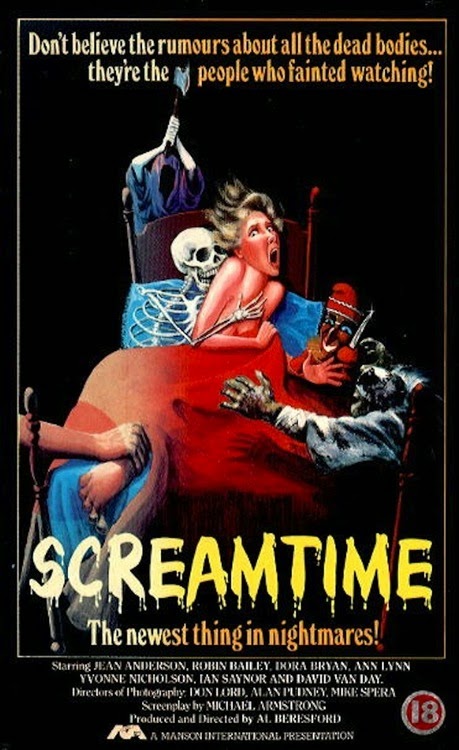
The original VHS cover was surprisingly not inaccurate for the movie within the box. This is an anthology movie about Punch and Judy, a mass murderer, and garden gnomes and buried zombie ghosts. Sure, they're all in different stories, but at least they're all in the movie.
While this is a British film, the framing device is in New York City, where two jerks steal three videos from the local store, and then go over to a girl's apartment, eat her food, make her miss her date, and they watch three British horror movies of negligible quality back to back. They are total jerks. I'm really surprised that the girl invites one of them to sleep with her in between the second and third movie.
The first movie they watch is about an old puppeteer who is doing his passion by doing Punch & Judy shows at the waterfront. He lives in a nice house with his wife in England. They have a son who has finished school (high school or college, it doesn't say). They know a couple of people who are successful in Canada. But, his wife hates the puppets and demands that he gives everything up and goes with her to live in Canada with her son. You know, after she rabidly insults him and calls him a loser for following his passion. The son is also bitter and a punk who berates him at the dinner table. When the son burns down the Punch & Judy stand, all hell breaks loose.
The second movie is about a newlywed couple who move into a house given to them by their father who apparently deals in real estate. The wife starts having increasingly crazy visions beginning with a boy on a bicycle in the yard, moving to happy guys bounding around with knives (blink and you'll miss it), and then to the actual recreation of a multiple murder scenario, driving her to insanity, because one doesn't hallucinate murder scenarios without going a wee bit crazy,
The third film regards a kid who wants to buy a car, so gets a second job as a gardener at a old posh house with two old ladies who love telling stories about their garden. They say there are fairies in it, and they take the manifestation of the garden gnomes who protected their previous owner. The previous owner was a woman who loved having affairs with young men, who would then die and their souls would be slaves of the gnomes.
While the movie is most definitely what it is: a no-budget not-that-shocking horror movie which would have a PG rating except for a single shot of gratuitous nudity as the girl in the framing device steps out of the shower. You know, kind of what you expect from straight-to-VHS 80s horror. There's some horrendously unbelievable violence, and my favorite part is that a the gardener kid gets crucifies like Jesus when he dies.
This movie is hilarious at times. The mother of the newlywed tells her daughter-in-law, "I don't even know why I had a son. Take my advice, and stick with girls." The high pitched Punch sounds during the murders of the first movie are hysterical. And, the two old biddies in the final story really make the movie. I'm not even kidding.
Thusly, Screamtime is actually better than its humble origins as a straight-to-video VHS but not by much. There are aspects that make this a cheesetastic success, and it has elements in the camp style. It almost feels like you're not laughing at it, but laughing with it. It knows it can't elevate itself past the no budget, so it spends its time winking at you. Dream House gets in a bit of tension despite its trappings, but the other two are loaded with cheeky jokes and insane storylines.
Which raises the question: when is a bad movie bad enough to be good? If a movie winks at you throughout, is it good enough to be entertaining? These are the types of questions one must ask for themselves. It is a different formula for everybody that tickles you. I am tickled by an old man chasing a girl with a big orange square of wood while shrieking "Beat the Wife!" in a high pitched squeak that is past a falsetto. I'm tickled by two old ladies gleefully talking about souls that become enslaved to the garden gnomes. I'm tickled by a guy eating fried chicken and sitting 3 ft from the tv screen commenting "It's British. I can tell by the way they talk."
Other people, however, may be bored and with good reason. The pacing in the first story is way off, and if you're not into a bit of humor, the third story will be irritating. Still, this one is worth a watch if you're bored and have nothing better to do, are sick and need something easy on the mind, or something. It's not really ultraviolent, though each of the three have slasher elements to it. It's somewhat sexist, but not overly done. I enjoyed myself, but it's not good. And, it's better than just middling. So, if you don't mind being tickled by low budget horror that makes you laugh more than scream and isn't designed for the gore or breast hounds, this is a good choice.
dir: Michael Armstrong, Stanley A. Long
The straight to video market in the 80s was infamous for having a whole slew of no budget horror movies that were done by amateurs meant to fill up the video shelves. Growing up in the 1980s, you come to know that you might have to dig deep into the wells for the gems that would periodically perk up. These videos disappeared to the annals of time for a good long period of time, until Netflix, criticized for having no selection, picked up a whole bunch of these no budget British films for their streaming service.
The original VHS cover was surprisingly not inaccurate for the movie within the box. This is an anthology movie about Punch and Judy, a mass murderer, and garden gnomes and buried zombie ghosts. Sure, they're all in different stories, but at least they're all in the movie.
While this is a British film, the framing device is in New York City, where two jerks steal three videos from the local store, and then go over to a girl's apartment, eat her food, make her miss her date, and they watch three British horror movies of negligible quality back to back. They are total jerks. I'm really surprised that the girl invites one of them to sleep with her in between the second and third movie.
The first movie they watch is about an old puppeteer who is doing his passion by doing Punch & Judy shows at the waterfront. He lives in a nice house with his wife in England. They have a son who has finished school (high school or college, it doesn't say). They know a couple of people who are successful in Canada. But, his wife hates the puppets and demands that he gives everything up and goes with her to live in Canada with her son. You know, after she rabidly insults him and calls him a loser for following his passion. The son is also bitter and a punk who berates him at the dinner table. When the son burns down the Punch & Judy stand, all hell breaks loose.
The second movie is about a newlywed couple who move into a house given to them by their father who apparently deals in real estate. The wife starts having increasingly crazy visions beginning with a boy on a bicycle in the yard, moving to happy guys bounding around with knives (blink and you'll miss it), and then to the actual recreation of a multiple murder scenario, driving her to insanity, because one doesn't hallucinate murder scenarios without going a wee bit crazy,
The third film regards a kid who wants to buy a car, so gets a second job as a gardener at a old posh house with two old ladies who love telling stories about their garden. They say there are fairies in it, and they take the manifestation of the garden gnomes who protected their previous owner. The previous owner was a woman who loved having affairs with young men, who would then die and their souls would be slaves of the gnomes.
While the movie is most definitely what it is: a no-budget not-that-shocking horror movie which would have a PG rating except for a single shot of gratuitous nudity as the girl in the framing device steps out of the shower. You know, kind of what you expect from straight-to-VHS 80s horror. There's some horrendously unbelievable violence, and my favorite part is that a the gardener kid gets crucifies like Jesus when he dies.
This movie is hilarious at times. The mother of the newlywed tells her daughter-in-law, "I don't even know why I had a son. Take my advice, and stick with girls." The high pitched Punch sounds during the murders of the first movie are hysterical. And, the two old biddies in the final story really make the movie. I'm not even kidding.
Thusly, Screamtime is actually better than its humble origins as a straight-to-video VHS but not by much. There are aspects that make this a cheesetastic success, and it has elements in the camp style. It almost feels like you're not laughing at it, but laughing with it. It knows it can't elevate itself past the no budget, so it spends its time winking at you. Dream House gets in a bit of tension despite its trappings, but the other two are loaded with cheeky jokes and insane storylines.
Which raises the question: when is a bad movie bad enough to be good? If a movie winks at you throughout, is it good enough to be entertaining? These are the types of questions one must ask for themselves. It is a different formula for everybody that tickles you. I am tickled by an old man chasing a girl with a big orange square of wood while shrieking "Beat the Wife!" in a high pitched squeak that is past a falsetto. I'm tickled by two old ladies gleefully talking about souls that become enslaved to the garden gnomes. I'm tickled by a guy eating fried chicken and sitting 3 ft from the tv screen commenting "It's British. I can tell by the way they talk."
Other people, however, may be bored and with good reason. The pacing in the first story is way off, and if you're not into a bit of humor, the third story will be irritating. Still, this one is worth a watch if you're bored and have nothing better to do, are sick and need something easy on the mind, or something. It's not really ultraviolent, though each of the three have slasher elements to it. It's somewhat sexist, but not overly done. I enjoyed myself, but it's not good. And, it's better than just middling. So, if you don't mind being tickled by low budget horror that makes you laugh more than scream and isn't designed for the gore or breast hounds, this is a good choice.
Friday, March 28, 2014
House (1977): When the Kitchen Sink technique works
House (aka Hausu) (1977)
dir: Nobuhiko Obayashi
In a traditional sense, nothing about House should work. It's a horror movie for kids that is all about love, loss and vampirism. As a film, it uses every single technique that had been invented by that time, and created new ones just for its own humor. It never really holds its attention on any one topic for any length of time, yet creates a hallucinatory throughline story. Yet, House is one of the craziest, most entertaining, balls-out films that works on weird hallucinatory levels as well as ridiculously high camp.
House tells the story of Gorgeous, whose father is about to remarry years after her mother passed away. Because he botched the introduction of his daughter and new wife, his daughter rebels and decides to spend her vacation with her aunt in some far off town. Her 6 friends have also recently learned they cannot go to a training camp due to a pregnant innkeeper, and choose to go with her.
Her aunt, living all alone in the middle of the country, greets them with open arms. Except that she is a vampiric witch, and employs both the house and all of the objects within it, in order to kill any unmarried females who dare to step within its walls. Auntie feeds off their life, and exchanges bodies and spirits so that she has possession of their identity as well.
What would normally be a relatively straightforward story of girls in peril, with a tragic backstory, turns into a child-like hallucinatory horror movie that comes off like a nightmare version of Sesame Street on acid. Much like Sesame Street's shorts, Obayashi uses everything under the sun to convey a child's heightened emotionality as well as blunter sense of the world. There's split frames, frames within frames, irises, deep focus, natural settings, matte backgrounds, blue screen, silent film, black and white, stop motion, practical effects, frame coloring, drawing on the frame, animation, slow motions, speed-ups, smash cuts, musical numbers...the list of everything that is in House is practically a compendium of cinematic techniques that were available at the time. A use of a few of those techniques go a long way, but House dares to include all of them.
That's not to say that the effects were all successful. Obayashi intended for the movie to look like a child's playtime machinations, with a sense that this isn't a mature adult making mature a movie for adults but a child communicating a child's experience. This child is explaining that she has a fear of a variety of things, including futons, pianos, clocks, reflections, cats, adults, and watermelons.
In order to properly enter this world, and take it as it wants to be taken, the viewer must turn himself into a child and turn off their preconceived notions of what a film actually should be like. Watching the film as an adult expecting a straightforward horror movie filled with adult creeping terrors around the corner is quickly obliterated by the opening, where a blue line outlines a box in the frame, and the cartoonish title treatment speaks the name "House" before eating you.
This type of whimsy continues through an opening scene where our heroine, Gorgeous, meets her stepmother. The scene seems like it is in the balcony of a spacious and stylish apartment with a matte painting backdrop of a setting sun makes it more 1980s Moonlighting than actually resembling a realist movie set. Any pretense at being realistic is dropped soon after when her new stepmother floats in from the side, with an invisible wind making her hair and her scarf trail her. It's heightened drama and setting, but it's so effective at setting a dreamy atmosphere that when we get to the schoolyard scenes that follow, the realism is drastically jarring. The school scenes are filmed in a style most reminiscent of any 1970s back to school special.
Given Obayashi's background in advertising, it's no surprise that House is as impeccable as it is inconceivable. The framing of the scene from the left with a giant pair of lips haunting the girls is stunning and amateur both. It's just off center, with the lips being the center of a frame that seems to have moved off to the left. The various odd sources of lighting are too hot in certain areas (notably the girl's butt), but still dramatic and creepy in the realm of the classical noirs. Compare that to the earlier frame of the head in the well, where the matte painting background gives everything an illusion of deepest focus, and the whole frame is lit and filmed like a classical watercolor painting. Which looks completely different to the neo-realist schoolyard scenes which feature no matte paintings and seem to even use a different film stock. Etc. But, they're all impeccably used, in an amateurish manner.
House doesn't have any pretense about being anything other than a film about 7 young girls in danger. Sure, it has some cultural allusions WWII and the bomb, and how the older generation is trying to cope with a younger generation who knows absolutely nothing about that earlier war and the destruction that was wrecked upon Japan as a result. From a child's perspective, though, that means nothing and the real source of fear are in the odd objects of the house. This is an art object. It's an experience. You're meant to laugh with it, and be scared by it. It's comedic, horrific, childlike and silly. But, most of all, it's different. This is primarily for experiencing something you haven't experienced since Sesame Street, put into a horror movie. It's an astounding film.
dir: Nobuhiko Obayashi
In a traditional sense, nothing about House should work. It's a horror movie for kids that is all about love, loss and vampirism. As a film, it uses every single technique that had been invented by that time, and created new ones just for its own humor. It never really holds its attention on any one topic for any length of time, yet creates a hallucinatory throughline story. Yet, House is one of the craziest, most entertaining, balls-out films that works on weird hallucinatory levels as well as ridiculously high camp.
House tells the story of Gorgeous, whose father is about to remarry years after her mother passed away. Because he botched the introduction of his daughter and new wife, his daughter rebels and decides to spend her vacation with her aunt in some far off town. Her 6 friends have also recently learned they cannot go to a training camp due to a pregnant innkeeper, and choose to go with her.
Her aunt, living all alone in the middle of the country, greets them with open arms. Except that she is a vampiric witch, and employs both the house and all of the objects within it, in order to kill any unmarried females who dare to step within its walls. Auntie feeds off their life, and exchanges bodies and spirits so that she has possession of their identity as well.
What would normally be a relatively straightforward story of girls in peril, with a tragic backstory, turns into a child-like hallucinatory horror movie that comes off like a nightmare version of Sesame Street on acid. Much like Sesame Street's shorts, Obayashi uses everything under the sun to convey a child's heightened emotionality as well as blunter sense of the world. There's split frames, frames within frames, irises, deep focus, natural settings, matte backgrounds, blue screen, silent film, black and white, stop motion, practical effects, frame coloring, drawing on the frame, animation, slow motions, speed-ups, smash cuts, musical numbers...the list of everything that is in House is practically a compendium of cinematic techniques that were available at the time. A use of a few of those techniques go a long way, but House dares to include all of them.
That's not to say that the effects were all successful. Obayashi intended for the movie to look like a child's playtime machinations, with a sense that this isn't a mature adult making mature a movie for adults but a child communicating a child's experience. This child is explaining that she has a fear of a variety of things, including futons, pianos, clocks, reflections, cats, adults, and watermelons.
In order to properly enter this world, and take it as it wants to be taken, the viewer must turn himself into a child and turn off their preconceived notions of what a film actually should be like. Watching the film as an adult expecting a straightforward horror movie filled with adult creeping terrors around the corner is quickly obliterated by the opening, where a blue line outlines a box in the frame, and the cartoonish title treatment speaks the name "House" before eating you.
This type of whimsy continues through an opening scene where our heroine, Gorgeous, meets her stepmother. The scene seems like it is in the balcony of a spacious and stylish apartment with a matte painting backdrop of a setting sun makes it more 1980s Moonlighting than actually resembling a realist movie set. Any pretense at being realistic is dropped soon after when her new stepmother floats in from the side, with an invisible wind making her hair and her scarf trail her. It's heightened drama and setting, but it's so effective at setting a dreamy atmosphere that when we get to the schoolyard scenes that follow, the realism is drastically jarring. The school scenes are filmed in a style most reminiscent of any 1970s back to school special.
Given Obayashi's background in advertising, it's no surprise that House is as impeccable as it is inconceivable. The framing of the scene from the left with a giant pair of lips haunting the girls is stunning and amateur both. It's just off center, with the lips being the center of a frame that seems to have moved off to the left. The various odd sources of lighting are too hot in certain areas (notably the girl's butt), but still dramatic and creepy in the realm of the classical noirs. Compare that to the earlier frame of the head in the well, where the matte painting background gives everything an illusion of deepest focus, and the whole frame is lit and filmed like a classical watercolor painting. Which looks completely different to the neo-realist schoolyard scenes which feature no matte paintings and seem to even use a different film stock. Etc. But, they're all impeccably used, in an amateurish manner.
House doesn't have any pretense about being anything other than a film about 7 young girls in danger. Sure, it has some cultural allusions WWII and the bomb, and how the older generation is trying to cope with a younger generation who knows absolutely nothing about that earlier war and the destruction that was wrecked upon Japan as a result. From a child's perspective, though, that means nothing and the real source of fear are in the odd objects of the house. This is an art object. It's an experience. You're meant to laugh with it, and be scared by it. It's comedic, horrific, childlike and silly. But, most of all, it's different. This is primarily for experiencing something you haven't experienced since Sesame Street, put into a horror movie. It's an astounding film.
Monday, February 10, 2014
Theatre of Blood (1973): Using the Stage for Revenge
Theatre of Blood (1973)
dir: Douglas Hickox
Rarely has a b-movie had such a high intellectual price of entry. This movie is custom made for fans of Shakespeare who also really like Vincent Price, and bloody low-budget horror movies. Given the amount of death in Shakespeare's tragedies, one might think that this has some crossovers.
Vincent Price is Edward Lionheart, a terrible Shakespearean actor who held a final season of Shakespearean tragedies, in which he played the lead and was panned for all of his performances. At some pre-film awards ceremony, he expected to get a "Critic's Choice Award," but was humiliated instead, and subsequently attempts suicide. He survives to exact his revenge on the ones who deserve it most: the critics. He starts killing the critics using the methods of various Shakespearean plays in the order he performed them in his last season. During the sequences, he also performs the choice speeches that surround the murder.
In order to fully appreciate this movie, it helps to have a cursory knowledge of Shakespeare. And, by cursory, I mean, knowledge of no less than 8 Shakespearean plays: Julius Caesar, Troilus and Cressida, Cymbeline, Henry VI Part 1, Richard III, The Merchant of Venice, Othello and Titus Andronicus.
Why do you need all of this knowledge? Because the death scenes are made into absurdist weird set pieces that seem like obscure oblique ways to kill people without any knowledge of their actual origins. Even with the knowledge of their origins, but without knowing the actual plays, the scenes are still rampant odes to some of the most famous scenes, and some of the least famous scenes, in Shakespeare with the dialogue stolen wholesale from the plays.
I can't imagine people who don't enjoy Shakespeare finding much enjoyment out of this movie. It seems like a prank in order to get you to eat your vegetables. If you find Shakespearean language dense and impenetrable, especially when parceled out at a spoken speed, you'll probably hate this.
Those who have studied Shakespeare sometimes are appalled by the sheer amount of violence in Shakespeare's plays, and this isn't for them either. The horror-comedy tropes are in full spectacle here, using and abusing all of Shakespeare's most violent tendencies.
But, for the crossover market, this is a perfect evisceration of both the supposed politeness of Shakespeare, and also a way to watch people get their secret jollies out on screen. Shakespeare was never polite. He was always just dense. But, his plays were always brutal.
But, then there's the second half of this movie, which is watching Vincent Price murder all of his critics who were so hoity-toity they couldn't appreciate him in the likes of The Abominable Dr. Phibes, or Dr. Goldfoot and the Bikini Machine, just to name a couple of his then-recent films. And, as such, he was going to hoist them on their own petard, so to speak. If it's Shakespeare they want, it's Shakespeare they'll get!!!
Plus, he always wanted to do Shakespeare, and he got to chew the scenery as he always loved to do and was so good at. But, that almost takes backseat to getting revenge on the critics for their need for high culture in film.
Will you enjoy it? Do you like Shakespeare and b-horrors? It's the most fun you can have watching Vincent Price, unless you don't get Shakespeare. And, that can be a high price of admission for many people. If you have that, it is amazing.
dir: Douglas Hickox
Rarely has a b-movie had such a high intellectual price of entry. This movie is custom made for fans of Shakespeare who also really like Vincent Price, and bloody low-budget horror movies. Given the amount of death in Shakespeare's tragedies, one might think that this has some crossovers.
Vincent Price is Edward Lionheart, a terrible Shakespearean actor who held a final season of Shakespearean tragedies, in which he played the lead and was panned for all of his performances. At some pre-film awards ceremony, he expected to get a "Critic's Choice Award," but was humiliated instead, and subsequently attempts suicide. He survives to exact his revenge on the ones who deserve it most: the critics. He starts killing the critics using the methods of various Shakespearean plays in the order he performed them in his last season. During the sequences, he also performs the choice speeches that surround the murder.
In order to fully appreciate this movie, it helps to have a cursory knowledge of Shakespeare. And, by cursory, I mean, knowledge of no less than 8 Shakespearean plays: Julius Caesar, Troilus and Cressida, Cymbeline, Henry VI Part 1, Richard III, The Merchant of Venice, Othello and Titus Andronicus.
Why do you need all of this knowledge? Because the death scenes are made into absurdist weird set pieces that seem like obscure oblique ways to kill people without any knowledge of their actual origins. Even with the knowledge of their origins, but without knowing the actual plays, the scenes are still rampant odes to some of the most famous scenes, and some of the least famous scenes, in Shakespeare with the dialogue stolen wholesale from the plays.
I can't imagine people who don't enjoy Shakespeare finding much enjoyment out of this movie. It seems like a prank in order to get you to eat your vegetables. If you find Shakespearean language dense and impenetrable, especially when parceled out at a spoken speed, you'll probably hate this.
Those who have studied Shakespeare sometimes are appalled by the sheer amount of violence in Shakespeare's plays, and this isn't for them either. The horror-comedy tropes are in full spectacle here, using and abusing all of Shakespeare's most violent tendencies.
But, for the crossover market, this is a perfect evisceration of both the supposed politeness of Shakespeare, and also a way to watch people get their secret jollies out on screen. Shakespeare was never polite. He was always just dense. But, his plays were always brutal.
But, then there's the second half of this movie, which is watching Vincent Price murder all of his critics who were so hoity-toity they couldn't appreciate him in the likes of The Abominable Dr. Phibes, or Dr. Goldfoot and the Bikini Machine, just to name a couple of his then-recent films. And, as such, he was going to hoist them on their own petard, so to speak. If it's Shakespeare they want, it's Shakespeare they'll get!!!
Plus, he always wanted to do Shakespeare, and he got to chew the scenery as he always loved to do and was so good at. But, that almost takes backseat to getting revenge on the critics for their need for high culture in film.
Will you enjoy it? Do you like Shakespeare and b-horrors? It's the most fun you can have watching Vincent Price, unless you don't get Shakespeare. And, that can be a high price of admission for many people. If you have that, it is amazing.
Thursday, January 30, 2014
Killer Condom (1996): Gay Horror coming out of the closet
Killer Condom (1996)
dir: Martin Walz
In 1996, gay cinema was finally starting to come into the mainstream, having been led by the 1-2 drag punch of The Adventures of Priscilla, Queen of the Desert, and To Wong Foo, Thanks for Everything, Julie Newmar. Finally, emboldened by the success of these 2 drag movies, queer cinema was making its way out of the art house and into the world of the genre.
In America, we saw the release of Bound, and The Birdcage. And, in Germany, Martin Walz made the first gay horror comedy satire that also had origins in comic books, Killer Condom. Based off the comic book of the same title by Ralf Konig, Killer Condom sent up cop movie tropes and horror tropes in a manner not much seen outside of Grindhouses. That it was also a satire of American politics and moralities made it that much more delectable.
Killer Condom is actually a misnomer. The actual title is Kondom des Grauens of Condom of Horrors. The titular condom never kills anybody. It just bites off their cocks. And, the movie delivers on condom violence in the first scene, when a college professor is forcing a student to have sex in the seedy Hotel Quickie, when the condom he puts on bites off his johnson.
Turns out, there was a plague of johnson removal in the Hotel Quickie that night, with four guys getting their penii removed, mostly in front of prostitutes. Detective Mackeroni, a Sicilian gay man played by Udo Samel, a German edition of Bob Hoskins, is on the case as he's a frequent customer at Hotel Quickie, having a predilection for young rent boys. And, while investigating, he picks up a new conquest, Billy...and also has an encounter with the Killer Condom who bites off his right nut while going after his 12+" pecker.
What follows is a send up of every hardboiled cop cliche. Mackeroni can't convince his boss that this is actually all being done by a condom. The boss yells and screams at him. His partner is a mismatched tall, lanky, straight homophobe. Mackeroni has to deal with an old flame, Babette (formerly Bob), who is a drag queen that used to be a cop. Mackeroni also has the new romance with Billy to come to terms with since he has walled off his emotions due to the hard life of New York City. There's even a visiting politician, Dick McGovern, who is a hard right-wing conservative who has flings on his travels, and who loses his dick from a condom that uses a rubber ducky as a diving board.
Then there's the condom itself. A cute white condom that giggles, squeaks, and makes all sorts of adorably humorous sounds, until it turns into a tube with teeth and becomes a grotesque throat of violence. I would be neglect if I didn't mention that H.R. Giger was the Creative Consultant for the film. Yes, that H.R. Giger. Which makes the film kind of beautifully seedy.
What really sets this movie apart from it's usual horror movie is that the morality it espouses is the opposite of the usual horror movie conservative bent. Yes, gays and hookers are punished in the course of the movie, but those punishments are always seen as wrong. By the end, Killer Condom has a pro-gay, sex positive message in the form of a finale sermon. Not only that, it sets itself up against the Religious Right which had been given a voice by the Republicans since the 1980s. Truly, this is a movie that is intended to piss off the homophobes.
Sure, some of the jokes are well-worn, with a setup that recalls the satirical intentions of Hollywood Chainsaw Hookers. Some of the humor also comes from insider gay knowledge, as in an amazing use of the Hanky Code that heterosexuals may not understand the set up for. And, at 107 minutes it is a bit long in the tooth, even though it's always doing something interesting throughout the course of those 107 minutes. But, gay horror movies have rarely been this much campy fun. And, really, when was the last time you saw a horror movie about condoms that had 2 distinct Hitchcock references, and a scene that was like a more real life scene from Cruising. Fortunately, stateside, Troma was able to see that Killer Condom was actually releasable, and they still have it available.
dir: Martin Walz
In 1996, gay cinema was finally starting to come into the mainstream, having been led by the 1-2 drag punch of The Adventures of Priscilla, Queen of the Desert, and To Wong Foo, Thanks for Everything, Julie Newmar. Finally, emboldened by the success of these 2 drag movies, queer cinema was making its way out of the art house and into the world of the genre.
In America, we saw the release of Bound, and The Birdcage. And, in Germany, Martin Walz made the first gay horror comedy satire that also had origins in comic books, Killer Condom. Based off the comic book of the same title by Ralf Konig, Killer Condom sent up cop movie tropes and horror tropes in a manner not much seen outside of Grindhouses. That it was also a satire of American politics and moralities made it that much more delectable.
Killer Condom is actually a misnomer. The actual title is Kondom des Grauens of Condom of Horrors. The titular condom never kills anybody. It just bites off their cocks. And, the movie delivers on condom violence in the first scene, when a college professor is forcing a student to have sex in the seedy Hotel Quickie, when the condom he puts on bites off his johnson.
Turns out, there was a plague of johnson removal in the Hotel Quickie that night, with four guys getting their penii removed, mostly in front of prostitutes. Detective Mackeroni, a Sicilian gay man played by Udo Samel, a German edition of Bob Hoskins, is on the case as he's a frequent customer at Hotel Quickie, having a predilection for young rent boys. And, while investigating, he picks up a new conquest, Billy...and also has an encounter with the Killer Condom who bites off his right nut while going after his 12+" pecker.
What follows is a send up of every hardboiled cop cliche. Mackeroni can't convince his boss that this is actually all being done by a condom. The boss yells and screams at him. His partner is a mismatched tall, lanky, straight homophobe. Mackeroni has to deal with an old flame, Babette (formerly Bob), who is a drag queen that used to be a cop. Mackeroni also has the new romance with Billy to come to terms with since he has walled off his emotions due to the hard life of New York City. There's even a visiting politician, Dick McGovern, who is a hard right-wing conservative who has flings on his travels, and who loses his dick from a condom that uses a rubber ducky as a diving board.
Then there's the condom itself. A cute white condom that giggles, squeaks, and makes all sorts of adorably humorous sounds, until it turns into a tube with teeth and becomes a grotesque throat of violence. I would be neglect if I didn't mention that H.R. Giger was the Creative Consultant for the film. Yes, that H.R. Giger. Which makes the film kind of beautifully seedy.
What really sets this movie apart from it's usual horror movie is that the morality it espouses is the opposite of the usual horror movie conservative bent. Yes, gays and hookers are punished in the course of the movie, but those punishments are always seen as wrong. By the end, Killer Condom has a pro-gay, sex positive message in the form of a finale sermon. Not only that, it sets itself up against the Religious Right which had been given a voice by the Republicans since the 1980s. Truly, this is a movie that is intended to piss off the homophobes.
Sure, some of the jokes are well-worn, with a setup that recalls the satirical intentions of Hollywood Chainsaw Hookers. Some of the humor also comes from insider gay knowledge, as in an amazing use of the Hanky Code that heterosexuals may not understand the set up for. And, at 107 minutes it is a bit long in the tooth, even though it's always doing something interesting throughout the course of those 107 minutes. But, gay horror movies have rarely been this much campy fun. And, really, when was the last time you saw a horror movie about condoms that had 2 distinct Hitchcock references, and a scene that was like a more real life scene from Cruising. Fortunately, stateside, Troma was able to see that Killer Condom was actually releasable, and they still have it available.
Wednesday, January 29, 2014
The Texas Chainsaw Massacre 2 (1986): Black Humor Takes Over
The Texas Chainsaw Massacre 2 (1986)
dir: Tobe Hooper
Poor Tobe Hooper. After directing The Texas Chainsaw Massacre, he became a hot commodity and got the job directing Poltergeist with Steven Spielberg producing. But, many of the actors and people on set of Poltergeist had constantly accused Hooper of being drunk on set, and Poltergeist being the work of Steven Spielberg taking control.
In any case, Poltergeist was a success, and landed Hooper a 3-picture deal with Cannon, which included Lifeforce, Invader From Mars, and The Texas Chainsaw Massacre 2. None of these three were box office successes, especially not on the scale of Poltergeist. Which may have been the Poltergeist curse on Hooper.
In any case, The Texas Chainsaw Massacre 2 is Hooper pulling a Sam Raimi and making an explicitly darkly humorous horror movie after an original where the dark humor that was present was buried under oppressive layers of chaos and horror. Sam Raimi went with splatstick in his sequel Evil Dead 2, which was released the year after Texas Chainsaw Massacre 2. But, Hooper led the way by making this movie's humor pitch pitch black. It should be telling when a scene where Leatherface uses a chainsaw as a surrogate penis, and he actually has an orgasm, is not the height of absurdity.
The Texas Chainsaw Massacre 2 takes place 13 years after the sequel, stating that Texas has been plagued by the chainsaw murders since the original murders took place, but the police, so far, haven't found anything and have disavowed knowledge of the murders. It turns out the family has been driven into an underground bunker in metro Dallas, and Pa is now a maker of the finest chili in Texas, made from human meat of course.
The film opens with a couple of kids wreaking havoc all over Texas' highways until they're killed by Leatherface in a truck. But, they were also harassing a local radio host, Stretch (Caroline Williams as a low-rent Laurie Metcalf), who apparently had no way of hanging up phone calls, who winds up recording their murder.
The case is being followed by Lieutenant Lefty, an ex Texas Ranger, whose nephew had gone missing, but never found. Lefty is played by Dennis Hopper who plays thinly veiled rage until he goes into full on Frank Booth mode by the end.
Lefty and Stretch team up for a game of cat and mouse, and find the lair in some elaborate underground habittrail of bone and wood. Lefty had already bought a pair of chainsaws, and decides to go chopping everything to pieces, while Stretch is romanced by Leatherface, then tortured and chased by the family.
Of course, this all leads to the climax...of DUELING CHAINSAWS!!! In the '80s, dueling chainsaws were a Thing here in Z-movie land. They popped up in this movie, in Phantasm II, Hollywood Chainsaw Hookers, Motel Hell, and even Tiger On Beat, a Chow Yun-Fat film. In The Texas Chainsaw Massacre 2, Dennis Hopper goes up against Leatherface in a rather epic climactic centerpiece that's pure hilarity. I mean, dueling chainsaws with Dennis Hopper...how could you not want to see that.
The Texas Chainsaw Massacre is a movie of two senses. It wants to appease the horror fans who would be turning out, especially if they were fans of the original. It wants to have moments of extreme violence and gore (even if it was severely cut for the original theatrical release) for the 80s, but then Hooper wanted to make a movie that appeased his sick sense of humor. One of the family is a Vietnam vet who has a metal plate in his head, damaged by a chainsaw. Pa rants about property taxes in a satire on what the blue staters think of rednecks. Everything about this film is almost a satire of itself.
Even when Stretch is attacked in the studio, there is a good long sequence of Leatherface sawing the hell out of a tub of ice and beer, before he decides he's in love with Stretch. Meanwhile, his brother won't stop ranting about nothing and everything and is newly exposed metal plate. It's a scene of pure absurd hilarity.
As such, Tobe Hooper was almost just trying to make a buck with this, but he failed in the end. It was wrongfully maligned by the critics, not seen by audiences, and generally ignored for the longest time. It's time for the post-Sam Raimi crowd to see it, and fall in love with the horror comedy edition of Leatherface, before he turned into a drag queen.
dir: Tobe Hooper
Poor Tobe Hooper. After directing The Texas Chainsaw Massacre, he became a hot commodity and got the job directing Poltergeist with Steven Spielberg producing. But, many of the actors and people on set of Poltergeist had constantly accused Hooper of being drunk on set, and Poltergeist being the work of Steven Spielberg taking control.
In any case, Poltergeist was a success, and landed Hooper a 3-picture deal with Cannon, which included Lifeforce, Invader From Mars, and The Texas Chainsaw Massacre 2. None of these three were box office successes, especially not on the scale of Poltergeist. Which may have been the Poltergeist curse on Hooper.
In any case, The Texas Chainsaw Massacre 2 is Hooper pulling a Sam Raimi and making an explicitly darkly humorous horror movie after an original where the dark humor that was present was buried under oppressive layers of chaos and horror. Sam Raimi went with splatstick in his sequel Evil Dead 2, which was released the year after Texas Chainsaw Massacre 2. But, Hooper led the way by making this movie's humor pitch pitch black. It should be telling when a scene where Leatherface uses a chainsaw as a surrogate penis, and he actually has an orgasm, is not the height of absurdity.
The Texas Chainsaw Massacre 2 takes place 13 years after the sequel, stating that Texas has been plagued by the chainsaw murders since the original murders took place, but the police, so far, haven't found anything and have disavowed knowledge of the murders. It turns out the family has been driven into an underground bunker in metro Dallas, and Pa is now a maker of the finest chili in Texas, made from human meat of course.
The film opens with a couple of kids wreaking havoc all over Texas' highways until they're killed by Leatherface in a truck. But, they were also harassing a local radio host, Stretch (Caroline Williams as a low-rent Laurie Metcalf), who apparently had no way of hanging up phone calls, who winds up recording their murder.
The case is being followed by Lieutenant Lefty, an ex Texas Ranger, whose nephew had gone missing, but never found. Lefty is played by Dennis Hopper who plays thinly veiled rage until he goes into full on Frank Booth mode by the end.
Lefty and Stretch team up for a game of cat and mouse, and find the lair in some elaborate underground habittrail of bone and wood. Lefty had already bought a pair of chainsaws, and decides to go chopping everything to pieces, while Stretch is romanced by Leatherface, then tortured and chased by the family.
Of course, this all leads to the climax...of DUELING CHAINSAWS!!! In the '80s, dueling chainsaws were a Thing here in Z-movie land. They popped up in this movie, in Phantasm II, Hollywood Chainsaw Hookers, Motel Hell, and even Tiger On Beat, a Chow Yun-Fat film. In The Texas Chainsaw Massacre 2, Dennis Hopper goes up against Leatherface in a rather epic climactic centerpiece that's pure hilarity. I mean, dueling chainsaws with Dennis Hopper...how could you not want to see that.
The Texas Chainsaw Massacre is a movie of two senses. It wants to appease the horror fans who would be turning out, especially if they were fans of the original. It wants to have moments of extreme violence and gore (even if it was severely cut for the original theatrical release) for the 80s, but then Hooper wanted to make a movie that appeased his sick sense of humor. One of the family is a Vietnam vet who has a metal plate in his head, damaged by a chainsaw. Pa rants about property taxes in a satire on what the blue staters think of rednecks. Everything about this film is almost a satire of itself.
Even when Stretch is attacked in the studio, there is a good long sequence of Leatherface sawing the hell out of a tub of ice and beer, before he decides he's in love with Stretch. Meanwhile, his brother won't stop ranting about nothing and everything and is newly exposed metal plate. It's a scene of pure absurd hilarity.
As such, Tobe Hooper was almost just trying to make a buck with this, but he failed in the end. It was wrongfully maligned by the critics, not seen by audiences, and generally ignored for the longest time. It's time for the post-Sam Raimi crowd to see it, and fall in love with the horror comedy edition of Leatherface, before he turned into a drag queen.
Tuesday, January 28, 2014
Hollywood Chainsaw Hookers (1988): When men gave women chainsaws
Hollywood Chainsaw Hookers (1988)
dir: Fred Olen Ray
How many times has it been complained that b-movies of the 80s were always about women getting killed in bloody, gruesome, graphic ways, and they always had a misogynistic point of view? There are always exceptions to that rule, and Hollywood Chainsaw Hookers was one of those very big exceptions.
Hollywood Chainsaw Hookers was never a movie that was going to set the world on fire. This was a B-movie made for the grindhouses and VHS set that starred Linnea Quigley, a tiny scream queen. Sending up film noir tropes with self-referential winking, while also blending in horror and plenty of nudity, Hollywood Chainsaw Hookers actually has developed a sizable cult following.
The story of Hollywood Chainsaw Hookers follows a hardboiled detective, Jack Chandler, who is looking for a lost teenager from backwoods America. Meanwhile, there is an ancient cult of chainsaw worshipping prostitutes who are killing their clients with wild abandon. And, that's about all there is to Hollywood Chainsaw Hookers. Hookers, nudity, chainsaws, murders, Fox Harris, overcooked hardboiled dialogue, and a climactic chainsaw duel!
When I mention that dialogue, Fred Olen Ray and T.L. Lankford didn't really scrimp on the quotables. "You could have knocked me over with a pubic hair." "The charge? Making McNuggets with a chainsaw." "Just what I need today, a private dick in my face." "Being a dick is a 24 hour a day job."
The dialogue is only matched by the set pieces. There is a chainsaw massacre scene that is all about Elvis. Elvis on the record player. A velvet Elvis painting covered by plastic wrap. A naked woman wearing nothing but a shower cap maniacally wielding a chainsaw chopping up a guy with body parts flying.
And, here's where Hollywood Chainsaw Hookers is actually a different movie than most of the other 80s cult movies. The victims in Hollywood Chainsaw Hookers are all men. The killers are all women, though let by The Stranger (played by Gunner Hansen). And, the women are wielding the second-most phallic instrument of death seen on screen (the first being the long drill in Slumber Party Massacre).
By giving women gigantic heavy cocks to penetrate men with, Fred Olen Ray is answering the feminist charges that all horror movies actually are intended to make women out to be victims. Now, the movie is still half a male story, with Jack Chandler taking a good half of the screen time, and being the hero. And, the killers are all under the power of another man, The Stranger, who is the leader of the cult. But, the women aren't the victims in this movie. They're the cock-wielding killers that is normally reserved for men.
Fred Olen Ray is a b-movie director, who works in the same realms as Jim Wynorski and David DeCoteau. Olen Ray even delved into the gay horror genre with the TV series The Lair, though he is straighter than straight. He also, at one point, had his own wrestling league, ACW, and was a wrestler in it. Olen Ray is a card, who knows how tongue-in-cheek his movies actually are. Hollywood Chainsaw Hookers is definitely his idea of satire and subversion, and it works. It pays off in spades.
Required Viewing.
dir: Fred Olen Ray
How many times has it been complained that b-movies of the 80s were always about women getting killed in bloody, gruesome, graphic ways, and they always had a misogynistic point of view? There are always exceptions to that rule, and Hollywood Chainsaw Hookers was one of those very big exceptions.
Hollywood Chainsaw Hookers was never a movie that was going to set the world on fire. This was a B-movie made for the grindhouses and VHS set that starred Linnea Quigley, a tiny scream queen. Sending up film noir tropes with self-referential winking, while also blending in horror and plenty of nudity, Hollywood Chainsaw Hookers actually has developed a sizable cult following.
The story of Hollywood Chainsaw Hookers follows a hardboiled detective, Jack Chandler, who is looking for a lost teenager from backwoods America. Meanwhile, there is an ancient cult of chainsaw worshipping prostitutes who are killing their clients with wild abandon. And, that's about all there is to Hollywood Chainsaw Hookers. Hookers, nudity, chainsaws, murders, Fox Harris, overcooked hardboiled dialogue, and a climactic chainsaw duel!
When I mention that dialogue, Fred Olen Ray and T.L. Lankford didn't really scrimp on the quotables. "You could have knocked me over with a pubic hair." "The charge? Making McNuggets with a chainsaw." "Just what I need today, a private dick in my face." "Being a dick is a 24 hour a day job."
The dialogue is only matched by the set pieces. There is a chainsaw massacre scene that is all about Elvis. Elvis on the record player. A velvet Elvis painting covered by plastic wrap. A naked woman wearing nothing but a shower cap maniacally wielding a chainsaw chopping up a guy with body parts flying.
And, here's where Hollywood Chainsaw Hookers is actually a different movie than most of the other 80s cult movies. The victims in Hollywood Chainsaw Hookers are all men. The killers are all women, though let by The Stranger (played by Gunner Hansen). And, the women are wielding the second-most phallic instrument of death seen on screen (the first being the long drill in Slumber Party Massacre).
By giving women gigantic heavy cocks to penetrate men with, Fred Olen Ray is answering the feminist charges that all horror movies actually are intended to make women out to be victims. Now, the movie is still half a male story, with Jack Chandler taking a good half of the screen time, and being the hero. And, the killers are all under the power of another man, The Stranger, who is the leader of the cult. But, the women aren't the victims in this movie. They're the cock-wielding killers that is normally reserved for men.
Fred Olen Ray is a b-movie director, who works in the same realms as Jim Wynorski and David DeCoteau. Olen Ray even delved into the gay horror genre with the TV series The Lair, though he is straighter than straight. He also, at one point, had his own wrestling league, ACW, and was a wrestler in it. Olen Ray is a card, who knows how tongue-in-cheek his movies actually are. Hollywood Chainsaw Hookers is definitely his idea of satire and subversion, and it works. It pays off in spades.
Required Viewing.
Monday, January 13, 2014
Stitches (2012): The Comedy of Violence
Stitches (2012)
dir: Conor McMahon
When one thinks of blackly comic clown movies, mostly the movies are bleak and full of loathing. Clowns in cinema have become symbols on which to hang ironic situations that destroy ones love of life and/or humanity. Shakes the Clown, and Vulgar, for instance, are two clown movies which are unrelentingly bleak and darkly funny through pessimistic means.
Stitches opens with the titular clown fucking a woman in a trailer, giving a nod to the common type of movie where clowns are put upon poor people who, through their desire to make people laugh, have lost all semblance of humanity in themselves. The next scene, a child's 10th birthday party, further emphasizes this type of reading, right up until Stitches is killed by the children on accident.
At this point, Stitches ceases with the typical bleakness of a clown's life, and becomes about guilt and redemption after a murder. 6 years later, the same child is having his 16th birthday party, and now it is time to pay the piper, as Stitches comes back to life seeking vengeance on those who murdered him.
The thing to remember when watching Stitches is that it seems to want people to think it is a horror movie, but it seems to be a complete and utter comedy, especially when Stitches is on screen. The killer clown scenes are filled with unbelievable levels of violence and gore, and it is when Stitches is around that the movie actually is kind of funny.
Despite Stitches' obvious low budget, McMahon actually crafted some spectacular and memorable kill scenes. Every now and then, Stitches even achieves the visceral reaction that makes somebody squirm pleasantly while watching the teenager be murdered. When it isn't attempting to be visceral, Stitches is aiming for spectacular. Frequently, McMahon shoots the blood splatter in slow-motion against stark black backgrounds, as if it was a special effect horror edition of Time Warp.
The movie doesn't hold enough actual interest in it to make it a good or great movie. There is little tension, and the wittiness is pretty much kept to Stitches and his murder scenes. Throughout the remainder of the movie, the wit is sorely lacking (e.g. Oh, look, the not-so-fat gay fat kid is gorging himself on cans of strawberries! HAR HAR!!), but it's never quite dull enough to quit the movie.
Who will like Stitches? The gorehounds and the easily amused. It's not gory in a realistic sense, but there is enough blood to be quite fun. And the jokes are witty enough to give it a pass. If you fit into neither of these categories, and also were looking for something high tension, you might be bored silly. But, for those in these categories, there is probably a lot to love.
dir: Conor McMahon
When one thinks of blackly comic clown movies, mostly the movies are bleak and full of loathing. Clowns in cinema have become symbols on which to hang ironic situations that destroy ones love of life and/or humanity. Shakes the Clown, and Vulgar, for instance, are two clown movies which are unrelentingly bleak and darkly funny through pessimistic means.
Stitches opens with the titular clown fucking a woman in a trailer, giving a nod to the common type of movie where clowns are put upon poor people who, through their desire to make people laugh, have lost all semblance of humanity in themselves. The next scene, a child's 10th birthday party, further emphasizes this type of reading, right up until Stitches is killed by the children on accident.
At this point, Stitches ceases with the typical bleakness of a clown's life, and becomes about guilt and redemption after a murder. 6 years later, the same child is having his 16th birthday party, and now it is time to pay the piper, as Stitches comes back to life seeking vengeance on those who murdered him.
The thing to remember when watching Stitches is that it seems to want people to think it is a horror movie, but it seems to be a complete and utter comedy, especially when Stitches is on screen. The killer clown scenes are filled with unbelievable levels of violence and gore, and it is when Stitches is around that the movie actually is kind of funny.
Despite Stitches' obvious low budget, McMahon actually crafted some spectacular and memorable kill scenes. Every now and then, Stitches even achieves the visceral reaction that makes somebody squirm pleasantly while watching the teenager be murdered. When it isn't attempting to be visceral, Stitches is aiming for spectacular. Frequently, McMahon shoots the blood splatter in slow-motion against stark black backgrounds, as if it was a special effect horror edition of Time Warp.
The movie doesn't hold enough actual interest in it to make it a good or great movie. There is little tension, and the wittiness is pretty much kept to Stitches and his murder scenes. Throughout the remainder of the movie, the wit is sorely lacking (e.g. Oh, look, the not-so-fat gay fat kid is gorging himself on cans of strawberries! HAR HAR!!), but it's never quite dull enough to quit the movie.
Who will like Stitches? The gorehounds and the easily amused. It's not gory in a realistic sense, but there is enough blood to be quite fun. And the jokes are witty enough to give it a pass. If you fit into neither of these categories, and also were looking for something high tension, you might be bored silly. But, for those in these categories, there is probably a lot to love.
Friday, October 18, 2013
Doghouse (2009): Men's Rights on screen
Doghouse (2009)
dir: Jake West
Sometimes, I don't know how to approach a movie, nor do I know how it is intended to be taken. I can't tell if Doghouse is trying to be a satirical indictment of sexist tropes and thoughts, especially of those in the Men's Rights type movement. Or, if Doghouse is meant to be a brodude type movie that is all "LULZ, stupid feminist women are bitchy zombies that are out to kill all men. Look at the men-hating she-beasts of this town called Moodley." Try as I might to give the benefit of the doubt, Doghouse really seems to settle on the latter interpretation, even though I really wanted to take it as the former. It just never quite makes it to satire because it is never searing of anything.
In case you haven't been alive for the past few years, the feminist movement has been making headway, and in some ways has been almost overextending their hand. The seeming over-extension is viewed by men as being misandrist and that spurned a counter movement founded in men's rights. The men's rights movement has been against how men are frequently seen as less than women, that men are always portrayed as the aggressors, that men can be raped for humor or effect (see Super or Descent), and that castration is seen as hilarity. It also has been about male superiority, in effect. But, unfortunately, the men's rights movement is also steeped in a lot of misogyny and no small bit of conservatism.
Doghouse takes both movements and blows them both to hell for some generic Bros Before Hoes type movie making. Did I say blows them both to hell? I mean it impotently ignores the piss out of them and maybe makes passively snide remarks at them. The movie opens with a montage of 6 guys. 3 of the guys have wives or girlfriends who are completely possessive and demanding. One guy has a boyfriend who is also possessive. One guy is a dateless comic book guy, who has an antagonistic tween boy customer. Those five are all going out for a boy's weekend for the sixth guy who was recently divorced and is torn up about it.
These 6 brodudes are all on a boy's weekend to a cabin or small house near the town of Moodley, a town where the women outnumber the men 4:1. Periodically voices of reason appear, such as the female who says intones that they're being self-centered assholes by assuming that the women will jump their bones because there's a dearth of men. But, these voices of reason are sexually harassed away. Go away, the brodudes are bro-ing out.
When we finally get to Moodley, the women there have all been infected with a zombie virus, and they have killed all of the men in town. And, the remainder of the movie is just the 6 brodudes and one other surviving guy versus the litany of zombie women stereotypes. Obviously, there will be murder, and many man-hating female zombies will be murdered in the course of the movie. Fortunately, the women aren't sexually tortured...you know, brutally murdered in the genitalia or breasts.
All this would point to a completely sexist male-good-female-bad make-me-a-sammich read, except the 6 brodudes are complete beta males. They're all whipped, and one is even abused by a 10-year-old boy. Their sexist musings are just as much a sign of their impotence as a sign of the larger-world sexism and stereotyping they participate in. They're also so fixated on the women that a 7th character, who has been fighting the women, has to tell them that all the men are dead...duh. They're moderately oblivious and have to grow and mature as men in order to escape the zombie town.
Meaning that the men get a character arc of maturity by facing up to these women who are out to kill them or own them. The divorced guy criticizes their treatment of women in a more universal sense, but that's about the only "you're not behaving right" moment in the movie.
As such, it's really hard to try to approach this as anything other than a brodude movie that's not even trying to be slyly political. It's just a brodude-loving, woman-hating misogynistic movie. Which might be slightly forgivable if the movie was as innovative as the movies that came before it. But, it isn't the be all end all of zombie horror-comedy movies that is made problematic by the terrible sexism in the movie. It isn't even the funniest one where a woman wants to tie down and change a man, while he wants to remain in his childhood. Instead, it's a rather mediocre movie that seems to be deeply sexist for little results.
dir: Jake West
Sometimes, I don't know how to approach a movie, nor do I know how it is intended to be taken. I can't tell if Doghouse is trying to be a satirical indictment of sexist tropes and thoughts, especially of those in the Men's Rights type movement. Or, if Doghouse is meant to be a brodude type movie that is all "LULZ, stupid feminist women are bitchy zombies that are out to kill all men. Look at the men-hating she-beasts of this town called Moodley." Try as I might to give the benefit of the doubt, Doghouse really seems to settle on the latter interpretation, even though I really wanted to take it as the former. It just never quite makes it to satire because it is never searing of anything.
In case you haven't been alive for the past few years, the feminist movement has been making headway, and in some ways has been almost overextending their hand. The seeming over-extension is viewed by men as being misandrist and that spurned a counter movement founded in men's rights. The men's rights movement has been against how men are frequently seen as less than women, that men are always portrayed as the aggressors, that men can be raped for humor or effect (see Super or Descent), and that castration is seen as hilarity. It also has been about male superiority, in effect. But, unfortunately, the men's rights movement is also steeped in a lot of misogyny and no small bit of conservatism.
Doghouse takes both movements and blows them both to hell for some generic Bros Before Hoes type movie making. Did I say blows them both to hell? I mean it impotently ignores the piss out of them and maybe makes passively snide remarks at them. The movie opens with a montage of 6 guys. 3 of the guys have wives or girlfriends who are completely possessive and demanding. One guy has a boyfriend who is also possessive. One guy is a dateless comic book guy, who has an antagonistic tween boy customer. Those five are all going out for a boy's weekend for the sixth guy who was recently divorced and is torn up about it.
These 6 brodudes are all on a boy's weekend to a cabin or small house near the town of Moodley, a town where the women outnumber the men 4:1. Periodically voices of reason appear, such as the female who says intones that they're being self-centered assholes by assuming that the women will jump their bones because there's a dearth of men. But, these voices of reason are sexually harassed away. Go away, the brodudes are bro-ing out.
When we finally get to Moodley, the women there have all been infected with a zombie virus, and they have killed all of the men in town. And, the remainder of the movie is just the 6 brodudes and one other surviving guy versus the litany of zombie women stereotypes. Obviously, there will be murder, and many man-hating female zombies will be murdered in the course of the movie. Fortunately, the women aren't sexually tortured...you know, brutally murdered in the genitalia or breasts.
All this would point to a completely sexist male-good-female-bad make-me-a-sammich read, except the 6 brodudes are complete beta males. They're all whipped, and one is even abused by a 10-year-old boy. Their sexist musings are just as much a sign of their impotence as a sign of the larger-world sexism and stereotyping they participate in. They're also so fixated on the women that a 7th character, who has been fighting the women, has to tell them that all the men are dead...duh. They're moderately oblivious and have to grow and mature as men in order to escape the zombie town.
Meaning that the men get a character arc of maturity by facing up to these women who are out to kill them or own them. The divorced guy criticizes their treatment of women in a more universal sense, but that's about the only "you're not behaving right" moment in the movie.
As such, it's really hard to try to approach this as anything other than a brodude movie that's not even trying to be slyly political. It's just a brodude-loving, woman-hating misogynistic movie. Which might be slightly forgivable if the movie was as innovative as the movies that came before it. But, it isn't the be all end all of zombie horror-comedy movies that is made problematic by the terrible sexism in the movie. It isn't even the funniest one where a woman wants to tie down and change a man, while he wants to remain in his childhood. Instead, it's a rather mediocre movie that seems to be deeply sexist for little results.
Friday, September 27, 2013
Office Killer (1997): Social satire, horror, and surrealism...not always a good mix
Office Killer (1997)
dir: Cindy Sherman
You'll have to indulge me (as if you haven't been indulging me already). An office-based horror comedy that came recommended courtesy of Netflix's Max (the PS3 interactive recommendation engine) based in the category "Goofy." It stars Molly Ringwald, Carol Kane, and Jeanne Tripplehorn. It was directed by a woman. The script was written by two women, and two men who were part of the New Queer Cinema movement in the early '90s. One of those men (who is actually uncredited in the film) is Todd Haynes, writer director of Far From Heaven, I'm Not There, and the HBO remake of Mildred Pierce. He also created a strong female role with [Safe] for Julianne Moore. Of course I'm going to watch this movie.
It isn't good.
Office Killer is set in the offices of some magazine (Constant Consumer, if you're curious) that is on the downfall. Constant Consumer, under the rule of Virginia Wingate (who seems to be some sort of Ariana Huffington caricature), is downsizing many of its employees and reducing much of the staff from full-time hires to freelancers who have to work from home. One of the victims is the quiet office worker bee Dorine Douglas, played mousily by Carol Kane. The responsibility for the downsizing is credited to Norah Reed (Tripplehorn), who is also close friends with the hip office worker Kim (Ringwald).
Dorine, who has gone crazy due to killing her molesty father and crippling her mother in a car accident when she was a teenager, now has to work at home with her crippled mother (Alice Drummond). The result of this change in atmosphere is that Dorine goes a bit crazy. Just a bit. She accidentally kills serial harasser Gary, then proceeds to start killing everybody else in the office, and keeps their bodies in the basement. And, for some completely unapparent-to-me reason she also kills a pair of girl scouts and steals their cookies.
And that's the whole of the plot. The movie tries for some sort of social commentary on downsizing and toxic office politics. It suggests that downsizing is due to Norah's embezzlement from the company rather than greed from the owners/executives or a downturn in readership.
It also goes on a bit about sexual harassment, but its strange in that it almost seems like everybody doesn't mind being harassed or harassing each other, demonstrated by the rampant passing around Gary's cold through kissing. Given that the movie completely sympathizes with Dorine (even letting her live in the end), obviously it is saying that office romances are icky. There is also the bit about Dorine's molesty father, and how she killed him. But, it doesn't dwell too long on that side topic of incestuous molestation.
The best thing this movie has going for it is the level of surrealistic gross-out that the movie attains in Dorine's basement with her collection of dead bodies. Dorine cuts off hands, cuts open cavities, and pulls off fingernails. She sprays down a rotting corpse with Windex and uses packing tape to patch up his body. She uses fingers on her clocks, and a hand as a paperweight. It's straight out of a much better horror movie, like a homespun Texas Chainsaw Massacre or a Crispin Glover indie film.
The tonality of the film feels like a lesser version of the Steve Martin vehicle Novocaine, where it doesn't quite know what it is, and ends up muddled in some lost tonality between comedy, tragedy, horror, and surreal. It might be considered goofy, but it definitely isn't goofball. It might be considered horror, but its not really tense or scary. It might be considered comedy, but it isn't that funny. It might be considered tragedy, but we are rooting for the murderess. Recommended only for the extremely curious. EXTREMELY CURIOUS.
dir: Cindy Sherman
You'll have to indulge me (as if you haven't been indulging me already). An office-based horror comedy that came recommended courtesy of Netflix's Max (the PS3 interactive recommendation engine) based in the category "Goofy." It stars Molly Ringwald, Carol Kane, and Jeanne Tripplehorn. It was directed by a woman. The script was written by two women, and two men who were part of the New Queer Cinema movement in the early '90s. One of those men (who is actually uncredited in the film) is Todd Haynes, writer director of Far From Heaven, I'm Not There, and the HBO remake of Mildred Pierce. He also created a strong female role with [Safe] for Julianne Moore. Of course I'm going to watch this movie.
It isn't good.
Office Killer is set in the offices of some magazine (Constant Consumer, if you're curious) that is on the downfall. Constant Consumer, under the rule of Virginia Wingate (who seems to be some sort of Ariana Huffington caricature), is downsizing many of its employees and reducing much of the staff from full-time hires to freelancers who have to work from home. One of the victims is the quiet office worker bee Dorine Douglas, played mousily by Carol Kane. The responsibility for the downsizing is credited to Norah Reed (Tripplehorn), who is also close friends with the hip office worker Kim (Ringwald).
Dorine, who has gone crazy due to killing her molesty father and crippling her mother in a car accident when she was a teenager, now has to work at home with her crippled mother (Alice Drummond). The result of this change in atmosphere is that Dorine goes a bit crazy. Just a bit. She accidentally kills serial harasser Gary, then proceeds to start killing everybody else in the office, and keeps their bodies in the basement. And, for some completely unapparent-to-me reason she also kills a pair of girl scouts and steals their cookies.
And that's the whole of the plot. The movie tries for some sort of social commentary on downsizing and toxic office politics. It suggests that downsizing is due to Norah's embezzlement from the company rather than greed from the owners/executives or a downturn in readership.
It also goes on a bit about sexual harassment, but its strange in that it almost seems like everybody doesn't mind being harassed or harassing each other, demonstrated by the rampant passing around Gary's cold through kissing. Given that the movie completely sympathizes with Dorine (even letting her live in the end), obviously it is saying that office romances are icky. There is also the bit about Dorine's molesty father, and how she killed him. But, it doesn't dwell too long on that side topic of incestuous molestation.
The best thing this movie has going for it is the level of surrealistic gross-out that the movie attains in Dorine's basement with her collection of dead bodies. Dorine cuts off hands, cuts open cavities, and pulls off fingernails. She sprays down a rotting corpse with Windex and uses packing tape to patch up his body. She uses fingers on her clocks, and a hand as a paperweight. It's straight out of a much better horror movie, like a homespun Texas Chainsaw Massacre or a Crispin Glover indie film.
The tonality of the film feels like a lesser version of the Steve Martin vehicle Novocaine, where it doesn't quite know what it is, and ends up muddled in some lost tonality between comedy, tragedy, horror, and surreal. It might be considered goofy, but it definitely isn't goofball. It might be considered horror, but its not really tense or scary. It might be considered comedy, but it isn't that funny. It might be considered tragedy, but we are rooting for the murderess. Recommended only for the extremely curious. EXTREMELY CURIOUS.
Thursday, September 19, 2013
Tucker and Dale vs Evil (2010): Inversion of Other Demonization
Tucker and Dale vs Evil (2010)
dir: Eli Craig
"It doesn't matter what happened. It only matters what looks like what happened." - Tucker
There is a whole sub-genre called Hicksploitation (or Hixploitation), in which there is demonization of the hick or the hillbilly by city folk. It's all about being on the wrong side of the tracks, and how the horror movie wants you to be on the right side of the track. Significant examples include The Texas Chainsaw Massacre, Last House on the Left, Deliverance, The Hills Have Eyes, Wolf Creek, House of 1,000 Corpses, Redneck Zombies, 2000 Maniacs, Wrong Turn. That list is not complete. Every single one of those movies cashes in on the target audience of middle-class big city white people, mostly teenagers or college kids, who end up in a hellscape created by the poorer backwoods folks. In those movies, the hick is generally posed as purely evil demons who only want to kill.
Tucker and Dale vs Evil uses those classist expectations and tropes, and uses them to turn it all on its head through the use of perspective. Tucker and Dale are the hillbilly title characters on vacation who come into contact with a bevvy of college kids who are going camping in the woods. Tucker has just bought a rundown cabin in the woods, and is planning on cleaning the place up by sawing down trees, cleaning, and making everything pretty, but at first it is one of those cabins that horror movies present as creepy murder cabins. Meanwhile, the college kids are freaked out by Dale due to his ineptly trying to hit on the college kids at the beginning of the movie while holding a scythe.
The first half of the movie is presented with the two different perspectives as two different movies flowing between each other. When Tucker and Dale are night fishing, one of the college girls slips on a rock out of view from the other students and falls unconscious into the water. However, what the college kids see is Tucker and Dale hoisting an unconscious friend into their rowboat and shouting "We got your friend!"
The movie continues as the college kids try to "rescue" Allison and end up killing themselves in increasingly horrific ways. Meanwhile, Tucker and Dale are trying to do work on their house, and protect Allison, and also inform the kids that they need to come get their friend. And then the kids start dying all around Tucker and Dale.
When Tucker and Dale's split fades away as both movies start to confront each other, and comes out as an all out war, the movie loses half of the tension it had in the first half of the movie. Even though it becomes a horror movie with the college kids as the antagonists, and it retains its comedic sensibilities, the tension between the warring perspectives evaporates and we're left with a little more straightforward of a movie.
As Tucker observes in the middle of the movie. "It doesn't matter what happened. It only matters what looks like what happened." Where this movie differs from most horror comedies, is it doesn't just lampoon or abuse tropes, it turns them inside out. It shows how certain events could be mis-perceived as something completely different based on expectations and tropes. Effectively, you're watching the movie as a buddy comedy, who keep getting invaded by a hixploitative horror movie with college kids.
Tucker and Dale is heavily political as well. While it is upending cliches through the dual perspective, it is also confronting the classism that hixploitation movies perpetuate through using the hillbilly as the "other" in the horror movie. In today's America, there is a split of the cultures that has been accomplished through the Republican's Southern Strategy in the 1960s. In the 1960s, the Republicans were losing ground as the Democrats were embracing the racial progresses that were happening through the Civil War. In order to regain power, the Republicans sold out their party to better represent the values of the Southern conservative values. In the 50 or so years since the southern strategy, the Republicans have not abandoned their southern strategy, and most voting maps are split between rural and big city, and north/west and south.
Frequently, the northern media has depicted the southern conservatives as hicks and others, and have labeled some of the states as "flyover" states. These states, for the most part, were part of the confederacy of the Civil War. And, as such, the south is demonized as being stupid hicks unworthy of having political opinions because they're racist and full of ultra-religious beliefs which should not be allowed due to separation of church and state. Its like they're yokels.
Kevin Smith further added to this discussion in 2011's horror movie Red State, where he depicted two teenage boys picked up by a church about to use these sinners as part of some sort of sacrificial ritual. It demonizes the religious as an "other" worthy of being villainized. The religious were a more specific reference to Westboro Baptist Church, the group who goes and protests various funerals and protests in order to spread its message of whatever.
Tucker and Dale is basically saying that everybody has the potential to be demonized. The college kids are the "other" to Tucker and Dale. This is shown by them frequently calling out "college kids" in order to get their attention. The antagonists in this movie are educated, young, mostly white, and middle class. As such, the message of Tucker and Dale is that everybody deserves to be heard, and that your side may not be right just because it "sounds" right.
In any case, Tucker and Dale is actually a hilarious movie that deserves to be found by more. It's violent and gruesome enough to satisfy the gorehounds, and hilarious enough to entertain everybody else. While the movie loses steam in the second half, it's first half more than makes up for that loss of momentum.
dir: Eli Craig
"It doesn't matter what happened. It only matters what looks like what happened." - Tucker
There is a whole sub-genre called Hicksploitation (or Hixploitation), in which there is demonization of the hick or the hillbilly by city folk. It's all about being on the wrong side of the tracks, and how the horror movie wants you to be on the right side of the track. Significant examples include The Texas Chainsaw Massacre, Last House on the Left, Deliverance, The Hills Have Eyes, Wolf Creek, House of 1,000 Corpses, Redneck Zombies, 2000 Maniacs, Wrong Turn. That list is not complete. Every single one of those movies cashes in on the target audience of middle-class big city white people, mostly teenagers or college kids, who end up in a hellscape created by the poorer backwoods folks. In those movies, the hick is generally posed as purely evil demons who only want to kill.
Tucker and Dale vs Evil uses those classist expectations and tropes, and uses them to turn it all on its head through the use of perspective. Tucker and Dale are the hillbilly title characters on vacation who come into contact with a bevvy of college kids who are going camping in the woods. Tucker has just bought a rundown cabin in the woods, and is planning on cleaning the place up by sawing down trees, cleaning, and making everything pretty, but at first it is one of those cabins that horror movies present as creepy murder cabins. Meanwhile, the college kids are freaked out by Dale due to his ineptly trying to hit on the college kids at the beginning of the movie while holding a scythe.
The first half of the movie is presented with the two different perspectives as two different movies flowing between each other. When Tucker and Dale are night fishing, one of the college girls slips on a rock out of view from the other students and falls unconscious into the water. However, what the college kids see is Tucker and Dale hoisting an unconscious friend into their rowboat and shouting "We got your friend!"
The movie continues as the college kids try to "rescue" Allison and end up killing themselves in increasingly horrific ways. Meanwhile, Tucker and Dale are trying to do work on their house, and protect Allison, and also inform the kids that they need to come get their friend. And then the kids start dying all around Tucker and Dale.
When Tucker and Dale's split fades away as both movies start to confront each other, and comes out as an all out war, the movie loses half of the tension it had in the first half of the movie. Even though it becomes a horror movie with the college kids as the antagonists, and it retains its comedic sensibilities, the tension between the warring perspectives evaporates and we're left with a little more straightforward of a movie.
As Tucker observes in the middle of the movie. "It doesn't matter what happened. It only matters what looks like what happened." Where this movie differs from most horror comedies, is it doesn't just lampoon or abuse tropes, it turns them inside out. It shows how certain events could be mis-perceived as something completely different based on expectations and tropes. Effectively, you're watching the movie as a buddy comedy, who keep getting invaded by a hixploitative horror movie with college kids.
Tucker and Dale is heavily political as well. While it is upending cliches through the dual perspective, it is also confronting the classism that hixploitation movies perpetuate through using the hillbilly as the "other" in the horror movie. In today's America, there is a split of the cultures that has been accomplished through the Republican's Southern Strategy in the 1960s. In the 1960s, the Republicans were losing ground as the Democrats were embracing the racial progresses that were happening through the Civil War. In order to regain power, the Republicans sold out their party to better represent the values of the Southern conservative values. In the 50 or so years since the southern strategy, the Republicans have not abandoned their southern strategy, and most voting maps are split between rural and big city, and north/west and south.
Frequently, the northern media has depicted the southern conservatives as hicks and others, and have labeled some of the states as "flyover" states. These states, for the most part, were part of the confederacy of the Civil War. And, as such, the south is demonized as being stupid hicks unworthy of having political opinions because they're racist and full of ultra-religious beliefs which should not be allowed due to separation of church and state. Its like they're yokels.
Kevin Smith further added to this discussion in 2011's horror movie Red State, where he depicted two teenage boys picked up by a church about to use these sinners as part of some sort of sacrificial ritual. It demonizes the religious as an "other" worthy of being villainized. The religious were a more specific reference to Westboro Baptist Church, the group who goes and protests various funerals and protests in order to spread its message of whatever.
Tucker and Dale is basically saying that everybody has the potential to be demonized. The college kids are the "other" to Tucker and Dale. This is shown by them frequently calling out "college kids" in order to get their attention. The antagonists in this movie are educated, young, mostly white, and middle class. As such, the message of Tucker and Dale is that everybody deserves to be heard, and that your side may not be right just because it "sounds" right.
In any case, Tucker and Dale is actually a hilarious movie that deserves to be found by more. It's violent and gruesome enough to satisfy the gorehounds, and hilarious enough to entertain everybody else. While the movie loses steam in the second half, it's first half more than makes up for that loss of momentum.
Tuesday, September 10, 2013
TerrorVision (1986): Horror through the TV
TerrorVision (1986)
dir: Ted Nicolaou
"This is music. Mu-sic. It's almost as important as food. This is TV. T-V. Next to food and music, this is mankind's greatest invention." - Suzy Putterman, TerrorVision
TerrorVision is the spectacle of pseudo-family-friendly late night television gone berzerk. Where else would you have a pair of braindead punk rock teenagers and their violent ADD-riddled little brother decide that a killer alien that came through the television could be a trainable pet? And, why would they team up with a sexed-up late night horror host in the vein of Elvira to try to destroy this trash alien that came through their satellite to assimilate them?
Oh yes, TerrorVision is that hard-to-define movie that is far out in left field abusing horror and sci-fi tropes to make a ridiculous comedy and becoming rather undefinable in the process. I remember it being in the horror section of my video store, but had I rented it as a horror I might have deemed it stupid, and not scary and a waste of time. Had it landed in the comedy section, it would have required a complete change of video art (see right). Sure, it has the tagline "People of Earth: your planet is about to be destroyed...sorry for the inconvenience" but the rest of the box looks like an actual horror movie, and wouldn't rent well in the comedy section. So, it would get shuffled off to the cult section for being undefinable.
TerrorVision is a cult movie for people with...particular tastes. It's a bag of the best 80's tropes that is collected, twisted and turned into one satirical movie. At the center is the nuclear three-generation family that has decided to buy a satellite system that eventually eats everything in its path. The nuclear family has two swinger parents, a militant war veteran grandfather, a bubble-headed MTV addicted baby punk teenage daughter, and the ADD-riddled son who is more fully aware of everything than anybody else in the film.
At this point, I should also mention that the parents are played by Gerrit Graham (Beef from Phantom of the Paradise) and the always amazing Mary Woronov (Mrs. Bland from Eating Raoul, Calamity Jane from Death Race 2000). And, the son is played by...Chad Allen?! Yeah, this movie is one of those movies that is as ridiculous and means it too.
Soon after getting their new satellite dish, it is attacked by a beam from Pluton, which beams down a grotesque eating-machine alien that consumes everything in its path. But, first the parents go out to pick up another swinging couple, Suzy, the daughter, goes on a date with her boyfriend O.D., and Grandpa is left to babysit Sherman, the son.
The movie wears its bubbleheaded satire of tropes on its sleeve. The swinger couples are as sleazy and over-the-top as ever, and both of them like it, except for the bisexual come-ons of the Greek swinger which gets a belligerent response from Dad. There are stupid sexy art prints on the wall, which includes one of my favorite paintings ever: a surreal Dali-esque four-breasted iron (featured in closeup at 29:27). They have a giant indoor swimming pool cum jacuzzi that they keep at 98.6 degrees ("It's like floating in your mother's womb"). The daughter purses her lips and headbangs to W.A.S.P. Grandpa has two airplanes glued to his helmet. This is a movie that sends everything over the top.
When the alien comes around and kills people, it doesn't just consume its prey, it also retains the ability to pose as the prey. It can use the heads and bodies it consumed in a lure-type facsimile and can imitate people. The son and daughter try training the alien as a pet, even trying to teach it how to speak (this is after it killed Grandpa, the parents, and the swinger couple) like in E.T.
Sure, the movie doesn't have anything smart to say. Hell, it's even abusing the trope of "your tv is out to kill you." But, that doesn't belie how stupid funny it is, and it intends it too. It isn't going for insight. It isn't going for social commentary, except to possibly comment on the trope-iness of generic social commentary movies. It's purely silly and a gigantic cartoon of a trashy z-movie. I haven't even mentioned the Elvira-esque Medusa who arrives last minute for some reason after being called by Sherman all evening. I also haven't mentioned the amazing intro song by The Fibonaccis, an 80s art house band whose lead singer was also a patient in Dr Caligari.
It's easy to see why people hate this movie. It's cheesy, the acting is bad, the effects are hilariously campy, it's intentionally dumb, it's silly with lots of horror tropes. It does everything backwards. But, if you have that special sensibility, you'll love this movie.
dir: Ted Nicolaou
"This is music. Mu-sic. It's almost as important as food. This is TV. T-V. Next to food and music, this is mankind's greatest invention." - Suzy Putterman, TerrorVision
TerrorVision is the spectacle of pseudo-family-friendly late night television gone berzerk. Where else would you have a pair of braindead punk rock teenagers and their violent ADD-riddled little brother decide that a killer alien that came through the television could be a trainable pet? And, why would they team up with a sexed-up late night horror host in the vein of Elvira to try to destroy this trash alien that came through their satellite to assimilate them?
Oh yes, TerrorVision is that hard-to-define movie that is far out in left field abusing horror and sci-fi tropes to make a ridiculous comedy and becoming rather undefinable in the process. I remember it being in the horror section of my video store, but had I rented it as a horror I might have deemed it stupid, and not scary and a waste of time. Had it landed in the comedy section, it would have required a complete change of video art (see right). Sure, it has the tagline "People of Earth: your planet is about to be destroyed...sorry for the inconvenience" but the rest of the box looks like an actual horror movie, and wouldn't rent well in the comedy section. So, it would get shuffled off to the cult section for being undefinable.
TerrorVision is a cult movie for people with...particular tastes. It's a bag of the best 80's tropes that is collected, twisted and turned into one satirical movie. At the center is the nuclear three-generation family that has decided to buy a satellite system that eventually eats everything in its path. The nuclear family has two swinger parents, a militant war veteran grandfather, a bubble-headed MTV addicted baby punk teenage daughter, and the ADD-riddled son who is more fully aware of everything than anybody else in the film.
At this point, I should also mention that the parents are played by Gerrit Graham (Beef from Phantom of the Paradise) and the always amazing Mary Woronov (Mrs. Bland from Eating Raoul, Calamity Jane from Death Race 2000). And, the son is played by...Chad Allen?! Yeah, this movie is one of those movies that is as ridiculous and means it too.
Soon after getting their new satellite dish, it is attacked by a beam from Pluton, which beams down a grotesque eating-machine alien that consumes everything in its path. But, first the parents go out to pick up another swinging couple, Suzy, the daughter, goes on a date with her boyfriend O.D., and Grandpa is left to babysit Sherman, the son.
The movie wears its bubbleheaded satire of tropes on its sleeve. The swinger couples are as sleazy and over-the-top as ever, and both of them like it, except for the bisexual come-ons of the Greek swinger which gets a belligerent response from Dad. There are stupid sexy art prints on the wall, which includes one of my favorite paintings ever: a surreal Dali-esque four-breasted iron (featured in closeup at 29:27). They have a giant indoor swimming pool cum jacuzzi that they keep at 98.6 degrees ("It's like floating in your mother's womb"). The daughter purses her lips and headbangs to W.A.S.P. Grandpa has two airplanes glued to his helmet. This is a movie that sends everything over the top.
When the alien comes around and kills people, it doesn't just consume its prey, it also retains the ability to pose as the prey. It can use the heads and bodies it consumed in a lure-type facsimile and can imitate people. The son and daughter try training the alien as a pet, even trying to teach it how to speak (this is after it killed Grandpa, the parents, and the swinger couple) like in E.T.
Sure, the movie doesn't have anything smart to say. Hell, it's even abusing the trope of "your tv is out to kill you." But, that doesn't belie how stupid funny it is, and it intends it too. It isn't going for insight. It isn't going for social commentary, except to possibly comment on the trope-iness of generic social commentary movies. It's purely silly and a gigantic cartoon of a trashy z-movie. I haven't even mentioned the Elvira-esque Medusa who arrives last minute for some reason after being called by Sherman all evening. I also haven't mentioned the amazing intro song by The Fibonaccis, an 80s art house band whose lead singer was also a patient in Dr Caligari.
It's easy to see why people hate this movie. It's cheesy, the acting is bad, the effects are hilariously campy, it's intentionally dumb, it's silly with lots of horror tropes. It does everything backwards. But, if you have that special sensibility, you'll love this movie.
Subscribe to:
Posts (Atom)