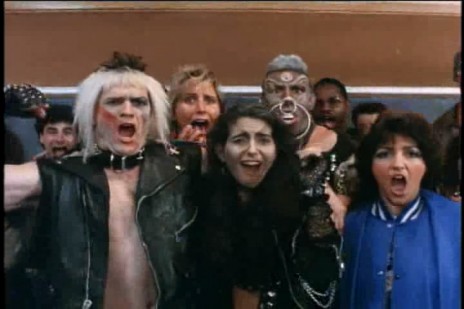
Beyond the Valley of the Dolls (1970)
dir: Russ Meyer
Boobs.
I think every review of a Russ Meyer film should begin with a word about breasts. Tits, mammaries, gazongas, huge tracts of land. Because, if there is one thing that Russ Meyer is obsessed with, it's breasts. Ok, well, two things because they do frequently travel in pairs.
However, to say Russ Meyer is obsessed with breasts is not to admonish him, nor to diminish his work as purely misogynistic exploitation. Far from it. Russ Meyer frequently enhances his love of the large chest with an equal love of the strong woman. His movies simultaneously exploit women in order to lust over their bodies and hold up women as stronger than life human beings who are very capable of surviving life without a man.
After the commercial success of Valley of the Dolls in 1967, 20th Century Fox commissioned Jacqueline Susann to write a sequel to the film, and she titled it Beyond the Valley of the Dolls. She had written the original novel, but had not written the screenplay...and both of her scripts failed to get published. Then, Fox looked to Russ Meyer and Roger Ebert to develop the film.
Ebert and Meyer didn't set out to make a straight-up drama like Valley of the Dolls was. Instead, they used the concept of camp in order to deconstruct Hollywood tropes that existed and would continue to exist in some fashion throughout. They're not subtle either. Making a sexy horror comedy musical drama that is also a satire, they just threw it all in and stirred.
Beyond the Valley of the Dolls is a film about a female rock group from the sticks who go out to Hollywood in order to find success. As they become successful, they succumb to the various trappings of Hollywood, and everything crumbles and turns to shit.
That description is simultaneously an exact overview of the film and a vast oversimplification. All of the trappings of Hollywood they succumb to are generic stock scenarios that usually come with the woman's pictures.
The central rock band is initially called The Kelly Affair, named after the lead singer. The film opens with them playing at a prom, then taking a break to smoke some grass in their van in the parking lot. They come up with the idea to go to Hollywood to find Kelly's estranged Aunt Susan. Well, really, we find out that Kelly's mother was actually the black sheep of the family and was written out of her mother's will, leaving Aunt Susan to inherit the family fortune.
Aunt Susan is actually the editor of some high profile fashion magazine, and is into a really wild party scene. She invites the Kelly Affair to a party at Ronny "Z-Man" Bartell's pad. Z-Man is a rock producer, and takes the Kelly Affair under his wing, renaming them The Carrie Nations, and makes them famous.
Kelly ditches her boyfriend for the love of a muscled surf actor. Aunt Susan tries to give Kelly half of the fortune, but her lawyer really wants the money and tries to stop that from happening. One bandmate falls in love with a law student, cheats on him with a boxer who then beats up the law student. Kelly's boyfriend is seduced by a porn star, gets heavily into drugs and tries to kill himself but becomes a paraplegic. Another bandmate, sleeps with Kelly's first boyfriend, gets pregnant, an abortion, succumbs to drugs, and becomes a depressed lesbian.
The specifics could really have been filled any number of ways, but the result would be the same. The Carrie Nations all succumb to the horrors of their new locale and lose themselves before figuring out that true happiness isn't found in drugs or materialism, but in love. The details are only significant in how they take specific tropes and turn them on their head.
Roger Ebert was, at the time, a relatively new film critic out of Chicago. He had only been working for a couple of years, and seemed a strange choice for a million dollar sequel. But, there had been a shift brewing in Hollywood at the time.
From the 1930s through the 1960s, Hollywood had been working under the Motion Picture Production Code, or the Hays Code, which monitored what content it deemed appropriate for wide release. Depictions of out-of-wedlock sexuality, any homosexuality, cursing, violence, and a whole litany of questionable moral judgments were not allowed by the Hays Code. But, by the late 1960s, the code was getting more and more lax in its enforcement to the point where Hollywood came up with a new system entirely.
In 1968, the MPAA ratings system was born with G, M (which would become GP and then PG), R, and X. 20th Century Fox was eager to test the system, as the public was demanding more and more mature offerings, and hired the breast-obsessed Russ Meyer and the film critic Roger Ebert. At the time, Fox was losing money, and trying out some experimental films. In 1970, it released M*A*S*H*, Beyond the Valley of the Dolls, and Myra Breckenridge. All experimental films, especially for studio product. BVD and Myra were Fox's June releases, even.
With Fox being embroiled in bitter power struggles, Ebert and Meyer were able to do whatever the hell they wanted. In essence, Ebert and Meyer made the ultimate movie to close out one era of film history and usher in the next. They smashed together the psychedelic genre of the 1960s with the woman's soap opera of the 1950s and the fame picture of all the time, and then added in sex, drugs, violence, alcohol, and even queer sexualities...all amped up to 11. The movie opens with a scene from the finale where a girl is woken up by a gun being thrust into her mouth by an unknown assailant. And, the smash cut to the beginning is from the trigger being pulled.
Ebert and Meyer were satirizing what had come before, and ushering the new cynical genre that would come in the 1970s, as also shown by the X-rated Myra Breckenridge, which would come out the week after. The darkness of the media conglomerates selling false truths were to be explored and openly mocked, through the use of camp.
There is a direct contrast to Beyond the Valley of the Dolls with Mahogany, as both of them use the same formula to different ends, but both ending up in camp. Mahogany doesn't realize it is going through camp, but ends up there due to the Sirkian subtexts that Berry Gordy consciously, or unconsciously, added in. Beyond the Valley of the Dolls actively subverts and mocks the formula with an intentionally campy tone inviting the viewer to actively dissect what they're watching as they're watching it.
Beyond the Valley of the Dolls makes little sense to most people who don't actively have a sense of its origins. Those who haven't witnessed the tropes, nor seen the formulas, may think that BVD is just a bad movie without realizing it is intentionally over-the-top. However, Beyond the Valley of the Dolls persists to this day as an deep track for those who stumble across its titillating content.
Showing posts with label Cult. Show all posts
Monday, May 5, 2014
Monday, April 7, 2014
Showgirls (1995): A Movie of Two Extremes: Pure Ambition and Pure Crap
Showgirls (1995)
dir: Paul Verhoeven
[taken and slightly expanded from my comments originally posted at The Dissolve]
[Trigger Warning]
Showgirls is a special failure. Very special. Verhoeven has the highest aspirations and, with Joe Esterhasz, created a plot that drives home his points about the sordid underbelly of Las Vegas. Yes, it uses the framework of All About Eve, but Showgirls isn't All About Eve, and Elizabeth Berkeley is no Anne Baxter.
There are two major faults with Showgirls that no movie can overcome: a terrible actress, and a terrible screenplay. In other words, Elizabeth Berkeley and Joe Esterhasz. Berkeley cannot act. That's a statement of fact. She never could. Growing up with Saved By the Bell, none of those kids could really act. None of them realized it. And, sadly, none of them ever would learn. Which was sad for those of us who hoped for more speedo clad movies with Mario Lopez going further down the gay movie pole. But, I digress. Berkeley's shining moment of Saved by the Bell was Jessie's Song, which had the era-defining "I'm So Excited...I'm So Scared" moment after a whole episode dedicated to caffeine pills. That one scene would define her whole acting presence in Showgirls.
Most reclamations gloss over most of the offensively bad parts that feature Berkeley and Esterhasz. Where she pulls out a switchblade on the driver, then stabs the radio playing Garth Brooks. The driver then swerves the truck to the shoulder, almost hitting a semi, then swerves back to the road once she puts it away, almost hitting the semi again. These people are histrionic.
Even when the terrible parts are mentioned by these revisionists, they gloss over Nomi's inexplicable attitude problems. How, in the initial meeting with Molly, Nomi goes from attacking a car, the pavement, soda, ketchup, and then the fries themselves...to suddenly moving into seductress mode without even a pause. And, Molly who sees a girl who is as violent as she is scared and refuses to answer her questions about identity and even mindless chit-chat, after knowing this girl for 10 minutes, offers her a place to live in her trailer. WHAT THE HELL?! This offer wasn't just unexpected to Nomi Malone, it was unbelievable to the audience.
The screenplay continues on with passages of dialogue that is frequently bad, but sometimes transcends to truly awful. The primary example of this would be:
Somewhere in Showgirls is a morality movie that is essential and needed to be made. A story of power struggles, exploitation, and the perception of dancing vs stripping. Plus, who holds the money, money as power, and what money, power, and success can buy you. Unfortunately, that got piled full of shit like Edna Bazoom and her honking dress as a mother figure, or Nomi's washing machine antics of sex.
Verhoeven doesn't realize how terrible it is. Because, he tries. And he succeeds in polishing the turd. There is some amazing cinematography, set ups, themes, and everything technical. It's an astounding movie in terms of its visuals and its pacing. Even as an unintentional comedy. Verhoeven isn't really to fault...except he chose the actress and helped write the script.
[More after Jump, including discussion and image of the rape scene and its presence in the film]
dir: Paul Verhoeven
[taken and slightly expanded from my comments originally posted at The Dissolve]
[Trigger Warning]
Showgirls is a special failure. Very special. Verhoeven has the highest aspirations and, with Joe Esterhasz, created a plot that drives home his points about the sordid underbelly of Las Vegas. Yes, it uses the framework of All About Eve, but Showgirls isn't All About Eve, and Elizabeth Berkeley is no Anne Baxter.
There are two major faults with Showgirls that no movie can overcome: a terrible actress, and a terrible screenplay. In other words, Elizabeth Berkeley and Joe Esterhasz. Berkeley cannot act. That's a statement of fact. She never could. Growing up with Saved By the Bell, none of those kids could really act. None of them realized it. And, sadly, none of them ever would learn. Which was sad for those of us who hoped for more speedo clad movies with Mario Lopez going further down the gay movie pole. But, I digress. Berkeley's shining moment of Saved by the Bell was Jessie's Song, which had the era-defining "I'm So Excited...I'm So Scared" moment after a whole episode dedicated to caffeine pills. That one scene would define her whole acting presence in Showgirls.
Most reclamations gloss over most of the offensively bad parts that feature Berkeley and Esterhasz. Where she pulls out a switchblade on the driver, then stabs the radio playing Garth Brooks. The driver then swerves the truck to the shoulder, almost hitting a semi, then swerves back to the road once she puts it away, almost hitting the semi again. These people are histrionic.
Even when the terrible parts are mentioned by these revisionists, they gloss over Nomi's inexplicable attitude problems. How, in the initial meeting with Molly, Nomi goes from attacking a car, the pavement, soda, ketchup, and then the fries themselves...to suddenly moving into seductress mode without even a pause. And, Molly who sees a girl who is as violent as she is scared and refuses to answer her questions about identity and even mindless chit-chat, after knowing this girl for 10 minutes, offers her a place to live in her trailer. WHAT THE HELL?! This offer wasn't just unexpected to Nomi Malone, it was unbelievable to the audience.
The screenplay continues on with passages of dialogue that is frequently bad, but sometimes transcends to truly awful. The primary example of this would be:
"You fucked him AND her."There's all kinds of wrong in this dialogue, not even talking about the logistics of getting AIDS without having sex. This dialogue isn't about a threesome, or even oral sex. This is about the infamous lap dance sequence where Nomi Malone gives Kyle MacLachlan a lapdance. This terrible dialogue would frequently transcend the realm of awful into the realm of ridiculous.
"Were you following me?! I didn't fuck anybody!!"
"I saw you! Man everybody got AIDS and shit. You know, what is it that you think you do? You fuck 'em without fucking them, that's what you do!"
Somewhere in Showgirls is a morality movie that is essential and needed to be made. A story of power struggles, exploitation, and the perception of dancing vs stripping. Plus, who holds the money, money as power, and what money, power, and success can buy you. Unfortunately, that got piled full of shit like Edna Bazoom and her honking dress as a mother figure, or Nomi's washing machine antics of sex.
Verhoeven doesn't realize how terrible it is. Because, he tries. And he succeeds in polishing the turd. There is some amazing cinematography, set ups, themes, and everything technical. It's an astounding movie in terms of its visuals and its pacing. Even as an unintentional comedy. Verhoeven isn't really to fault...except he chose the actress and helped write the script.
[More after Jump, including discussion and image of the rape scene and its presence in the film]
Friday, March 28, 2014
House (1977): When the Kitchen Sink technique works
House (aka Hausu) (1977)
dir: Nobuhiko Obayashi
In a traditional sense, nothing about House should work. It's a horror movie for kids that is all about love, loss and vampirism. As a film, it uses every single technique that had been invented by that time, and created new ones just for its own humor. It never really holds its attention on any one topic for any length of time, yet creates a hallucinatory throughline story. Yet, House is one of the craziest, most entertaining, balls-out films that works on weird hallucinatory levels as well as ridiculously high camp.
House tells the story of Gorgeous, whose father is about to remarry years after her mother passed away. Because he botched the introduction of his daughter and new wife, his daughter rebels and decides to spend her vacation with her aunt in some far off town. Her 6 friends have also recently learned they cannot go to a training camp due to a pregnant innkeeper, and choose to go with her.
Her aunt, living all alone in the middle of the country, greets them with open arms. Except that she is a vampiric witch, and employs both the house and all of the objects within it, in order to kill any unmarried females who dare to step within its walls. Auntie feeds off their life, and exchanges bodies and spirits so that she has possession of their identity as well.
What would normally be a relatively straightforward story of girls in peril, with a tragic backstory, turns into a child-like hallucinatory horror movie that comes off like a nightmare version of Sesame Street on acid. Much like Sesame Street's shorts, Obayashi uses everything under the sun to convey a child's heightened emotionality as well as blunter sense of the world. There's split frames, frames within frames, irises, deep focus, natural settings, matte backgrounds, blue screen, silent film, black and white, stop motion, practical effects, frame coloring, drawing on the frame, animation, slow motions, speed-ups, smash cuts, musical numbers...the list of everything that is in House is practically a compendium of cinematic techniques that were available at the time. A use of a few of those techniques go a long way, but House dares to include all of them.
That's not to say that the effects were all successful. Obayashi intended for the movie to look like a child's playtime machinations, with a sense that this isn't a mature adult making mature a movie for adults but a child communicating a child's experience. This child is explaining that she has a fear of a variety of things, including futons, pianos, clocks, reflections, cats, adults, and watermelons.
In order to properly enter this world, and take it as it wants to be taken, the viewer must turn himself into a child and turn off their preconceived notions of what a film actually should be like. Watching the film as an adult expecting a straightforward horror movie filled with adult creeping terrors around the corner is quickly obliterated by the opening, where a blue line outlines a box in the frame, and the cartoonish title treatment speaks the name "House" before eating you.
This type of whimsy continues through an opening scene where our heroine, Gorgeous, meets her stepmother. The scene seems like it is in the balcony of a spacious and stylish apartment with a matte painting backdrop of a setting sun makes it more 1980s Moonlighting than actually resembling a realist movie set. Any pretense at being realistic is dropped soon after when her new stepmother floats in from the side, with an invisible wind making her hair and her scarf trail her. It's heightened drama and setting, but it's so effective at setting a dreamy atmosphere that when we get to the schoolyard scenes that follow, the realism is drastically jarring. The school scenes are filmed in a style most reminiscent of any 1970s back to school special.
Given Obayashi's background in advertising, it's no surprise that House is as impeccable as it is inconceivable. The framing of the scene from the left with a giant pair of lips haunting the girls is stunning and amateur both. It's just off center, with the lips being the center of a frame that seems to have moved off to the left. The various odd sources of lighting are too hot in certain areas (notably the girl's butt), but still dramatic and creepy in the realm of the classical noirs. Compare that to the earlier frame of the head in the well, where the matte painting background gives everything an illusion of deepest focus, and the whole frame is lit and filmed like a classical watercolor painting. Which looks completely different to the neo-realist schoolyard scenes which feature no matte paintings and seem to even use a different film stock. Etc. But, they're all impeccably used, in an amateurish manner.
House doesn't have any pretense about being anything other than a film about 7 young girls in danger. Sure, it has some cultural allusions WWII and the bomb, and how the older generation is trying to cope with a younger generation who knows absolutely nothing about that earlier war and the destruction that was wrecked upon Japan as a result. From a child's perspective, though, that means nothing and the real source of fear are in the odd objects of the house. This is an art object. It's an experience. You're meant to laugh with it, and be scared by it. It's comedic, horrific, childlike and silly. But, most of all, it's different. This is primarily for experiencing something you haven't experienced since Sesame Street, put into a horror movie. It's an astounding film.
dir: Nobuhiko Obayashi
In a traditional sense, nothing about House should work. It's a horror movie for kids that is all about love, loss and vampirism. As a film, it uses every single technique that had been invented by that time, and created new ones just for its own humor. It never really holds its attention on any one topic for any length of time, yet creates a hallucinatory throughline story. Yet, House is one of the craziest, most entertaining, balls-out films that works on weird hallucinatory levels as well as ridiculously high camp.
House tells the story of Gorgeous, whose father is about to remarry years after her mother passed away. Because he botched the introduction of his daughter and new wife, his daughter rebels and decides to spend her vacation with her aunt in some far off town. Her 6 friends have also recently learned they cannot go to a training camp due to a pregnant innkeeper, and choose to go with her.
Her aunt, living all alone in the middle of the country, greets them with open arms. Except that she is a vampiric witch, and employs both the house and all of the objects within it, in order to kill any unmarried females who dare to step within its walls. Auntie feeds off their life, and exchanges bodies and spirits so that she has possession of their identity as well.
What would normally be a relatively straightforward story of girls in peril, with a tragic backstory, turns into a child-like hallucinatory horror movie that comes off like a nightmare version of Sesame Street on acid. Much like Sesame Street's shorts, Obayashi uses everything under the sun to convey a child's heightened emotionality as well as blunter sense of the world. There's split frames, frames within frames, irises, deep focus, natural settings, matte backgrounds, blue screen, silent film, black and white, stop motion, practical effects, frame coloring, drawing on the frame, animation, slow motions, speed-ups, smash cuts, musical numbers...the list of everything that is in House is practically a compendium of cinematic techniques that were available at the time. A use of a few of those techniques go a long way, but House dares to include all of them.
That's not to say that the effects were all successful. Obayashi intended for the movie to look like a child's playtime machinations, with a sense that this isn't a mature adult making mature a movie for adults but a child communicating a child's experience. This child is explaining that she has a fear of a variety of things, including futons, pianos, clocks, reflections, cats, adults, and watermelons.
In order to properly enter this world, and take it as it wants to be taken, the viewer must turn himself into a child and turn off their preconceived notions of what a film actually should be like. Watching the film as an adult expecting a straightforward horror movie filled with adult creeping terrors around the corner is quickly obliterated by the opening, where a blue line outlines a box in the frame, and the cartoonish title treatment speaks the name "House" before eating you.
This type of whimsy continues through an opening scene where our heroine, Gorgeous, meets her stepmother. The scene seems like it is in the balcony of a spacious and stylish apartment with a matte painting backdrop of a setting sun makes it more 1980s Moonlighting than actually resembling a realist movie set. Any pretense at being realistic is dropped soon after when her new stepmother floats in from the side, with an invisible wind making her hair and her scarf trail her. It's heightened drama and setting, but it's so effective at setting a dreamy atmosphere that when we get to the schoolyard scenes that follow, the realism is drastically jarring. The school scenes are filmed in a style most reminiscent of any 1970s back to school special.
Given Obayashi's background in advertising, it's no surprise that House is as impeccable as it is inconceivable. The framing of the scene from the left with a giant pair of lips haunting the girls is stunning and amateur both. It's just off center, with the lips being the center of a frame that seems to have moved off to the left. The various odd sources of lighting are too hot in certain areas (notably the girl's butt), but still dramatic and creepy in the realm of the classical noirs. Compare that to the earlier frame of the head in the well, where the matte painting background gives everything an illusion of deepest focus, and the whole frame is lit and filmed like a classical watercolor painting. Which looks completely different to the neo-realist schoolyard scenes which feature no matte paintings and seem to even use a different film stock. Etc. But, they're all impeccably used, in an amateurish manner.
House doesn't have any pretense about being anything other than a film about 7 young girls in danger. Sure, it has some cultural allusions WWII and the bomb, and how the older generation is trying to cope with a younger generation who knows absolutely nothing about that earlier war and the destruction that was wrecked upon Japan as a result. From a child's perspective, though, that means nothing and the real source of fear are in the odd objects of the house. This is an art object. It's an experience. You're meant to laugh with it, and be scared by it. It's comedic, horrific, childlike and silly. But, most of all, it's different. This is primarily for experiencing something you haven't experienced since Sesame Street, put into a horror movie. It's an astounding film.
Wednesday, March 26, 2014
Aachi & Ssipak (2006): Giving Crap to the Government
Aachi and Ssipak (2006)
dir: Jo-Beom Jim
Ed's Note: This review is based on the original Aachi and Ssipak, and not Mondo Media's 2014 English language rewrite and dub. Mondo Media did not put the original version of the film on either their blu-ray or their DVD. That version can be found through usual channels, as well as a website with a Y and a T in it.
The world of Aachi and Ssipak isn't that hard to imagine. A world where natural resources have run out. A world where electricity is harnessed from one renewable resource: feces. A world where the government runs the electric company and also demands people give their feces for the electricity. A world where they placate the masses by giving them a highly addictive drug for regularly pooping instead of, probably, selling feces on the black market as its own type of resource. And, a world where that drug has had the negative power to make people constipated, mutated, yet still addicted to the drug that requires the ability to poop.
Jo-Beom Jim has concocted a world which bends in on itself in some of the likeliest manners, given the two axioms of resources have run out and the world is now run on crap. He created a world where the lines between government and commercial entities blur, where the authority is just as destructive and violent as the criminals, where drugs and media create placid easily manipulated addicts, and bodily function and pleasure are married in intimate ways.
Needless to say, this movie gets very complicated very fast for a movie that merely appears to be about poop and porn. Let's try to unwind this movie.
Aachi and Ssipak opens with a scrawl giving the basic outlines of this dystopic future, then jumps in to its first of many action sequences. The diaper gang, a bunch of adorable and disposable blue mutants who are ripe to be stuffed creatures out of a Disney background character, is seeking to seize a shipment of Juicybars, the drug given to people for their fecal matter. The diaper gang have mutated in a way that they don't have the ability to poop, and now must subsist solely on Juicybars. This seizing is foiled by Geko, a renegade cyborg cop, whose goal is foil the gangs, but not necessarily to save the shipment. All of Geko's behaviors is monitored and dictated by a large headed woman who appears to be CEO and Dictator of the country.
Aachi and Ssipak, are two small-time criminals in one of the ghettos who both deal for Juicybars, and also hold up bathrooms to try to steal them for resale on the black market. Their primary dealings happen with an organized mob, who are out to get them for shortchanging the deal, and also stepping in territories that aren't theirs. They also have a friend, Jimmy the Freak, who is a wanna-be porn director who wants to make a porn movie about a woman who defecates strongly.
The way that the feces are actually distributed to people is by a ring placed in anuses at birth that also encode that person's identity into their ass. When a ring detects a successful bowel movement, it delivers a Juicybar to the bathroom of the defecator, and also the main government computer identifies the defecator by name.
When Jimmy the Freak tells the Diaper King about this, the Diaper King gets the idea to take out the identity rings from his Diaper Gang minions, and put them in the anus of a porn actress, Beautiful. Beautiful had already become the object of affection for Ssipak, who rescues her from Jimmy and the King only to find out she had already been implanted with all the rings and now gets mountains of Juicybars.
The above four paragraphs are all packed into the movie's first 30 mind-bending minutes. And, I haven't even mentioned the sequence where Aachi and Ssipak get Jimmy the Freak high as hell on Juicybars, then hypnotize him to go into the mob office to perform scenes from Basic Instinct and Misery. For all of Aachi and Ssipak's low brow humor and aims at base sensibilities, Jo-Beom Jim has created a scathing satire on all things government, consumer and media. The vast majority of the second and third acts are made up of cinematic action sequences upon action sequences taken from other films, most notably Indiana Jones and the Temple of Doom.
For a movie whose first 45 minutes are packed with more cultural insight and impact than many movies do with 2 or 3 hours, it's hard not to be both disappointed and relieved that the spins didn't keep coming for the entirety of the movie. When you piece together everything, you're allowed to mindlessly sit back and watch the action unfold, which is also a scathing indictment of how cinema soothes people into complacency. You see all of this corruption through the use of drugs and government, but the happy ending is that Aachi and Ssipak rescued Beautiful and are able to become rich again. Not that the government corruption has ceased to exist, or that the people are done being drugged, but our heroes made out for themselves. It's a high note that's as intentionally hollow and flawed as anything the movie corrupts.
On the other hand, the movie is so well done. The sight of the diaper gang mutants being so chipperly evil is always hilarious, as is their frequent gory and brutal murders. They're the most precious victims of action movies. Jo-Beom Jim's action sequences are rapid paced and fast moving, and really well done. They don't obscure the action and are visually sumptuous.
Aachi and Ssipak's hyperkinetic nature, high-brow satirical intents, and mixture of medium-brow and low-brow humor makes this a movie that is simultaneously a must see and a movie that will be appreciated by few. The scatological and pornographic nature of the film will turn most people off, though Aachi and Ssipak shows no actual feces or sex in the film. Yet, because it attacks both the brain and the adrenaline, Aachi and Ssipak is a one-of-a-kind thrill ride of a weird type of intelligence, making this a required viewing.
dir: Jo-Beom Jim
Ed's Note: This review is based on the original Aachi and Ssipak, and not Mondo Media's 2014 English language rewrite and dub. Mondo Media did not put the original version of the film on either their blu-ray or their DVD. That version can be found through usual channels, as well as a website with a Y and a T in it.
The world of Aachi and Ssipak isn't that hard to imagine. A world where natural resources have run out. A world where electricity is harnessed from one renewable resource: feces. A world where the government runs the electric company and also demands people give their feces for the electricity. A world where they placate the masses by giving them a highly addictive drug for regularly pooping instead of, probably, selling feces on the black market as its own type of resource. And, a world where that drug has had the negative power to make people constipated, mutated, yet still addicted to the drug that requires the ability to poop.
Jo-Beom Jim has concocted a world which bends in on itself in some of the likeliest manners, given the two axioms of resources have run out and the world is now run on crap. He created a world where the lines between government and commercial entities blur, where the authority is just as destructive and violent as the criminals, where drugs and media create placid easily manipulated addicts, and bodily function and pleasure are married in intimate ways.
Needless to say, this movie gets very complicated very fast for a movie that merely appears to be about poop and porn. Let's try to unwind this movie.
Aachi and Ssipak opens with a scrawl giving the basic outlines of this dystopic future, then jumps in to its first of many action sequences. The diaper gang, a bunch of adorable and disposable blue mutants who are ripe to be stuffed creatures out of a Disney background character, is seeking to seize a shipment of Juicybars, the drug given to people for their fecal matter. The diaper gang have mutated in a way that they don't have the ability to poop, and now must subsist solely on Juicybars. This seizing is foiled by Geko, a renegade cyborg cop, whose goal is foil the gangs, but not necessarily to save the shipment. All of Geko's behaviors is monitored and dictated by a large headed woman who appears to be CEO and Dictator of the country.
Aachi and Ssipak, are two small-time criminals in one of the ghettos who both deal for Juicybars, and also hold up bathrooms to try to steal them for resale on the black market. Their primary dealings happen with an organized mob, who are out to get them for shortchanging the deal, and also stepping in territories that aren't theirs. They also have a friend, Jimmy the Freak, who is a wanna-be porn director who wants to make a porn movie about a woman who defecates strongly.
The way that the feces are actually distributed to people is by a ring placed in anuses at birth that also encode that person's identity into their ass. When a ring detects a successful bowel movement, it delivers a Juicybar to the bathroom of the defecator, and also the main government computer identifies the defecator by name.
When Jimmy the Freak tells the Diaper King about this, the Diaper King gets the idea to take out the identity rings from his Diaper Gang minions, and put them in the anus of a porn actress, Beautiful. Beautiful had already become the object of affection for Ssipak, who rescues her from Jimmy and the King only to find out she had already been implanted with all the rings and now gets mountains of Juicybars.
The above four paragraphs are all packed into the movie's first 30 mind-bending minutes. And, I haven't even mentioned the sequence where Aachi and Ssipak get Jimmy the Freak high as hell on Juicybars, then hypnotize him to go into the mob office to perform scenes from Basic Instinct and Misery. For all of Aachi and Ssipak's low brow humor and aims at base sensibilities, Jo-Beom Jim has created a scathing satire on all things government, consumer and media. The vast majority of the second and third acts are made up of cinematic action sequences upon action sequences taken from other films, most notably Indiana Jones and the Temple of Doom.
For a movie whose first 45 minutes are packed with more cultural insight and impact than many movies do with 2 or 3 hours, it's hard not to be both disappointed and relieved that the spins didn't keep coming for the entirety of the movie. When you piece together everything, you're allowed to mindlessly sit back and watch the action unfold, which is also a scathing indictment of how cinema soothes people into complacency. You see all of this corruption through the use of drugs and government, but the happy ending is that Aachi and Ssipak rescued Beautiful and are able to become rich again. Not that the government corruption has ceased to exist, or that the people are done being drugged, but our heroes made out for themselves. It's a high note that's as intentionally hollow and flawed as anything the movie corrupts.
On the other hand, the movie is so well done. The sight of the diaper gang mutants being so chipperly evil is always hilarious, as is their frequent gory and brutal murders. They're the most precious victims of action movies. Jo-Beom Jim's action sequences are rapid paced and fast moving, and really well done. They don't obscure the action and are visually sumptuous.
Aachi and Ssipak's hyperkinetic nature, high-brow satirical intents, and mixture of medium-brow and low-brow humor makes this a movie that is simultaneously a must see and a movie that will be appreciated by few. The scatological and pornographic nature of the film will turn most people off, though Aachi and Ssipak shows no actual feces or sex in the film. Yet, because it attacks both the brain and the adrenaline, Aachi and Ssipak is a one-of-a-kind thrill ride of a weird type of intelligence, making this a required viewing.
Tuesday, March 25, 2014
The Visitor (1979): Wackiness foiled by pacing
The Visitor (1979)
dir: Guilio Paradisi
When I was a child, I used to be fascinated by the horror movie VHS art in the aisles. Some of them completely frightened me, like the original are for Fright Night, which had the clouds over a house turning into a vampire about to descend onto the suburban home. Whoever did that poster deserves an award for making me frightened of its contents.
Other notable VHS horror art were Black Roses (which had dimensional bubble art), April Fools Day, Gothic, TerrorVision, and today's featured film, The Visitor (shown at right). What's notable for The Visitor is the the strange absurdity of the art: a giant eyeball floating over a large city with two monster hands holding a bloody wire pulled taut between thrm. Add in the lightning strikes, and this is probably the origins of my personal fascination of using eyeballs in marketing imagery. They're fascinating, visually stunning, full of meaning, and generally kind of hypnotizing. Other people think they're creepy, but that's only when the eyeball comes in pairs, and with eyelids.
I hadn't actually gotten around to watching The Visitor because I believe the film was removed from the shelves by the time I was old enough to rent it. This year, in 2014, Alamo Drafthouse has released a remastered high-def extended full length version of The Visitor and revealed that, for all of its crazy psychotic beauty, the key art for The Visitor has almost nothing to do with the Italian ripoff content within.
The Visitor is but one in a long line of European ripoff films that featured riffs on a variety of original American titles. The horror genre was especially intent on focusing on Rosemary's Baby, The Exorcist, and The Omen. Some movies would throw one or two of these films into a blender and see what comes out. Beyond the Door was The Exorcist meets Rosemary's Baby. The Devil Within Her was mainly It's Alive combined with Rosemary's Baby and would predate The Omen.
The Visitor, however, wasn't content to rip off just the four American films about. It would also include The Birds, Carrie, THX1138, Close Encounters of the Third Kind, and The Holy Mountain. Basically it takes all 8 films and throws them haphazardly into a blender so you get a mismashed slurry that comes out the end.
The film opens on a Jodorowsky-esque surreal landscape that tells some story of an evil demon/spirit/God that was destroyed by a good evil/spirit/God through the use of some birds that would peck its brains out. The evil spirit also turned into a bird to kill the other birds. Though, the evil spirit died, he was able to copulate with humans, Zeus style, leaving bits of his spirit to continue popping up in random human wombs.
All of this exposition is relayed by a Jesus figure who is also the leader of a cult of bald children in some form of extraterrestrial white room. Suddenly, another figure pops his head in and says that they found the next vessel, and she JUST TURNED 8!! Duh DUH!!!
Fairly soon, the movie then turns into a cross between The Omen, Carrie, and Rosemary's Baby, with the story of an executive trying to marry a single mother whose kid is the aforementioned vessel. The executive is under the guise of some evil outfit who is working for some evil spirit. The single mother is pregnant with another kid, who she feels is evil and is harassed into keeping the spawn. The 8-year-old, however, is an evil spirit who can make things happen with her mind just to spite everybody. But, she's also the biggest, most foul-mouthed brat in the world, even telling Shelley Winters, her new nanny, that she shoved her birthday present up her ass. Not in a The Exorcist foul-mouthed demonic way, but in a Fuck You, I'm A Spoiled Brat kind of way.
There's also a story where the second adult figure from the Jesus white room is tracking down the kid and the demon spawn in order to defeat them before they release evil into the world or something. And, a police officer is also tracking down the kid, after a birthday present bird became a gun that shot her mother, paralyzing her from the waist down.
With all of this going on, one is tempted to say this is would be a fantastic piece of gonzo trashiness, but in the Drafthouse release the pacing of The Visitor is more languid than any of its brethern. With a runtime of 109 minutes, The Visitor's crazy non-sequitorness doesn't hold up to sustained watching, instead feeling like the ultimate party movie rather than a real film. One you can talk through and then look up and see somebody get shot, or a kid swearing and then continue the conversation without having missed much because there isn't much to miss.
And, while some of the visuals are stunning (especially the opening sequences and the one featuring a discotheque lighted airport runway. It isn't sustained for too terribly long. It's a competent film that just doesn't rise to the occasion of the early and closing sequences. While individual sequences of randomness are
Overall, The Visitor suffers from too much bluster without anything substantial to connect the threads. One could easily argue that none of the other knock off blender films have much substance either, but most of those either have a strong throughline, or keep their running time blessedly short. The constant throwing of random scenes from other films does nothing to help keep the viewer compelled to see what's next when half of the film is rendered with a slow, languorous pacing that lulls the viewer toe distraction. Yet, at a party, this is a feature not a flaw.
Is it a success? No. It's an archival piece of weirdness that should be treasured, but it doesn't live up to the trashy camp highs and lows that Drafthouse's cult has built up around it. There's a reason its cult status never followed through on creating a following.
dir: Guilio Paradisi
When I was a child, I used to be fascinated by the horror movie VHS art in the aisles. Some of them completely frightened me, like the original are for Fright Night, which had the clouds over a house turning into a vampire about to descend onto the suburban home. Whoever did that poster deserves an award for making me frightened of its contents.
Other notable VHS horror art were Black Roses (which had dimensional bubble art), April Fools Day, Gothic, TerrorVision, and today's featured film, The Visitor (shown at right). What's notable for The Visitor is the the strange absurdity of the art: a giant eyeball floating over a large city with two monster hands holding a bloody wire pulled taut between thrm. Add in the lightning strikes, and this is probably the origins of my personal fascination of using eyeballs in marketing imagery. They're fascinating, visually stunning, full of meaning, and generally kind of hypnotizing. Other people think they're creepy, but that's only when the eyeball comes in pairs, and with eyelids.
I hadn't actually gotten around to watching The Visitor because I believe the film was removed from the shelves by the time I was old enough to rent it. This year, in 2014, Alamo Drafthouse has released a remastered high-def extended full length version of The Visitor and revealed that, for all of its crazy psychotic beauty, the key art for The Visitor has almost nothing to do with the Italian ripoff content within.
The Visitor is but one in a long line of European ripoff films that featured riffs on a variety of original American titles. The horror genre was especially intent on focusing on Rosemary's Baby, The Exorcist, and The Omen. Some movies would throw one or two of these films into a blender and see what comes out. Beyond the Door was The Exorcist meets Rosemary's Baby. The Devil Within Her was mainly It's Alive combined with Rosemary's Baby and would predate The Omen.
The Visitor, however, wasn't content to rip off just the four American films about. It would also include The Birds, Carrie, THX1138, Close Encounters of the Third Kind, and The Holy Mountain. Basically it takes all 8 films and throws them haphazardly into a blender so you get a mismashed slurry that comes out the end.
The film opens on a Jodorowsky-esque surreal landscape that tells some story of an evil demon/spirit/God that was destroyed by a good evil/spirit/God through the use of some birds that would peck its brains out. The evil spirit also turned into a bird to kill the other birds. Though, the evil spirit died, he was able to copulate with humans, Zeus style, leaving bits of his spirit to continue popping up in random human wombs.
All of this exposition is relayed by a Jesus figure who is also the leader of a cult of bald children in some form of extraterrestrial white room. Suddenly, another figure pops his head in and says that they found the next vessel, and she JUST TURNED 8!! Duh DUH!!!
Fairly soon, the movie then turns into a cross between The Omen, Carrie, and Rosemary's Baby, with the story of an executive trying to marry a single mother whose kid is the aforementioned vessel. The executive is under the guise of some evil outfit who is working for some evil spirit. The single mother is pregnant with another kid, who she feels is evil and is harassed into keeping the spawn. The 8-year-old, however, is an evil spirit who can make things happen with her mind just to spite everybody. But, she's also the biggest, most foul-mouthed brat in the world, even telling Shelley Winters, her new nanny, that she shoved her birthday present up her ass. Not in a The Exorcist foul-mouthed demonic way, but in a Fuck You, I'm A Spoiled Brat kind of way.
There's also a story where the second adult figure from the Jesus white room is tracking down the kid and the demon spawn in order to defeat them before they release evil into the world or something. And, a police officer is also tracking down the kid, after a birthday present bird became a gun that shot her mother, paralyzing her from the waist down.
With all of this going on, one is tempted to say this is would be a fantastic piece of gonzo trashiness, but in the Drafthouse release the pacing of The Visitor is more languid than any of its brethern. With a runtime of 109 minutes, The Visitor's crazy non-sequitorness doesn't hold up to sustained watching, instead feeling like the ultimate party movie rather than a real film. One you can talk through and then look up and see somebody get shot, or a kid swearing and then continue the conversation without having missed much because there isn't much to miss.
And, while some of the visuals are stunning (especially the opening sequences and the one featuring a discotheque lighted airport runway. It isn't sustained for too terribly long. It's a competent film that just doesn't rise to the occasion of the early and closing sequences. While individual sequences of randomness are
Overall, The Visitor suffers from too much bluster without anything substantial to connect the threads. One could easily argue that none of the other knock off blender films have much substance either, but most of those either have a strong throughline, or keep their running time blessedly short. The constant throwing of random scenes from other films does nothing to help keep the viewer compelled to see what's next when half of the film is rendered with a slow, languorous pacing that lulls the viewer toe distraction. Yet, at a party, this is a feature not a flaw.
Is it a success? No. It's an archival piece of weirdness that should be treasured, but it doesn't live up to the trashy camp highs and lows that Drafthouse's cult has built up around it. There's a reason its cult status never followed through on creating a following.
Monday, March 3, 2014
Barbarella (1968): Love in Space, Euro-Style
dir: Roger Vadim
Any viewer of fine camp classics knows the name Barbarella. It has three things that make up the movie: 1) Jane Fonda in and out of a lot of awesomely 60s costumes; 2) Jane Fonda doing a zero-gravity striptease with some very frisky credits; 3) Gloriously 60s modernist psychedelic sets.
Yet, that hardly touches the glorious camp efforts of Barbarella, the oversexed space heroine who goes tramping around the galaxy to rescue Durand Durand, an agent who may have been kidnapped by the Great Tyrant for his weapon, the Positronic Ray. Along the way she does battle with evil bitey dolls, hooks up with rough trade and blind angels, and defeats Durand Durand's death by orgasm machine. And, that's just a touch of the gloriously silly trampiness that is in Barbarella.
Barbarella was actually adapted from a French erotic comic of the same name from the early 1960s. It was a comic associated with the swinging '60s and the feminist-driven sexual revolution that also came around with the pill. It was a male fantasy of an empowered woman who felt free to have sex with anybody she chose, with no real consequences. While totally couched in male fantasy, Barbarella also served as an early example of men trying to give women actual agency. It's quite telling that the only ones chastising Barbarella for her libido are the villains of the movie, namely Durand Durand after she breaks his pleasure organ.
Roger Vadim, as a director, had made his breakthrough a decade earlier with the French movie, ...And God Created Woman, which was his first calling for liberation of sexual mores, even though he laced it with conservative moral underpinnings in order to make it palatable for that earlier time. Barbarella has no such hang-ups, and sheds all of the conservative morals that pinned down ...And God Created Woman.
Vadim has a particular love affair with the female body, and it shows in Barbarella, in which he leers and lusts after Jane Fonda. From the fantastic and iconic zero-gravity striptease, to her frequently mussed hair after numerous courtships, to any number of her skin tight outfits of fabulousness, the camera is always making sure we know this is an attractive woman who welcomes most attention to her. And, so, the audience is invited to leer over Barbarella's body, just as Vadim did.
In the current feminist culture obsessed with desexualizing men and women, instead of owning the sexuality inherent in the human body, both male and female, Barbarella has become something of a male fantasy demon. But, in a culture where sex is seen as a healthy, zesty, and fun part of human life, Barbarella marks a point where women and men both are leered at and lusted after. This is marked by John Phillip Law's blind angel, who wears nothing but a diaper and a pair of wings. He is considered the height of beauty, and if you're into the slim but muscled blond type, he is. Vadim actually lets the audience lust after Law when he's on screen as well.
Of course, all of these politics are just extra-textual threads interweaved into the fun romp of a sci-fi sexploitation tale of a woman in outer space who has a fantastic wardrobe. Really, Barbarella isn't even a sleazy sexploitation movie, and instead just has fun with the scenarios that constantly pop up. Originally, due to the nudity in the credits, Barbarella was R-rated, but a later reissue with altered credits received a PG-rating. Vadim achieves a fun-for-the-whole-family feeling in Barbarella that undercuts any of the nasty feelings one might have towards the movie. As such, Barbarella is required viewing, if only for the fabulous sets, costumes, and creepy dolls.
Roger Vadim, as a director, had made his breakthrough a decade earlier with the French movie, ...And God Created Woman, which was his first calling for liberation of sexual mores, even though he laced it with conservative moral underpinnings in order to make it palatable for that earlier time. Barbarella has no such hang-ups, and sheds all of the conservative morals that pinned down ...And God Created Woman.
Vadim has a particular love affair with the female body, and it shows in Barbarella, in which he leers and lusts after Jane Fonda. From the fantastic and iconic zero-gravity striptease, to her frequently mussed hair after numerous courtships, to any number of her skin tight outfits of fabulousness, the camera is always making sure we know this is an attractive woman who welcomes most attention to her. And, so, the audience is invited to leer over Barbarella's body, just as Vadim did.
In the current feminist culture obsessed with desexualizing men and women, instead of owning the sexuality inherent in the human body, both male and female, Barbarella has become something of a male fantasy demon. But, in a culture where sex is seen as a healthy, zesty, and fun part of human life, Barbarella marks a point where women and men both are leered at and lusted after. This is marked by John Phillip Law's blind angel, who wears nothing but a diaper and a pair of wings. He is considered the height of beauty, and if you're into the slim but muscled blond type, he is. Vadim actually lets the audience lust after Law when he's on screen as well.
Of course, all of these politics are just extra-textual threads interweaved into the fun romp of a sci-fi sexploitation tale of a woman in outer space who has a fantastic wardrobe. Really, Barbarella isn't even a sleazy sexploitation movie, and instead just has fun with the scenarios that constantly pop up. Originally, due to the nudity in the credits, Barbarella was R-rated, but a later reissue with altered credits received a PG-rating. Vadim achieves a fun-for-the-whole-family feeling in Barbarella that undercuts any of the nasty feelings one might have towards the movie. As such, Barbarella is required viewing, if only for the fabulous sets, costumes, and creepy dolls.
Monday, February 3, 2014
The Holy Mountain (1973): Religion is corrupt
The Holy Mountain (1973)
dir: Alejandro Jodorowsky
In the world of film, frequently once you unleash your work of art into the world, it no longer becomes your own. Especially if you're trafficking in spiritual and symbolic cinema where the viewer can, or must, inject himself and his own interpretations in order to fill in the gaps where his knowledge is lacking. The Holy Mountain, is probably one of the most symbolic and esoteric films unleashed onto a largely Christian public.
One of my first reviews explored the post-1969 world of spirituality through the documentary The Source Family, wherein a group of spiritual seekers formed around a patriarchal figure who formed his own makeshift religion out of common sense, and various other spiritualities including Paganism, Christianity, Buddhism, and almost anything you can imagine. Father Yod created an ur-religion to enlighten his flock, in a way.
Jodorowski's The Holy Mountain is about the quest for enlightenment and the Ultimate Truths of the universe. It is a satire, a quest, and a bit of snark all at once. It's weird, often visually stunning, and just a general freakout that was unleashed on the midnight crowds in the 1970s.
The Holy Mountain is actually divided into five acts. Act 1: History. Act 2: Trials of the Thief. Act 3: Current Events. Act 4: Death/Rebirth. Act 5: Quest. Each act is told in over-the-top symbolism, and each has its own brutality.
In Act 1, we follow the Thief (who can also be seen as The Fool), as he wanders through a Mexican town, accompanied by his partner, a midget with no hands or feet. They try to gather money by hook or by crook, and see a whole lot of symbolic gestures through their journeys. First they see the Pagan Mexico. Then, they wander upon a Frog and Salamander show called The Conquest of Mexico, in which Ancient Mexico is bombed and murdered and taken over by the Romans. The Romans then bring Catholicism to hock at Mexico, who buy into it in hoards. The Thief tried to get in on the action, and, already resembling other forms of Jesus, makes a figure of himself, and sells himself as crucifixes. But, he is rejected. Upon rejection, he happens on a tall red obelisk, from which a large hook with gold comes down, and he decides to go up to see what is up there.
In Act 2, The Thief, now in the obelisk, meets The Alchemist. After dueling the alchemist, the alchemist cleanses the Thief, then turns the Thief's excrement into gold, and tells the Thief that he is excrement but can be turned into gold. Then he begins to train the Thief to become his second assistant.
Act 3 introduces The Thief, and the Audience, to a group of 7 different power players on Earth currently. Each is represented by a planet, and each represents the worst impulses of the world. There is an arms dealer, a kids war toys manufacturer, a sex artist, a government financier, a police chief, a cosmetics and mattress manufacturer, and an architect. Each are uniquely selfish, self-centered, and willing to sell out the world in order to make themselves a buck. Money rules almost every one of these power players.
Act 4 is all the trials of the whole group must go through before they can think about climbing the Holy Mountain. First they must abandon their worldly goods. Then, they must abandon their self. Then, they get steadily stripped down through a variety of chemicals and go through a death and rebirth sequence through which they can obtain a more pure sense of self.
Act 5 is the journey to the top of the mountain. They first go to Lotus Island. They start to get sidetracked at the Pantheon Bar, but reject that carnal sensibility. They must move on to achieve enlightenment. They begin their ascent, where they go through a trial of their fears, like lying naked with a bunch of tarantulas on your body!!! OMG. And, finally, they reach the summit. The thief, however, is dismissed to be the next trainer at the top of the obelisk and gets a prostitute and monkey as a consolation prize. He finds eternity through love and not enlightenment. Which is OK, because it was all a strange sham anyways. When the rest of the group reach the top table, where they are supposed to duel the immortals, they find the immortals are dummies. The alchemist reveals that this is all a movie anyways, and true enlightenment must be found on your own. And there is real life outside of the movie screen. Go find it.
But, through that, there is a weird undercurrent of distrust of spirituality. The finale is a gimmick that is meant to not answer the big questions because that answer is always personal, but what of the group that is formed? It is formed of the worst people of society. Is it saying that anybody through giving of themselves can find spirituality once they abandon Earthly goods? Does this alleviate any of the wrong-doing they have set in motion? Is religion just as much an easy answer as, say, stopping at the Pantheon Bar?
And, Jodorowsky is also criticizing the hedonistic hippies even more than he is criticizing religion. At least the pagan spiritual religion that the movie is based in gets a fair shake. But, the druggie hippies who spout that enlightment can be found solely through a drug are shown to be idiots that should be ignored. As such, he is saying that they don't really believe that they've found spirituality, even though they claim to. They've just found a distraction. At the bar.
So, what is pure in The Holy Mountain? Is anything pure? Is anything worthwhile? Is the search for enlightenment a worthwhile gesture, or is it just a lark? Are we ever going to find anything? Was Jodorowsky tearing down everything he saw around him in order to find a way through? Is this another movie about the search for the greater something in the post-1969 black hole before disco and cocaine really took over? Is it fraudulent?
Whatever it is, it is a visually stunning, frequently obscene, sometimes blasphemous, biting, prescient piece of work. With constant nudity, violence, and viscera, Jodorowsky frequently keeps his viewers on their toes. That he also has an eye for extraordinary compositions makes The Holy Mountain an art piece to be reckoned with.
Required Viewing.
dir: Alejandro Jodorowsky
In the world of film, frequently once you unleash your work of art into the world, it no longer becomes your own. Especially if you're trafficking in spiritual and symbolic cinema where the viewer can, or must, inject himself and his own interpretations in order to fill in the gaps where his knowledge is lacking. The Holy Mountain, is probably one of the most symbolic and esoteric films unleashed onto a largely Christian public.
One of my first reviews explored the post-1969 world of spirituality through the documentary The Source Family, wherein a group of spiritual seekers formed around a patriarchal figure who formed his own makeshift religion out of common sense, and various other spiritualities including Paganism, Christianity, Buddhism, and almost anything you can imagine. Father Yod created an ur-religion to enlighten his flock, in a way.
Jodorowski's The Holy Mountain is about the quest for enlightenment and the Ultimate Truths of the universe. It is a satire, a quest, and a bit of snark all at once. It's weird, often visually stunning, and just a general freakout that was unleashed on the midnight crowds in the 1970s.
The Holy Mountain is actually divided into five acts. Act 1: History. Act 2: Trials of the Thief. Act 3: Current Events. Act 4: Death/Rebirth. Act 5: Quest. Each act is told in over-the-top symbolism, and each has its own brutality.
In Act 1, we follow the Thief (who can also be seen as The Fool), as he wanders through a Mexican town, accompanied by his partner, a midget with no hands or feet. They try to gather money by hook or by crook, and see a whole lot of symbolic gestures through their journeys. First they see the Pagan Mexico. Then, they wander upon a Frog and Salamander show called The Conquest of Mexico, in which Ancient Mexico is bombed and murdered and taken over by the Romans. The Romans then bring Catholicism to hock at Mexico, who buy into it in hoards. The Thief tried to get in on the action, and, already resembling other forms of Jesus, makes a figure of himself, and sells himself as crucifixes. But, he is rejected. Upon rejection, he happens on a tall red obelisk, from which a large hook with gold comes down, and he decides to go up to see what is up there.
In Act 2, The Thief, now in the obelisk, meets The Alchemist. After dueling the alchemist, the alchemist cleanses the Thief, then turns the Thief's excrement into gold, and tells the Thief that he is excrement but can be turned into gold. Then he begins to train the Thief to become his second assistant.
Act 3 introduces The Thief, and the Audience, to a group of 7 different power players on Earth currently. Each is represented by a planet, and each represents the worst impulses of the world. There is an arms dealer, a kids war toys manufacturer, a sex artist, a government financier, a police chief, a cosmetics and mattress manufacturer, and an architect. Each are uniquely selfish, self-centered, and willing to sell out the world in order to make themselves a buck. Money rules almost every one of these power players.
Act 4 is all the trials of the whole group must go through before they can think about climbing the Holy Mountain. First they must abandon their worldly goods. Then, they must abandon their self. Then, they get steadily stripped down through a variety of chemicals and go through a death and rebirth sequence through which they can obtain a more pure sense of self.
Act 5 is the journey to the top of the mountain. They first go to Lotus Island. They start to get sidetracked at the Pantheon Bar, but reject that carnal sensibility. They must move on to achieve enlightenment. They begin their ascent, where they go through a trial of their fears, like lying naked with a bunch of tarantulas on your body!!! OMG. And, finally, they reach the summit. The thief, however, is dismissed to be the next trainer at the top of the obelisk and gets a prostitute and monkey as a consolation prize. He finds eternity through love and not enlightenment. Which is OK, because it was all a strange sham anyways. When the rest of the group reach the top table, where they are supposed to duel the immortals, they find the immortals are dummies. The alchemist reveals that this is all a movie anyways, and true enlightenment must be found on your own. And there is real life outside of the movie screen. Go find it.
But, through that, there is a weird undercurrent of distrust of spirituality. The finale is a gimmick that is meant to not answer the big questions because that answer is always personal, but what of the group that is formed? It is formed of the worst people of society. Is it saying that anybody through giving of themselves can find spirituality once they abandon Earthly goods? Does this alleviate any of the wrong-doing they have set in motion? Is religion just as much an easy answer as, say, stopping at the Pantheon Bar?
And, Jodorowsky is also criticizing the hedonistic hippies even more than he is criticizing religion. At least the pagan spiritual religion that the movie is based in gets a fair shake. But, the druggie hippies who spout that enlightment can be found solely through a drug are shown to be idiots that should be ignored. As such, he is saying that they don't really believe that they've found spirituality, even though they claim to. They've just found a distraction. At the bar.
So, what is pure in The Holy Mountain? Is anything pure? Is anything worthwhile? Is the search for enlightenment a worthwhile gesture, or is it just a lark? Are we ever going to find anything? Was Jodorowsky tearing down everything he saw around him in order to find a way through? Is this another movie about the search for the greater something in the post-1969 black hole before disco and cocaine really took over? Is it fraudulent?
Whatever it is, it is a visually stunning, frequently obscene, sometimes blasphemous, biting, prescient piece of work. With constant nudity, violence, and viscera, Jodorowsky frequently keeps his viewers on their toes. That he also has an eye for extraordinary compositions makes The Holy Mountain an art piece to be reckoned with.
Required Viewing.
Friday, January 31, 2014
Accion Mutante (1993): Freaks in a Freak Nation
Accion Mutante (1993)
Dir: Alex de la Iglesia
First films are works of a weird passion. Accion Mutante is no exception. Alex de la Iglesia is a Spanish filmmaker that never quite made the jump from Spain to America due to his weird and culty sensibilities. He made one film in America, Perdita Durango, based off the third novel in the Sailor and Lulu series that began with Wild at Heart, brought to the screen by David Lynch. And, it was dismissed as being too Post-Tarantino.
Accion Mutante was produced by Pedro and Augustin Almodovar, who were in the middle of a weird kinky streak with Tie Me Up! Tie Me Down!, High Heels, and Kika. And, to top Iglesia's incestuous cult connection off, the special effects team of Accion Mutante had also worked on the special effects of the Jeunet and Caro cult classic, Delicatessan.
Why people haven't touted Iglesia is beyond my comprehension.
Accion Mutante is a genuinely weird film. It's a film made out of three different parts which feels like three different films smashed together. It isn't three films running concurrently, but three different movies one after the other.
The first act establishes the world of Earth, which has been taken up by obsession with looks. Everybody is beautiful, and obsessed with shallow things like clothing, drugs, music, and looks. Accion Mutante opens up with a botched kidnapping that turns to murder of a bodybuilder and his lover by a bunch of incompetent mutants, including a siamese twin, an idiot giant, and a guy with no legs who rides around in a hovering cart.
When their leader, Ramon, comes back out of jail, they attempt another kidnapping, this time of a donut heiress on her wedding day. This time, though the attempt goes haywire, they lose two of their members, and kill countless in the wedding party, they actually do manage to kidnap Patricia, the heiress.
The second act is a spaceship mutiny movie, where Ramon tells the crew the ransom is 10m, but really it is 100m. When the crew finds out the truth on the news, they confront Ramon, which manipulates them, then kills them one by one, as Patricia looks on with her mouth stapled shut.
The third act is a Mad Max rip off on a derelict mining planet, Axturiax, where the ransom exchange is going to take place. This section suddenly has three parallel journeys. One journey is Ramon and Patricia, who find their way to a house where 3 generations of female-starved men take them in, before tying up and raping Patricia while torturing Ramon. The second journey is Alex who is the siamese twin of Juan, who had been killed by Ramon. Alex and his dead twin brother come across a tour guide to take them to the location. The third is Patricia's husband and father who are planning on killing everybody on the planet.
Did I mention that it's a comedy?
The whole movie plays out like a cross between Troma and a Jeunet and Caro film. While the movie periodically has a political bent about looks and the cult of appearance, it never really sticks around long enough to say anything. But, who cares? It's riotous fun, and a lark. Sure, it's the equivalent to a garage band with little production values, and a first album without the polish. But, it is a fun film.
Dir: Alex de la Iglesia
First films are works of a weird passion. Accion Mutante is no exception. Alex de la Iglesia is a Spanish filmmaker that never quite made the jump from Spain to America due to his weird and culty sensibilities. He made one film in America, Perdita Durango, based off the third novel in the Sailor and Lulu series that began with Wild at Heart, brought to the screen by David Lynch. And, it was dismissed as being too Post-Tarantino.
Accion Mutante was produced by Pedro and Augustin Almodovar, who were in the middle of a weird kinky streak with Tie Me Up! Tie Me Down!, High Heels, and Kika. And, to top Iglesia's incestuous cult connection off, the special effects team of Accion Mutante had also worked on the special effects of the Jeunet and Caro cult classic, Delicatessan.
Why people haven't touted Iglesia is beyond my comprehension.
Accion Mutante is a genuinely weird film. It's a film made out of three different parts which feels like three different films smashed together. It isn't three films running concurrently, but three different movies one after the other.
The first act establishes the world of Earth, which has been taken up by obsession with looks. Everybody is beautiful, and obsessed with shallow things like clothing, drugs, music, and looks. Accion Mutante opens up with a botched kidnapping that turns to murder of a bodybuilder and his lover by a bunch of incompetent mutants, including a siamese twin, an idiot giant, and a guy with no legs who rides around in a hovering cart.
When their leader, Ramon, comes back out of jail, they attempt another kidnapping, this time of a donut heiress on her wedding day. This time, though the attempt goes haywire, they lose two of their members, and kill countless in the wedding party, they actually do manage to kidnap Patricia, the heiress.
The second act is a spaceship mutiny movie, where Ramon tells the crew the ransom is 10m, but really it is 100m. When the crew finds out the truth on the news, they confront Ramon, which manipulates them, then kills them one by one, as Patricia looks on with her mouth stapled shut.
The third act is a Mad Max rip off on a derelict mining planet, Axturiax, where the ransom exchange is going to take place. This section suddenly has three parallel journeys. One journey is Ramon and Patricia, who find their way to a house where 3 generations of female-starved men take them in, before tying up and raping Patricia while torturing Ramon. The second journey is Alex who is the siamese twin of Juan, who had been killed by Ramon. Alex and his dead twin brother come across a tour guide to take them to the location. The third is Patricia's husband and father who are planning on killing everybody on the planet.
Did I mention that it's a comedy?
The whole movie plays out like a cross between Troma and a Jeunet and Caro film. While the movie periodically has a political bent about looks and the cult of appearance, it never really sticks around long enough to say anything. But, who cares? It's riotous fun, and a lark. Sure, it's the equivalent to a garage band with little production values, and a first album without the polish. But, it is a fun film.
Tuesday, September 3, 2013
Dr. Caligari (1989): Where Satire, Arthouse and New Wave collide
Dr. Caligari (1989)
dir: Stephen Sayadian
"I have beauty inside me. But, oh, when beauty is trapped, it gets ugly."
Picture this. Burning Man. 2000. Wandering around the festival, my friend and I stop in at a tent that was something like Bad Movie Camp. They were showing terrible movies all night. Wandering around, half crazed because you've just been fried all day, and are now freezing your ass off, you stumble upon this tent, showing a movie you've never heard of, or seen a trailer for. This movie is surreal and bizarre and hilarious and fascinating. It is in a grotesque toxic dayglo neon color scheme, with stilted, dramatic acting. Suddenly, they bring out a cake, and cut into it, and it has a pulsing blood thing. Next thing you know, out comes Fox Harris in a Marilyn Monroe wig demanding to be called Babs. And...yeah...I was hooked. This totally-blitzed-out-of-your-mind, not-knowing-what-you're-watching mode is the best way to see this movie.
Go.
Rent it now. Buy it from the porn website Excalibur films (which is the only way to buy the DVD). Watch it before you read the next sentence. This may excite you in ways you have no idea you have ever had.
But, since you're here, I might as well tell you why this movie is so good, and why you should look into it.
Yes, this was my first venture into the world of Stephen Sayadian and his pseudonym Rinse Dream. And, also my first venture into the world of Jerry Stahl (you know, other than ALF). Stephen Sayadian, as Rinse Dream, was a hit in the world of hardcore Gonzo porn. Gonzo porn?! Yes, gonzo porn. His most successful film, including Dr. Caligari, was a sci-fi porn apocalypse flick called Cafe Flesh. Unlike more porns, this actually had acting and a semblance of a thought out plot. The titular Cafe was the result of a deadly accident that had severely hobbled the world, and made sex fatal for 95% of the population. The remaining 5% were instructed to put on elaborate sex shows for an audience. And, the elaborate sex shows include a guy dressed as a #2 pencil having sex with a woman while another naked woman is using a steno writing machine while repeating "Do you want me to type a memo?" A different sex scene was sampled by White Zombie for the opening of More Human Than Human.
Sayadian and Stahl had first started working together on the gonzo porno Nightdreams, which had a woman who was oversexualized being locked up in a mental institution and having her dreams monitored. This led to all kinds of weird surrealistic scenes which include a talking fish, and phallic masks. The movie is best remembered for the scene where a woman fellates a box of Cream of Wheat while a piece of toasted Wonder Bread plays the saxaphone in the background. No, it exists and is on the internet (NSFW, but not a porn blog).
But, I didn't know any of this at the time. All I knew was this movie, which I found out was called Dr Caligari, was amazing. I had to see it on my own. And, I found it. And, it was good.
Dr Caligari, like Nightdreams, is about a woman, Mrs. Van Houten, who is oversexualized and is forced into an institution for having an overstimulated libido which leads her to have overly symbolic hallucinations. These hallucinations include making out with a giant flesh wall, baby masked guys in bubble baths with razors, or pulsating, bleeding sores that sprout up on her body. She is committed to Caligari's Insane Asylum by her politician husband, who isn't even trying to have sex with her.
The CIA is filled with other freaky sex types, most notably John Durbin as a child molesting murderer. Dr Caligari, the granddaughter of the Dr Caligari from the German expressionist classic, is doing weird experiments on her patients. The other doctors, a family headed by Fox Harris, are planning a coup because of it. But, before they can overthrow Caligari, she instutes a variety of brain transplants, which leave Fox Harris as a sex pot wanting to be called Babs, John Durbin as an effeminate bitch, and Mrs Van Houten as an oversexed criminal.
All of this is almost secondary to the experience of just plain watching Dr Caligari, which is like a surreal nightmare dreamed up at some intersection of Forbidden Zone, The Cabinet of Dr Caligari, Eraserhead, and 1980's New Wave love of neon and sex. The sets are all German experessionist pointy and shadowed and representational. The acting is straight out of some weird sleazy European art film. The reality is as surreal as Dali or Lynch. And, the plot is as political as it can get without being overt.
No, really. Political? A movie which has a woman getting her hand melted by a scarecrow's pants, and then anally raping her husband is political? I mean just that sentence is political.
In American society, women are supposed to be asexual. Women aren't supposed to have overstrung libidos. They get called sluts and whores. Even today, promiscuous women are still punished for their desire to have sex. And, in the world of Dr. Caligari, women are locked up by men for their overt desire for sex. Les Van Houten, Mrs. Van Houten's wife (who doesn't even get a first name in the credits), is a politician who worries she is having an episode, when all she wants is a bit of shagging. And, when he first calls Dr Caligari, she first starts drilling him on the sex that Mrs. Van Houten is actually getting, asking for number of orgasms and whether they're "clitoral or vag." But, Dr Caligari accedes to the commitment anyways.
Later, Mrs. Van Houten's libido is transplanted with a murderer's impulses, because to be violent is better than to be horny. And, Dr Caligari is also playing with identity and agency in her own self. She's wearing a yellow dress with giant metal balls as cups. I'm sure it isn't a coincidence that this look would kind of be appropriated by Peaches in Peaches Does Herself. It's a take on the tits as bullets, and almost as a warrior statement. Dr. Caligari is a woman who is ruling her sex and her life. She's also seen getting cunnilingus from a patient.
The world of Dr. Caligari is completely against the sex negative culture of the United States. It mocks the point that we're restricting sex to those who are in control of it. We don't know why Les Van Houten isn't giving Mrs. Van Houten the ol' in-out, but in the world at large, nobody cares. Wanting sex is bad, and it is his wife that's at fault. But, luckily, Sayadian gives Les his just desserts in the end, by way of his wife.
The movie is Cult. And, I mean Cult. The only reason I found it on DVD was because I discovered somewhere that the producer was an owner of Excalibur Films, which does hardcore porno, and was distributing it on the DL exclusively through there. They were also putting out Nightdreams, which I also highly recommend pairing as a two-set. You won't find them that erotic, so don't prepare for a night of unable to control yourself handsiness. But, they are intriguing in their satire of the world they were made in.
dir: Stephen Sayadian
"I have beauty inside me. But, oh, when beauty is trapped, it gets ugly."
Picture this. Burning Man. 2000. Wandering around the festival, my friend and I stop in at a tent that was something like Bad Movie Camp. They were showing terrible movies all night. Wandering around, half crazed because you've just been fried all day, and are now freezing your ass off, you stumble upon this tent, showing a movie you've never heard of, or seen a trailer for. This movie is surreal and bizarre and hilarious and fascinating. It is in a grotesque toxic dayglo neon color scheme, with stilted, dramatic acting. Suddenly, they bring out a cake, and cut into it, and it has a pulsing blood thing. Next thing you know, out comes Fox Harris in a Marilyn Monroe wig demanding to be called Babs. And...yeah...I was hooked. This totally-blitzed-out-of-your-mind, not-knowing-what-you're-watching mode is the best way to see this movie.
Go.
Rent it now. Buy it from the porn website Excalibur films (which is the only way to buy the DVD). Watch it before you read the next sentence. This may excite you in ways you have no idea you have ever had.
But, since you're here, I might as well tell you why this movie is so good, and why you should look into it.
Yes, this was my first venture into the world of Stephen Sayadian and his pseudonym Rinse Dream. And, also my first venture into the world of Jerry Stahl (you know, other than ALF). Stephen Sayadian, as Rinse Dream, was a hit in the world of hardcore Gonzo porn. Gonzo porn?! Yes, gonzo porn. His most successful film, including Dr. Caligari, was a sci-fi porn apocalypse flick called Cafe Flesh. Unlike more porns, this actually had acting and a semblance of a thought out plot. The titular Cafe was the result of a deadly accident that had severely hobbled the world, and made sex fatal for 95% of the population. The remaining 5% were instructed to put on elaborate sex shows for an audience. And, the elaborate sex shows include a guy dressed as a #2 pencil having sex with a woman while another naked woman is using a steno writing machine while repeating "Do you want me to type a memo?" A different sex scene was sampled by White Zombie for the opening of More Human Than Human.
Sayadian and Stahl had first started working together on the gonzo porno Nightdreams, which had a woman who was oversexualized being locked up in a mental institution and having her dreams monitored. This led to all kinds of weird surrealistic scenes which include a talking fish, and phallic masks. The movie is best remembered for the scene where a woman fellates a box of Cream of Wheat while a piece of toasted Wonder Bread plays the saxaphone in the background. No, it exists and is on the internet (NSFW, but not a porn blog).
But, I didn't know any of this at the time. All I knew was this movie, which I found out was called Dr Caligari, was amazing. I had to see it on my own. And, I found it. And, it was good.
Dr Caligari, like Nightdreams, is about a woman, Mrs. Van Houten, who is oversexualized and is forced into an institution for having an overstimulated libido which leads her to have overly symbolic hallucinations. These hallucinations include making out with a giant flesh wall, baby masked guys in bubble baths with razors, or pulsating, bleeding sores that sprout up on her body. She is committed to Caligari's Insane Asylum by her politician husband, who isn't even trying to have sex with her.
The CIA is filled with other freaky sex types, most notably John Durbin as a child molesting murderer. Dr Caligari, the granddaughter of the Dr Caligari from the German expressionist classic, is doing weird experiments on her patients. The other doctors, a family headed by Fox Harris, are planning a coup because of it. But, before they can overthrow Caligari, she instutes a variety of brain transplants, which leave Fox Harris as a sex pot wanting to be called Babs, John Durbin as an effeminate bitch, and Mrs Van Houten as an oversexed criminal.
All of this is almost secondary to the experience of just plain watching Dr Caligari, which is like a surreal nightmare dreamed up at some intersection of Forbidden Zone, The Cabinet of Dr Caligari, Eraserhead, and 1980's New Wave love of neon and sex. The sets are all German experessionist pointy and shadowed and representational. The acting is straight out of some weird sleazy European art film. The reality is as surreal as Dali or Lynch. And, the plot is as political as it can get without being overt.
No, really. Political? A movie which has a woman getting her hand melted by a scarecrow's pants, and then anally raping her husband is political? I mean just that sentence is political.
In American society, women are supposed to be asexual. Women aren't supposed to have overstrung libidos. They get called sluts and whores. Even today, promiscuous women are still punished for their desire to have sex. And, in the world of Dr. Caligari, women are locked up by men for their overt desire for sex. Les Van Houten, Mrs. Van Houten's wife (who doesn't even get a first name in the credits), is a politician who worries she is having an episode, when all she wants is a bit of shagging. And, when he first calls Dr Caligari, she first starts drilling him on the sex that Mrs. Van Houten is actually getting, asking for number of orgasms and whether they're "clitoral or vag." But, Dr Caligari accedes to the commitment anyways.
Later, Mrs. Van Houten's libido is transplanted with a murderer's impulses, because to be violent is better than to be horny. And, Dr Caligari is also playing with identity and agency in her own self. She's wearing a yellow dress with giant metal balls as cups. I'm sure it isn't a coincidence that this look would kind of be appropriated by Peaches in Peaches Does Herself. It's a take on the tits as bullets, and almost as a warrior statement. Dr. Caligari is a woman who is ruling her sex and her life. She's also seen getting cunnilingus from a patient.
The world of Dr. Caligari is completely against the sex negative culture of the United States. It mocks the point that we're restricting sex to those who are in control of it. We don't know why Les Van Houten isn't giving Mrs. Van Houten the ol' in-out, but in the world at large, nobody cares. Wanting sex is bad, and it is his wife that's at fault. But, luckily, Sayadian gives Les his just desserts in the end, by way of his wife.
The movie is Cult. And, I mean Cult. The only reason I found it on DVD was because I discovered somewhere that the producer was an owner of Excalibur Films, which does hardcore porno, and was distributing it on the DL exclusively through there. They were also putting out Nightdreams, which I also highly recommend pairing as a two-set. You won't find them that erotic, so don't prepare for a night of unable to control yourself handsiness. But, they are intriguing in their satire of the world they were made in.
Thursday, August 29, 2013
Class of Nuke 'Em High (1986): High School and Nuclear Waste
Class of Nuke 'Em High (1986)
dir: Lloyd Kaufman
"One day they're a bunch of clean cut preppies, and the next they're a bunch of violent, perverted cretins!" - Class of Nuke 'em High
Class of Nuke 'Em High isn't the first film to talk about punk rock, high school, and youth. It is the first to wrap it in nuclear fears.
OK, as you probably know, this is a Troma film, and one of its early classics. It's a comic book posing as a movie that is basically an excuse for grotesque special effects and rampant sex, drugs, and violence. It's whole message is an ironic The Kids Are All Right., even as it poses the kids as mutated cretins from another planet. Sure, these may be morphing balls of hormones one doesn't even recognize as their own, but they're a-OK. Class of Nuke 'em High is actually a little headier than it lets on, and it is kind of a sly subversive take on the high school gross out film that had been set up by Porky's and would later be refreshed by American Pie.
Just to put this movie into a time/culture context, Hollywood was going through a High School glut. 1985 brought us The Breakfast Club, Back to the Future, Just One of the Guys, Mischief, and Secret Admirer. 1986 brought us Ferris Bueller's Day Off, Lucas, Hoosiers, and Pretty in Pink. I think it's telling that not one of these featured mutation, punks, or rampant and random violence. Things had changed a lot since the 1982 films of Porky's, Fast Times at Ridgemont High, and The Last American Virgin. The closer is the ass tape humiliation story you only hear about in The Breakfast Club.
The era of the punk was in the process of morphing from its early 80s incarnation of hardcore into its late 80s of provoking extremism on its way to the 90s ska and pop punk. GG Allin was just starting up, with his performances of extreme offensiveness, anti-authoritarianism, and extreme offensiveness. It is no mere coincidence that Troma movies reflected this underground current of grand guignol mixed with a fuck you attitude towards everything.
Class of Nuke 'Em High concerns a high school in Tromaville, the setting for all early Troma classics, that is situated near an unsafe nuclear power plant. The nuclear power plant has started leaking waste and some of the student members - most notably the honor society - consume it or touch it, and turn into a local gang of waster youth punks, goths, and new wavers called The Cretins.
Semi-outcasts Warren, Eddie and Chrissy (Warren's girlfriend) go partying, and smoke some nuclear waste tainted weed from The Cretins. Chrissy gets preggers with a monster that she orally miscarries by throwing up the mutated spermy into a school toilet, which gets flushed into the system. Meanwhile, Warren gets super strength and starts killing people. Eventually, the spermy turns into a monster, and it all leads to the destruction of the high school.
Intriguing to Class of Nuke 'Em High, but not unique, is the acknowledgement of of a clique system, but without setting up a caste system of "cool." Everybody makes everybody else's life hell. Warren is a goody-two-shoes footballer. Eddie is a weird arty dropout (sort of a stoner cross between Ducky and Heather's Veronica). Chrissy is a cheerleader. The Cretins were once the honor students. They pick on everybody, including old ladies on the street. In the '80s, high school was presented more as 1000 cuts of pain, rather than people who ruled the school. Even in Fast Times, everybody was still rather cordial to each other, even if they weren't in each others' cliques.
These 80s cliques more closely resembles the way I remember high school. We were all cliques of fucked up groups, but no one group dominated the school. My high school experience was definitely closer to this representation than that of Heathers, Jawbreaker, or G,B.F. which all had high schools with "ruling cliques." Or, maybe I just ignored the "rulers." Maybe I just dismissed my the caste system.
In addition to this look at the caste systems, Class of Nuke 'Em High is an exaggerated look at the fears adults have toward high school students. When parents were just starting to get over their fear of punks (which had already been starting to implode), and getting back to their worry about drugs and bullying, Class of Nuke 'Em High ridicules these fears by heightening them to ridiculous levels. Kids are going to rebel, but at least they're not like these cartoon caricatures, right? *nudge nudge*
At the same time, it also is a sort of proto-Buffy the Vampire Slayer in which all of the fears are made supernatural, by way of nuclear contamination. Sure, it doesn't tackle any serious issues in any serious ways, but there is something to be said for the in your faceness of the sperm vomit posing as warning against teen pregnancy and drugs. It has its cake and eats it too by monsterizing a normal concern while also satirizing through extremity.
In any case, Class of Nuke 'Em High is a silly movie from our friends at Troma. It's one of Troma's original greats, when it seemed to have nothing but entertaining on its mind, but actually had something to say underneath it all. Required viewing.
dir: Lloyd Kaufman
"One day they're a bunch of clean cut preppies, and the next they're a bunch of violent, perverted cretins!" - Class of Nuke 'em High
Class of Nuke 'Em High isn't the first film to talk about punk rock, high school, and youth. It is the first to wrap it in nuclear fears.
OK, as you probably know, this is a Troma film, and one of its early classics. It's a comic book posing as a movie that is basically an excuse for grotesque special effects and rampant sex, drugs, and violence. It's whole message is an ironic The Kids Are All Right., even as it poses the kids as mutated cretins from another planet. Sure, these may be morphing balls of hormones one doesn't even recognize as their own, but they're a-OK. Class of Nuke 'em High is actually a little headier than it lets on, and it is kind of a sly subversive take on the high school gross out film that had been set up by Porky's and would later be refreshed by American Pie.
Just to put this movie into a time/culture context, Hollywood was going through a High School glut. 1985 brought us The Breakfast Club, Back to the Future, Just One of the Guys, Mischief, and Secret Admirer. 1986 brought us Ferris Bueller's Day Off, Lucas, Hoosiers, and Pretty in Pink. I think it's telling that not one of these featured mutation, punks, or rampant and random violence. Things had changed a lot since the 1982 films of Porky's, Fast Times at Ridgemont High, and The Last American Virgin. The closer is the ass tape humiliation story you only hear about in The Breakfast Club.
The era of the punk was in the process of morphing from its early 80s incarnation of hardcore into its late 80s of provoking extremism on its way to the 90s ska and pop punk. GG Allin was just starting up, with his performances of extreme offensiveness, anti-authoritarianism, and extreme offensiveness. It is no mere coincidence that Troma movies reflected this underground current of grand guignol mixed with a fuck you attitude towards everything.
Class of Nuke 'Em High concerns a high school in Tromaville, the setting for all early Troma classics, that is situated near an unsafe nuclear power plant. The nuclear power plant has started leaking waste and some of the student members - most notably the honor society - consume it or touch it, and turn into a local gang of waster youth punks, goths, and new wavers called The Cretins.
Semi-outcasts Warren, Eddie and Chrissy (Warren's girlfriend) go partying, and smoke some nuclear waste tainted weed from The Cretins. Chrissy gets preggers with a monster that she orally miscarries by throwing up the mutated spermy into a school toilet, which gets flushed into the system. Meanwhile, Warren gets super strength and starts killing people. Eventually, the spermy turns into a monster, and it all leads to the destruction of the high school.
Intriguing to Class of Nuke 'Em High, but not unique, is the acknowledgement of of a clique system, but without setting up a caste system of "cool." Everybody makes everybody else's life hell. Warren is a goody-two-shoes footballer. Eddie is a weird arty dropout (sort of a stoner cross between Ducky and Heather's Veronica). Chrissy is a cheerleader. The Cretins were once the honor students. They pick on everybody, including old ladies on the street. In the '80s, high school was presented more as 1000 cuts of pain, rather than people who ruled the school. Even in Fast Times, everybody was still rather cordial to each other, even if they weren't in each others' cliques.
These 80s cliques more closely resembles the way I remember high school. We were all cliques of fucked up groups, but no one group dominated the school. My high school experience was definitely closer to this representation than that of Heathers, Jawbreaker, or G,B.F. which all had high schools with "ruling cliques." Or, maybe I just ignored the "rulers." Maybe I just dismissed my the caste system.
In addition to this look at the caste systems, Class of Nuke 'Em High is an exaggerated look at the fears adults have toward high school students. When parents were just starting to get over their fear of punks (which had already been starting to implode), and getting back to their worry about drugs and bullying, Class of Nuke 'Em High ridicules these fears by heightening them to ridiculous levels. Kids are going to rebel, but at least they're not like these cartoon caricatures, right? *nudge nudge*
At the same time, it also is a sort of proto-Buffy the Vampire Slayer in which all of the fears are made supernatural, by way of nuclear contamination. Sure, it doesn't tackle any serious issues in any serious ways, but there is something to be said for the in your faceness of the sperm vomit posing as warning against teen pregnancy and drugs. It has its cake and eats it too by monsterizing a normal concern while also satirizing through extremity.
In any case, Class of Nuke 'Em High is a silly movie from our friends at Troma. It's one of Troma's original greats, when it seemed to have nothing but entertaining on its mind, but actually had something to say underneath it all. Required viewing.
Subscribe to:
Posts (Atom)