The Comedy (2012)
dir: Rick Alverson
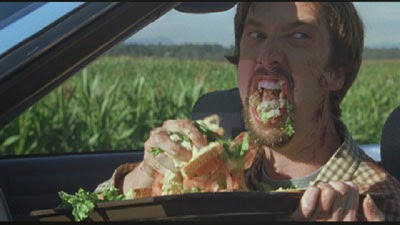
At the center of The Comedy is a Williamsburg trust fund hipster who has no reason to be productive, and so his boredom with life is documented for examination. Directed and co-written by Rick Alverson, The Comedy takes a sharp incisive look at the emptiness of ironic provocation without purpose.
Swanson (Tim Heidecker) is a middle-aged rich white guy whose brother is in a psych ward and his father is on life support. His mother is presumably out of the picture. He doesn't need a job because his father made a fortune, and he lives either at home or on a boat, which he has anchored in the middle of the water. He passes his time by either hanging out with his friends trying to out-offend each other, or by placing himself in situations of people less fortunate than he in an ironic attempt to try experiencing something other than soulless boredom.
Swanson is an asshole, but only because he has nothing better to do. He isn't trying to better the world when he flirts with a girl at a party by telling her that Hitler had some really good ideas outside of that whole murdering thing. And, he's not trying to be anything but an empty provocateur when he pays a cab driver to let him drive the cab for 20 minutes, during which he provokes a woman by calling her a hooker, then running away leaving everybody else to clean up his mess.
Tim Heidecker and Eric Wareheim are actually subversive choices to act in The Comedy, since they're the creators of Tim and Eric Awesome Show, Great Job!, a surrealistic sketch show that deals heavily in irony and sarcasm. If you're annoyed or disgusted by the show, that's the joke. Alverson is exploring how that sense of humor can destroy your own sense of self.
Rick Alverson's look at the life is filmed and paced like an Albert Camus novel. His basic philosophy is that putting up a wall of self-defensive irony will not protect your soul, and instead destroy your ability to connect with the world except on the most superficial of levels. Swanson, has one or two moments where he is actually being vulnerable but quickly realizes what he did and puts up shields. When he is talking with his sister-in-law, he asks about his brother, genuinely. Before that, he was ranting off faux-offensively to put her on edge, and she asks if he's genuinely asking the question, to which he retreats and asks about conjugal visits in the padded cell. The irony being Swanson is that he's actually going through some hardcore crap in his life that he's basically trying very hard not to feel about, and thus he's trying to make everybody else feel like he does.
But, Swanson isn't the only participant in this charade. Eric Wareheim as Van Arman, one of Swanson's "friends," participates in the same faux-offensive behavior, but does it without the self-aware emotional shielding that pervades Swanson's story. Arman reinforces the acceptability of Swanson's detachment, and doesn't challenge the status quo. When a different cab driver doesn't have a working radio, Arman starts singing "You're gonna get a-no-no tip" while Swanson and another friend for the remainder of the ride, while the poor cab driver finishes his job.
What The Comedy and Rick Alverson does well is depict the non-upper class and capture their loathing of this group of entitled white hipsters. Both cab drivers, the probably illegal landscapers, the Catholics, the nurses at a hospital, the black guys at a bar in the ghetto during an act of "slumming," the in home nurse who cares for his dad - all of them are harassed or provoked by Swanson, but realize they would probably get shafted if they didn't give in to the rich guy who can pay to do what he wants. These instances of class division reminded me of Cheap Thrills, where a rich guy pays poor guys to entertain him through dares and humiliation. But, Swanson isn't charismatic. And, Swanson's humiliation isn't with joy or friendliness.
While The Comedy does a great job of creating a case of soullessness for Swanson as the Williamsburg hipster, it introduces reinforcing friends without giving them reason to be so jaded with the world. This is The Comedy's main fault. It closely examines the behavior of a full culture, but it only focuses on one case and gives him easy excuses. Which, adds to the great absurdism of its philosophy. We're looking for meaning in things, but can't find it in the places we're looking.
Is The Comedy an easy movie? No. But, it's not a hipster provocation either. Or, maybe it is? One could easily be forgiven for thinking the whole movie is actually being ironic in its intended purposes and is as empty as the characters it depicts. It's only fair for a movie about people dealing in emptiness for one to come back from The Comedy thinking it's actually empty.
But, the way I watched, and maybe I'm not in on the joke, it's about the emptiness of the lifestyle. The Comedy is a plea for humanity to let down its shields and actually feel what life hands them.
Showing posts with label black comedy. Show all posts
Thursday, May 1, 2014
Wednesday, April 30, 2014
Wrong Cops (2013): The irony of being bad
Wrong Cops (2013)
dir: Quentin Dupieux
Quentin Dupieux's films are dense blocks of absurdism that exist in a world of their own. His first American-released film, Rubber, was a grindhouse horror movie about a psychokinetic murderous tire that also had a 4th wall breaking meta layer slapped on top. His second movie, Wrong, was a film that looked at the twee surrealism of emotional indie films (such as Garden State) and made them absurdly difficult. Wrong Cops makes a music-obsessed version of Reno 911, with a bunch of cops doing wrong things at all times.
One story of Wrong Cops is about a drug-dealing cop trying to figure out what to do with a guy who is shot in the back of his trunk. Another story is about a desk jockey trying to hide his gay pornographic past. And, another is about a cop trying to see some breasts. Marilyn Manson also appears as a teenage music lover. The stories are all edited together to form a cohesive story out of 4-5 different strands.
The rough draft version of Wrong Cops premiered at Sundance with three chapters that were shown successively. The first chapter, now available online, is about the drug-dealing cop harassing Marilyn Manson, a story which gets chopped into the movie and dismissed into back story. The second and third chapters were similarly stand-alone. Quentin's vision had the film being 7 different chapters that were going to be ran successively.
The constant interweaving of the story lines almost seems organic, and possibly makes the film into an easier to swallow tablet. But, it changes the intent of the original concept. The Sundance version of Wrong Cops seems like it would be a comment on the television show Cops where each story is told and finished with some hangovers and characters bleeding into the next story. Instead, the film ends up becoming a quasi-sketch comedy where the bits dance around each other.
Wrong Cops is a funny movie. But, the difference in editing seems to make it a completely different movie, and makes the current version of Wrong Cops seem very disposable. Entertainingly disposable, mind you, but the sketch format it now seems to have tames both the surreality and the darkness that is within the frames.
Perhaps that is the comment. That a cop getting maced because he sexually harassed a young female is kind of dark. And, if condensed into one complete chapter, the absurdism would be stronger. But, as a sketch comedy, surrealism is the name of the game. Mr. Show and Upright Citizens Brigade both went darker and more absurdist faster and more frequently. Even Reno 911 had more dark and absurd moments than Wrong Cops has.
Would I recommend it? Sure. I, actually, really enjoyed the movie despite my above kvetching about the editing decision for the final version. It's funny and has a lot of great scenes, mostly tied together by the shot guy who ties a lot of the stories together as he's dying. And, all he wants to do is hear some music. But, I would love to see what the critically-derided chapter divided version would feel like.
dir: Quentin Dupieux
Quentin Dupieux's films are dense blocks of absurdism that exist in a world of their own. His first American-released film, Rubber, was a grindhouse horror movie about a psychokinetic murderous tire that also had a 4th wall breaking meta layer slapped on top. His second movie, Wrong, was a film that looked at the twee surrealism of emotional indie films (such as Garden State) and made them absurdly difficult. Wrong Cops makes a music-obsessed version of Reno 911, with a bunch of cops doing wrong things at all times.
One story of Wrong Cops is about a drug-dealing cop trying to figure out what to do with a guy who is shot in the back of his trunk. Another story is about a desk jockey trying to hide his gay pornographic past. And, another is about a cop trying to see some breasts. Marilyn Manson also appears as a teenage music lover. The stories are all edited together to form a cohesive story out of 4-5 different strands.
The rough draft version of Wrong Cops premiered at Sundance with three chapters that were shown successively. The first chapter, now available online, is about the drug-dealing cop harassing Marilyn Manson, a story which gets chopped into the movie and dismissed into back story. The second and third chapters were similarly stand-alone. Quentin's vision had the film being 7 different chapters that were going to be ran successively.
The constant interweaving of the story lines almost seems organic, and possibly makes the film into an easier to swallow tablet. But, it changes the intent of the original concept. The Sundance version of Wrong Cops seems like it would be a comment on the television show Cops where each story is told and finished with some hangovers and characters bleeding into the next story. Instead, the film ends up becoming a quasi-sketch comedy where the bits dance around each other.
Wrong Cops is a funny movie. But, the difference in editing seems to make it a completely different movie, and makes the current version of Wrong Cops seem very disposable. Entertainingly disposable, mind you, but the sketch format it now seems to have tames both the surreality and the darkness that is within the frames.
Perhaps that is the comment. That a cop getting maced because he sexually harassed a young female is kind of dark. And, if condensed into one complete chapter, the absurdism would be stronger. But, as a sketch comedy, surrealism is the name of the game. Mr. Show and Upright Citizens Brigade both went darker and more absurdist faster and more frequently. Even Reno 911 had more dark and absurd moments than Wrong Cops has.
Would I recommend it? Sure. I, actually, really enjoyed the movie despite my above kvetching about the editing decision for the final version. It's funny and has a lot of great scenes, mostly tied together by the shot guy who ties a lot of the stories together as he's dying. And, all he wants to do is hear some music. But, I would love to see what the critically-derided chapter divided version would feel like.
Tuesday, April 29, 2014
Ass Backwards (2013): Girls can be idiots too!
Ass Backwards (2013)
dir: Chris Nelson
wr: June Diane Raphael, Casey Wilson
One of the criticisms of the film industry is that there aren't enough female writers or directors working. And, of the responses is "Well, write something! Direct something! Do it for youself!" In this case, two comediennes who frequently work together decided to write a movie for themselves, and got some up and coming guy to direct it. What came out was off-the-wall and absurdist humor whose built-in audience will have to pass it on to other people.
Ass Backwards takes the usual gay-friendly chick comedy and flips it on its head. It's the inverse mirror world version of Romy and Michele's High School Reunion. Stop me if you've heard this set-up before. Two airhead girls who are unhappy in their situation find an invite to something from their past. That something has a lot of pain associated with it because they sucked at it. But, they decide to return to their past to try to reclaim it for success and win over their ex-heartthrobs.
In Ass Backwards, that something isn't high school, but a beauty pageant where one girl totally botched the question portion of the test and the other girl botched the talent portion. But, because there are very few interpersonal relations in pageant life to exploit, Ass Backwards makes the movie more episodic road trip and less final scene. More Pee Wee's Big Adventure than Romy and Michele.
Along the journey, Kate and Chloe discover that one of their father's is deep in debt because they can't get a job and are using his money to live beyond their means. They meet up with an addict from an Intervention-style rehab show. They find their way onto a lesbian compound. Along the way they fight and discover they can see each other plainly, though they accept each other with their flaws.
One could easily argue that Ass Backwards is a facile movie. It's trying to be the next Wet Hot American Summer, with a built in absurdist bent so that the "go to town" montage is stretched into the whole movie. But, it's problem is that it went a little overboard with the hipster irony.You're ironically laughing at Kate and Chloe for being such idiots. You're ironically laughing at the situations they get placed in. You're ironically laughing at the people in those situations as well. The whole movie becomes one big wall of irony where you don't really give a shit about anybody because you're supposed to be laughing at them all.
Nelson, Raphael and Wilson have created a movie which is the definition of aloof. By making everybody and everything a target, including their characters, the movie ends up a soulless catalog of detached amusement. Unlike other hipster comedies, Ass Backwards is too detached from its characters to have much heart to it. It isn't a knowing, loving movie which nudges you because it knows that it's creators are really geeky for making such a compendium, a la Wet Hot American Summer. It doesn't have that insider feeling that Portlandia has, where the targets are the people they interact with and love. Ass Backwards instead pokes at everything. But, it isn't even poking fun at itself, a la Freddy Got Fingered.
And, unlike the Go To Town montage, Ass Backwards never goes DARK. Sure, there's misunderstood rape and crack use, but it doesn't ever get into the sticky black depths that either Wet Hot American Summer went, nor Freddy Got Fingered or even Observe and Report. Because everybody on board stays above the material, and that keeps Raphael and Wilson from plunging the depths they keep attempting to plumb.
That said, there's an audience for Ass Backwards. They're the kids in the leather jackets who will sit behind you in a theater just to rip apart a director's choices. Or, the kids wearing the shades in the park commenting on the yuppies playing frisbee, and how they go to the gym. Or, the kids talking about how a band sold out. This is the movie made to laugh at everybody and everything with detachment and derision. It has an audience. That audience is not me.
dir: Chris Nelson
wr: June Diane Raphael, Casey Wilson
One of the criticisms of the film industry is that there aren't enough female writers or directors working. And, of the responses is "Well, write something! Direct something! Do it for youself!" In this case, two comediennes who frequently work together decided to write a movie for themselves, and got some up and coming guy to direct it. What came out was off-the-wall and absurdist humor whose built-in audience will have to pass it on to other people.
Ass Backwards takes the usual gay-friendly chick comedy and flips it on its head. It's the inverse mirror world version of Romy and Michele's High School Reunion. Stop me if you've heard this set-up before. Two airhead girls who are unhappy in their situation find an invite to something from their past. That something has a lot of pain associated with it because they sucked at it. But, they decide to return to their past to try to reclaim it for success and win over their ex-heartthrobs.
In Ass Backwards, that something isn't high school, but a beauty pageant where one girl totally botched the question portion of the test and the other girl botched the talent portion. But, because there are very few interpersonal relations in pageant life to exploit, Ass Backwards makes the movie more episodic road trip and less final scene. More Pee Wee's Big Adventure than Romy and Michele.
Along the journey, Kate and Chloe discover that one of their father's is deep in debt because they can't get a job and are using his money to live beyond their means. They meet up with an addict from an Intervention-style rehab show. They find their way onto a lesbian compound. Along the way they fight and discover they can see each other plainly, though they accept each other with their flaws.
One could easily argue that Ass Backwards is a facile movie. It's trying to be the next Wet Hot American Summer, with a built in absurdist bent so that the "go to town" montage is stretched into the whole movie. But, it's problem is that it went a little overboard with the hipster irony.You're ironically laughing at Kate and Chloe for being such idiots. You're ironically laughing at the situations they get placed in. You're ironically laughing at the people in those situations as well. The whole movie becomes one big wall of irony where you don't really give a shit about anybody because you're supposed to be laughing at them all.
Nelson, Raphael and Wilson have created a movie which is the definition of aloof. By making everybody and everything a target, including their characters, the movie ends up a soulless catalog of detached amusement. Unlike other hipster comedies, Ass Backwards is too detached from its characters to have much heart to it. It isn't a knowing, loving movie which nudges you because it knows that it's creators are really geeky for making such a compendium, a la Wet Hot American Summer. It doesn't have that insider feeling that Portlandia has, where the targets are the people they interact with and love. Ass Backwards instead pokes at everything. But, it isn't even poking fun at itself, a la Freddy Got Fingered.
And, unlike the Go To Town montage, Ass Backwards never goes DARK. Sure, there's misunderstood rape and crack use, but it doesn't ever get into the sticky black depths that either Wet Hot American Summer went, nor Freddy Got Fingered or even Observe and Report. Because everybody on board stays above the material, and that keeps Raphael and Wilson from plunging the depths they keep attempting to plumb.
That said, there's an audience for Ass Backwards. They're the kids in the leather jackets who will sit behind you in a theater just to rip apart a director's choices. Or, the kids wearing the shades in the park commenting on the yuppies playing frisbee, and how they go to the gym. Or, the kids talking about how a band sold out. This is the movie made to laugh at everybody and everything with detachment and derision. It has an audience. That audience is not me.
Tuesday, April 15, 2014
Bad Parents (2012): When Bad Intentions Aren't Enough
Bad Parents (2012)
dir: Caytha Jentis
Movie pitch: Soccer Moms are currently hot in pop culture. They're the butt of every easy joke you can ever find. So, how about this: There's a mom who suddenly finds herself thrown into this milieu, and goes a little crazy over it. She wasn't crazy to begin with, but suddenly the pressure goes to the mom's head and...bam, she kills the coach. Just to make sure the irony is hit home, we put in Janeane Garofalo in as the nutty soccer mom lead, and then we fill up the rest of the cast with a bunch of comedians and comediennes who may have hit some rough patches. We'll call it Bad Parents. Sure-fire hit!
Yeah, but no. This is a movie based on a play, It's All About The Kids, by Caytha Jentis who also adapted it for screen and directed the movie and produced it. To top it off, it is supposedly semi-autobiographical, based in her "insider knowledge" of soccer mom life. Let's just say that Ms Jentis is a bit too close to the subject matter to properly do it justice.
Janeane Garofalo plays a mother who puts her daughter on a soccer team, which has been split up into A and B teams, and her daughter ends up on the A team. But, she immediately starts feeling the pressure of whether her kid is good enough to be on the A team, or whether the coach is good enough to get wins. The coach has been murdered, it's revealed in the first couple minutes, but the mystery of why is not a mystery. And, the when isn't even that surprising. In fact, the murder sets up a level of dark expectation that is never really met.
Bad Parents is supposed to be about the the mania of soccer mom life, which is portrayed by Garofalo and is picked up and echoed through the various moms on the team...but it never really gets all that manic. In fact, the closest to manic is the ever reliably unhinged Cheri Oteri, who deserves so much better material than this. There is one scene that reflects the absurdity of it all, and that stars Oteri and a walk-on by hunky husband Ben Bailey. Ben Bailey calls as a president of some prestigious soccer academy and proceeds to have soccer mom phone sex with Cheri Oteri by talking about how good her kid is while she's making dinner. Oteri is glorious in it.
The rest of the movie constantly tries to live up to the dark absurdity of it all, but constantly fails miserably, and that's in part due to Garofalo sleepwalking through the role, Christopher Titus never fully embracing the assholishness of the character, and Jentis making a movie that feels amateurish. In fact, most of the proceedings seem like Jentis is treating the subject matter with kid's gloves, never fully committing to mocking or even making judgement calls on the culture. Instead, Garofalo has to make the half-hearted comments that point out the absurdity in a series of white room folding laundry asides.
Garofalo is a major part of why this movie fails, never finding either the heart of the character nor the wit of the movie. Unfortunately, Janeane Garofalo is a one-note actress/comedienne who is still amazingly brilliant when she turns in a cold-hearted cynical exhausted character (her walk-on in Broad City being an amazing recent example), but always flounders when she steps out of her comfort zone to try to find wit in the normal-ish characters. It also doesn't help her that she's surrounded by better actresses who grasp the ridiculousness a little more, and flounder less.
Unfortunately, the movie's budget probably went to the cast and not to anything else as the movie feels like it has the budget of a $100 student film. With shoddy camera work, and a dedication to that digital camera feel, Bad Parents is never really good. It's main problem is that it feels aloof but doesn't want to. Soccer Moms are way too easy of a target, but Bad Parents never even hits that target. It's never endearing toward soccer moms nor is it mocking of them. And, thus, Bad Parents becomes a completely unwatchable mess of a terrible movie.
That being said, movie producers...you need to make Cheri Oteri a star. In both this and Southland Tales, she's shown the ability to shine in weird material, and find the funny. Please, give her better roles.
dir: Caytha Jentis
Movie pitch: Soccer Moms are currently hot in pop culture. They're the butt of every easy joke you can ever find. So, how about this: There's a mom who suddenly finds herself thrown into this milieu, and goes a little crazy over it. She wasn't crazy to begin with, but suddenly the pressure goes to the mom's head and...bam, she kills the coach. Just to make sure the irony is hit home, we put in Janeane Garofalo in as the nutty soccer mom lead, and then we fill up the rest of the cast with a bunch of comedians and comediennes who may have hit some rough patches. We'll call it Bad Parents. Sure-fire hit!
Yeah, but no. This is a movie based on a play, It's All About The Kids, by Caytha Jentis who also adapted it for screen and directed the movie and produced it. To top it off, it is supposedly semi-autobiographical, based in her "insider knowledge" of soccer mom life. Let's just say that Ms Jentis is a bit too close to the subject matter to properly do it justice.
Janeane Garofalo plays a mother who puts her daughter on a soccer team, which has been split up into A and B teams, and her daughter ends up on the A team. But, she immediately starts feeling the pressure of whether her kid is good enough to be on the A team, or whether the coach is good enough to get wins. The coach has been murdered, it's revealed in the first couple minutes, but the mystery of why is not a mystery. And, the when isn't even that surprising. In fact, the murder sets up a level of dark expectation that is never really met.
Bad Parents is supposed to be about the the mania of soccer mom life, which is portrayed by Garofalo and is picked up and echoed through the various moms on the team...but it never really gets all that manic. In fact, the closest to manic is the ever reliably unhinged Cheri Oteri, who deserves so much better material than this. There is one scene that reflects the absurdity of it all, and that stars Oteri and a walk-on by hunky husband Ben Bailey. Ben Bailey calls as a president of some prestigious soccer academy and proceeds to have soccer mom phone sex with Cheri Oteri by talking about how good her kid is while she's making dinner. Oteri is glorious in it.
The rest of the movie constantly tries to live up to the dark absurdity of it all, but constantly fails miserably, and that's in part due to Garofalo sleepwalking through the role, Christopher Titus never fully embracing the assholishness of the character, and Jentis making a movie that feels amateurish. In fact, most of the proceedings seem like Jentis is treating the subject matter with kid's gloves, never fully committing to mocking or even making judgement calls on the culture. Instead, Garofalo has to make the half-hearted comments that point out the absurdity in a series of white room folding laundry asides.
Garofalo is a major part of why this movie fails, never finding either the heart of the character nor the wit of the movie. Unfortunately, Janeane Garofalo is a one-note actress/comedienne who is still amazingly brilliant when she turns in a cold-hearted cynical exhausted character (her walk-on in Broad City being an amazing recent example), but always flounders when she steps out of her comfort zone to try to find wit in the normal-ish characters. It also doesn't help her that she's surrounded by better actresses who grasp the ridiculousness a little more, and flounder less.
Unfortunately, the movie's budget probably went to the cast and not to anything else as the movie feels like it has the budget of a $100 student film. With shoddy camera work, and a dedication to that digital camera feel, Bad Parents is never really good. It's main problem is that it feels aloof but doesn't want to. Soccer Moms are way too easy of a target, but Bad Parents never even hits that target. It's never endearing toward soccer moms nor is it mocking of them. And, thus, Bad Parents becomes a completely unwatchable mess of a terrible movie.
That being said, movie producers...you need to make Cheri Oteri a star. In both this and Southland Tales, she's shown the ability to shine in weird material, and find the funny. Please, give her better roles.
Friday, April 11, 2014
O.C. and Stiggs (1987): The OG of Anti Comedy
O.C. and Stiggs (1987) (or 1985, when it was completed)
dir: Robert Altman
When O.C. and Stiggs was actually made, it was supposed to be a Porkys-esque teen comedy that was derived from one of the blackest, meanest, most abrasive issues of National Lampoon that was ever created. The majority of the issue is Here, though without the formatting of the original issue. It's abrasive and full of National Lampoon's trademark asshole humor. It's brutal, classist, sexist, offensive, and, above all, irreverent.
Somehow, somebody had the bright idea of making this issue into a movie. Then, somebody else had the bright idea of having Robert Altman direct it. Probably, because they saw M*A*S*H* and thought he could handle a couple of amoral misfits wreaking havoc all over town, and on one family in particular. The results are mixed and the problems are legion.
O.C. and Stiggs are the titular jerks who have a vendetta against the Schwab family, an upper-middle-class family that makes its money from insurance. Randall Schwab, the father, owns the insurance company that has screwed over O.C.'s grandad, who is also a vet. And, so, both O.C. and Stiggs use class warfare to make life a complete hell for Schwab and his brood.
With O.C. and Stiggs, we see the predecessors of both Ferris Bueller and Freddy Got Fingered's Gord. We see Ferris Bueller in that they're able to wheedle and deal with anybody they come across, if they see something they need to serve their purposes. But, they're also like Gord in that they are egotistical assholes who believe it is their god given right to make somebody's life hell. They are two people of a hive mind that constantly uses and manipulates people in order to basically drive Schwab and his family crazy.
But, this is an anti-Reagan motif. Robert Altman was revving up his cheap shot political movie career that would also include Tanner '88, and exercised a lot of his cheap shots in O.C. and Stiggs. Schwab isn't just any old middle-class family. They're racist, classist, xenophobic, hypocritically moral Reaganites who lead sheltered and socially challenged lives. Heck, even the logo (not on the box) makes it seem like Altman is attempting to channel Ralph Steadman's design work for Hunter S. Thompson's Fear and Loathing in Las Vegas. This is a movie that is posing against the stuffed shirts.
So, we're generally rooting against the Reagan conservatives, because that's always been Altman's go to target. But, O.C. and Stiggs are also homophobic jerkoffs who don't give two shits about anybody else. This leaves us in a stance where you're watching a movie about people you generally don't like. The main difference between O.C. and Stiggs and Gord is that O.C. and Stiggs also take on the privileged mannerisms that the movie is rallying against. They have snotty overly-upper-class-inflected voices of the privileged. They are taking the piss out of the yacht club set, but then they dress like uber-yuppy tourists. Unlike Gord, O.C. and Stiggs don't care if you hate them. They just don't give a fuck.
That being said, Altman did tone down much of the Lampoon article, basically gutting it, redistributing it, and generally making it softer for a more palatable mainstream audience. But, with such unlikable protagonists and antagonists, this movie was bound to be a failure.
The biggest question is, is it good? It is an Altman movie, and he paces O.C. and Stiggs less like the ADHD afflicted Freddy Got Fingered and more like his slower-moving M*A*S*H*, partially because the ADHD style hadn't fully taken hold yet. Altman has large set pieces, and long scenes which sometimes stretch too long for the payoff. And, sometimes the payoff actually works.
The non-ADHD pacing really throws off the movie, though, because if one segment is annoying you you actually have to sit and wait for quite awhile before the next one comes around. With Freddy Got Fingered, at least you have the possibility that the scene will end in a minute or 2. But, Altman knows there are depths to humor that can only be plumbed through sustained takes and extended scenes. So, he'll just go on and on...which sucks if you hate the scene you're in.
O.C. and Stiggs is a mixed bag and is like a deep OG edition of Freddy Got Fingered. You instantly hate everybody and everything, yet it's an anti-humorish prank that will either tickle you or not. The targets are rather facile, even for Altman, and the movie is sort of just there. It's pacing is off for the type of movie it is, yet it is almost forgivable because that wasn't a fashion that had been really developed yet (though it had been preceded by Laugh-In and Airplane). Proceed with caution.
dir: Robert Altman
When O.C. and Stiggs was actually made, it was supposed to be a Porkys-esque teen comedy that was derived from one of the blackest, meanest, most abrasive issues of National Lampoon that was ever created. The majority of the issue is Here, though without the formatting of the original issue. It's abrasive and full of National Lampoon's trademark asshole humor. It's brutal, classist, sexist, offensive, and, above all, irreverent.
Somehow, somebody had the bright idea of making this issue into a movie. Then, somebody else had the bright idea of having Robert Altman direct it. Probably, because they saw M*A*S*H* and thought he could handle a couple of amoral misfits wreaking havoc all over town, and on one family in particular. The results are mixed and the problems are legion.
O.C. and Stiggs are the titular jerks who have a vendetta against the Schwab family, an upper-middle-class family that makes its money from insurance. Randall Schwab, the father, owns the insurance company that has screwed over O.C.'s grandad, who is also a vet. And, so, both O.C. and Stiggs use class warfare to make life a complete hell for Schwab and his brood.
With O.C. and Stiggs, we see the predecessors of both Ferris Bueller and Freddy Got Fingered's Gord. We see Ferris Bueller in that they're able to wheedle and deal with anybody they come across, if they see something they need to serve their purposes. But, they're also like Gord in that they are egotistical assholes who believe it is their god given right to make somebody's life hell. They are two people of a hive mind that constantly uses and manipulates people in order to basically drive Schwab and his family crazy.
But, this is an anti-Reagan motif. Robert Altman was revving up his cheap shot political movie career that would also include Tanner '88, and exercised a lot of his cheap shots in O.C. and Stiggs. Schwab isn't just any old middle-class family. They're racist, classist, xenophobic, hypocritically moral Reaganites who lead sheltered and socially challenged lives. Heck, even the logo (not on the box) makes it seem like Altman is attempting to channel Ralph Steadman's design work for Hunter S. Thompson's Fear and Loathing in Las Vegas. This is a movie that is posing against the stuffed shirts.
So, we're generally rooting against the Reagan conservatives, because that's always been Altman's go to target. But, O.C. and Stiggs are also homophobic jerkoffs who don't give two shits about anybody else. This leaves us in a stance where you're watching a movie about people you generally don't like. The main difference between O.C. and Stiggs and Gord is that O.C. and Stiggs also take on the privileged mannerisms that the movie is rallying against. They have snotty overly-upper-class-inflected voices of the privileged. They are taking the piss out of the yacht club set, but then they dress like uber-yuppy tourists. Unlike Gord, O.C. and Stiggs don't care if you hate them. They just don't give a fuck.
That being said, Altman did tone down much of the Lampoon article, basically gutting it, redistributing it, and generally making it softer for a more palatable mainstream audience. But, with such unlikable protagonists and antagonists, this movie was bound to be a failure.
The biggest question is, is it good? It is an Altman movie, and he paces O.C. and Stiggs less like the ADHD afflicted Freddy Got Fingered and more like his slower-moving M*A*S*H*, partially because the ADHD style hadn't fully taken hold yet. Altman has large set pieces, and long scenes which sometimes stretch too long for the payoff. And, sometimes the payoff actually works.
The non-ADHD pacing really throws off the movie, though, because if one segment is annoying you you actually have to sit and wait for quite awhile before the next one comes around. With Freddy Got Fingered, at least you have the possibility that the scene will end in a minute or 2. But, Altman knows there are depths to humor that can only be plumbed through sustained takes and extended scenes. So, he'll just go on and on...which sucks if you hate the scene you're in.
O.C. and Stiggs is a mixed bag and is like a deep OG edition of Freddy Got Fingered. You instantly hate everybody and everything, yet it's an anti-humorish prank that will either tickle you or not. The targets are rather facile, even for Altman, and the movie is sort of just there. It's pacing is off for the type of movie it is, yet it is almost forgivable because that wasn't a fashion that had been really developed yet (though it had been preceded by Laugh-In and Airplane). Proceed with caution.
Thursday, April 10, 2014
Freddy Got Fingered (2001): Dawn of a New Media
Freddy Got Fingered (2001)
dir: Tom Green
Walking out of Freddy Got Fingered in 2001 with an anime obsessed geek who was willing to go see this...thing with me, we argued about whether or not this movie was good. My friend commented that it wasn't a good movie, but there were funny bits, specifically the constant maiming of a neighbor boy around the age of 8.
What neither of us fully realized was that MTV and Tom Green in general, and Freddy Got Fingered specifically, were the middle steps in a cultural evolution that is still continuing to this day. Freddy Got Fingered isn't just a love letter to the ADHD embracing, stupid-loving, non-sequitur obsessed stoner who were already obsessing over the seemingly mature juvenilia that MTV was sputtering out in between music videos; Freddy Got Fingered was written and directed by seemingly one of these stoners who loved seeing somebody take the piss out of life. Oh, and it starred him too.
Tom Green had originally started out on cable access in Canada with a Candid Camera-esque prank show where he frequently played pranks that preyed on the manners of polite society, and frequently would use his parents as props in the show. This formula would be repeated in Bam Margera's Viva La Bam who would blend Tom Green's show with Jackass.
The Tom Green Show would be picked up by The Comedy Channel (a Canadian channel not to be confused with Comedy Central) in 1996, and then picked up by MTV in 1999. At this point in MTV's history, Jackass hadn't aired yet, and MTV's main claim to fictional tv show fame was Daria and Celebrity Deathmatch. They were still airing music videos with programming like 120 Minutes and were starting to get really happy with the reality programming with Road Rules and Real World.
In reality, almost everything that happened in one segment of popular culture can be traced to three television shows. One on MTV and one on Cartoon Network. These shows would start to define the warped senses of humor of the youth of America. On MTV was Liquid Television, and on Cartoon Network was Space Ghost Coast to Coast.
In 1991, MTV put out a show called Liquid Television, which captured a weird zeitgeist of the adult animation shorts that had been previously been delegated to obscure VHS tapes. Liquid Television was a mix of original and festival shorts that were sometimes separated by a pair of lips overlaid on static making some brief snarky comment. Occasionally, there were long-running recurring segments, like the whole first chapter of Aeon Flux, but the majority of the content were episodic or individualized. Liquid Television was the launch pad for both Mike Judge and Bill Plympton.
What Liquid Television represented was an anarchic humor that was just plain...weird. One moment you could be watching a segment called Stick Figure Theater, where stick figures drawn with a note card background would re-enact famous movie scenes or music videos. The next moment you'd be watching a highly-detailed sci-fi epic. The next you'd be watching a cheap stop motion short of a biker chick on a revenge bent. It distilled all of pop culture into an intense half hour of short snippets. That everything was in a different aesthetic helped separate one from the next, and it became a Gold Standard show that was far too short-lived for how good it was.
From Liquid Television, we would get Beavis & Butthead, Aeon Flux and The Maxx. These would eventually lead to Daria, and, spiritually, The Sifl and Olly Show. But, Liquid Television would be cancelled by 1994.
Meanwhile, the year prior, in 1990, Spike and Mike would add the Sick and Twisted festival to their Classic Animation festival, which would be a throw everything at the wall and see what stuck. Spike and Mike had an eye for quality, but they would frequently throw things that just seemed out of left field creating a hodgepodge of animation aimed at adults that was just as ADD as Liquid Television. This festival is still staggering along, though not nearly as popular as it once was.
In 1994, Cartoon Network would create the long running late night talk show Space Ghost Coast to Coast which was hosted by a 1960s superhero and his enemies. The talk show segments were full of absurd interviews that had little to do with the real life celebrity interviewees, and frequently interrupted for warfare between Space Ghost and his bandleader/enemy Zorak and director/producer/enemy Moltar, both of whom openly hated Space Ghost.
Space Ghost Coast to Coast was just as non-sequitur as Liquid Television, but it was a 15-minute show, and the humor was constantly pure absurdism. Space Ghost would interview the celebrities as if they were superheroes, or if he didn't know anything about them. Zorak and Moltar would constantly prank and antagonize Space Ghost, sometimes under the guise of escaping but mostly just to antagonize Space Ghost. There was barely any coherence to the shows, and were frequently over before you could adjust to the tone of the series. Space Ghost Coast to Coast would lead to the creation of Adult Swim in 2001, with equally absurd and antagonistic shows such as Aqua Teen Hunger Force and The Brak Show.
Just to recap: two networks were airing antagonistic absurdist shows with short segments that developed cult followings that led to other antagonistic and absurdist shows. Both networks were aimed at youth and generally ignored by the adults at large.
In the mainstream networks: Big Brother premiered in 1999, and Survivor premiered in 2000.
And, so comes Tom Green in 1999.
The Tom Green Show wasn't a product of these shows. It was one of these shows. The Tom Green Show was a prank show that reveled in absurdist pranks that played around with what was supposed to be polite and mannered. It was more anarchic and confronting than most that had preceded it. In it's MTV incarnation, it took on the form of a chat show with Tom as host and relating new and old segments from the Comedy Network incarnation. The show was generally reviled by critics, though embraced by youth.
And, so comes Freddy Got Fingered.
To correctly gauge this film, one has to place it in it's time. Jackass didn't appear on television until October 2000. The Tom Green Show had been off the air due to both testicular cancer and Freddy Got Fingered filming. 6 months after Jackass, in April 2001, movie theaters would see Freddy Got Fingered. And, 6 months later in October 2001, Adult Swim would finally premiere on Cartoon Network. On a similar note, Fear Factor would premiere in June 2001.
The timeline, thus far:
dir: Tom Green
Walking out of Freddy Got Fingered in 2001 with an anime obsessed geek who was willing to go see this...thing with me, we argued about whether or not this movie was good. My friend commented that it wasn't a good movie, but there were funny bits, specifically the constant maiming of a neighbor boy around the age of 8.
What neither of us fully realized was that MTV and Tom Green in general, and Freddy Got Fingered specifically, were the middle steps in a cultural evolution that is still continuing to this day. Freddy Got Fingered isn't just a love letter to the ADHD embracing, stupid-loving, non-sequitur obsessed stoner who were already obsessing over the seemingly mature juvenilia that MTV was sputtering out in between music videos; Freddy Got Fingered was written and directed by seemingly one of these stoners who loved seeing somebody take the piss out of life. Oh, and it starred him too.
Tom Green had originally started out on cable access in Canada with a Candid Camera-esque prank show where he frequently played pranks that preyed on the manners of polite society, and frequently would use his parents as props in the show. This formula would be repeated in Bam Margera's Viva La Bam who would blend Tom Green's show with Jackass.
The Tom Green Show would be picked up by The Comedy Channel (a Canadian channel not to be confused with Comedy Central) in 1996, and then picked up by MTV in 1999. At this point in MTV's history, Jackass hadn't aired yet, and MTV's main claim to fictional tv show fame was Daria and Celebrity Deathmatch. They were still airing music videos with programming like 120 Minutes and were starting to get really happy with the reality programming with Road Rules and Real World.
In reality, almost everything that happened in one segment of popular culture can be traced to three television shows. One on MTV and one on Cartoon Network. These shows would start to define the warped senses of humor of the youth of America. On MTV was Liquid Television, and on Cartoon Network was Space Ghost Coast to Coast.
In 1991, MTV put out a show called Liquid Television, which captured a weird zeitgeist of the adult animation shorts that had been previously been delegated to obscure VHS tapes. Liquid Television was a mix of original and festival shorts that were sometimes separated by a pair of lips overlaid on static making some brief snarky comment. Occasionally, there were long-running recurring segments, like the whole first chapter of Aeon Flux, but the majority of the content were episodic or individualized. Liquid Television was the launch pad for both Mike Judge and Bill Plympton.
What Liquid Television represented was an anarchic humor that was just plain...weird. One moment you could be watching a segment called Stick Figure Theater, where stick figures drawn with a note card background would re-enact famous movie scenes or music videos. The next moment you'd be watching a highly-detailed sci-fi epic. The next you'd be watching a cheap stop motion short of a biker chick on a revenge bent. It distilled all of pop culture into an intense half hour of short snippets. That everything was in a different aesthetic helped separate one from the next, and it became a Gold Standard show that was far too short-lived for how good it was.
From Liquid Television, we would get Beavis & Butthead, Aeon Flux and The Maxx. These would eventually lead to Daria, and, spiritually, The Sifl and Olly Show. But, Liquid Television would be cancelled by 1994.
Meanwhile, the year prior, in 1990, Spike and Mike would add the Sick and Twisted festival to their Classic Animation festival, which would be a throw everything at the wall and see what stuck. Spike and Mike had an eye for quality, but they would frequently throw things that just seemed out of left field creating a hodgepodge of animation aimed at adults that was just as ADD as Liquid Television. This festival is still staggering along, though not nearly as popular as it once was.
In 1994, Cartoon Network would create the long running late night talk show Space Ghost Coast to Coast which was hosted by a 1960s superhero and his enemies. The talk show segments were full of absurd interviews that had little to do with the real life celebrity interviewees, and frequently interrupted for warfare between Space Ghost and his bandleader/enemy Zorak and director/producer/enemy Moltar, both of whom openly hated Space Ghost.
Space Ghost Coast to Coast was just as non-sequitur as Liquid Television, but it was a 15-minute show, and the humor was constantly pure absurdism. Space Ghost would interview the celebrities as if they were superheroes, or if he didn't know anything about them. Zorak and Moltar would constantly prank and antagonize Space Ghost, sometimes under the guise of escaping but mostly just to antagonize Space Ghost. There was barely any coherence to the shows, and were frequently over before you could adjust to the tone of the series. Space Ghost Coast to Coast would lead to the creation of Adult Swim in 2001, with equally absurd and antagonistic shows such as Aqua Teen Hunger Force and The Brak Show.
Just to recap: two networks were airing antagonistic absurdist shows with short segments that developed cult followings that led to other antagonistic and absurdist shows. Both networks were aimed at youth and generally ignored by the adults at large.
In the mainstream networks: Big Brother premiered in 1999, and Survivor premiered in 2000.
And, so comes Tom Green in 1999.
The Tom Green Show wasn't a product of these shows. It was one of these shows. The Tom Green Show was a prank show that reveled in absurdist pranks that played around with what was supposed to be polite and mannered. It was more anarchic and confronting than most that had preceded it. In it's MTV incarnation, it took on the form of a chat show with Tom as host and relating new and old segments from the Comedy Network incarnation. The show was generally reviled by critics, though embraced by youth.
And, so comes Freddy Got Fingered.
To correctly gauge this film, one has to place it in it's time. Jackass didn't appear on television until October 2000. The Tom Green Show had been off the air due to both testicular cancer and Freddy Got Fingered filming. 6 months after Jackass, in April 2001, movie theaters would see Freddy Got Fingered. And, 6 months later in October 2001, Adult Swim would finally premiere on Cartoon Network. On a similar note, Fear Factor would premiere in June 2001.
The timeline, thus far:
- 1990: Spike and Mike's Sick and Twisted Festival, underground
- 1991: Liquid Television, MTV
- 1993: Beavis and Butthead, MTV
- 1994: The Tom Green Show, Cable Access
- 1994: Space Ghost Coast to Coast, Cartoon Network
- 1996: The Tom Green Show, Comedy Network
- 1997: The Sifl and Olly Show, MTV
- 1999: The Tom Green Show, MTV
- 1999: Big Brother, CBS
- 2000: Survivor, CBS
- 2000: Jackass, MTV
- 2001: Freddy Got Fingered, Nationwide Theaters
- 2001: Fear Factor, NBC
- 2001: Adult Swim, Cartoon Network
...
Freddy Got Fingered is both a product of its time and a herald of things to come. But, what is it? It is a blend of the manchild narrative, the grossout movie, and absurdist cinema of Luis Bunuel.
Tom Green plays Gord, who lives at home with the dream of becoming an animator. When he's rejected, he comes back to live at home (at the age of 28) after having been out of the house for a handful of days to work on his animations, but gets stuck in a rut until he has an epiphany and gets his dream job. He's constantly at odds with his father, with whom he has more in common than is initially thought.
See? That's a pretty traditional manchild narrative. Arrested development makes his own way in the manner which he thinks is appropriate. What's in the details is what makes and breaks Freddy Got Fingered.
The first thing we see is a fake out intro that would later be cribbed by Trey Parker and Matt Stone for Team America: World Police, by having amateur sketches on paper while Tom Green makes absurdist comments. Then we pull back to find Gord lying on his bed making himself giggle while telling these stories to himself. And, so we see the beginnings of the antagonistic humor that poked fun not just at the characters but at the audience, a technique that Bunuel used to great effect frequently by subverting people's expectations. The opening credits play over Gord skateboarding through a mall, being chased by the cops, which continues the antagonistic thread that plays throughout the film.
Then, on the road, he is driving from Portland to Los Angeles on some road that isn't the 1, the 101, or I-5. We're not on the main path here. And, he sees a car, comes to a screeching halt at something off screen, then jumps out to jerk off a horse. For no reason. And, so we get to the grossout film...in scene 3.
And, that's the whole entire pattern of Freddy Got Fingered, a manchild narrative that frequently takes completely absurdist stops to attack, offend, or attack and offend either somebody or the audience that has little to do with the actual movie. The movie comes to a screeching halt so that Gord can deliver a baby and swing it around the room by its umbilical cord. The movie comes to another screeching halt so that Gord can beat his paraplegic girlfriend's shins with a rod. Or, so the neighbor boy will get increasingly injured throughout the film.
For an 87 minute movie, Freddy Got Fingered has a hell of a lot of these non-essential scenes that eventually build the main story of Gord finding his way to manhood. Not maturity, because he doesn't ever mature; he just finds success doing it his way, and continues to antagonize his father.
The main problem is with the quality of filmmaking on display, which sometimes is just downright atrocious. I'm not sure if it is the DVD, but there's an early exchange between Green and Drew Barrymore, where he's telling her that her boss' wife is dead and the whole image changes between angles. Green is lit well and bright and sunny, but Barrymore is underlit, overexposed, and grainy.
The ineptitude of Freddy Got Fingered gets in the way of solid defenses of the movie as an absurdist work of genius. It seems like Green made the film on the fly with little respect for quality or time for dailies. So, how does one come to the defense that seems so openly antagonistic and of negligible quality?
It's an anti-comedy. And, it's in a style that few people actually appreciate. It was used in The Exterminating Angel, a movie where the hoi polloi couldn't leave a party because of manners, and end up tearing down the house. Andy Kaufman would make use of this in his standup in the 80s, which would be revived with Man on the Moon. But, it wouldn't find its audience until Adult Swim, which trailed Freddy Got Fingered by 6 months.
Adult Swim is nothing but 11 minute shorts of side stories that sometimes make up a semblance of a story. Aqua Teen Hunger Force, for example, had a series finale of a pool that filled with blood caused by a house being built on an ancient burial ground, revealed by the Cybernetic Ghost of Christmas Past From the Future. The house would be purchased by Glenn Danzig. In 11 minutes.
Freddy Got Fingered is short attention span theater at its finest. It's hilarious if you find it funny, and it's quick and doesn't overstay its welcome, though Green has been threatening to ruin that. Scenes will sometimes stretch into set pieces, and set pieces will shorten into brief scenes. The pacing is unexpected but never offensively off the wall. Unless you find the humor tiresome, in which case you'll hate the film.
But, it's hard to deny Freddy Got Fingered its place in history. And it's certainly discernible from other films it has been surrounded by. It's a film you'll love or hate based on your sense of humor. If you're not a fan of attacks on the audience, you'll hate this film.
Monday, February 10, 2014
Theatre of Blood (1973): Using the Stage for Revenge
Theatre of Blood (1973)
dir: Douglas Hickox
Rarely has a b-movie had such a high intellectual price of entry. This movie is custom made for fans of Shakespeare who also really like Vincent Price, and bloody low-budget horror movies. Given the amount of death in Shakespeare's tragedies, one might think that this has some crossovers.
Vincent Price is Edward Lionheart, a terrible Shakespearean actor who held a final season of Shakespearean tragedies, in which he played the lead and was panned for all of his performances. At some pre-film awards ceremony, he expected to get a "Critic's Choice Award," but was humiliated instead, and subsequently attempts suicide. He survives to exact his revenge on the ones who deserve it most: the critics. He starts killing the critics using the methods of various Shakespearean plays in the order he performed them in his last season. During the sequences, he also performs the choice speeches that surround the murder.
In order to fully appreciate this movie, it helps to have a cursory knowledge of Shakespeare. And, by cursory, I mean, knowledge of no less than 8 Shakespearean plays: Julius Caesar, Troilus and Cressida, Cymbeline, Henry VI Part 1, Richard III, The Merchant of Venice, Othello and Titus Andronicus.
Why do you need all of this knowledge? Because the death scenes are made into absurdist weird set pieces that seem like obscure oblique ways to kill people without any knowledge of their actual origins. Even with the knowledge of their origins, but without knowing the actual plays, the scenes are still rampant odes to some of the most famous scenes, and some of the least famous scenes, in Shakespeare with the dialogue stolen wholesale from the plays.
I can't imagine people who don't enjoy Shakespeare finding much enjoyment out of this movie. It seems like a prank in order to get you to eat your vegetables. If you find Shakespearean language dense and impenetrable, especially when parceled out at a spoken speed, you'll probably hate this.
Those who have studied Shakespeare sometimes are appalled by the sheer amount of violence in Shakespeare's plays, and this isn't for them either. The horror-comedy tropes are in full spectacle here, using and abusing all of Shakespeare's most violent tendencies.
But, for the crossover market, this is a perfect evisceration of both the supposed politeness of Shakespeare, and also a way to watch people get their secret jollies out on screen. Shakespeare was never polite. He was always just dense. But, his plays were always brutal.
But, then there's the second half of this movie, which is watching Vincent Price murder all of his critics who were so hoity-toity they couldn't appreciate him in the likes of The Abominable Dr. Phibes, or Dr. Goldfoot and the Bikini Machine, just to name a couple of his then-recent films. And, as such, he was going to hoist them on their own petard, so to speak. If it's Shakespeare they want, it's Shakespeare they'll get!!!
Plus, he always wanted to do Shakespeare, and he got to chew the scenery as he always loved to do and was so good at. But, that almost takes backseat to getting revenge on the critics for their need for high culture in film.
Will you enjoy it? Do you like Shakespeare and b-horrors? It's the most fun you can have watching Vincent Price, unless you don't get Shakespeare. And, that can be a high price of admission for many people. If you have that, it is amazing.
dir: Douglas Hickox
Rarely has a b-movie had such a high intellectual price of entry. This movie is custom made for fans of Shakespeare who also really like Vincent Price, and bloody low-budget horror movies. Given the amount of death in Shakespeare's tragedies, one might think that this has some crossovers.
Vincent Price is Edward Lionheart, a terrible Shakespearean actor who held a final season of Shakespearean tragedies, in which he played the lead and was panned for all of his performances. At some pre-film awards ceremony, he expected to get a "Critic's Choice Award," but was humiliated instead, and subsequently attempts suicide. He survives to exact his revenge on the ones who deserve it most: the critics. He starts killing the critics using the methods of various Shakespearean plays in the order he performed them in his last season. During the sequences, he also performs the choice speeches that surround the murder.
In order to fully appreciate this movie, it helps to have a cursory knowledge of Shakespeare. And, by cursory, I mean, knowledge of no less than 8 Shakespearean plays: Julius Caesar, Troilus and Cressida, Cymbeline, Henry VI Part 1, Richard III, The Merchant of Venice, Othello and Titus Andronicus.
Why do you need all of this knowledge? Because the death scenes are made into absurdist weird set pieces that seem like obscure oblique ways to kill people without any knowledge of their actual origins. Even with the knowledge of their origins, but without knowing the actual plays, the scenes are still rampant odes to some of the most famous scenes, and some of the least famous scenes, in Shakespeare with the dialogue stolen wholesale from the plays.
I can't imagine people who don't enjoy Shakespeare finding much enjoyment out of this movie. It seems like a prank in order to get you to eat your vegetables. If you find Shakespearean language dense and impenetrable, especially when parceled out at a spoken speed, you'll probably hate this.
Those who have studied Shakespeare sometimes are appalled by the sheer amount of violence in Shakespeare's plays, and this isn't for them either. The horror-comedy tropes are in full spectacle here, using and abusing all of Shakespeare's most violent tendencies.
But, for the crossover market, this is a perfect evisceration of both the supposed politeness of Shakespeare, and also a way to watch people get their secret jollies out on screen. Shakespeare was never polite. He was always just dense. But, his plays were always brutal.
But, then there's the second half of this movie, which is watching Vincent Price murder all of his critics who were so hoity-toity they couldn't appreciate him in the likes of The Abominable Dr. Phibes, or Dr. Goldfoot and the Bikini Machine, just to name a couple of his then-recent films. And, as such, he was going to hoist them on their own petard, so to speak. If it's Shakespeare they want, it's Shakespeare they'll get!!!
Plus, he always wanted to do Shakespeare, and he got to chew the scenery as he always loved to do and was so good at. But, that almost takes backseat to getting revenge on the critics for their need for high culture in film.
Will you enjoy it? Do you like Shakespeare and b-horrors? It's the most fun you can have watching Vincent Price, unless you don't get Shakespeare. And, that can be a high price of admission for many people. If you have that, it is amazing.
Monday, January 13, 2014
Stitches (2012): The Comedy of Violence
Stitches (2012)
dir: Conor McMahon
When one thinks of blackly comic clown movies, mostly the movies are bleak and full of loathing. Clowns in cinema have become symbols on which to hang ironic situations that destroy ones love of life and/or humanity. Shakes the Clown, and Vulgar, for instance, are two clown movies which are unrelentingly bleak and darkly funny through pessimistic means.
Stitches opens with the titular clown fucking a woman in a trailer, giving a nod to the common type of movie where clowns are put upon poor people who, through their desire to make people laugh, have lost all semblance of humanity in themselves. The next scene, a child's 10th birthday party, further emphasizes this type of reading, right up until Stitches is killed by the children on accident.
At this point, Stitches ceases with the typical bleakness of a clown's life, and becomes about guilt and redemption after a murder. 6 years later, the same child is having his 16th birthday party, and now it is time to pay the piper, as Stitches comes back to life seeking vengeance on those who murdered him.
The thing to remember when watching Stitches is that it seems to want people to think it is a horror movie, but it seems to be a complete and utter comedy, especially when Stitches is on screen. The killer clown scenes are filled with unbelievable levels of violence and gore, and it is when Stitches is around that the movie actually is kind of funny.
Despite Stitches' obvious low budget, McMahon actually crafted some spectacular and memorable kill scenes. Every now and then, Stitches even achieves the visceral reaction that makes somebody squirm pleasantly while watching the teenager be murdered. When it isn't attempting to be visceral, Stitches is aiming for spectacular. Frequently, McMahon shoots the blood splatter in slow-motion against stark black backgrounds, as if it was a special effect horror edition of Time Warp.
The movie doesn't hold enough actual interest in it to make it a good or great movie. There is little tension, and the wittiness is pretty much kept to Stitches and his murder scenes. Throughout the remainder of the movie, the wit is sorely lacking (e.g. Oh, look, the not-so-fat gay fat kid is gorging himself on cans of strawberries! HAR HAR!!), but it's never quite dull enough to quit the movie.
Who will like Stitches? The gorehounds and the easily amused. It's not gory in a realistic sense, but there is enough blood to be quite fun. And the jokes are witty enough to give it a pass. If you fit into neither of these categories, and also were looking for something high tension, you might be bored silly. But, for those in these categories, there is probably a lot to love.
dir: Conor McMahon
When one thinks of blackly comic clown movies, mostly the movies are bleak and full of loathing. Clowns in cinema have become symbols on which to hang ironic situations that destroy ones love of life and/or humanity. Shakes the Clown, and Vulgar, for instance, are two clown movies which are unrelentingly bleak and darkly funny through pessimistic means.
Stitches opens with the titular clown fucking a woman in a trailer, giving a nod to the common type of movie where clowns are put upon poor people who, through their desire to make people laugh, have lost all semblance of humanity in themselves. The next scene, a child's 10th birthday party, further emphasizes this type of reading, right up until Stitches is killed by the children on accident.
At this point, Stitches ceases with the typical bleakness of a clown's life, and becomes about guilt and redemption after a murder. 6 years later, the same child is having his 16th birthday party, and now it is time to pay the piper, as Stitches comes back to life seeking vengeance on those who murdered him.
The thing to remember when watching Stitches is that it seems to want people to think it is a horror movie, but it seems to be a complete and utter comedy, especially when Stitches is on screen. The killer clown scenes are filled with unbelievable levels of violence and gore, and it is when Stitches is around that the movie actually is kind of funny.
Despite Stitches' obvious low budget, McMahon actually crafted some spectacular and memorable kill scenes. Every now and then, Stitches even achieves the visceral reaction that makes somebody squirm pleasantly while watching the teenager be murdered. When it isn't attempting to be visceral, Stitches is aiming for spectacular. Frequently, McMahon shoots the blood splatter in slow-motion against stark black backgrounds, as if it was a special effect horror edition of Time Warp.
The movie doesn't hold enough actual interest in it to make it a good or great movie. There is little tension, and the wittiness is pretty much kept to Stitches and his murder scenes. Throughout the remainder of the movie, the wit is sorely lacking (e.g. Oh, look, the not-so-fat gay fat kid is gorging himself on cans of strawberries! HAR HAR!!), but it's never quite dull enough to quit the movie.
Who will like Stitches? The gorehounds and the easily amused. It's not gory in a realistic sense, but there is enough blood to be quite fun. And the jokes are witty enough to give it a pass. If you fit into neither of these categories, and also were looking for something high tension, you might be bored silly. But, for those in these categories, there is probably a lot to love.
Thursday, January 2, 2014
Kaboom (2010): The Flawed Uprising of the Millennials
Kaboom (2010)
dir: Gregg Araki
Did I say that Nowhere marked the end of the Teenage Apocalypse trilogy? AHAHAHAHAHAH!!!
For 13 years, Araki stayed away from portraying youth culture in his movies. Sure, Mysterious Skin was about young adults, but he wasn't a representation for the generation that was just now coming up. Then, in 2010, Araki releases Kaboom, a celebration of all things Millennial, and a guide to what is going on.
Kaboom is about a gay 18-year-old boy, Smith, about to turn 19 who is experiencing weird events in the days leading up to, and past, his 19th birthday. He has dreams about hallways, girls, and dumpsters behind doors. His lesbian friend starts dating a psychotic witch with psychic abilities. He starts dating a British girl, who uses him and other guys to have orgasms. One of his dream girls pukes on his shoes before being decapitated in front of him by three guys in masks. And, it's all because he's the Chosen One of a cult where his father is a very powerful leader. And, it all ends in the nuclear destruction of the world.
Kaboom feels like it picked up where Nowhere was leaving off. Look at the frame I used for the Nowhere clip. It's a dark soul being surrounded by happy go lucky colors. Kaboom is all about color. There is no oppressed dark brooding soul. Gays are merrily accepted by everybody. Smith's roommate, a dumb blond surfer, is comfortable trying to suck his own dick in front. Of course, the surfer is also working for the cult who eventually kidnaps Smith in order to bring him to his father, but that's revealed in the final act.
The Millennials are post-acceptance. This is the conundrum presented by G.B.F. What is the big deal about coming out when most kids accept you anyways? Araki handles it more skillfully, of course, as he is a far more observant eye and is skilled in cramming every fucking nook and cranny in his movies with something to talk about.
But, the Millennials in Kaboom are also acted on by their parental forces. The father in Kaboom looks old enough to be a Boomer. The RA (James Duval) who is the leader of the counter force, takes on the guise of a hippy. The Boomers have control over the lives of the Millennials, and it's almost as if Gen X doesn't exist, except in secret. Duval is not old enough to be a Boomer Hippy, and takes his disguise off by the end of the film in order to save Smith, but he has to make like he is one.
Araki is still saying that Boomers are out to destroy the world. As they once destroyed the Gen Xers by coopting them into their web of commercialism, so to will they co-opt the Millennials, or else they'll blow up the whole fucking planet. When the Millennials refuse to go to become like their father, Dad hits the big red button and destroys everything.
Which is very reminiscent of modern day politics. Especially in 2013, three years after, but the need to get out the youth has always been one of the goals of the politicians. In the Obama vs McCain grudge match of 2008, they were seriously trying to duke it out over the youth vote. The youth, more so than before, are voting against the established leaders, and starting to make changes in the world that they want to see. Here in Seattle, in 2013 we elected our first socialist city councilwoman, and in nearby Seatac, they voted in a $15/hr minimum wage. All to the chagrin of the established, mostly Boomer-aged, politicians.
The cult also represents everything corporate. There is something worshiping about the cult of commercialism that isn't present anywhere else in the movie. They are busy kidnapping kids at young ages, and trying to brainwash them to be good little cult members, and the ones who don't function right are released upon the world, such as the psychotic lesbian witch girlfriend. There isn't a specific religious symbol invoked in the cult, but it feels very much like a corporate co-option of the New Age symbolism.
And, so, Araki's solution for the Millennials to succeed in killing themselves in order to save themselves. With Kaboom, he finally crafted a high-energy bullet train of sex, love, and meaning as a way to welcome in the next generation. It feels fresh, energetic, and joyous with all the energy that a new generation can give off. And, yet, it could be all too bleakly hilarious, if it weren't so fucking true.
dir: Gregg Araki
Did I say that Nowhere marked the end of the Teenage Apocalypse trilogy? AHAHAHAHAHAH!!!
For 13 years, Araki stayed away from portraying youth culture in his movies. Sure, Mysterious Skin was about young adults, but he wasn't a representation for the generation that was just now coming up. Then, in 2010, Araki releases Kaboom, a celebration of all things Millennial, and a guide to what is going on.
Kaboom is about a gay 18-year-old boy, Smith, about to turn 19 who is experiencing weird events in the days leading up to, and past, his 19th birthday. He has dreams about hallways, girls, and dumpsters behind doors. His lesbian friend starts dating a psychotic witch with psychic abilities. He starts dating a British girl, who uses him and other guys to have orgasms. One of his dream girls pukes on his shoes before being decapitated in front of him by three guys in masks. And, it's all because he's the Chosen One of a cult where his father is a very powerful leader. And, it all ends in the nuclear destruction of the world.
Kaboom feels like it picked up where Nowhere was leaving off. Look at the frame I used for the Nowhere clip. It's a dark soul being surrounded by happy go lucky colors. Kaboom is all about color. There is no oppressed dark brooding soul. Gays are merrily accepted by everybody. Smith's roommate, a dumb blond surfer, is comfortable trying to suck his own dick in front. Of course, the surfer is also working for the cult who eventually kidnaps Smith in order to bring him to his father, but that's revealed in the final act.
The Millennials are post-acceptance. This is the conundrum presented by G.B.F. What is the big deal about coming out when most kids accept you anyways? Araki handles it more skillfully, of course, as he is a far more observant eye and is skilled in cramming every fucking nook and cranny in his movies with something to talk about.
But, the Millennials in Kaboom are also acted on by their parental forces. The father in Kaboom looks old enough to be a Boomer. The RA (James Duval) who is the leader of the counter force, takes on the guise of a hippy. The Boomers have control over the lives of the Millennials, and it's almost as if Gen X doesn't exist, except in secret. Duval is not old enough to be a Boomer Hippy, and takes his disguise off by the end of the film in order to save Smith, but he has to make like he is one.
Araki is still saying that Boomers are out to destroy the world. As they once destroyed the Gen Xers by coopting them into their web of commercialism, so to will they co-opt the Millennials, or else they'll blow up the whole fucking planet. When the Millennials refuse to go to become like their father, Dad hits the big red button and destroys everything.
Which is very reminiscent of modern day politics. Especially in 2013, three years after, but the need to get out the youth has always been one of the goals of the politicians. In the Obama vs McCain grudge match of 2008, they were seriously trying to duke it out over the youth vote. The youth, more so than before, are voting against the established leaders, and starting to make changes in the world that they want to see. Here in Seattle, in 2013 we elected our first socialist city councilwoman, and in nearby Seatac, they voted in a $15/hr minimum wage. All to the chagrin of the established, mostly Boomer-aged, politicians.
The cult also represents everything corporate. There is something worshiping about the cult of commercialism that isn't present anywhere else in the movie. They are busy kidnapping kids at young ages, and trying to brainwash them to be good little cult members, and the ones who don't function right are released upon the world, such as the psychotic lesbian witch girlfriend. There isn't a specific religious symbol invoked in the cult, but it feels very much like a corporate co-option of the New Age symbolism.
And, so, Araki's solution for the Millennials to succeed in killing themselves in order to save themselves. With Kaboom, he finally crafted a high-energy bullet train of sex, love, and meaning as a way to welcome in the next generation. It feels fresh, energetic, and joyous with all the energy that a new generation can give off. And, yet, it could be all too bleakly hilarious, if it weren't so fucking true.
Wednesday, January 1, 2014
Nowhere (1997): The Downfall of Generation X, Part 3 (Abandonment)
Nowhere (1997)
dir: Gregg Araki
And so it comes to this.
Gregg Araki went for an avant garde French New Wave meets The Real World aspect in Totally F***ed Up to show the independence of the subcultural teenagers. In The Doom Generation, Araki went for more of a film school student atmosphere where it felt like the students were trying to become commercial, but just on their way. And, with Nowhere, Araki decided to make a movie that felt full-on Hollywood television. Described as 90210 on acid, Nowhere is the final step in the death of the subcultures that belonged to Generation X.
Gays, 1997
I've said earlier that I consider 1997 to be the pivot point in gay pop cultural breakthrough. Not that gay culture didn't exist before 1997, but that with Ellen coming out of the closet, the real world was forced to finally confront the gay identity in a mass-produced, aimed-at-everybody television show.
Alternately, 1997 was also the year that Gregg Araki went from gay-identified to bi-identified, and started dating Kathleen Robinson publicly. It should be noted that Kathleen Robinson is Lucifer in Nowhere, and their relationship probably started on the set.
On the other hand, since Totally F***ed Up came out, Bill Clinton had passed two notorious bills that were only repealed in the past couple of years. In December of 1993, Clinton signed into law DADT, "Don't Ask Don't Tell" which prevented gays from serving openly in the military with punishment being dishonorable discharge and denial of benefits. And, in 1996, the Defense of Marriage Act (DoMA) was passed, preventing the federal government from recognizing gay marriages which might be presented in the future.
Even with those federal restrictions passing, the gay train was full on the move, and the gays were starting to pick up speed in the culture by 1997.
Independent Cinema and MTV
By 1997, the independent scene that was fledgling in 1993 had picked up full force to be the "indie" scene. Kevin Smith, who had directed 1994's Clerks had gone on to do Mallrats and would release Chasing Amy in 1997, starring then semi-unknown Ben Affleck. Richard Linklater, who had made the influential Slacker would move on to do Dazed and Confused, Before Sunrise, and SubUrbia. MTV's The Real World stopped being about people interacting with each other, and in season 5 (1996), they were starting to cast for maximal drama and also assign season-long jobs or group tasks.
Basically, the experimentation had started moving towards traditional narrative. Dazed and Confused, and its predecessor, American Graffiti are by far the more experimental things in the lists, and they influence Nowhere in all kinds of ways. But, everybody is moving less for the subject and more for the commercial. Richard Linklater would fumble with SubUrbia and 1998's The Newton Boys before returning to his world with Waking Life and Tape.
Subculture Ate Itself
By 1997, Bill Clinton had been elected twice. He was seen as a more progressive President, and coming off 12 years of Ronald Reagan and George H.W. Bush, he was more progressive. He was more about social programs, but also about balancing the budget, which neither Reagan nor Bush were interested in. Besides that, MTV had finally gotten in on the political game with their Rock the Vote campaign where they had pop culture icons going on television and telling people to vote for Clinton.
In the meantime, kids were tired of being angry all the time. Since the dawn of punk, this reaction against the era of the hippy had been raging against the machine that they couldn't figure out. But, with Clinton's success, it was finally time to take a chill pill and start bringing in the mellow. Dave Matthews Band would come onto the scene in 1994 with Under the Table and Dreaming, and in 1996 would follow up with Crash, scoring megahits with both. In 1997, The New Radicals would put out the happiest fucking song, You Get What You Give, which is actually a really good song. Barenaked Ladies were starting to come online. And, youth pop culture was pushing away from the Nirvana and Nine Inch Nails sounding bands to embrace a new happy.
In the meantime, Nine Inch Nails had only released The Downward Spiral in 1994, and wouldn't release another album until 1999's The Fragile. Marilyn Manson would take the face of goth industrial and bring it to the shock-addicted mall masses with Antichrist Superstar, shocking all of the parents in the process. Industrial in general started moving away from the metal influences to the dance floor influenced, and the brooding started to disappear.
The goths were dissipating and folding themselves in with the new bubblegum crowd. There was a more accepting tolerance of the dark ones as being the artistic ones, and the crowds started mixing for big mash-ups of happiness.
Generation X (1965-1978), Cuspies (1979-1985), and Millennials (1985-2001)
1996 was also one of the final years that the "core" Generation X babies turned 18. Given that the core can be defined from 1978 through 1984, it's hard to say, but the years 1979-1985 has always been termed "cuspies." But, 1996 and 1997 were the death of Generation X for the longest time, and then they started transitioning into the Millennials.
The Millennials are reacting to the two generations before them. The first is an obvious direct reaction to the nihilism of the Gen X youth, where Gen X wanted to reject everything around them. The Millennials wanted to accept everything around them. But, they also were reacting to the impact of the Boomers, and realized that the leadership around them still sucked, and that everything needed to change. The Millennials were raised to take charge of the everybody and have the balls to believe that they were the best.
But, we're not to the Millennials yet. In 1997, the first of the Millennials would be 12 years old. But, there were the Cuspies who would display traits of both generations, starting with the acceptance of everybody, but still keeping the rejection of leaderships. The Cuspies are a lost set of years with people directly saying that they were completely influenced by Gen X or by the Millennials.
Nowhere
And, so, here we are. Nowhere. The end of the trilogy. The movie where everything ends. Or, at least Gen X ends.
Nowhere is a cross of the widespread LA movie (a la Short Cuts), and the high school party movie (a la Dazed and Confused). Nowhere follows a very disparate, multi-racial, multi-aged fluidly-sexual group of teenagers as they go through their day in order to get to a party. They talk, fuck, do drugs, kill themselves, are attacked by aliens, do more drugs, and make their way to the culminating Jujyfruit's Party.
Unlike either The Doom Generation or Totally F***ed Up, the doom and gloom fatalism of the goth industrial subculture has been replaced with the more sunshiny bolds and pastels of the incoming happiness that would dominate pulp culture for the next decade+. Instead of Rose McGowan smoking, fucking, and cursing up and down the strip, we get Duval's black girlfriend (multi-racial relationship!), who is also dating and fucking other girls and guys, insisting that she believes that humans are made to love, and they should love as many as humanly possible while they can.
Of course, there are two dark sides to Nowhere. The first is the physical manifestation of alienation by having an actual alien come around and kill people. The first group he kills are three valley girls who are talking shallowly about who they're dating, fucking, and who's fucking who and not and...all that's left are their retainers. Then he kills Duval's male love interest in a locker room.
The other dark side to Nowhere is the incoming violence from outside pressures. The first is seen in the form of Baywatch hunk Jaason Simmons, who brutally beats and rapes one of the characters who had a crush on him. She doesn't tell anybody, and kills herself while watching a preacher on tv. The other is drugs, which leads Jeremy Jordan, who just had his nipple rings ripped off during rough sex, to kill himself in an oven after watching the same preacher. The world is too fucked up to live in it anymore, can't deal. I'm outta here.
There is also sheer psychotic violence which leads one guy to beat another guy to death with a can of soup because he was sold cut drugs.
Everything feels amped up and ready for the darkness to finally come crashing down and leave. The final scene of Nowhere has the previously-vaporized male love-interest climbing into Duval's window and talking about their attraction. But, after embracing, the interest coughs blood, dies, and an alien emerges from his body, says "I'm outta here" and leaves through the window. The end.
Nowhere on its own is about the warnings of alienation, and the dangers of sin in the world. It's a blackly comic, surreal, and well executed take on the youthful wanton party scene twinged with warning signs about excess and nihilism. And, it's hilarious. As the most Hollywood of the Teenage Apocalypse trilogy, Nowhere is also the most successful in its attempts as subversive entertainment.
Teenage Apocalypse, Part III
What Nowhere is talking about, in the grand scheme of things, is the final breaths of a subculture that was on its way out anyways. The alien is the manifestation of all things negative with the subculture. The alien is the final Hollywood metaphor for alienation and despair.
But, even the alien ultimately leaves the youth. The alien decides that their new culture of total and unabashed love is too fucked up even for him, and he leaves Generation X to fight for themselves as they transition into the next generation, whose ideals are far different than what they've experienced.
Nowhere also is about the integration of celebrity and commercialization into all sectors of youth life. Everybody is played by famous or semi-famous people. Debi Mazar, Christina Applegate, Traci Lords, Shannen Doherty, Debi Mazar, John Ritter, and Denise Richards were all in this movie with varying sized roles. Rachel True had established herself in The Craft before playing Duval's girlfriend. The names were getting bigger, and they were out to co-opt you.
It should also be noted that this was the first instance where Gregg Araki used the title "The Gregg Araki film" instead of "a homo film" or "a heterosexual film." Araki would come out as bisexual in 1997, with the release of Nowhere, and in turn made a movie where every character has degrees of fluid sexuality. Nobody is purely gay, and you get the idea that most of the characters go both ways, if they wanted. Araki would explore this more in his next movie, Splendor.
In the end, Nowhere seems like Hollywood made a movie about youth going to a party, doing drugs, fucking, and sometimes dying. And, it is a goodbye letter to say how the world of the Gen X rebel is going to end. Not by committing suicide, but by giving in to the commercialization around them. By embracing themselves too much. And, out of necessity...because things can't stay the same forever. That would be boring.
Nowhere is the conclusion of the Teenage Apocalypse trilogy...or, is it?
Ed's note: This movie hasn't had a US release on DVD or blu yet, though I have seen it streaming. There is a UK release that came out in 2012, but no sight of a US release yet.
dir: Gregg Araki
And so it comes to this.
Gregg Araki went for an avant garde French New Wave meets The Real World aspect in Totally F***ed Up to show the independence of the subcultural teenagers. In The Doom Generation, Araki went for more of a film school student atmosphere where it felt like the students were trying to become commercial, but just on their way. And, with Nowhere, Araki decided to make a movie that felt full-on Hollywood television. Described as 90210 on acid, Nowhere is the final step in the death of the subcultures that belonged to Generation X.
Gays, 1997
I've said earlier that I consider 1997 to be the pivot point in gay pop cultural breakthrough. Not that gay culture didn't exist before 1997, but that with Ellen coming out of the closet, the real world was forced to finally confront the gay identity in a mass-produced, aimed-at-everybody television show.
Alternately, 1997 was also the year that Gregg Araki went from gay-identified to bi-identified, and started dating Kathleen Robinson publicly. It should be noted that Kathleen Robinson is Lucifer in Nowhere, and their relationship probably started on the set.
On the other hand, since Totally F***ed Up came out, Bill Clinton had passed two notorious bills that were only repealed in the past couple of years. In December of 1993, Clinton signed into law DADT, "Don't Ask Don't Tell" which prevented gays from serving openly in the military with punishment being dishonorable discharge and denial of benefits. And, in 1996, the Defense of Marriage Act (DoMA) was passed, preventing the federal government from recognizing gay marriages which might be presented in the future.
Even with those federal restrictions passing, the gay train was full on the move, and the gays were starting to pick up speed in the culture by 1997.
Independent Cinema and MTV
By 1997, the independent scene that was fledgling in 1993 had picked up full force to be the "indie" scene. Kevin Smith, who had directed 1994's Clerks had gone on to do Mallrats and would release Chasing Amy in 1997, starring then semi-unknown Ben Affleck. Richard Linklater, who had made the influential Slacker would move on to do Dazed and Confused, Before Sunrise, and SubUrbia. MTV's The Real World stopped being about people interacting with each other, and in season 5 (1996), they were starting to cast for maximal drama and also assign season-long jobs or group tasks.
Basically, the experimentation had started moving towards traditional narrative. Dazed and Confused, and its predecessor, American Graffiti are by far the more experimental things in the lists, and they influence Nowhere in all kinds of ways. But, everybody is moving less for the subject and more for the commercial. Richard Linklater would fumble with SubUrbia and 1998's The Newton Boys before returning to his world with Waking Life and Tape.
Subculture Ate Itself
By 1997, Bill Clinton had been elected twice. He was seen as a more progressive President, and coming off 12 years of Ronald Reagan and George H.W. Bush, he was more progressive. He was more about social programs, but also about balancing the budget, which neither Reagan nor Bush were interested in. Besides that, MTV had finally gotten in on the political game with their Rock the Vote campaign where they had pop culture icons going on television and telling people to vote for Clinton.
In the meantime, kids were tired of being angry all the time. Since the dawn of punk, this reaction against the era of the hippy had been raging against the machine that they couldn't figure out. But, with Clinton's success, it was finally time to take a chill pill and start bringing in the mellow. Dave Matthews Band would come onto the scene in 1994 with Under the Table and Dreaming, and in 1996 would follow up with Crash, scoring megahits with both. In 1997, The New Radicals would put out the happiest fucking song, You Get What You Give, which is actually a really good song. Barenaked Ladies were starting to come online. And, youth pop culture was pushing away from the Nirvana and Nine Inch Nails sounding bands to embrace a new happy.
In the meantime, Nine Inch Nails had only released The Downward Spiral in 1994, and wouldn't release another album until 1999's The Fragile. Marilyn Manson would take the face of goth industrial and bring it to the shock-addicted mall masses with Antichrist Superstar, shocking all of the parents in the process. Industrial in general started moving away from the metal influences to the dance floor influenced, and the brooding started to disappear.
The goths were dissipating and folding themselves in with the new bubblegum crowd. There was a more accepting tolerance of the dark ones as being the artistic ones, and the crowds started mixing for big mash-ups of happiness.
Generation X (1965-1978), Cuspies (1979-1985), and Millennials (1985-2001)
1996 was also one of the final years that the "core" Generation X babies turned 18. Given that the core can be defined from 1978 through 1984, it's hard to say, but the years 1979-1985 has always been termed "cuspies." But, 1996 and 1997 were the death of Generation X for the longest time, and then they started transitioning into the Millennials.
The Millennials are reacting to the two generations before them. The first is an obvious direct reaction to the nihilism of the Gen X youth, where Gen X wanted to reject everything around them. The Millennials wanted to accept everything around them. But, they also were reacting to the impact of the Boomers, and realized that the leadership around them still sucked, and that everything needed to change. The Millennials were raised to take charge of the everybody and have the balls to believe that they were the best.
But, we're not to the Millennials yet. In 1997, the first of the Millennials would be 12 years old. But, there were the Cuspies who would display traits of both generations, starting with the acceptance of everybody, but still keeping the rejection of leaderships. The Cuspies are a lost set of years with people directly saying that they were completely influenced by Gen X or by the Millennials.
Nowhere
And, so, here we are. Nowhere. The end of the trilogy. The movie where everything ends. Or, at least Gen X ends.
Nowhere is a cross of the widespread LA movie (a la Short Cuts), and the high school party movie (a la Dazed and Confused). Nowhere follows a very disparate, multi-racial, multi-aged fluidly-sexual group of teenagers as they go through their day in order to get to a party. They talk, fuck, do drugs, kill themselves, are attacked by aliens, do more drugs, and make their way to the culminating Jujyfruit's Party.
Unlike either The Doom Generation or Totally F***ed Up, the doom and gloom fatalism of the goth industrial subculture has been replaced with the more sunshiny bolds and pastels of the incoming happiness that would dominate pulp culture for the next decade+. Instead of Rose McGowan smoking, fucking, and cursing up and down the strip, we get Duval's black girlfriend (multi-racial relationship!), who is also dating and fucking other girls and guys, insisting that she believes that humans are made to love, and they should love as many as humanly possible while they can.
Of course, there are two dark sides to Nowhere. The first is the physical manifestation of alienation by having an actual alien come around and kill people. The first group he kills are three valley girls who are talking shallowly about who they're dating, fucking, and who's fucking who and not and...all that's left are their retainers. Then he kills Duval's male love interest in a locker room.
The other dark side to Nowhere is the incoming violence from outside pressures. The first is seen in the form of Baywatch hunk Jaason Simmons, who brutally beats and rapes one of the characters who had a crush on him. She doesn't tell anybody, and kills herself while watching a preacher on tv. The other is drugs, which leads Jeremy Jordan, who just had his nipple rings ripped off during rough sex, to kill himself in an oven after watching the same preacher. The world is too fucked up to live in it anymore, can't deal. I'm outta here.
There is also sheer psychotic violence which leads one guy to beat another guy to death with a can of soup because he was sold cut drugs.
Everything feels amped up and ready for the darkness to finally come crashing down and leave. The final scene of Nowhere has the previously-vaporized male love-interest climbing into Duval's window and talking about their attraction. But, after embracing, the interest coughs blood, dies, and an alien emerges from his body, says "I'm outta here" and leaves through the window. The end.
Nowhere on its own is about the warnings of alienation, and the dangers of sin in the world. It's a blackly comic, surreal, and well executed take on the youthful wanton party scene twinged with warning signs about excess and nihilism. And, it's hilarious. As the most Hollywood of the Teenage Apocalypse trilogy, Nowhere is also the most successful in its attempts as subversive entertainment.
Teenage Apocalypse, Part III
What Nowhere is talking about, in the grand scheme of things, is the final breaths of a subculture that was on its way out anyways. The alien is the manifestation of all things negative with the subculture. The alien is the final Hollywood metaphor for alienation and despair.
But, even the alien ultimately leaves the youth. The alien decides that their new culture of total and unabashed love is too fucked up even for him, and he leaves Generation X to fight for themselves as they transition into the next generation, whose ideals are far different than what they've experienced.
Nowhere also is about the integration of celebrity and commercialization into all sectors of youth life. Everybody is played by famous or semi-famous people. Debi Mazar, Christina Applegate, Traci Lords, Shannen Doherty, Debi Mazar, John Ritter, and Denise Richards were all in this movie with varying sized roles. Rachel True had established herself in The Craft before playing Duval's girlfriend. The names were getting bigger, and they were out to co-opt you.
It should also be noted that this was the first instance where Gregg Araki used the title "The Gregg Araki film" instead of "a homo film" or "a heterosexual film." Araki would come out as bisexual in 1997, with the release of Nowhere, and in turn made a movie where every character has degrees of fluid sexuality. Nobody is purely gay, and you get the idea that most of the characters go both ways, if they wanted. Araki would explore this more in his next movie, Splendor.
In the end, Nowhere seems like Hollywood made a movie about youth going to a party, doing drugs, fucking, and sometimes dying. And, it is a goodbye letter to say how the world of the Gen X rebel is going to end. Not by committing suicide, but by giving in to the commercialization around them. By embracing themselves too much. And, out of necessity...because things can't stay the same forever. That would be boring.
Nowhere is the conclusion of the Teenage Apocalypse trilogy...or, is it?
Ed's note: This movie hasn't had a US release on DVD or blu yet, though I have seen it streaming. There is a UK release that came out in 2012, but no sight of a US release yet.
Tuesday, December 24, 2013
The Ice Harvest (2005): Because, Screw Christmas
The Ice Harvest (2005)
dir: Harold Ramis
"As Wichita falls, so falls Wichita falls."
Every Christmas, Hollywood counter-programs one or two cynical acidic movies around Christmastime in order to appeal to those of us who don't really want to watch award-winning film and are tired of the family feelings holiday genre. In 2005, that piece of counter-programming was the slice of lemon that is Harold Ramis' The Ice Harvest.
Harold Ramis is the comedy veteran who came out of SCTV, directed National Lampoon's Vacation, co-wrote Ghostbusters and also directed Groundhog Day. Ramis, however, is only as good as his screenplay, as Multiplicity and Bedazzled aren't exactly testaments to the genre.
That's where Robert Benton and Richard Russo step in with a brilliantly bitter, acidic adaptation of Scott Phillips' debut novel, The Ice Harvest, a screenplay about the last Christmas Eve in Wichita for a mob lawyer who just ripped off his employers.
Charlie Arglist (John Cusack) and his pal Vic Cavanaugh (Billy Bob Thornton) steal $2m from Arglist's employer and local mob boss Bill Guerrard (Randy Quaid). As a freezing rain coats the city, they wait for the morning before they actually make their getaway. Charlie is bombarded by a slew of challenges from his drunk friend who is now married to Charlie's ex-wife, a strip club bartender who is getting revenge on a guy for beating the guy's stripper girlfriend, and the sultry woman who is running the bars.
Ramis and team keep the movie somewhere between a drunken goodbye to the city and a Payback-esque revenge mob comedy. The good guys are sleazy, and the bad guys are worse. The movie is full of acidic burning dialogue that is filled with irony and sorrow. With a movie styled like a low-rent film noir (and not the new-fangled neo-noir), bitter humor, violence and nudity, and enough alcohol to cause 4 people to pass out, The Ice Harvest really pulls out the stops to make a Christmas movie for the people who hate Christmas.
There is little joy in The Ice Harvest. The little icy black comedy is sandpaper dry. The humor feels like a cross between fatalistic and regret. And, yet it is hilarious. The movie's half-assed twists and turns at the end are less genius than just accepted and tragic. This is the anti-Christmas movie that is all about the people who have lost the reason for Christmas. Why watch it? Because, screw Christmas, that's why.
dir: Harold Ramis
"As Wichita falls, so falls Wichita falls."
Every Christmas, Hollywood counter-programs one or two cynical acidic movies around Christmastime in order to appeal to those of us who don't really want to watch award-winning film and are tired of the family feelings holiday genre. In 2005, that piece of counter-programming was the slice of lemon that is Harold Ramis' The Ice Harvest.
Harold Ramis is the comedy veteran who came out of SCTV, directed National Lampoon's Vacation, co-wrote Ghostbusters and also directed Groundhog Day. Ramis, however, is only as good as his screenplay, as Multiplicity and Bedazzled aren't exactly testaments to the genre.
That's where Robert Benton and Richard Russo step in with a brilliantly bitter, acidic adaptation of Scott Phillips' debut novel, The Ice Harvest, a screenplay about the last Christmas Eve in Wichita for a mob lawyer who just ripped off his employers.
Charlie Arglist (John Cusack) and his pal Vic Cavanaugh (Billy Bob Thornton) steal $2m from Arglist's employer and local mob boss Bill Guerrard (Randy Quaid). As a freezing rain coats the city, they wait for the morning before they actually make their getaway. Charlie is bombarded by a slew of challenges from his drunk friend who is now married to Charlie's ex-wife, a strip club bartender who is getting revenge on a guy for beating the guy's stripper girlfriend, and the sultry woman who is running the bars.
Ramis and team keep the movie somewhere between a drunken goodbye to the city and a Payback-esque revenge mob comedy. The good guys are sleazy, and the bad guys are worse. The movie is full of acidic burning dialogue that is filled with irony and sorrow. With a movie styled like a low-rent film noir (and not the new-fangled neo-noir), bitter humor, violence and nudity, and enough alcohol to cause 4 people to pass out, The Ice Harvest really pulls out the stops to make a Christmas movie for the people who hate Christmas.
There is little joy in The Ice Harvest. The little icy black comedy is sandpaper dry. The humor feels like a cross between fatalistic and regret. And, yet it is hilarious. The movie's half-assed twists and turns at the end are less genius than just accepted and tragic. This is the anti-Christmas movie that is all about the people who have lost the reason for Christmas. Why watch it? Because, screw Christmas, that's why.
Tuesday, November 19, 2013
Very Bad Things (1998): Purposefully misconstruing a movie
Very Bad Things (1998)
dir: Peter Berg
I've loved Very Bad Things since it came out in theaters. It was savaged by critics upon release for its myriad of issues regarding gratuitous violence, black as black humor, and even attempts at seeing it as a racist movie. Yes, it very much is gratuitously violent, as it is a horror movie dressed in comedy clothing. No, it isn't racist, fuck you very much Roger Ebert.
One thing I noticed after watching the movie post-financial crisis is that this movie could easily be construed as a financial crisis allegory. Now, obviously, this is a completely wrong interpretation as the movie came out 10 YEARS before the financial crisis reared its ugly head, but if you indulge me I'm going to misconstrue this movie in every possible way in order to see something that's definitely not there, but I found fascinating nonetheless.
First thing's first. This is a bachelor party movie that also has a wedding in it. The party consists of five guys, and we're introduced to most of them at or through their jobs. The bachelor is Kyle Fisher (Jon Favreau), who works in banking or finance. He works with two brothers, Michael and Adam Berkow (Jeremy Piven and Daniel Stern). The best man of the wedding is Robert Boyd (Christian Slater), who is introduced by way of his real estate sign. The last partygoer is Charles Moore (Leland Orser) who is a blue-collar mechanic.
So, 3 financial workers, 1 real estate agent, and a mechanic. Kyle is getting married to Laura Garrety (Cameron Diaz), and Adam is married to Lois (Jeanne Tripplehorn). Adam also has two kids, one who is angry as fuck and the other who is a crippled kid. Laura is introduced in a government office waiting with Kyle to sign their marriage certificate and stating demands and rules while constantly demanding validation of their connection. Lois is introduced watching over the group with a camera and also setting rules for the group (No Smoking), which Boyd flagrantly breaks in front of her.
It's easy to see this as an allegory where we have the financial and real estate sectors with a token blue-collar friend. And, two of them are married or getting married to the government. And, the two kids represent America and its future.
This group of financial and real estate sectors go to Las Vegas to celebrate the inevitable further tying of finance and government. While in Vegas, they drink, party, do drugs and talk about things from the dumbing down of the future generations ("I'm not going to force my kids to learn"), how to manipulate the next generations through marketing tactics ("Don't eyeball your kids"), delusional paranoia, and Scorched Earth Scenarios while watching WWF wrestling. Then, as they're partying down, the hooker comes in.
The hooker, like Moore, is representative of the workers in America. She knows what she is, and she does what's asked, but charges for it. Moore is blue-collar while the hooker is more white collar. Moore is more middle class, but the hooker is lower-class (despite her charging exorbitant amounts of money). The lower class seduces the upper class, sort of in a game. And, she pays for that by being killed on a towel rack through the head. So, the financial sector used the lower class, didn't pay them for their work, then ultimately killed them while fucking them. Simultaneously, the middle class is rough and tumbling with the financial and real estate sectors, and almost kills himself by jumping through the glass table.
Uh oh. This is not good. Everybody starts to panic, but their fearless leader tells them that they can hide this. And, then the security guard shows up. The security guard is like the pathetic arm of the government that wants to enforce the laws and make sure everybody is going OK. Maybe get a little hand out as long as nobody is dead. The cops are corrupt. And, when he gets a glimpse of the dead lower-class, and starts to ask about it, he gets killed with a corkscrew. So, now the finance and the real estate sector together have killed the lower class, had the middle class hurt itself for its entertainment, and then killed an enforcement or regulatory agency.
They then chop up the bodies, and hide them to clean up their crimes. Of course, they are going to bury them in the desert, but you can't bury the lower class with the regulatory agencies. They'll find out about each other. So, they get buried in separate packages. On their way home to the government, they get cleaned up and go through a slight remorse that lasts for the total duration of the ride home. There's no real guilt. There is mainly the worry that they'll get caught. And there's mainly the worry that the security guard has children who will increase the likelihood for the search.
They return home, and the government-as-wives are waiting to see them with open arms and wanting to make sure everything is OK for their press conference...er...wedding that will happen in a couple of days. But, Adam, the financial sector already married to the government with two kids who are the future generations, catches the fear. In a gas station scene where he is filling up his minivan while the family is waiting, Adam isn't wanting to talk to anybody about anything for fear of giving up the game, meanwhile the future is starting to ring in his ears. The government distracts the next generation with a new shiny: Whizzers. But, the government can't get them for the kids, so the financial sector has to get it for them. When he can't produce the pacifying candy due to his distracting paranoia, he almost gets into a car accident, damaging the surface of the government.
At the rehearsal wedding dinner, which normally happens the night before the wedding, the family financial sector, who owns a minivan aka the American symbol of family, loses his cool, and fights with another financial sector, his brother. Michael is intent on insulting the families and future of America ("your kids are one crutch away from a telethon"). But, Adam is steadfast in his beliefs of the union of finance, government and the future. Still, Michael in his SUV (a symbol of emptiness, testosterone, and waste at that time), wants to kill the old ties by way of killing the minivan. Adam gets in the way, and down goes one financial institution at the hands of another. And, to display how untouchable these people are, in the hospital, the police don't even arrest Michael.
The widowed government gets hints of what has been down, but doesn't have the details. So, she calls everybody into a hearing to try to figure out the facts. First the boys pull the wool over her eyes by telling her that Adam had played with the lower class (fucked a hooker), and that he had a habit of fucking the lower class. She breaks down and tells them, impotently, that she doesn't believe them, half because she can't, and have because she doesn't want to. But, then Boyd kills half of the government by fighting with it, and strangling it. Then, Boyd kills the second financial institution, Michael, and makes it look like the now-defunct financial sector and that part of the government killed each other.
Meanwhile, Cameron Diaz government has been looking after the future who are pissed as fuck. They destroy her well laid out plans to have a happy celebration by throwing a basketball on it. Then Diaz and Fisher find out they're responsible for looking after the future by themselves. So, the whole financial sector has been consolidated to one person, looking after the future. The future goes from one financial sector/government pairing to another. And, there was no real win for this transaction as the money has been leached out of the supposed payoff.
You may have noticed that the worker, Moore, hasn't been killed yet nor has he been talked about much since Vegas. In reality, he doesn't really do anything from the hooker scene until the climax. Oh sure, the worker is still hanging around, but does absolutely nothing throughout the course of the movie until the very end. Because, you can't kill the workers completely, otherwise you have no product.
At the wedding, the government puts the final nail in the real estate sector. The worker tentatively checks on him when the real estate leaches on to him. Thusly, the knot between government and finance is tied and at peace. Until the government wants to make sure that none of the bodies are found and demands that the financial sector re-bury them in the desert, kill the worker, and the dog.
And, it's only here, in the finale, where the details turn from allegorical summation into revenge fantasy. In the real world, the financial sector would have killed the worker and lived with the government happily ever after while keeping an eye on the crippled future of America. That's how it really would have ended had Peter Berg not wanted to make this a morality tale. And, to be honest, most black comedies are morality tales. Most of the times, the morals come together in the bad people getting their dues and morality living on, but luckily we don't get that either.
In the movie's ending, the financial sector, realizing that you can't completely kill the worker, lets him live. Until they get in a car accident, crippling both the financial sector and the workers. Which leaves a now commoned and ugly government to try to clean up the mess. And the future of America is either angry and crippled, or just angry. One calls the government "your bitch wife" while the angry one pointedly asks "Is the bathroom clean? It better be spotless." The worker is now paralyzed in a wheelchair doing circles. The financial sector lost his legs. And, the government freaks out and trying to kill herself in traffic. Which isn't that bad of a guess either, all things considered (government stoppages, etc).
Of course, none of this is really there. It's all a little like looking at Nostradamus' predictions and trying to assign value to their words and placing the warnings on the phrases after the events happened. See? He was trying to tell us that there would be an Earthquake! See...Peter Berg was subliminally preparing us for the oncoming financial and real estate crisis that would be happening. It could be a little PKD'ish if this were true. Or, maybe it's more Room 237 where people are seeing things they want to see.
Even though this allegory is very much not true, I love Very Bad Things. It's one of the bleakest most horrific belly laughing comedies that was never going to make the mainstream I have seen. It ranks close to Man Bites Dog with its blend of horror and gallows humor. But, unlike Man Bites Dog, Very Bad Things ends with a scene of passive-aggressive revenge that doesn't sit well with people who want the bad people to suffer. Recommended.
dir: Peter Berg
I've loved Very Bad Things since it came out in theaters. It was savaged by critics upon release for its myriad of issues regarding gratuitous violence, black as black humor, and even attempts at seeing it as a racist movie. Yes, it very much is gratuitously violent, as it is a horror movie dressed in comedy clothing. No, it isn't racist, fuck you very much Roger Ebert.
One thing I noticed after watching the movie post-financial crisis is that this movie could easily be construed as a financial crisis allegory. Now, obviously, this is a completely wrong interpretation as the movie came out 10 YEARS before the financial crisis reared its ugly head, but if you indulge me I'm going to misconstrue this movie in every possible way in order to see something that's definitely not there, but I found fascinating nonetheless.
First thing's first. This is a bachelor party movie that also has a wedding in it. The party consists of five guys, and we're introduced to most of them at or through their jobs. The bachelor is Kyle Fisher (Jon Favreau), who works in banking or finance. He works with two brothers, Michael and Adam Berkow (Jeremy Piven and Daniel Stern). The best man of the wedding is Robert Boyd (Christian Slater), who is introduced by way of his real estate sign. The last partygoer is Charles Moore (Leland Orser) who is a blue-collar mechanic.
So, 3 financial workers, 1 real estate agent, and a mechanic. Kyle is getting married to Laura Garrety (Cameron Diaz), and Adam is married to Lois (Jeanne Tripplehorn). Adam also has two kids, one who is angry as fuck and the other who is a crippled kid. Laura is introduced in a government office waiting with Kyle to sign their marriage certificate and stating demands and rules while constantly demanding validation of their connection. Lois is introduced watching over the group with a camera and also setting rules for the group (No Smoking), which Boyd flagrantly breaks in front of her.
It's easy to see this as an allegory where we have the financial and real estate sectors with a token blue-collar friend. And, two of them are married or getting married to the government. And, the two kids represent America and its future.
This group of financial and real estate sectors go to Las Vegas to celebrate the inevitable further tying of finance and government. While in Vegas, they drink, party, do drugs and talk about things from the dumbing down of the future generations ("I'm not going to force my kids to learn"), how to manipulate the next generations through marketing tactics ("Don't eyeball your kids"), delusional paranoia, and Scorched Earth Scenarios while watching WWF wrestling. Then, as they're partying down, the hooker comes in.
The hooker, like Moore, is representative of the workers in America. She knows what she is, and she does what's asked, but charges for it. Moore is blue-collar while the hooker is more white collar. Moore is more middle class, but the hooker is lower-class (despite her charging exorbitant amounts of money). The lower class seduces the upper class, sort of in a game. And, she pays for that by being killed on a towel rack through the head. So, the financial sector used the lower class, didn't pay them for their work, then ultimately killed them while fucking them. Simultaneously, the middle class is rough and tumbling with the financial and real estate sectors, and almost kills himself by jumping through the glass table.
Uh oh. This is not good. Everybody starts to panic, but their fearless leader tells them that they can hide this. And, then the security guard shows up. The security guard is like the pathetic arm of the government that wants to enforce the laws and make sure everybody is going OK. Maybe get a little hand out as long as nobody is dead. The cops are corrupt. And, when he gets a glimpse of the dead lower-class, and starts to ask about it, he gets killed with a corkscrew. So, now the finance and the real estate sector together have killed the lower class, had the middle class hurt itself for its entertainment, and then killed an enforcement or regulatory agency.
They then chop up the bodies, and hide them to clean up their crimes. Of course, they are going to bury them in the desert, but you can't bury the lower class with the regulatory agencies. They'll find out about each other. So, they get buried in separate packages. On their way home to the government, they get cleaned up and go through a slight remorse that lasts for the total duration of the ride home. There's no real guilt. There is mainly the worry that they'll get caught. And there's mainly the worry that the security guard has children who will increase the likelihood for the search.
They return home, and the government-as-wives are waiting to see them with open arms and wanting to make sure everything is OK for their press conference...er...wedding that will happen in a couple of days. But, Adam, the financial sector already married to the government with two kids who are the future generations, catches the fear. In a gas station scene where he is filling up his minivan while the family is waiting, Adam isn't wanting to talk to anybody about anything for fear of giving up the game, meanwhile the future is starting to ring in his ears. The government distracts the next generation with a new shiny: Whizzers. But, the government can't get them for the kids, so the financial sector has to get it for them. When he can't produce the pacifying candy due to his distracting paranoia, he almost gets into a car accident, damaging the surface of the government.
At the rehearsal wedding dinner, which normally happens the night before the wedding, the family financial sector, who owns a minivan aka the American symbol of family, loses his cool, and fights with another financial sector, his brother. Michael is intent on insulting the families and future of America ("your kids are one crutch away from a telethon"). But, Adam is steadfast in his beliefs of the union of finance, government and the future. Still, Michael in his SUV (a symbol of emptiness, testosterone, and waste at that time), wants to kill the old ties by way of killing the minivan. Adam gets in the way, and down goes one financial institution at the hands of another. And, to display how untouchable these people are, in the hospital, the police don't even arrest Michael.
The widowed government gets hints of what has been down, but doesn't have the details. So, she calls everybody into a hearing to try to figure out the facts. First the boys pull the wool over her eyes by telling her that Adam had played with the lower class (fucked a hooker), and that he had a habit of fucking the lower class. She breaks down and tells them, impotently, that she doesn't believe them, half because she can't, and have because she doesn't want to. But, then Boyd kills half of the government by fighting with it, and strangling it. Then, Boyd kills the second financial institution, Michael, and makes it look like the now-defunct financial sector and that part of the government killed each other.
Meanwhile, Cameron Diaz government has been looking after the future who are pissed as fuck. They destroy her well laid out plans to have a happy celebration by throwing a basketball on it. Then Diaz and Fisher find out they're responsible for looking after the future by themselves. So, the whole financial sector has been consolidated to one person, looking after the future. The future goes from one financial sector/government pairing to another. And, there was no real win for this transaction as the money has been leached out of the supposed payoff.
You may have noticed that the worker, Moore, hasn't been killed yet nor has he been talked about much since Vegas. In reality, he doesn't really do anything from the hooker scene until the climax. Oh sure, the worker is still hanging around, but does absolutely nothing throughout the course of the movie until the very end. Because, you can't kill the workers completely, otherwise you have no product.
At the wedding, the government puts the final nail in the real estate sector. The worker tentatively checks on him when the real estate leaches on to him. Thusly, the knot between government and finance is tied and at peace. Until the government wants to make sure that none of the bodies are found and demands that the financial sector re-bury them in the desert, kill the worker, and the dog.
And, it's only here, in the finale, where the details turn from allegorical summation into revenge fantasy. In the real world, the financial sector would have killed the worker and lived with the government happily ever after while keeping an eye on the crippled future of America. That's how it really would have ended had Peter Berg not wanted to make this a morality tale. And, to be honest, most black comedies are morality tales. Most of the times, the morals come together in the bad people getting their dues and morality living on, but luckily we don't get that either.
In the movie's ending, the financial sector, realizing that you can't completely kill the worker, lets him live. Until they get in a car accident, crippling both the financial sector and the workers. Which leaves a now commoned and ugly government to try to clean up the mess. And the future of America is either angry and crippled, or just angry. One calls the government "your bitch wife" while the angry one pointedly asks "Is the bathroom clean? It better be spotless." The worker is now paralyzed in a wheelchair doing circles. The financial sector lost his legs. And, the government freaks out and trying to kill herself in traffic. Which isn't that bad of a guess either, all things considered (government stoppages, etc).
Of course, none of this is really there. It's all a little like looking at Nostradamus' predictions and trying to assign value to their words and placing the warnings on the phrases after the events happened. See? He was trying to tell us that there would be an Earthquake! See...Peter Berg was subliminally preparing us for the oncoming financial and real estate crisis that would be happening. It could be a little PKD'ish if this were true. Or, maybe it's more Room 237 where people are seeing things they want to see.
Even though this allegory is very much not true, I love Very Bad Things. It's one of the bleakest most horrific belly laughing comedies that was never going to make the mainstream I have seen. It ranks close to Man Bites Dog with its blend of horror and gallows humor. But, unlike Man Bites Dog, Very Bad Things ends with a scene of passive-aggressive revenge that doesn't sit well with people who want the bad people to suffer. Recommended.
Monday, November 18, 2013
The Life and Loves of a She-Devil (1986): Envy or Vengeance
The Life and Loves of a She-Devil (1986)
dir: Phillip Saville
When people mention She-Devil, most Americans automatically think of the Susan Seidelman-helmed movie starring Roseanne Barr and Meryl Streep. Some think about Fay Weldon's novel, and a rare awesome few know that there was a BBC-produced mini-series in between the two.
Seidelman's version is a truncated version of the novel and mini-series, which all but eliminates two of the main themes of the book: love can be toxic and beauty trumps all. Seidelman's She-Devil is a Barr vehicle that makes the case for "women doing it for themselves" and that men suck, which is actually a theme in Seidelman's career.
Saville's The Life and Loves of a She-Devil is much more complex than Seidelman's version, and it skews far closer to the source novel. Saville's She-Devil deals with sex, appearance, money, power, envy, vengeance, faith, and almost everything under the sun. Instead of being Seidelman's rather simplistic, but effective, feminist revenge fantasy, Saville created a whole world for the she-devil to rage against.
The Life and Loves of a She-Devil is Fay Weldon's feminist screed about a pointedly ugly housewife, Ruth Patchett, who is married to accountant Bob. Bob falls for the much more attractive Mary Fisher, a famous scion of trashy romance novels. After a series of disappointments, Bob leaves Ruth with their two kids to go live with Mary Fisher in her mansion by the sea. In the process, Bob calls Ruth a She-Devil, and Ruth takes that to heart proceeding to exact cunning and brutal revenge on Bob and the rest of the world.
Saville's She-Devil opens with Mary Fisher winning an award, and meeting Bob at an after party before getting him to take her home before seducing him. All in front of Ruth. Bob and Mary develop a relationship, and Bob steadily becomes distanced. During their anniversary dinner, at which Bob's parents are in attendance with Ruth having made dinner, the dinner is destroyed and Bob berates and humiliates Ruth in front of everybody. It isn't the first time he has humiliated her, either. At an earlier point, Ruth was making dinner, something minor had broken down, Ruth broke down with it and Bob screamed at her. Anyways, at the anniversary dinner, Bob humiliates Ruth, but even his parents side with Ruth and start to reprimand Bob, until Bob's father tries to dominate his mom. And, by the end of the night, Bob left Ruth permanently to start seeing Mary Fisher permanently.
In this scene, we start seeing the complexities that were smoothed by Seidelman. The sexism and male domination are not just a result of Bob and Ruth's toxic relationship, but they are also time-tested attitudes which Bob had been raised around. His father subtly abuses his mom, and tries to dominate her constantly. It's a system of patriarchy that Weldon displayed and is railing against. And these sexist attitudes are passed down by the generations, even though they have always been subtly challenged. The challenge of equality is growing from generation to generation against the will of men like Bob and his father.
Of course, in both versions, Ruth is as ugly as can be. She has a gigantic mole, skin conditions, bad teeth, limp hair, and is largely overweight. In Saville's version, Ruth is also 6'2" as yet another contrast between her and Mary Fisher, which becomes important by the end. Ruth is the opposite of Mary Fisher; thus, Ruth is the opposite of what society has deemed to be conventionally attractive, and she suffers for it. Saville and Weldon constantly harp about how Ruth is an ugly hideous woman and that she has a much, much harder life because of it. Ruth even soliloquizes that ugly women, as they get older, frequently get harder from the constant pressures and disappointments that they face while waiting for old age to equalize everybody.
And, so, the main thrust of the movie is Ruth's actions after being left for the younger, richer, single, childless, Mary Fisher. Ruth's first revenge is blowing up the house, telling the insurance company that she was at fault, and dumping the kids with Mary Fisher and Bob in their love nest before disappearing.
Ruth then dons a gigantic red wig and has sex with an ugly older man with an eye infection as a way to get hired into the old person's home where Mary Fisher's mom is. As she's fucking the old man, she kisses the eye infection, and connects as a pointedly ugly people romantic sex type thing, which is also a pointed counterpoint to the beautiful Mary Fisher fucking the average Bob (which is even more defined in Seidelman's version as her Bob is kind of hot).
At the rest home, Ruth hooks up with a nurse who eventually leaves to work at a psych ward. And, Ruth sends Mary's mom to Mary, while also working to have Mrs. Fisher banned from the nursing home. Ruth then reconnects with the nurse at the psych ward, and they develop a plan to steal money from Bob's clients and start up a temp agency business. The first round of embezzlement is sizable enough to start the agency. And, here is the first huge difference between the versions. In Saville's edition, Ruth embezzles money to herself through an ATM, causing her to be extremely wealthy. But, Seidelman's Ruth gets the money for the employment agency from the nurse.
As Ruth is both setting up Bob and stealing from his clients, she also hooks him up with a married secretary who also starts sleeping with him. The secretary's excuses for not getting what she wants out of her marriage sound slightly similar to Bob's excuses for sleeping with Mary. She's bored, and not getting what she wants.
And, it's here that Saville's version starts really departing from Seidelman's. In Saville's world, women aren't just oppressed victims. Sometimes they can be the criminal. The secretary is completely cheating on her husband. And, that she gets fired while Bob got hired for it is more evidence of the patriarchical construction of the world than that men are sleazier than women. In a man's world, it's OK for men to sleep to the top, but it isn't for a woman. But, in Saville's and Weldon's world, both men and women have the capacity to be equally terrible. Instead of it being an unfair game that men are constantly cheating on women, the secretary is also cheating on her husband, and it stops being so one-sidedly sexist. Sure, Bob slept his way to the top by hooking Mary Fisher's account through sex; while the secretary gets fired. But, both parties are being just purely icky.
At this point, Bob is getting arrested for embezzlement, partly set up by the vengeful secretary. And, as such, Ruth disappears again, to reappear as Polly Patch, as a militant nanny to the Judge ruling on Bob's trial. She develops a relationship with the judge on the judge's terms. She isn't scared of the judge, as his wife is. When the judge is stressed out, he abuses the wife. His wife is also completely scared of Polly. But, Polly eventually manipulates the Judge to going harsh on Bob, in no small part by being the willing subject of his S&M bedroom games. Saville is spelling out the corruption of sex and justice.
Ruth disappears AGAIN, and shows up as a maid to a priest. The priest is the leader of the church where Mary Fisher has started going back to as a crisis of faith. Ruth semi-seduces the priest, who is now prepped to be seduced by Mary Fisher. Meanwhile, Ruth's kids have all but disappeared, and are now not a part of any of the equations.
Ruth's final act is to get a series of expensive plastic surgery with the money she embezzled. Her goal is to have herself completely made up to look like Mary Fisher, including getting 6 inches lopped off her legs. Mary Fisher, who had been fucking the priest, falls out of her window and dies after the priest ditches her. This leaves her mansion up for purchase. Now Ruth, looking like Mary, buys up the mansion, picks up Bob when he's released, and fucks guys in front of him. The end.
Throughout both version's of She-Devil, Ruth is constantly envious of Mary Fisher's wealth and love palace. She's always commenting on it with a source of sarcasm and derision that betray her true desires of wanting to be Mary Fisher. She wants her husband on her terms. She wants Mary's wealth. She wants Mary's good looks. She wants to have Mary Fisher's life, and she's willing to go to any length.
And, with Saville's finale, she is completely participating in the system that oppressed her. She had 6" cut off her legs, and had to learn to walk again. She would be in complete pain for the rest of her life. She would be on blood thinners to prevent clotting. But, she wanted the looks she was denied. And, she wanted the house that Mary Fisher had. And, she wanted the money that Mary Fisher had. And, she doesn't care that she's participating in the oppressive system to get there; this time around, Ruth is the oppressor.
Seidelman doesn't want to indict Ruth, really. At least, she doesn't want to indict her nearly as hard as Weldon and Saville do. Seidelman wants to create a feminist revenge scheme where she crafts a completely happy ending by oppressing the male oppressor (Bob) while letting the independent woman win. Seidelman even lets Mary Fisher off the hook, by giving her a serious work to finally write, and letting her achieve success in the serious lit world instead of the trashy romance world
Seidelman's version is all about letting women succeed in the face of patriarchy, and she makes the story purely a revenge fantasy.
Saville's mini-series is far more scorched earth. Ruth is an envious self-made bitch who doesn't care about the advancement of women so much as the advancement of herself. She's no better than any of the men in the novel. Mary Fisher is a bitch who insults Ruth at every turn. Her mom is a bitch who tells Mary that she wasn't wanted. Bob is an asshole because he's Bob. The secretary isn't innocent. Everybody sucks. It's far far darker of a revenge fantasy that hits on so much more of the system.
What's intriguing is that one is tempted to say "well, Saville is a dude, and Seidelman is a woman, so of course Saville is more apt to demonize women in turn." Except, no. Fay Weldon's novel isn't nice to women either. It doesn't let anybody off the hook. So, Seidelman's version is merely pointing towards a more purely feminist version than a real world adaptation. It's an interesting contemplation on what the differences are, except Seidelman had also made the weird Making Mr. Right in which a woman teaches a male android emotions.
While Saville's mini-series is deeper (of course, it also has a 3hr49mn run time to do it), and darker, it isn't as purely entertaining as Seidelman's simpler diatribe. It's a different experience. And for different results. With Saville's version, the acting is decent, and the production starts off typical BBC but advances to be better than BBC but still not cinematic quality. Saville's version is deeper, but it isn't the passive feminist entertainment that Seidelman's is. Saville's version is better. It just isn't lazy Saturday afternoon rewatch with belly laughs.
Added note: Saville's The Life and Loves of a She-Devil is not available on DVD in the US. But, it is available on DVD in Britain, as well as on Youtube in a playlist that was taken from a well-worn VHS copy. Indulge.
dir: Phillip Saville
When people mention She-Devil, most Americans automatically think of the Susan Seidelman-helmed movie starring Roseanne Barr and Meryl Streep. Some think about Fay Weldon's novel, and a rare awesome few know that there was a BBC-produced mini-series in between the two.
Seidelman's version is a truncated version of the novel and mini-series, which all but eliminates two of the main themes of the book: love can be toxic and beauty trumps all. Seidelman's She-Devil is a Barr vehicle that makes the case for "women doing it for themselves" and that men suck, which is actually a theme in Seidelman's career.
Saville's The Life and Loves of a She-Devil is much more complex than Seidelman's version, and it skews far closer to the source novel. Saville's She-Devil deals with sex, appearance, money, power, envy, vengeance, faith, and almost everything under the sun. Instead of being Seidelman's rather simplistic, but effective, feminist revenge fantasy, Saville created a whole world for the she-devil to rage against.
The Life and Loves of a She-Devil is Fay Weldon's feminist screed about a pointedly ugly housewife, Ruth Patchett, who is married to accountant Bob. Bob falls for the much more attractive Mary Fisher, a famous scion of trashy romance novels. After a series of disappointments, Bob leaves Ruth with their two kids to go live with Mary Fisher in her mansion by the sea. In the process, Bob calls Ruth a She-Devil, and Ruth takes that to heart proceeding to exact cunning and brutal revenge on Bob and the rest of the world.
Saville's She-Devil opens with Mary Fisher winning an award, and meeting Bob at an after party before getting him to take her home before seducing him. All in front of Ruth. Bob and Mary develop a relationship, and Bob steadily becomes distanced. During their anniversary dinner, at which Bob's parents are in attendance with Ruth having made dinner, the dinner is destroyed and Bob berates and humiliates Ruth in front of everybody. It isn't the first time he has humiliated her, either. At an earlier point, Ruth was making dinner, something minor had broken down, Ruth broke down with it and Bob screamed at her. Anyways, at the anniversary dinner, Bob humiliates Ruth, but even his parents side with Ruth and start to reprimand Bob, until Bob's father tries to dominate his mom. And, by the end of the night, Bob left Ruth permanently to start seeing Mary Fisher permanently.
In this scene, we start seeing the complexities that were smoothed by Seidelman. The sexism and male domination are not just a result of Bob and Ruth's toxic relationship, but they are also time-tested attitudes which Bob had been raised around. His father subtly abuses his mom, and tries to dominate her constantly. It's a system of patriarchy that Weldon displayed and is railing against. And these sexist attitudes are passed down by the generations, even though they have always been subtly challenged. The challenge of equality is growing from generation to generation against the will of men like Bob and his father.
Of course, in both versions, Ruth is as ugly as can be. She has a gigantic mole, skin conditions, bad teeth, limp hair, and is largely overweight. In Saville's version, Ruth is also 6'2" as yet another contrast between her and Mary Fisher, which becomes important by the end. Ruth is the opposite of Mary Fisher; thus, Ruth is the opposite of what society has deemed to be conventionally attractive, and she suffers for it. Saville and Weldon constantly harp about how Ruth is an ugly hideous woman and that she has a much, much harder life because of it. Ruth even soliloquizes that ugly women, as they get older, frequently get harder from the constant pressures and disappointments that they face while waiting for old age to equalize everybody.
And, so, the main thrust of the movie is Ruth's actions after being left for the younger, richer, single, childless, Mary Fisher. Ruth's first revenge is blowing up the house, telling the insurance company that she was at fault, and dumping the kids with Mary Fisher and Bob in their love nest before disappearing.
Ruth then dons a gigantic red wig and has sex with an ugly older man with an eye infection as a way to get hired into the old person's home where Mary Fisher's mom is. As she's fucking the old man, she kisses the eye infection, and connects as a pointedly ugly people romantic sex type thing, which is also a pointed counterpoint to the beautiful Mary Fisher fucking the average Bob (which is even more defined in Seidelman's version as her Bob is kind of hot).
At the rest home, Ruth hooks up with a nurse who eventually leaves to work at a psych ward. And, Ruth sends Mary's mom to Mary, while also working to have Mrs. Fisher banned from the nursing home. Ruth then reconnects with the nurse at the psych ward, and they develop a plan to steal money from Bob's clients and start up a temp agency business. The first round of embezzlement is sizable enough to start the agency. And, here is the first huge difference between the versions. In Saville's edition, Ruth embezzles money to herself through an ATM, causing her to be extremely wealthy. But, Seidelman's Ruth gets the money for the employment agency from the nurse.
As Ruth is both setting up Bob and stealing from his clients, she also hooks him up with a married secretary who also starts sleeping with him. The secretary's excuses for not getting what she wants out of her marriage sound slightly similar to Bob's excuses for sleeping with Mary. She's bored, and not getting what she wants.
And, it's here that Saville's version starts really departing from Seidelman's. In Saville's world, women aren't just oppressed victims. Sometimes they can be the criminal. The secretary is completely cheating on her husband. And, that she gets fired while Bob got hired for it is more evidence of the patriarchical construction of the world than that men are sleazier than women. In a man's world, it's OK for men to sleep to the top, but it isn't for a woman. But, in Saville's and Weldon's world, both men and women have the capacity to be equally terrible. Instead of it being an unfair game that men are constantly cheating on women, the secretary is also cheating on her husband, and it stops being so one-sidedly sexist. Sure, Bob slept his way to the top by hooking Mary Fisher's account through sex; while the secretary gets fired. But, both parties are being just purely icky.
At this point, Bob is getting arrested for embezzlement, partly set up by the vengeful secretary. And, as such, Ruth disappears again, to reappear as Polly Patch, as a militant nanny to the Judge ruling on Bob's trial. She develops a relationship with the judge on the judge's terms. She isn't scared of the judge, as his wife is. When the judge is stressed out, he abuses the wife. His wife is also completely scared of Polly. But, Polly eventually manipulates the Judge to going harsh on Bob, in no small part by being the willing subject of his S&M bedroom games. Saville is spelling out the corruption of sex and justice.
Ruth disappears AGAIN, and shows up as a maid to a priest. The priest is the leader of the church where Mary Fisher has started going back to as a crisis of faith. Ruth semi-seduces the priest, who is now prepped to be seduced by Mary Fisher. Meanwhile, Ruth's kids have all but disappeared, and are now not a part of any of the equations.
Ruth's final act is to get a series of expensive plastic surgery with the money she embezzled. Her goal is to have herself completely made up to look like Mary Fisher, including getting 6 inches lopped off her legs. Mary Fisher, who had been fucking the priest, falls out of her window and dies after the priest ditches her. This leaves her mansion up for purchase. Now Ruth, looking like Mary, buys up the mansion, picks up Bob when he's released, and fucks guys in front of him. The end.
Throughout both version's of She-Devil, Ruth is constantly envious of Mary Fisher's wealth and love palace. She's always commenting on it with a source of sarcasm and derision that betray her true desires of wanting to be Mary Fisher. She wants her husband on her terms. She wants Mary's wealth. She wants Mary's good looks. She wants to have Mary Fisher's life, and she's willing to go to any length.
And, with Saville's finale, she is completely participating in the system that oppressed her. She had 6" cut off her legs, and had to learn to walk again. She would be in complete pain for the rest of her life. She would be on blood thinners to prevent clotting. But, she wanted the looks she was denied. And, she wanted the house that Mary Fisher had. And, she wanted the money that Mary Fisher had. And, she doesn't care that she's participating in the oppressive system to get there; this time around, Ruth is the oppressor.
Seidelman doesn't want to indict Ruth, really. At least, she doesn't want to indict her nearly as hard as Weldon and Saville do. Seidelman wants to create a feminist revenge scheme where she crafts a completely happy ending by oppressing the male oppressor (Bob) while letting the independent woman win. Seidelman even lets Mary Fisher off the hook, by giving her a serious work to finally write, and letting her achieve success in the serious lit world instead of the trashy romance world
Seidelman's version is all about letting women succeed in the face of patriarchy, and she makes the story purely a revenge fantasy.
Saville's mini-series is far more scorched earth. Ruth is an envious self-made bitch who doesn't care about the advancement of women so much as the advancement of herself. She's no better than any of the men in the novel. Mary Fisher is a bitch who insults Ruth at every turn. Her mom is a bitch who tells Mary that she wasn't wanted. Bob is an asshole because he's Bob. The secretary isn't innocent. Everybody sucks. It's far far darker of a revenge fantasy that hits on so much more of the system.
What's intriguing is that one is tempted to say "well, Saville is a dude, and Seidelman is a woman, so of course Saville is more apt to demonize women in turn." Except, no. Fay Weldon's novel isn't nice to women either. It doesn't let anybody off the hook. So, Seidelman's version is merely pointing towards a more purely feminist version than a real world adaptation. It's an interesting contemplation on what the differences are, except Seidelman had also made the weird Making Mr. Right in which a woman teaches a male android emotions.
While Saville's mini-series is deeper (of course, it also has a 3hr49mn run time to do it), and darker, it isn't as purely entertaining as Seidelman's simpler diatribe. It's a different experience. And for different results. With Saville's version, the acting is decent, and the production starts off typical BBC but advances to be better than BBC but still not cinematic quality. Saville's version is deeper, but it isn't the passive feminist entertainment that Seidelman's is. Saville's version is better. It just isn't lazy Saturday afternoon rewatch with belly laughs.
Added note: Saville's The Life and Loves of a She-Devil is not available on DVD in the US. But, it is available on DVD in Britain, as well as on Youtube in a playlist that was taken from a well-worn VHS copy. Indulge.
Wednesday, October 9, 2013
American Psycho (2001): Comedy in the face of horror
![]() |
| "Fore! is essentially a continuation of Sports but with an even more professional sheen." |
dir: Mary Harron
writer: Mary Harron, Guinevere Turner
author: Bret Easton Ellis
Books and movies are separate entities, and it is generally unfair to use a book to critique a movie, especially if that movie had otherwise hewed close to the themes of the book. For instance, Adaptation. chose to make grave changes to its book The Orchid Thief and ended up staying closer to the themes of the novel. And, then there are the instances where the movie hews close to the narrative of the book, but completely changes everything, like the relation to Dr. Strangelove and Red Alert.
So, while it is fair to separate the two, it is also fair to examine how they are different. With American Psycho, the relationship is far more complex than any of the other relations mentioned so far because American Psycho the novel has so many different layers it needs to be read at.
The Novel (1st pass)
"I was writing about a society in which the surface became the only thing. Everything was surface -- food, clothes -- that is what defined people. So, I wrote a book that is all surface action: no narrative, no characters to latch onto, flat, endlessly repetitive. I used comedy to get at the absolute banality of the violence of a perverse decade. Look, it's a very annoying book. But that is how, as a writer, I took in those years." - Bret Easton Ellis, New York Times, March 3, 1991
Let's start with a basic rule. Bret Easton Ellis is a provocateur. But, he's also oblique. He will punch you in the face in order to demonstrate the risks of plastic surgery. That said, the first time one reads the rather excessive American Psycho, one takes it at face value. I mean, it's really hard to see the comments on plastic surgery while you're in blinding pain, right?
At the time of American Psycho, Bret Easton Ellis was living a lifestyle very similar to Patrick Bateman, and very publicly at that too. He had been lumped in as a bad boy of writing, and as part of a literary brat pack that included Jay McInerney and Tama Janowitz. All of whom were on the East Coast, frequently associated with New York City, and always talking about drugs and sex. They were also living the lifestyle they seemed to be promoting. Or at least putting on the airs that they did. They also used real life people in their novels, either directly or indirectly.
As such, it is very easy to read American Psycho as a satire and as an indulgence of that lifestyle. Ellis' main protagonists, anti-heroes though they may be, are generally read as stand-ins for Ellis himself. His novels have been seen as somewhat auto-biographical, and also gloating in the excesses he presented. The criticisms for The Rules of Attraction, for instance, were largely that the protagonists were completely vacant and seemed to be happy and angry without any real reason as to why.
On the face of American Psycho, Ellis is dissecting the behavioral patterns of Patrick Bateman, a Wall Street rich dude who attempts to be as cold as they come to the point of being a serial killer. He holds a bloodthirsty contempt for women, and also hates anybody who is either more successful than him, or stupider than him.
American Psycho, the novel, is written in the first person. Patrick Bateman is our narrator and host for the book which clocks in at a solid 399 pages in my paperback edition. The only time the novel isn't personal is when Patrick Bateman is espousing on the wonders of Genesis, Whitney Houston, or Huey Lewis & and The News in multi-page dissections of their discography. The remainder of the novel is spent following around Patrick Bateman as he tries to hobnob with the cool, rich and powerful kids. He also spends a lot of time raping, violating, torturing, or brutally murdering people, mostly women. And, in between, he lists name brands of every piece of clothing he and everybody else is wearing, while also obsessing over Donald Trump.
Did I mention it's a comedy? Ellis will spend a lot of time espousing on silly items such as business cards, and going over trite and inane dialogue, or over the minute details of life. "Evelyn is talking but I'm not listening. Her dialogue overlaps her own dialogue. Her mouth is moving, but I'm not hearing anything and I can't listen, I can't really concentrate, since my rabbit has been cut to look...just...like...a...star!"
The novel is celebrating the things it is satirizing. Based somewhat in reality, and somewhat on actual experiences, the novel is easily read as Ellis saying "I got mine bitches!" while also satirizing the actual excess of the novel. Since Bateman is writing about his enthusiasm for all the material goods, the cocaine, the terrible music (like Katrina and the Waves), and everything else status, we are led to believe that he is actually in love with all of this. And, when he switches over into murder, it is equally as rapturous.
Patrick is posing throughout the novel. He's successful at it, and he is dating the right girl, and going to the right clubs and wearing the right clothes. But, he has a murderous side that slowly and increasingly comes out as the book moves on. Ellis will start going on for pages writing mundanely about the brutal aspects of whatever torture/murder Bateman is inflicting on his victims. And, it seems like Bateman is reveling more honestly in the murders than he is in the '80s excess. It seems like violence is honest, while the lifestyle isn't.
The first pass of American Psycho is like reading the novel version of Man Bites Dog, about a rather charming serial killer who is able to pass in American society. It's as horrific as Man Bites Dog, if not more so, including the censored version. But, Bateman is able to pass in society, and is frequently chased by his own mentality.
There are hints that, as the violence gets more extreme, and Bateman claims he is increasingly losing his mind, the book isn't real. But, by the time you get to that point, you're already bought in on the reality of the novel and believe that Bateman is actually a psychotic serial killer who is also a Wall Street Executive. When the novel came out, there was debate over whether the murders were real or in his head, without any real debate about it.
On this surface, American Psycho is a sufficient satire and celebration of '80s excess, and is also about the brutality that some men can commit on everyday people. Because, it's not just women that Bateman kills; his first victim is a homeless guy and his dog. And, on this level, its also a cutting look into what it takes to get ahead in America. You have to be bold, you have to fit in but stand out at fitting in. You have to do the right things, look the right way, and be the right person. You can have your inner life, but you have to be the right person on the outside.
This satire of '80s excess was also released in 1991, one year after Paris is Burning, this was all about the excess of 80s culture. American Psycho displayed the full-on fetishization of the high powered executive in Manhattan that Paris is Burning was also emulating in the poorer subcultures of the Bronx drag scene. American Psycho was all about hardbodies, models, and pop culture in much of the same manners as Paris is Burning. Taken together, both American Psycho and Paris is Burning show, full-on, the materialistic wasteland that the 1980s had become. Add in Tom Wolfe's The Bonfire of the Vanities, and you have the complete picture for the self-important grandeur of the businessman that would eventually lead to the frequent rises and falls in the American economy.
The Movie (1st pass)
"On a literal level, Bateman would never have gotten away with it. But, that is precisely the point of the novel - and the film. No one suspects Bateman of being a monster because his externals fit so perfectly into his social landscape." - Mary Harron, production notes from original DVD
Mary Harron and Guinevere Turner had a history coming into this movie. Turner had gotten her first start as a writer on Rose Troche's Go Fish, a seminal lesbian film out of the New Queer Cinema movement. Mary Harron and Turner both teamed up on I Shot Andy Warhol, Harron's first movie. I Shot Andy Warhol was about Valerie Solanas, feminist author of the SCUM manifesto and, also, lover and shooter of Andy Warhol. The SCUM Manifesto was a screed that talked about a world without men, and was scathing in its critique of a male-dominated world in the 1960s.
When American Psycho the film came out, Harron was quoted in the press saying that American Psycho is a horror movie, and all of the fear of American Psycho is fear as a woman. Indeed, much of American Psycho the novel is about how Bateman doesn't respect a single woman, and tortured them throughout the novel.
As such, American Psycho, the film, is pointedly a woman's take on a male protagonist as originated by a male author. Turner was none too happy with the novel, and actually hates it in real life. She had to do it for money because a different project she was set to work on fell through. Regardless of attitude towards source material, both Turner and Harron made the film as if Bateman was a representative of the American power male.
The film of American Psycho has a lot in common with Tom Wolfe's novel The Bonfire of the Vanities, and it's depiction of the male power figure in the form of Sherman McCoy. Bateman and McCoy share wealth, a love of mistresses, and a heightened egomania that constantly occurs. Bateman and McCoy also are paranoid about getting caught and frequently stress about the consequences to their behavior.
Harron's Bateman is generic, interchangeable, and generally just perceived as one of them. She occasionally has people call Bateman out as a loser or a geek, but mainly behind Bateman's back as Bateman does about everybody else behind their back. The gossip in the film is constant and sharply aimed at everybody.
Harron's Bateman is also an actual serial killer up until the last act, where she gives surreality a twist and starts to make it a "did he or didn't he" questionable scenario. By keeping a large portion of the violence off screen (the unrated version takes out moments of sex, but not of violence), Harron is keeping us with Bateman all the time, and heightening the fear of the women. Indeed, one of the pure horror scenes that she recreates is of a prostitute being chased by Bateman clad only in white running shoes, streaked in blood, and chasing her through the building with a chainsaw, ultimately dropping it on the woman's head while laughing.
This is a horror for women. It is a symbol of phallic male power. While its reality is questioned by the stylization, neither Harron nor Turner delve into why the character of Bateman. They just merely assume he's either crazy or he's a misogynistic dick who kills either for power or to display power. Or, at least that's how they construct the movie for the most part. The one time that Bateman kills after being humiliated, he kills the bully of that target who was stating his ability to get into Dorsia, a restaurant that is also a symbol of status.
As such, Harron has created her own movie based on a surface reaction to the novel, especially a first time reading it. And, while it is a funny piece of comedy horror and satire that skewers the '80s and also the cult of male conformity and machismo, Harron ultimately misses the point of the novel.
The Novel (2nd pass)
"American Psycho came out of a place of a place of severe alienation, loneliness and self-loathing. I was pursuing a life that I knew was bullshit, and yet I couldn't stop myself from doing it." - Bret Easton Ellis, Paris Review, Spring 2012
Earlier, I had mentioned that Bret Easton Ellis is intrinsically tied to his novels. He is practically his own model. Later, Ellis would parody this idea in Lunar Park, which was a self-referential book about him dealing with the demons that he all but refused to acknowledge during his previous years. As such, Patrick Bateman's society was Ellis' society, regardless of how little he wanted to admit it back then.
American Psycho takes the irony of Bret Easton Ellis novels and turns it on its head a bit. It's also a further development of the novel version of The Rules of Attraction. In the novel The Rules of Attraction, Ellis explored multiple viewpoints through the use of multiple first person narrators. Many of these narrators were unreliable narrators, as they each had their own depiction of the same scene, each wildly different from each other. It's like Rashomon but over the course of a full year in college, and with constantly overlapping versions instead of one at a time.
American Psycho, however, takes more of its origins from Lolita or The Sound and the Fury, where it is completely first-person, using an unreliable narrator who also delves deep into his own personal fantasies without letting the reader know where the lines of his sanity is breaking. Reading American Psycho a second way required a bit of between-the-line reading.
Patrick Bateman is a complete loser in the novel. Nobody likes him, everybody hates him, and he doesn't like acknowledging it. His fiance is cheating on him very openly with one of his closest "friends." His drinking buddies constantly call him geek and dweeb for his constant repetition of "rules" from various fashion magazine memorizations, models ditch him at a moment's notice and seems bored to talk with him because he's so vacant. He can't get into Dorsia, but his "loser" brother, Sean Bateman can on a moment's notice.
Patrick Bateman is a loser. And, he is completely trying and failing to pose at life. All of his efforts at wearing the right clothes, reading the right magazines, watching the right shows, and using the right video stores are for naught. Even his mind-numblingly generic essays about popular bands are like amalgams from a Rolling Stone review, and half of them are so essentially wrong. Everybody thinks that he just hangs around taking up air. And, the constant acknowledgement of that pisses him off, because he doesn't have any real friends. Even his finace hates him. And, this resentment of the inability to be real and be popular boils into an anger.
This anger boils into flashes of violent fantasy. Every instance of violent fantasy in the novel is always cued by rejection and humiliation. He is rejected by his fiance, so he calls up a hooker to murder her. Bateman is passed over for a particular account, so kills the guy who got the account. It is very much that instant flash of "If only I could kill these people, then they would know who's boss."
The unreliability of the narrator couches all of this rejection in paragraphs and paragraphs of self delusion and narcissism. Much like Bateman can't see the forest for the trees, Ellis could barely see his own lifestyle even through his book. For the most part, he rejected the idea that he was the protagonist and that the book was completely about him. But, it wasn't until time, distance, and a more widespread acceptance of the novel had come to pass that Ellis really started coming out and admitting that the book was ultimately about his own unhappiness in the lifestyle that was totally Bateman.
The real meaning of American Psycho isn't about serial killers being able to pass in society. Patrick Bateman is no Benoit from Man Bites Dog. Even though Benoit's friends seem more scared of him than actually like him, Benoit is actually a killer who kills for purpose. Bateman is a coward. A dork, a geek, and a loser who takes all of his impotent rage out by fantasizing about killing people he deems unworthy. He never actually kills anybody. His fantasies are complete delusions. He's just massively unsatisfied.
The Movie (2nd pass)
"Certainly, I'm sure I explored a whole set of female fears in the film because the character is something that would be frightening to a woman. What could happen to you on a date, or that good-looking charming person turns out to be a monster. Men at their worst, what could they do to you." - Marry Harron, The Cinema Girl, circa 2000
Previously, I stated that American Psycho is a woman's point of view of the horror on screen. Mary Harron said that the horror of the book is the horror of a woman. These statements are only half correct.
Mary Harron recognizes that everybody thinks Bateman is a loser, and sets the film in his mind with his perception of who he is. The movie itself is more problematic than the book. A movie is harder to present other people's perceptions of Bateman as a geek and a loser when he is presented so immaculately and identically as everybody else that we are watching. He rarely slips into a status that is empty compared to everybody else because everybody else is just as empty.
We get reactions from people calling him a loser. He can't get into Dorsia. His business card isn't even up to snuff. His friends keep hanging out with him, and they rarely seem disturbed or annoyed by his actions. He isn't presented as a loser. And, thus, we're in a position that was initially presented with Rashomon. Since this is a movie with a completely unreliable narrator, to the point that his fantasies are completely surreal, can we assume that Bateman is a loser because occasionally the humiliations break through the shell of the movie? Or, can we assume that Harron was completely making a movie about the male psyche, and its danger towards women, and decided to make a horror movie because it was completely her fear.
Harron's quotes lean towards the latter, but the film is filled with enough inconsistencies to make it a more curious artifact up for discussion than one could get upon first viewing. The main problem is that one can relate to the characters calling Bateman a loser for completely different reasons than the ones that they're calling him loser for in the movie. Indeed, he could be a misunderstood hero in the movie.
Harron has laid the groundwork for the murders to be completely in Bateman's (and thus the narrator's) head. She has laid the groundwork for a reading that what you're watching isn't the full story, and you need to look deeper into the movie that's as much about surface as it is about deception and self-deception. Bateman the narrator could be lying to you. He lies (rather badly) to everybody else. Harron has Bateman saying things to the characters that should make people do spit takes or second glances but actually provoke no response. It could be taken as a critique of the obliviousness of his people, or their nonchalance towards violence. But, because of the unreliability of the narrator, one doesn't even know if he said them in reality, or just said it in his head. When he screams at a bartender how he wants to torture her, you don't know if he was saying that in his head and said he said it to make himself look good, or if her actually said it and nobody noticed.
Both the novel and the film are worth a look. The film is far less brutal than the novel, and it has far less interest in the banality of horror than the novel. It doesn't really want to say that violence is as boring and mundane as the novel is satirizing. And, it thus has a few different points. It also doesn't really plunge the male psyche as much as the novel, which completely engulfs the reader the first time and then stands off on subsequent reads.

Subscribe to:
Posts (Atom)