Showing posts with label feminism. Show all posts

Friday, April 4, 2014

The Punk Singer (2013): A Woman in the Open Wild

The Punk Singer (2013)
dir: Sini Anderson

If you grew up in the 90s, there was an air of women standing up for themselves...again. There was a vague feeling that this stemmed from the late 60s and into the 70s search for equality, but never had there been such a command of male techniques as what started forming in the late 1980s and into the 90s.

In the 90s, grunge became a thing, and punk moved into the mainstream. Almost all of the music was male dominated music that had to do with general teen angst and blah blah blah. But, then there was the riot grrrl movement, which had caught the attention of even many of the male adolescents in my generation. These were some seriously commanding female presences fighting for their right to be heard.

The four strongest female bands that I remembered from my misspent youth were L7, Hole, PJ Harvey, and Bikini Kill. All four of these bands landed in my worldview in the midwest within a year of each other, and all four kind of rocked my world.

The Punk Singer is about one of those bands...or more precisely, the lead singer of one of those bands.

To say that The Punk Singer is about the Riot Grrrl scene is overselling the movie. Yet, it is about a key component of that scene. To say that The Punk Singer is only about Kathleen Hanna is to undersell the movie because it also explains what she stood for and puts her in the very specific scene which she helped create. Sini Anderson has created a documentary that serves as a standalone footnote to other movies which were directly about the Riot Grrrl scene.

Kathleen Hanna is the lead singer of Bikini Kill, the creator of Julie Ruin, and later would lead Le Tigre before she disappeared from the spotlight for years. She would also marry Adam Horovitz of the Beastie Boys. The Punk Singer follows Hanna from her youth as an art student through her life and into a where is she now, punctuated by home video, concert footage and interviews primarily with Hanna herself.

Anderson has constructed the movie so that you not only get a sense of who Hanna was, but why she was important. If Anderson oversells Hanna's role in creating the Riot Grrrl scene, it is primarily because she is singularly focused on Hanna due to the movie's nature as a portrait. Anderson uses footage from other films that are solely about the Riot Grrrl scene and includes those titles as a "If you want to learn more, here are some movies which dive deeper."

The Punk Singer is an essential footnote to the Riot Grrrl documentaries, especially because it wraps up the mysterious reason that Hanna disappeared from public life in 2005, stating that she was done and had said all that she had to say (spoiler: it was as false as it felt when she disappeared). It may even draw the new kids into seeing what their elders were up to, and how it paved the way for the 3rd wave of feminists.

Anderson keeps it personal, and includes some righteous concert footage. If it gets a bit rough it is only because some of this was homemade footage. But, it is an expertly assembled story of a girl who had something to say and demanded to be heard.

Thursday, March 13, 2014

Plush (2013): The Male Stalker, updated

Plush (2013)
dir: Catherine Hardwicke

The crazy male stalker is a genre that has been around for ages. One of the definitive crazy male relationship movies of anybody who was a teenager in the 90s was 1996's Fear, where Marky Mark was trying to launch his acting career with Reese Witherspoon and Alyssa Milano. But, Fear is only good for nostalgia value for its ridiculous over-the-top nature.

Of course, that was 17 years ago (can you believe that?!), and Fear has largely been left to the dusty video bins. And, Lifetime Original Films haven't been doing their duty filling the gap with a full litany of woman-in-trouble films lately, instead doing things like remaking Flowers in the Attic. The obvious solution is to update it, make it a bit punkier, and to hire a teenage-familiar director for the job.

Fortunately/unfortunately for us, that director is Catherine Hardwicke, director of the first installment of Twilight. Luckily, she didn't bring any of the bored distanced nature that she gave to that Twilight film. Hardwicke, instead, creates a mildly compelling. if ultimately ridiculous, film that also adds a bit of bisexual panic to the film.

Hardwicke, with Arty Nelson, wrote a story about a faux goth rock sibling-led band, where the brother dies, and the sister hires then fucks a new guitarist. Enzo, the new guitarist, initially, is presented as gay, but that's passed off as "what is gay?" when he finally fucks Hayley, the lead singer whose brother died. They write a new hit song, and fuck along the tour.

When Hayley returns home to her husband and kids, Enzo promptly starts inserting himself in her life, and she fucks him in the home...because he's so seductive or something. But, then she finds out she's preggers with Enzo's kid, and all hell breaks loose.

What makes Plush different from Fear is that Hayley is a 25-year-old rock star instead of a teenager, and she also has a pair of walking-talking kids with hunky 31-year-old Cam Gigendet. She started her family life really early, especially for a rock star. And, there is 100% fewer decapitated dogs.

Really, Plush has an end run sexual assault, much like Fear had a couple end run sexual assaults. Hayley saves herself with a method as equally ridiculous as killing somebody with a carnival peace pipe. All of the murders actually happen off screen. There is actual sexings that happens on screen, though the nudity is also minimal. Really, Plush is Fear but aged a few years.

Hardwicke isn't giving us anything new. She's not subverting anything. She's merely re-wrapping an old trope in new clothing. It's more of a feminist trope, for sure. And, the woman of the movie is actually a breadwinner, even though she had married a journalist and author. It's well-made enough, though the ending is extremely condensed. The switch from Enzo's in love personality to his crazy personality is sudden and drastic, filled with ridiculous quirks and hilarious acting. Hardwicke is not a subtle director. Mildly stylish, somewhat ridiculous, semi-entertaining, but not subtle. Which, I think is a good descriptor of this movie as of any other movie she has directed.

Friday, March 7, 2014

Coffy (1973): Saving the Neighborhood is Woman's Work

Coffy (1973)
dir: Jack Hill

While the white cinema of the 1970s largely pitted itself against strong female characters and feminism, the blaxploitation genre was starting to give women more opportunity to be strong, forceful characters involved in saving their community. Pam Grier became one of the icons of female power through her work as the leading lady in movies such as Foxy Brown, Friday Foster, and Black Mama, White Mama.

Coffy, however, was her first dive as the black hero of the black community, setting her up against a white power structure intent on enslaving the black community through the use of drugs. As the titular hero, Coffy is a strong female nurse whose little sister got hooked on smack, and ended up insane in the hospital and seemingly permanently damaged. In order to exact revenge for her sister, as well as an attempt to stop the system keeping the black community down, Coffy fights and kills her way up the chain, and even ties it to city councilmen.

Coffy was written and directed by Jack Hill, a white man working in the exploitation idiom. With Coffy, Hill made his first step into the blaxploitation genre which had already had strong footholds in the culture by 1973. Hill was also attempting to make a socially conscious exploitation film which wasn't just about fighting power structures for T&A and violence.

Looking at the other exploitation films that came out around this time, Coffy was downright revolutionary and progressive in terms of its attitude toward women. Black women, mainly. The black women in the movie are largely women in charge or with power. Obviously, there's Coffy. But, an early confrontation with a prostitute shows the prostitute now being pimped out by a black woman named Harriet.

On the other hand, white women are shown as being generally complacent in their own prostitution, and even territorial about their pimps and business. Almost all of the men, black or white, are shown to be corrupt figures whether they're straight our gangsters, or politicians and cops. Only one cop escapes the sour bitterness of white power corruption, and that's Carter, a cop who gets badly beaten early in the film when he tries to expose his partner as being corrupt. Of course, there are minor non-speaking characters that populate the sides of the film, suggesting that not everybody is corrupt.The doctors and nurses in the hospital, for instance, are men and women who are trying to suffer their way through doing good work.

Other, more articulate and better versed articles, outline the film's feminism, and the problems that it creates through its cat fights and brutalizing of female prostitutes. Even the earlier mentioned white prostitute who helps Coffy is beaten first by Coffy then by her pimp, and Coffy shows no remorse because the prostitute had a chance to get clean and didn't take it.

What bringing Coffy into this week's discussion does do is show that not all movies were nearly as troubling towards women's lib, and some people were listening. Unfortunately, as feminism got stronger, for awhile, so did the cinematic actions taken against feminism. Then, the men started perverting the female power struggle to make women the villains. In modern times, finding a strong female role in genre films is still tough, and mainly delegated to group ensemble pieces, or Angelina Jolie films. Even Michelle Rodriguez gets thrown into the ensemble picture category far too often for her own good.

If you're looking for a strong female action heroine who doesn't fade away into a group ensemble, your choices are still quite limited. However, Coffy is still one of the more stylish films from the exploitation genre that actually may fill your needs. Sure, it's problematic, and there may be a few too many ripping off of women's tops in the cat fights (didn't I say it was problematic?), but it isn't rape-infested, and it makes some compelling points about the invasion of drugs into the black community (and I'm not talking about the white power structure that Hill claims is behind it all).

Required Viewing.

Monday, December 16, 2013

The Hot Flashes (2013): Female Power means Men Still Suck

The Hot Flashes (2013)
dir: Susan Seidelman

I hate saying that Susan Seidelman seems to have a problem with men based on three movies, but she kind of has a problem with men based on three of her movies.

In Making Mr. Right, a woman is needed to create a civilized man. In She-Devil, she eradicates any implications that the woman could also be doing dastardly deeds in a male-dominated world. And, in The Hot Flashes, most men suck...unless they're midgets or pot smokers.

The Hot Flashes is Seidelman's attempt at a Calandar Girls-esque comedy for America. The base plot is a rust-belt mobile breast cancer testing unit has become bankrupt for some reason or another, and needs a lot of money. Brooke Shields decides to get together a gang of women to try a fundraiser to get money to save the van. Except, Seidelman doesn't believe in exploiting bodies for sex so she has the old women create a basketball team to play against the high school state championship team.

At first the team is at odds with each other, as Daryl Hannah is a closeted lesbian, or Virginia Madsen slept with Camryn Manheim's then-boyfriend, now-husband years ago, or Wanda Sykes is running for mayor in a white town. But, they all come together to win the games, even through the adversity that happens.

And, there is adversity. The first source of adversity is Brooke Shields' husband, Eric Roberts, who is sleeping with another basketball mom and town Christian. The second source of adversity is Virginia Madsen's ex-husband, Carl Roberts, who is also the coach of the high school basketball team, and doesn't want to help the female team out by exploiting his team. And the third source of adversity is the all-male school board, who wants to cancel the game after receiving a complaint from the basketball mom. Men suck.

And, so does Christianity as the daughter of the town Christian is also a tramp, and both her and the mother hates lesbians. And, of course, the whole movie has to stop when Daryl Hannah finally comes out and brings her girlfriend to the game.

Ugh.

Susan Seidelman actually makes this concoction of cliches go down rather smoothly, and it helps that she has an obviously all-star cast. And, she's really trying to retain the men suck nature of her earlier films, but its just so much that it's ringing a bit hollow by now. Even Camryn Manheim's faithful man is portrayed as too interested in the young bodies on television to be interested in Manheim anymore. But, the only woman who is awful in the whole movie is the Christian woman, because she hates lesbians, cheats on her husband, and also sleeps with Eric Roberts.

I mean, really. Can you get any more obvious?  This whole movie feels like a feminist internet meme list of grievances. Christianity? Check. Homophobia? Check. No good cheating men? Check. Body image? Check. Men controlling the world? Check. Divorce? Check. Racism? Check.

There isn't any grace to it either. While it goes down smoothly, it has all the subtlety of a Steven Spielberg movie, and all the grace of an Adam Sandler movie. Or, worse, a Lifetime Original Movie pre-2005. The dialogue is stilted, the jokes are lame, the games are expected, and almost everything is by the book. Seidelman whittled away all the edges of her jagged little pills in her earlier work to make this more of a mass market movie (though she included enough sexuality, drug use, and foul language to somehow garner her an R-rating) and, in turn, made a movie that was boring and obvious.

It should be noted that this movie isn't just Susan Seidelman either. There is another voice behind this movie, and its a voice of a man. Brad Hennig, a gay man from San Francisco. The initial version of this script has probably been tooling around Hollywood for 8 years at least, as it is mentioned on this website, which celebrates a contest that was won in 2005 for some script called Heavens to Betsy. Now, in the 8 years between when that was out and when the movie was finally made, Seidelman may have made any number of changes, but Hennig is the only credited writer. Of course, gay men are more acceptable as they're not as much of a threat to feminists due to them being an oppressed minority, so that's cool with Seidelman.

Maybe that's the point, though. This might be a movie that is to sell to the rust-belt television watching moms on a Saturday who wouldn't normally watch an obviously-feminist movie (though I think they're the ones who, like me, loved the dark comedy of She-Devil). Maybe this is to push them to rethink their decisions and the world around them.

And its smooth enough to maybe work in that conceit. But, this is the type of movie to watch idly when you're sick and it comes on on a weekday afternoon and its either this, soap operas or trial reality shows. It's a mildly boring crowd-pleaser. And...Susan Seidelman, you can do better than this. I've seen it. Try harder.

Tuesday, December 3, 2013

Freeway (1996): A Leftist Feminist Screed...by accident?

Freeway (1996)
dir: Matthew Bright

As some personal background, I have a history with this movie. This movie came out when I was a developing teenager. I think I remember it playing for all of a week in my market. It got rave reviews from both of my local newspapers, 2 thumbs up from Siskel and Ebert, and everybody was commenting on how the movie was an overly-violent, tarted-up, foul-mouthed blackly comic modern exploitation take on the Big Bad Wolf fable.

Of course, I had to see it.

By this time, I had already been absorbing early John Waters and knew my way about some of the midnight screeds if not the 70s exploitation genre. But, still, Freeway blew me away. I rented this movie on VHS the first week it was out, and watched it twice before returning it. This was the type of balls-out black comedy that I'd been looking for.

It wasn't until recently when I really started looking at it as the ground-breaking work that it actually is. There is so much bubbling under the take-no-prisoners surface, but it gets coated in every bit of slick bleakness that it all you see is the black-as-night sugar coating, and not the radically political underbelly that Matthew Bright has concocted, inadvertently or intentionally.

Now, Matthew Bright was a person with ties to some of the Hollywood alternatives. He had been a writer and actor in Forbidden Zone, directed by Richard Elfman in part to highlight Oingo Boingo, whose leadership Richard had just passed to Danny Elfman, his brother. He had also scripted Guncrazy, the Drew Barrymore vehicle by Tamra Davis, wife of Mike D of the Beastie Boys and director of CB4.

Matthew Bright had ties. With Freeway, he made the move to also being a director, and scored an executive producer in Oliver Stone. And, with Freeway, Matthew Bright made the only movie that has any sort of quality, or at least mass appeal. It's hard to determine just how much of this movie is Matthew Bright's and how much is Oliver Stone's, especially given Bright's later works, Ted Bundy, Freeway 2, and Tiptoes. Yes, THAT Tiptoes.

Freeway is interesting in that it is possibly one of the most radically progressive scripts to ever come out of even the indie world with one of the most exploitative features even in the post-Tarantino world.

Bright took a Brothers Grimm cautionary tale of Red Riding Hood, and made it more adult. We're introduced to Vanessa Lutz, a high schooler, as she is being taught to read the sentence "The cat drinks milk." When she finally manages to figure it out, she makes out with her black fiance, Chopper, as a reward. The next scene introduces the audience to her mother prostituting herself on the street, and her stepfather smoking crack in the motel room they reside in. And, in the third scene, Vanessa is watching TV with her stepfather when the local news does a story on the I-5 Killer, who has been raping and killing teenage girls up and down the freeway.

Matthew Bright engages in one of the most effective storytelling setups ever. The main character is an illiterate Southern female criminal who is in an interracial relationship, her mother is a meth-addicted whore, her father is out of the picture, her stepfather is a crack-smoking pedophile, and there is a killer on the loose. Within minutes, her mother is pinched, the cops take away her parents, she cuffs the child welfare lady, and takes off for her grandmother's house with a basket of beer and a gun from her boyfriend who is also killed.

On the freeway, her car breaks down, and in walks Bob Wolverton, who is a school psychiatrist who probes her brain, then degrades her. He assaults her until she manages to grab the gun and take back the situation, and shoots Bob...who survives. And then they go through the court systems a bit before Bob is exposed as a pederast, and everybody ends up at her grandmother's house where Bob has killed the grandma, and is set to kill Vanessa.

Matthew Bright has created a movie with so many political issues.

First, Freeway is feminist. Sure, it's written by a man and has a male perspective. And, Matthew Bright's commentary is totally one of the most disturbing thing that has ever been put to disc, with Bright constantly perving over the bodies of the females in the movie, saying that this film is his "Ode to girls."  Which, *shudder*. I don't know if it is a joke, but he's just sounding creepy.  However, this is totally one of the feminist movies of the 1990s. Vanessa Lutz is a female who can only be a female. She is given agency, aggression, and is a victim of a system that is set up against her, but does not allow herself to be victimized. She accepts help when it is necessary, but otherwise, she's never a damsel-in-distress, nor is she a gender-neutral character. Vanessa Lutz is a street-smart girl who has a brutal sense of morality, but she does have a functioning sense of morality.

Which is more than most of the men in the movie have. Bob Wolverton is a rapist and a murderer. Both of the detectives think that she's a lying criminal because of her past of being a shoplifter, firebug, and was pinched for soliciting. Her stepfather is a lazy shit who molests her while her mother is out being a prostitute. Yet, the moral center is this strong female character who constantly looks after herself in a system that has been aimed against her.

Freeway is also progressive in sociopolitical ways as well. Much like the earlier Pink Flamingoes, whose opening song is actually used in the first scene of Freeway, Matther Bright is engaging in what most of polite society would call the dregs. This is a girl who came from a broken trailer trashy home, whose mother split from the father after she splashed chemicals on grandma's face. Her family is addicted to drugs and gets rent vouchers. These are ALL of the conservative hot button issues of how society is falling to the bottom.

Bright is also using these characters to contrast with the characters of Bob and his wife. Mrs. Wolverton is constantly shown in white and gold, which was in fashion with the yacht club elite. They live in a multi-level house in the suburbs, and own an SUV. They have a big yard, and basically have a lot of money. These are the "respectable" people, who even on television get called "heroes." Yet, Mrs. Wolverton is out for Vanessa's blood, and Bob is a serial rapist and murderer.

Freeway isn't a type of script that comes along all that much, because it is also a vital smooth black comedy which masks all of this through an over-the-top tonality that makes it feel as light as 8 Heads in a Duffel Bag, except hilarious. The last movie I can think of that had a strong female in the face of adversity and a focus on treating the poor as people of a certain morality, was the sour but great Frozen. Strong female characters are rare, especially unconditionally strong females. Movies like Gravity are being praised as Feminist because it is about a female who carries the whole damn movie, but this is a female who almost kills herself and has to conjure a male voice to give her strength. Not Vanessa. She may be troubled, but she doesn't need a man to give her strength. It is all female.

In turn, this movie may have benefited from being partically produced by Oliver Stone, whose fingerprint might actually be on this film. It is in the energetic phase of Stone's filmmaking, such as Natural Born Killers and U-Turn. The frequent jokes, visual puns (such as Freeway Entrance with a sign saying No Motorized Bikes immediately after Chopper being killed), aggressive people, moral amorality, and inversion of meaning have tones that seem to be founded in Stone's past as much as Bright's past. And, given Bright's "this is my ode to girl" commentary, one is left to wonder if it is more of Stone's movie.

But, in any case, Freeway is an amazing one-of-a-kind bullet of sexy violent leftism. It's almost a progressive screed saying "think of the children." It's fast, hilarious, smart, and brutal. Bright would never create a film of such nerve again.

Postscript: keep your eye on the jewelry, as that's almost a story unto itself. Vanessa starts off with a necklace that says "Foxy Lady" while also having stuffed teddy bear earrings. Meanwhile, Mrs. Wolverton is introduced with these earrings that look like a tchotchke cabinet of maybe religious symbolism puked on her ears. They're seriously the single-most ridiculous pair of earrings I think I have seen in a movie. Everything tones down a bit by the end, but man...those earrings.

Monday, November 18, 2013

The Life and Loves of a She-Devil (1986): Envy or Vengeance

The Life and Loves of a She-Devil (1986)
dir: Phillip Saville

When people mention She-Devil, most Americans automatically think of the Susan Seidelman-helmed movie starring Roseanne Barr and Meryl Streep. Some think about Fay Weldon's novel, and a rare awesome few know that there was a BBC-produced mini-series in between the two.

Seidelman's version is a truncated version of the novel and mini-series, which all but eliminates two of the main themes of the book: love can be toxic and beauty trumps all. Seidelman's She-Devil is a Barr vehicle that makes the case for "women doing it for themselves" and that men suck, which is actually a theme in Seidelman's career.

Saville's The Life and Loves of a She-Devil is much more complex than Seidelman's version, and it skews far closer to the source novel. Saville's She-Devil deals with sex, appearance, money, power, envy, vengeance, faith, and almost everything under the sun. Instead of being Seidelman's rather simplistic, but effective, feminist revenge fantasy, Saville created a whole world for the she-devil to rage against.

The Life and Loves of a She-Devil is Fay Weldon's feminist screed about a pointedly ugly housewife, Ruth Patchett, who is married to accountant Bob. Bob falls for the much more attractive Mary Fisher, a famous scion of trashy romance novels. After a series of disappointments, Bob leaves Ruth with their two kids to go live with Mary Fisher in her mansion by the sea. In the process, Bob calls Ruth a She-Devil, and Ruth takes that to heart proceeding to exact cunning and brutal revenge on Bob and the rest of the world.

Saville's She-Devil opens with Mary Fisher winning an award, and meeting Bob at an after party before getting him to take her home before seducing him. All in front of Ruth. Bob and Mary develop a relationship, and Bob steadily becomes distanced. During their anniversary dinner, at which Bob's parents are in attendance with Ruth having made dinner, the dinner is destroyed and Bob berates and humiliates Ruth in front of everybody. It isn't the first time he has humiliated her, either. At an earlier point, Ruth was making dinner, something minor had broken down, Ruth broke down with it and Bob screamed at her. Anyways, at the anniversary dinner, Bob humiliates Ruth, but even his parents side with Ruth and start to reprimand Bob, until Bob's father tries to dominate his mom. And, by the end of the night, Bob left Ruth permanently to start seeing Mary Fisher permanently.

In this scene, we start seeing the complexities that were smoothed by Seidelman. The sexism and male domination are not just a result of Bob and Ruth's toxic relationship, but they are also time-tested attitudes which Bob had been raised around. His father subtly abuses his mom, and tries to dominate her constantly. It's a system of patriarchy that Weldon displayed and is railing against. And these sexist attitudes are passed down by the generations, even though they have always been subtly challenged. The challenge of equality is growing from generation to generation against the will of men like Bob and his father.

Of course, in both versions, Ruth is as ugly as can be. She has a gigantic mole, skin conditions, bad teeth, limp hair, and is largely overweight. In Saville's version, Ruth is also 6'2" as yet another contrast between her and Mary Fisher, which becomes important by the end. Ruth is the opposite of Mary Fisher; thus, Ruth is the opposite of what society has deemed to be conventionally attractive, and she suffers for it. Saville and Weldon constantly harp about how Ruth is an ugly hideous woman and that she has a much, much harder life because of it. Ruth even soliloquizes that ugly women, as they get older, frequently get harder from the constant pressures and disappointments that they face while waiting for old age to equalize everybody.

And, so, the main thrust of the movie is Ruth's actions after being left for the younger, richer, single, childless, Mary Fisher. Ruth's first revenge is blowing up the house, telling the insurance company that she was at fault, and dumping the kids with Mary Fisher and Bob in their love nest before disappearing.

Ruth then dons a gigantic red wig and has sex with an ugly older man with an eye infection as a way to get hired into the old person's home where Mary Fisher's mom is. As she's fucking the old man, she kisses the eye infection, and connects as a pointedly ugly people romantic sex type thing, which is also a pointed counterpoint to the beautiful Mary Fisher fucking the average Bob (which is even more defined in Seidelman's version as her Bob is kind of hot).

At the rest home, Ruth hooks up with a nurse who eventually leaves to work at a psych ward. And, Ruth sends Mary's mom to Mary, while also working to have Mrs. Fisher banned from the nursing home. Ruth then reconnects with the nurse at the psych ward, and they develop a plan to steal money from Bob's clients and start up a temp agency business. The first round of embezzlement is sizable enough to start the agency. And, here is the first huge difference between the versions. In Saville's edition, Ruth embezzles money to herself through an ATM, causing her to be extremely wealthy. But, Seidelman's Ruth gets the money for the employment agency from the nurse.

As Ruth is both setting up Bob and stealing from his clients, she also hooks him up with a married secretary who also starts sleeping with him. The secretary's excuses for not getting what she wants out of her marriage sound slightly similar to Bob's excuses for sleeping with Mary. She's bored, and not getting what she wants.

And, it's here that Saville's version starts really departing from Seidelman's. In Saville's world, women aren't just oppressed victims. Sometimes they can be the criminal. The secretary is completely cheating on her husband. And, that she gets fired while Bob got hired for it is more evidence of the patriarchical construction of the world than that men are sleazier than women. In a man's world, it's OK for men to sleep to the top, but it isn't for a woman. But, in Saville's and Weldon's world, both men and women have the capacity to be equally terrible. Instead of it being an unfair game that men are constantly cheating on women, the secretary is also cheating on her husband, and it stops being so one-sidedly sexist. Sure, Bob slept his way to the top by hooking Mary Fisher's account through sex; while the secretary gets fired. But, both parties are being just purely icky.

At this point, Bob is getting arrested for embezzlement, partly set up by the vengeful secretary. And, as such, Ruth disappears again, to reappear as Polly Patch, as a militant nanny to the Judge ruling on Bob's trial. She develops a relationship with the judge on the judge's terms. She isn't scared of the judge, as his wife is. When the judge is stressed out, he abuses the wife. His wife is also completely scared of Polly.  But, Polly eventually manipulates the Judge to going harsh on Bob, in no small part by being the willing subject of his S&M bedroom games. Saville is spelling out the corruption of sex and justice.

Ruth disappears AGAIN, and shows up as a maid to a priest. The priest is the leader of the church where Mary Fisher has started going back to as a crisis of faith. Ruth semi-seduces the priest, who is now prepped to be seduced by Mary Fisher. Meanwhile, Ruth's kids have all but disappeared, and are now not a part of any of the equations.

Ruth's final act is to get a series of expensive plastic surgery with the money she embezzled. Her goal is to have herself completely made up to look like Mary Fisher, including getting 6 inches lopped off her legs. Mary Fisher, who had been fucking the priest, falls out of her window and dies after the priest ditches her. This leaves her mansion up for purchase. Now Ruth, looking like Mary, buys up the mansion, picks up Bob when he's released, and fucks guys in front of him. The end.

Throughout both version's of She-Devil, Ruth is constantly envious of Mary Fisher's wealth and love palace. She's always commenting on it with a source of sarcasm and derision that betray her true desires of wanting to be Mary Fisher. She wants her husband on her terms. She wants Mary's wealth. She wants Mary's good looks. She wants to have Mary Fisher's life, and she's willing to go to any length.

And, with Saville's finale, she is completely participating in the system that oppressed her. She had 6" cut off her legs, and had to learn to walk again. She would be in complete pain for the rest of her life. She would be on blood thinners to prevent clotting. But, she wanted the looks she was denied. And, she wanted the house that Mary Fisher had. And, she wanted the money that Mary Fisher had. And, she doesn't care that she's participating in the oppressive system to get there; this time around, Ruth is the oppressor.

Seidelman doesn't want to indict Ruth, really.  At least, she doesn't want to indict her nearly as hard as Weldon and Saville do. Seidelman wants to create a feminist revenge scheme where she crafts a completely happy ending by oppressing the male oppressor (Bob) while letting the independent woman win. Seidelman even lets Mary Fisher off the hook, by giving her a serious work to finally write, and letting her achieve success in the serious lit world instead of the trashy romance world

Seidelman's version is all about letting women succeed in the face of patriarchy, and she makes the story purely a revenge fantasy.

Saville's mini-series is far more scorched earth.  Ruth is an envious self-made bitch who doesn't care about the advancement of women so much as the advancement of herself. She's no better than any of the men in the novel. Mary Fisher is a bitch who insults Ruth at every turn. Her mom is a bitch who tells Mary that she wasn't wanted. Bob is an asshole because he's Bob. The secretary isn't innocent. Everybody sucks. It's far far darker of a revenge fantasy that hits on so much more of the system.

What's intriguing is that one is tempted to say "well, Saville is a dude, and Seidelman is a woman, so of course Saville is more apt to demonize women in turn." Except, no. Fay Weldon's novel isn't nice to women either. It doesn't let anybody off the hook. So, Seidelman's version is merely pointing towards a more purely feminist version than a real world adaptation. It's an interesting contemplation on what the differences are, except Seidelman had also made the weird Making Mr. Right in which a woman teaches a male android emotions.

While Saville's mini-series is deeper (of course, it also has a 3hr49mn run time to do it), and darker, it isn't as purely entertaining as Seidelman's simpler diatribe. It's a different experience. And for different results. With Saville's version, the acting is decent, and the production starts off typical BBC but advances to be better than BBC but still not cinematic quality. Saville's version is deeper, but it isn't the passive feminist entertainment that Seidelman's is. Saville's version is better. It just isn't lazy Saturday afternoon rewatch with belly laughs.

Added note: Saville's The Life and Loves of a She-Devil is not available on DVD in the US. But, it is available on DVD in Britain, as well as on Youtube in a playlist that was taken from a well-worn VHS copy. Indulge.

Monday, August 26, 2013

I Spit On Your Grave (1978): Woman as Victim and Victor

I Spit On Your Grave (1978)
dir: Mier Zarchi

In 1978, a movie was self-distributed titled Day of the Woman.  Later, it was picked up for slightly wider distribution, and re-released as I Spit On Your Grave. The impact of this film was both solid and null, thanks in large part to its graphic nature. Roger Ebert and Gene Siskel rallied against this movie, calling it depraved, and immoral.  They considered the violence to be purely exploitative, and just as damaging to women due to their perception of the exploitative nature of the rape.  They were wrong. Maybe.

I Spit On Your Grave is one of the most disturbing and harrowing movie experiences one could find.  I remember the first time I encountered the movie.  In my film class, we had just finished watching Last House on the Left, the old Wes Craven rape-revenge movie that Americanized and politicized Ingmar Bergman's The Virgin Spring.  I had commented that Last House wasn't as shocking or brutal as I had been expecting, and was softened by the comic relief of the police, the hick music, and that the torture was way more psychological than I had been expecting; the result of the politicization of the subject matter.  My professor handed me a semi-bootleg of I Spit On Your Grave, and this had been the movie I had been expecting.

I Spit On Your Grave is a raw, amateur rape-revenge movie that does not flinch from nor does it glorify the act of rape.  It is a 100-minute movie, but it has no plot development beyond big city female author comes to backwoods, gets gang raped, and exacts bloody revenge.  But, the tonality of the film sets it apart from other files of its ilk, like Last House on the Left, The Accused, and Ms. 45.  

I Spit On Your Grave features a grueling and excruciating 24 minute sequence of Jennifer, the main woman, being repeatedly trapped, raped, and freed by a group of four men.  There is no soundtrack.  There is no joy in this sequence.  There are amplified volumes of the woman screaming.  There is no silly thwaping sound that would reduce the horror, or hint at any eroticism, on screen.  There are distorted close-ups of the faces of the male rapists, not distorted enough to be cartoonish, but enough to be frightening.  It is a harrowing experience from the victim's point of view.

Then, we get a bit of downtime before we get a 30 minute sequence of Jennifer ensnaring the men and then brutally murdering them.  Unlike the rape scenes, this is filled with semi-heroic imagery and are primarily from the perpetrator's point of view: that of the woman.  These are much more filled with victory and resolution than the rape, which is filled with horror and dread.

As such, I Spit On Your Grave is intended to be almost a feminist fantasy tract where it shows how brutal men are to women, and it also shows that a woman is perfectly capable of extracting her own revenge.

It's problematic in its text, but it isn't nearly as problematic as Lucky McKee's The Woman.  In The Woman, McKee is attempting to take a point of view of a judgmental third party, but mainly focuses on the "civilized" family.  We have a lot of point of view shots from both victim and aggressor.  It becomes seriously problematic in terms of how to process the crimes we are seeing on screen.  Are we supposed to be encouraging the misogynist?  Are we supposed to be empathizing with one party over another?  Only by going over the top has Lucky McKee achieved any level of distance between the viewer and the aggressor.

In I Spit On Your Grave, Zarchi never gives us the point of view of the rapist.  We never lust over Jennifer's body.  There aren't long lingering shots that romanticize the woman's body during any of the rape sequences.  These are raw and brutal acts that pierce your soul, if you're watching it right.  On the other hand, due to the nature of film, it is often a third-party camera.  There is a way, if you're sick enough, to enjoy this rape sequence for the act of rape itself.  I'm sure there are people who watch it and say "yeah, that's how it should be done" even though it is another person suffering.

Therein lies a rub.  Should an act be depicted if somebody else can get vicarious pleasure from it?  Should the depictions be more like Natural Born Killers, where we can take the viewpoint of the killers, even as Oliver Stone is trying to condemn our consumption of the act? As in Irreversible, should these brutal acts be depicted in an distant way?  Should it be more like Fight Club's final edit of Angel's face breaking, where the act happens mainly off-screen, denying the viewer any vicarious thrill from it, and leaving it to the imagination?

These are actual questions that will always be up for debate, and have answers that probably differ between people, and between acts, and between movies and intent.  But, in the case of I Spit On Your Grave, Zarchi didn't make this movie for the pleasure of showing rape.  He made it to depict a revenge fantasy.  He wanted a strong woman in it to exact her own revenge.  And, once the revenge is done, the credits roll.

Friday, August 23, 2013

The Woman (2011): Text vs Subtext

The Woman (2011)
dir: Lucky McKee

The problem with indulging in the text as you're condemning in the subtext, is that sometimes the condemnation message is lost in the actual commentary.  Spring Breakers suffers from that a little.  Natural Born Killers suffered from the rampant indulgence in lurid violence while trying to condemn it.  And, then, there's The Woman.

Given that the majority of movie goers, especially horror watchers, will rarely indulge in seeking out the back history of a writer or director of certain movies, it is necessary to take movies out of their authorial context, and analyze it on its own merits.  Lucky McKee is a writer and director of many movies that have affinities for women.  May, for instance, is a movie about a girl who is strange, and can't deal with the friends who have masks. If we lean on McKee's strong feminist tendencies, then we have an obvious answer about what the movie is trying to say, but it still requires parsing out whether the subtext of the condemnation supercedes the actual text of the movie.

The title character of The Woman is a feral girl who is found in the woods by Chris Cleek, a family man and lawyer, who is also very controlling and demanding of his family of 2 daughters and a son.  Cleek sets up his backyard cellar to hold The Woman hostage, under the auspices of "civilizing" her.  As per this formula, Cleek sets upon destroying The Woman to try to bring her to his idea of womanhood, which is passive towards men and everybody.

From the outset, Cleek is a raging misogynist, while his wife and teenage daughter are living in mental prisons of passivity.  His littlest daughter is still in the formulation stage, and his tween/teen son has already picked up Dad's bad habits towards humanity.  

And, as we watch the movie, we watch Chris chain The Woman, shoot her, strip her, power wash her, rape her, and otherwise abuse her.  Later, we see the aftermath of his son torturing The Woman with a pair of needlenose pliers while pleasuring himself.  We also see Chris beat women left and right, and his son do petty pains against girls for little reason.  Textually, The Woman is a movie that consistently indulges in men beating or raping girls or women.  It's always presented in a "horrific" tone, but it does little to diminish that almost all of the abuse and violence, except for the final scene of the climax, was perpetuated by a man.


Above, I put two videos of what happened at a Sundance screening in 2011.  I had not heard this before I watched the movie, but watched the movie because I find Lucky McKee fascinating as a filmmaker.  The first video has an introduction by Lucky McKee, an audience member bursting into a rage after the movie ended, and then parts of the Q&A after the outbursting man had been escorted out. The second video is the conversation that happened with the upset man after he had been escorted out of the theater, and he further explains his views to an disinterested third party. Other walkouts had happened during the movie, but this was the most captured and commented on.

The man's visceral reaction to the movie, especially at the end, was based exclusively on the text of this movie.  This man's reaction was all about how the movie was nothing but a vehicle for the steady and systematic abuse of women to be enjoyed by an audience.  And, to a point, he's not wrong.  On the surface, this movie only has two strong women, The Woman and the teacher of the teenage daughter, and even the teacher is destroyed by the masculine forces in the movie.

The subtext is what we're supposed to be reading into it.  The subtext is that men can be, or are, raging misogynists and that this is not OK, and that is why it is a horror movie instead of a comedy.  It is showing us that men can be completely evil, and exposes the masking that people wear to pass through life.  This isn't exactly a new concept.  It almost reminds me of the story of Jaycee Lee Dugard, a girl who had been kidnapped for 18 years, and even worked at the print shop of her kidnapper.  This man was a raging misogynistic control freak, and it was definitely a horror to her.  And, his wife had either been passively accepting of the kidnapping or actively involved in it.

In the subtext, this is a radical feminist film about the evils men do to women, especially since the only two male characters are the ones doing evil and providing the horrors.  This is a film that punishes women for existing.  The teacher is an aggressive but polite woman, and she is punished.  The wife is a passive woman, and she is punished.  The Woman is punished for being an aggressive woman, though at least she survives.  The daughter is the only one who has been spared any punishment, except for the pregnancy she has which may or may not be due to incest.

So, what does this actually say, beyond "men are assholes?"  I can't tell.  It revels too much in the torturing of women, especially since it was written by two men and directed by one of them, in order to make a clear case for its feminist trappings.  It does make a stronger case for a meditation on civility vs feral.  But, it's point, other than to shock, seems to have been lost even on the filmmaker.

In the end, The Woman is a grotesque and offensive film which is well made.  If you're watching to have your stomach churned and your morality challenged, this is a movie that was made for your night.  But, if you want to watch and have an understanding of its commentary, you may be in for more of a challenge.

Thursday, August 22, 2013

Spring Breakers (2012): Cultural Teardown through Feminist Empowerment

Spring Breakers (2012)
Dir: Harmony Korine

The gun has frequently been a symbolic representation of the phallus.  In cinema, it is rare for a woman to fetishize a gun, because a woman doesn't have a penis.  Spring Breakers fucks that all up.

Now, its not to say that Spring Breakers is the first movie to have a woman and her gun.  Off the top of my head, there was 1989's Blue Steel, 1991's Thelma & Louise, 2/3 of the movies that Angelina Jolie stars in, and also, to a lesser extent, in 2011's Bridesmaids.  Let's also not forget the empowerment of the gun in Planet Terror (the first half of Grindhouse), where a woman gains her force and also gets a gun as a leg.  But, It is safe to say the majority of loving one's gun is depicted a masculine trait in cinema, representative of one's agency and manhood.  One of the most blatant would be in 1987's Full Metal Jacket.

The thing about Spring Breakers that few of the above movies have done is allow the girls with guns to be girls.  Angelina Jolie frequently becomes "a man with tits" in tight clothing.  The other half are masculinized and have the duality of a man and a woman thrust upon them.  But, Spring Breakers takes it the other way.  It is about a group of girls who subvert and abuse the usual masculine norm by taking it for themselves without giving up the identity of a woman.

In Spring Breakers, Harmony Korine has created a collision course of everything that is being marketed at youth.  The myriad of inspirations are: hip hop culture and its appropriation, Scarface (which has been appropriated as gangster), Britney Spears in both Disney and rebellion form, MTV Spring Break and its later inspiration Girls Gone Wild, techno videos (Aphex Twin and Prodigy's Smack My Bitch Up most significantly), video games, bad girl tv shows, and youthful killer movies, most strongly Badlands.  Instead of letting any one of these dominate the conversation of as a genre, Harmony has put them all, undiluted, into a melting pot and created a highly toxic and potent mixture that is at once critique and reveling.

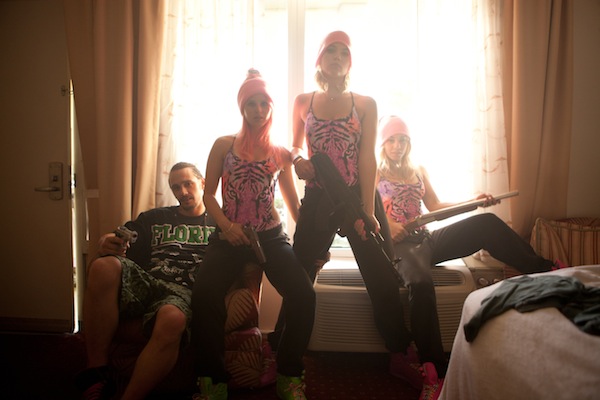
Spring Breakers is about a group of economically deficient girls who hold up a restaurant to get money for going on a spring break trip to Florida.  There, they party it up by drinking, doing drugs, and having sex at their leisure before being sprung by Alien (James Franco), a Scarface-cum-gangster who revels in excess and pulls them out of their comfort zone, until the more rebellious ones take control of the situation and become gangsters in their own right.

Harmony Korine has also stepped out of his comfort zone to make this saga of pop culture gone terribly terribly wrong, and terribly terribly right.  Where most of Korine's other work has been rough and raw depictions of humanity at its most fucked up, this is Korine recreating the romanticism and allure of all of society's youth marketing and presenting it in a dreamy fantasy, which is at odds with the condemnation we should feel towards this.  Korine realizes this, but doesn't pass judgement on it either.  It is at once completely alluring and toxic.  Energizing and disheartening.

The main reason it seems so freshly toxic to most is that Korine gave the agency and fragility to four young girls, at least one of whom was a Disney superstar destined to be changed out for another one.  Instead of a gangster movie being about men, it focuses on young girls, who also reveal their vulnerability throughout the film.  Most in society want to hug and protect the fragile girls and have them act like objects without their own strength and power.  If this movie had put college boys at the forefront, it would have been seen as purely distasteful boys will be boys.  But, by putting girls in the roles, and letting them be girls as well, Spring Breakers creates a wholly new dimension of feminism.

Korine, in the main Korine touch of the film, seemingly has no interest or invested meaning beyond "this is the state of what exists."  His script for Kids passed little moral judgement, even as a young teenage boy who had AIDS was going around fucking virgins and infecting them, even raping one passed out girl in her sleep.  It didn't celebrate this violation, nor did it condemn it.  It merely presented it as a thing that might happen.

In not passing judgement, and in choosing genres that celebrate rebelliousness, objectification, and empowerment, Korine is able to give four young girls agency, while frequently showing, in slow motion, guys pouring beer on topless girls' breasts.  His indulgence in these objectifications are at once to show that girls can be complicit in their own objectification, and that these girls can and do lead their own way.

In the second act of Spring Breakers, things get a bit hairy when Alien lets the girls out of jail.  He brings them to a party filled with black men, where the camera allows the little white girls to be leered at and they are shown to be uncomfortable in this objectification.  Here, Spring Breakers is also showing the racism that is present in culture, as well as the differences between wanted and unwanted objectification.  For the previous 20 minutes, we had been witnessing this group of girls, among others, show off their bodies and invite the leering gaze of other young, white, college-aged men.  Once we get into people who are twinged with blackness, though, things get a little worrysome for awhile.  The girls are somewhat pressured, but never accosted or pawed.  They are more safe in this party than they probably were at the spring break party where they were arrested.  They are in control of their facilities (given they didn't take any drugs), they aren't sources of sex for testosterone laden men.  But, the otherness of the black element adds to the tension that the girls, and, by extension, the audience feels.

Eventually, once at home with the showboating Alien, and dwindling the numbers as they send one girl back home, the girls take their own agency and pick up Alien's guns as their own.  They play with the guns, and even use them as phalluses on Alien, as shown in the photo.  Here, women are taking control of their own agency and controlling the penis as well.  Is Korine trying to say that the penis/gun is the only way to get all power and agency?  Or that the penis is merely a collective cultural symbol for power and agency, and that any woman who wants to take control of their own destiny is free to do so?  Or, is Korine playing with heady fetish imagery and possibly inverting the gender for maximal impact?  Could it be all three?  Are we as turned on by women wielding a phallus at a guy as we are at a guy wielding a phallus at a woman? If this movie wasn't presented as pure fantasia - by way of repetitive dreamlike voice-overs, repeated footage, time lapses, and over lush cinematography - would we have less of a problem with it, or more?

Spring Breakers, has all of these messages, questions, and more compressed into a tight and electrifying 93 minutes.  If you want to see a statement on sexual politics in the mainstream, this is the movie you need to be watching.  It is as exploitative as all get out...but so is youth culture.