Showing posts with label Absurdist. Show all posts

Thursday, April 10, 2014

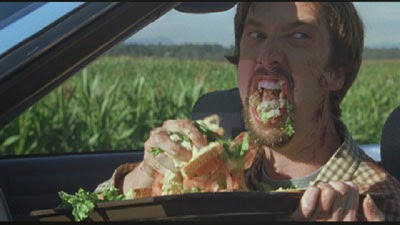
Freddy Got Fingered (2001): Dawn of a New Media

Freddy Got Fingered (2001)
dir: Tom Green

Walking out of Freddy Got Fingered in 2001 with an anime obsessed geek who was willing to go see this...thing with me, we argued about whether or not this movie was good. My friend commented that it wasn't a good movie, but there were funny bits, specifically the constant maiming of a neighbor boy around the age of 8.

What neither of us fully realized was that MTV and Tom Green in general, and Freddy Got Fingered specifically, were the middle steps in a cultural evolution that is still continuing to this day. Freddy Got Fingered isn't just a love letter to the ADHD embracing, stupid-loving, non-sequitur obsessed stoner who were already obsessing over the seemingly mature juvenilia that MTV was sputtering out in between music videos; Freddy Got Fingered was written and directed by seemingly one of these stoners who loved seeing somebody take the piss out of life. Oh, and it starred him too.

Tom Green had originally started out on cable access in Canada with a Candid Camera-esque prank show where he frequently played pranks that preyed on the manners of polite society, and frequently would use his parents as props in the show. This formula would be repeated in Bam Margera's Viva La Bam who would blend Tom Green's show with Jackass.

The Tom Green Show would be picked up by The Comedy Channel (a Canadian channel not to be confused with Comedy Central) in 1996, and then picked up by MTV in 1999. At this point in MTV's history, Jackass hadn't aired yet, and MTV's main claim to fictional tv show fame was Daria and Celebrity Deathmatch. They were still airing music videos with programming like 120 Minutes and were starting to get really happy with the reality programming with Road Rules and Real World.

In reality, almost everything that happened in one segment of popular culture can be traced to three television shows. One on MTV and one on Cartoon Network. These shows would start to define the warped senses of humor of the youth of America. On MTV was Liquid Television, and on Cartoon Network was Space Ghost Coast to Coast.

In 1991, MTV put out a show called Liquid Television, which captured a weird zeitgeist of the adult animation shorts that had been previously been delegated to obscure VHS tapes. Liquid Television was a mix of original and festival shorts that were sometimes separated by a pair of lips overlaid on static making some brief snarky comment. Occasionally, there were long-running recurring segments, like the whole first chapter of Aeon Flux, but the majority of the content were episodic or individualized. Liquid Television was the launch pad for both Mike Judge and Bill Plympton.

What Liquid Television represented was an anarchic humor that was just plain...weird. One moment you could be watching a segment called Stick Figure Theater, where stick figures drawn with a note card background would re-enact famous movie scenes or music videos. The next moment you'd be watching a highly-detailed sci-fi epic. The next you'd be watching a cheap stop motion short of a biker chick on a revenge bent. It distilled all of pop culture into an intense half hour of short snippets. That everything was in a different aesthetic helped separate one from the next, and it became a Gold Standard show that was far too short-lived for how good it was.

From Liquid Television, we would get Beavis & Butthead, Aeon Flux and The Maxx. These would eventually lead to Daria, and, spiritually, The Sifl and Olly Show. But, Liquid Television would be cancelled by 1994.

Meanwhile, the year prior, in 1990, Spike and Mike would add the Sick and Twisted festival to their Classic Animation festival, which would be a throw everything at the wall and see what stuck. Spike and Mike had an eye for quality, but they would frequently throw things that just seemed out of left field creating a hodgepodge of animation aimed at adults that was just as ADD as Liquid Television. This festival is still staggering along, though not nearly as popular as it once was.

In 1994, Cartoon Network would create the long running late night talk show Space Ghost Coast to Coast which was hosted by a 1960s superhero and his enemies. The talk show segments were full of absurd interviews that had little to do with the real life celebrity interviewees, and frequently interrupted for warfare between Space Ghost and his bandleader/enemy Zorak and director/producer/enemy Moltar, both of whom openly hated Space Ghost.

Space Ghost Coast to Coast was just as non-sequitur as Liquid Television, but it was a 15-minute show, and the humor was constantly pure absurdism. Space Ghost would interview the celebrities as if they were superheroes, or if he didn't know anything about them. Zorak and Moltar would constantly prank and antagonize Space Ghost, sometimes under the guise of escaping but mostly just to antagonize Space Ghost. There was barely any coherence to the shows, and were frequently over before you could adjust to the tone of the series. Space Ghost Coast to Coast would lead to the creation of Adult Swim in 2001, with equally absurd and antagonistic shows such as Aqua Teen Hunger Force and The Brak Show.

Just to recap: two networks were airing antagonistic absurdist shows with short segments that developed cult followings that led to other antagonistic and absurdist shows. Both networks were aimed at youth and generally ignored by the adults at large.

In the mainstream networks: Big Brother premiered in 1999, and Survivor premiered in 2000.

And, so comes Tom Green in 1999.

The Tom Green Show wasn't a product of these shows. It was one of these shows. The Tom Green Show was a prank show that reveled in absurdist pranks that played around with what was supposed to be polite and mannered. It was more anarchic and confronting than most that had preceded it. In it's MTV incarnation, it took on the form of a chat show with Tom as host and relating new and old segments from the Comedy Network incarnation. The show was generally reviled by critics, though embraced by youth.

And, so comes Freddy Got Fingered.

To correctly gauge this film, one has to place it in it's time. Jackass didn't appear on television until October 2000. The Tom Green Show had been off the air due to both testicular cancer and Freddy Got Fingered filming. 6 months after Jackass, in April 2001, movie theaters would see Freddy Got Fingered. And, 6 months later in October 2001, Adult Swim would finally premiere on Cartoon Network. On a similar note, Fear Factor would premiere in June 2001.

The timeline, thus far:

  • 1990: Spike and Mike's Sick and Twisted Festival, underground
  • 1991: Liquid Television, MTV
  • 1993: Beavis and Butthead, MTV
  • 1994: The Tom Green Show, Cable Access
  • 1994: Space Ghost Coast to Coast, Cartoon Network
  • 1996: The Tom Green Show, Comedy Network
  • 1997: The Sifl and Olly Show, MTV
  • 1999: The Tom Green Show, MTV
  • 1999: Big Brother, CBS
  • 2000: Survivor, CBS
  • 2000: Jackass, MTV
  • 2001: Freddy Got Fingered, Nationwide Theaters
  • 2001: Fear Factor, NBC
  • 2001: Adult Swim, Cartoon Network
...

Freddy Got Fingered is both a product of its time and a herald of things to come. But, what is it? It is a blend of the manchild narrative, the grossout movie, and absurdist cinema of Luis Bunuel. 

Tom Green plays Gord, who lives at home with the dream of becoming an animator. When he's rejected, he comes back to live at home (at the age of 28) after having been out of the house for a handful of days to work on his animations, but gets stuck in a rut until he has an epiphany and gets his dream job. He's constantly at odds with his father, with whom he has more in common than is initially thought.

See? That's a pretty traditional manchild narrative. Arrested development makes his own way in the manner which he thinks is appropriate. What's in the details is what makes and breaks Freddy Got Fingered

The first thing we see is a fake out intro that would later be cribbed by Trey Parker and Matt Stone for Team America: World Police, by having amateur sketches on paper while Tom Green makes absurdist comments. Then we pull back to find Gord lying on his bed making himself giggle while telling these stories to himself. And, so we see the beginnings of the antagonistic humor that poked fun not just at the characters but at the audience, a technique that Bunuel used to great effect frequently by subverting people's expectations. The opening credits play over Gord skateboarding through a mall, being chased by the cops, which continues the antagonistic thread that plays throughout the film.

Then, on the road, he is driving from Portland to Los Angeles on some road that isn't the 1, the 101, or I-5. We're not on the main path here. And, he sees a car, comes to a screeching halt at something off screen, then jumps out to jerk off a horse. For no reason. And, so we get to the grossout film...in scene 3.

And, that's the whole entire pattern of Freddy Got Fingered, a manchild narrative that frequently takes completely absurdist stops to attack, offend, or attack and offend either somebody or the audience that has little to do with the actual movie. The movie comes to a screeching halt so that Gord can deliver a baby and swing it around the room by its umbilical cord. The movie comes to another screeching halt so that Gord can beat his paraplegic girlfriend's shins with a rod. Or, so the neighbor boy will get increasingly injured throughout the film.

For an 87 minute movie, Freddy Got Fingered has a hell of a lot of these non-essential scenes that eventually build the main story of Gord finding his way to manhood. Not maturity, because he doesn't ever mature; he just finds success doing it his way, and continues to antagonize his father.

The main problem is with the quality of filmmaking on display, which sometimes is just downright atrocious. I'm not sure if it is the DVD, but there's an early exchange between Green and Drew Barrymore, where he's telling her that her boss' wife is dead and the whole image changes between angles. Green is lit well and bright and sunny, but Barrymore is underlit, overexposed, and grainy. 

The ineptitude of Freddy Got Fingered gets in the way of solid defenses of the movie as an absurdist work of genius. It seems like Green made the film on the fly with little respect for quality or time for dailies. So, how does one come to the defense that seems so openly antagonistic and of negligible quality?

It's an anti-comedy. And, it's in a style that few people actually appreciate. It was used in The Exterminating Angel, a movie where the hoi polloi couldn't leave a party because of manners, and end up tearing down the house. Andy Kaufman would make use of this in his standup in the 80s, which would be revived with Man on the Moon. But, it wouldn't find its audience until Adult Swim, which trailed Freddy Got Fingered by 6 months.

Adult Swim is nothing but 11 minute shorts of side stories that sometimes make up a semblance of a story. Aqua Teen Hunger Force, for example, had a series finale of a pool that filled with blood caused by a house being built on an ancient burial ground, revealed by the Cybernetic Ghost of Christmas Past From the Future. The house would be purchased by Glenn Danzig. In 11 minutes.

Freddy Got Fingered is short attention span theater at its finest. It's hilarious if you find it funny, and it's quick and doesn't overstay its welcome, though Green has been threatening to ruin that. Scenes will sometimes stretch into set pieces, and set pieces will shorten into brief scenes. The pacing is unexpected but never offensively off the wall. Unless you find the humor tiresome, in which case you'll hate the film.

But, it's hard to deny Freddy Got Fingered its place in history. And it's certainly discernible from other films it has been surrounded by. It's a film you'll love or hate based on your sense of humor. If you're not a fan of attacks on the audience, you'll hate this film. 

Thursday, March 27, 2014

Paprika (2006): A Tale of Two Cities, With a Little Bit of Spice

Paprika (2006)
Dir: Satoshi Kon

The final finished movie of the late, great, Satoshi Kon was 2006's Paprika, a film exploring the space between what are considered to be polar opposites: reality and dreams. It was a continuation of Kon's fascination of the spaces between, as well as what perception is to reality, as he previously explored in Perfect Blue and Millennium Actress. Kon, as always, is also fascinated with the exploration of film itself, and the storytelling devices within, including meta-filmmaking, and what it means to make a meta film.

The title character Paprika is a dream-world alternate persona created by the psychiatrist Dr. Chiba for use during dream sessions with her patients. Where Dr. Chiba is a serious woman with black hair and a stern, professional demeanor, Paprika is a redhead with bright clothing and a chipper demeanor. Using a new device called the DC Mini, Dr. Chiba is able to insert herself into her patients' dreams to analyze them and to create a deeper connection.

Somebody has stolen a few extra DC Minis, and is using them to start penetrating even the waking conscious of anybody who has used the DC Mini at any point to pull them into a singular dream world. That dream world is a chaotic parade of toys, technology, and symbols marching to...somewhere, absorbing and destroying any and all of the participants that it brings into its reality. Now, Dr. Chiba, her boss, and Dr Tokita, the inventor of the DC Mini, must figure out who stole the DC Minis, and stop them from taking over the minds of the world.

Of course, that description barely even scratches the surface of what Paprika does, which is float in between reality, dream world, the internet and cinema with a reckless abandon that is breathtakingly fluid. The relative straightforwardness of the plot is just a device on which Kon hangs his favorite obsessions. He opens the movie with a dream collage based in several different movies establishing a detective character and patient through his recurring nightmare. Then, it flows right into a dream-like reality opening credits sequence where Paprika breaks all the laws of reality as the credits are projected onto the reality of the buildings.

Kon's obsessions with where real life ends and our perception begins causes the worlds to beat and bash at each other throughout the movie, creating an almost hallucinatory sense of what is actually being put on screen. Which is exactly what the medium of animation should be used for: to create a fully integrated world where reality isn't what it could be. Like Spirited Away, the animation used in Paprika creates a fictional world where it feels like anything can happen.

Kon's intentions is purely to have fun and a nightmare world is part of that fun. If you're frightened, grossed out, offended...it's all part of the game that Kon plays with his audience. Those feelings are the opposite of the light-hearted, carefree feeling that much of the film creates. All of this adds to the themes of opposites - old vs young, new vs old, technology vs luddite, dreams vs reality, man vs woman, good vs evil, fat vs skinny, mental vs physical, life vs death, etc. - that Kon injects throughout Paprika. Even in the parade, old fashioned Japanese toys mix with robots, and refrigerators lead the dolls. Kon seems to be calling for the new Japanese culture that has been brewing since before the '00s to not completely reject the old Japanese culture it seems intent on ousting. What Kon wants is a culture that is based in the new but doesn't forget the old, and has a bit of a twist to it all in order to make things original.

Paprika is a movie to obsess over. There's a lot of information to process the first time through as you're being pulled in and out of the various worlds that Kon creates. It's a hell of a lot of fun too. It's only flaw is a single use of bizarre sexual violence to create a feeling of violation, but even that seems to be about emotional wreckage more than evil dudes just being evil. Leaving that little bit out, it is an excellent mind trip of a movie that remains Kon's most accomplished work.

Thursday, October 10, 2013

What Is It? (2005): Horror of the other

The Other Films Classic
(revisited)

What is it? (2005)
dir: Crispin Glover

Original Review (circa 2005)
The mere mention of Crispin Glover is enough to send some geek's panties in a bunch. His landmark appearance in Back to the Future as George McFly has sealed him into the American conscience forever. More recently, he has been trying to get back into the culty subconscious with Bartleby and Willard.

This time, however, Crispin has made a 76-minute, cheap dada film. At times it reminded me of genius, while overall it almost insulted me, but not because of its content. Content?

What Is It? is a movie where, in one half of the movie, all of the actors have Down's Syndrome, giving it a freakshow feel to it. The other half of the movie includes Crispin Glover, Adam Parfrey, and a guy with cerebral palsy. This all had the feel of what John Waters was attempting to do with Desperate Living, and simultaneously feeling more successful and failing miserably.

The half with the Down's Syndrome actors also features many many killed snails. It is about a guy who has snails, and ends up killing one. He is also tormented by a bunch of other people, and a grasshopper. He falls in love with 2 girls, one of which he has sex with in a graveyard. He also has a falling out with a friend who teases him.

In a weird semi-interior set, Crispin Glover is the director of this show. He is something like the control of the guy's mind, and the cerebral palsy guy is something like the sexuality. Well, he at least gets masturbated in explicit scenes. There is other "shocking" imagery made humorous, like Nazi Swaztikas crossed with Shirley Temple, and minstrels in black face saying they're Michael Jackson.

In the outside world, the tormentor is still dealing with his love of killing snails and being beaten by the other people. They beat him with rocks, and such. Later, they beat the minstrel after putting him on trial.

Back to the interior, Crispin Glover is still the ruler of his set, and tries to control everybody, but fails miserably.

What Is It? makes less sense than Dr. Caligari, and has more than a passing style stolen from it. The claustrophobic mental space feels very much like the way the no-wall sets of Dr. Caligari felt claustrophobic. They also had some dialogue that was absolute nonsense. And, it was all wrapped up with absurdist imagery for humor.

The problem is, about 20 minutes into the movie...maybe a little more...What Is It? runs out of imagery. For the next 56 minutes, we keep running on the same sets of images, only introducing new imagery in the form of an absurdist puppet show. The movie seems little more than a movie which attempts to push the envelope in offensive and taboo imagery. It tries to mock and confuse the audience. But, the issue is that it only has enough different imagery for a 40 minute movie.

Even worse than that, the cinematography, set design, and everything else felt very very cheap and almost unplanned. It felt like "OK, this is the way we can do it and get it out of the way." It didn't feel interesting, and was quite...boring. Dr. Caligari, on the other hand, had amazing cinematography and framing. The difference between the two is quite astounding.

Revisited
What Is It? is the first movie in a trilogy by Crispin Glover, who has only completed the first two movies, with the second being It is Fine. Everything is Fine! Having seen the second movie, It is Fine deals more with genre filmmaking and ripping apart expectations.  The only thing really linking the two are Crispin Glover and the actor with CP, who also wrote the screenplay for It is Fine.

What is It? will always suffer from the lack of original imagery to fill the running time.  In fact, I still believe in most of the review I wrote with little exception except for my take on the movie's nihilism and lack of meaning itself.  With a little bit more world view, one realizes Glover is using horrific imagery to create an absurdist normalization of horror movie tropes.  People with Down's Syndrome are automatically the other of society, and normally they would be the horror movie villains. Indeed, Glover is having them kill snails with impunity.

At the same time, Glover is attempting (though I still believe he was failing) in trying to show that the actual horror is selling out, and commercialization of the image.  This is why he had absurdist puppet shows with laundry boxes.  This is why he had Shirley Temple the Nazi, or the minstrel form of Michael Jackson.  It is all about crossing the horror with the commercialization.  In more recent times, he would be able to get away with showing images of Sandra Bullock with her Nazi boyfriend surrounded by satanic imagery.  It really doesn't add up to much except that Crispin Glover hates having to hock his image.

Ultimately, the Down's Syndrome people are the heroes and victims of the semi-existent horror imagery.  The villains are the society that sells people and makes everything into a taboo.  Because, by othering everything, including minstrels and Nazis, we are also othering those like the actors with Down's Syndrome.  This is an inversion of the usual imagery, which is why it seems so shocking. Well, that and the killing of snails.

It's still a movie whose intent is to shock, and it isn't shocking because it intends to.  Other people might be shocked by the loads of taboo imagery contained within, but the internet has been jading us. As an absurdist film, What is It? fails to keep things interesting for its relatively short running time, which is one of the worst things a film can do.

Available only as roadshow whenever Crispin Glover tours with it.