Showing posts with label Sexual Politics. Show all posts

Tuesday, September 24, 2013

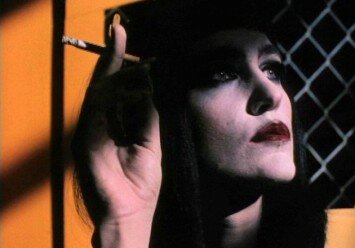
American Mary (2012): Feminism through Independence

American Mary (2012)
dir: Jen and Sylvia Soska

Last month, we had a variety of rape-revenge movies directed by men.  There was The Woman by Lucky McKee, I Spit On Your Grave by Mier Zarchi, and Ticked-Off Trannies With Knives by Israel Luna.  Ticked-Off Trannies had men either in drag or identifying as women getting raped, but the other two are women getting raped.  We explored the differences between them, and how the point of view of The Woman makes it much more problematic than I Spit On Your Grave, even if it shies away from the actual acts.

In 2012, Jen and Sylvia Soska made their second horror movie, American Mary, a rape-revenge horror movie they combined with the body horror genre, the Giallo genre, and the coming of age genre.  While the end result of this genre mashing isn't disturbing, scary or intense, it is moody, gothy, tense at times, and wholly fascinating.

American Mary refers to Mary Mason, a young medical student studying to be a surgeon of some kind. She has financial difficulties, and is targeted by her professor for various minor indiscretions, such as a phone ringing in class or missing a lecture. While the audience may think that some sort of reprimand is justified (letting your phone ring in class is just plain rude), Dr Grant seems to take special delight in making the reprimand seem personal and harsh.

In order to make ends meet, Mary applies to become a stripper, but due to a last minute circumstance, ends up performing surgery on a guy who has been tortured for whatever reason.  The motivations of a strip club owner torturing guys and removing their eyeballs is never made completely clear, but the owner says "no questions" and the movie just lets it flow.

Following this surgery, she is contacted by a stripper named Beatress, who has been getting plastic surgery to make her look like Betty Boop (if you squint your eyes).  Beatress has a friend, Ruby, who wants to be turned into a doll.  And, by "turned into a doll," Ruby wants to have her nipples and labia removed, and her vagina closed up as much as possible.  This is because Ruby wants to be idealized and not sexualized.

Meanwhile, at her residency, Mary is noted for her professional bedside manner, and is invited to a late-night after-hours party by Dr. Walsh...where she is drugged and raped (onscreen, briefly, but clothed) by Dr. Grant.  For whatever reason, she doesn't go to the cops, but drops out of med school, and decides to go into underground body modification surgery, where she eventually develops a good reputation under the name Bloody Mary.

But, first, she must exact revenge on Dr. Grant by performing her first BME surgeries (without anesthetic), including teeth filing, genital mutilation, tongue splitting, and amputation.  Weirdly, this series of surgeries happens offscreen, with a flourish of a body-mod hand drawing.

Bloody Mary becomes a bigger and bigger success in the BME community as time goes by.  She earns a reputation, and puts together a website, as well as does a series of surgeries on a pair of twins who run an influential website, or something.  The cops come snooping around the missing Dr. Grant.  But, they find nothing.

At some point, the movie mildly treads water in a reverse CSI mode, where we think the cops keep getting closer. When the movie has padded it's running time enough, it decides to kick in the finale. Finally, after all this time (which seems like weeks, if not months...especially since her reputation needed to develop), Ruby's husband sees the surgery she had, and kills Ruby, beats Beatress, and then attacks Mary, stabbing her.  But, Mary sews herself up to die of internal bleeding. Yeah, it is a bit out of the blue.

Outside of the completely left field ending, the movie is well executed and just plain moody.  It may be disturbing to people not into BME, but to those used to it, it is mainly just a picture about a girl who does surgery for awhile, with some detectives following her.  It's almost Giallo-esque, but it doesn't have the blood and gore scenes to back that up.  It's very body horror, but it rarely gets close to the surgeries to be in that horrific.  But, what it is is political.

In interviews, the Soska sisters have said that they started out as actresses where they would end up with bit parts that sounded like a Vivid resume.  Hooker #2 this, or Call Girl that. And, they wrote Dead Hooker in a Trunk to mock that.  Then, they wrote American Mary as a response to the idea that there really was no big named horror villain that was a female.  There was no real female equivalent of Jason or Freddy. And, in the vein of American Psycho, they chose to make the whole movie about the villain.

As such, they've made a movie about rape, rape culture, and feminine power in the face of it all.  While there are 5 speaking male characters, 3 are rather rapey (Billy Barker, Dr Grant and Dr Walsh) while 2 are rather nice.  And, Mary's only 2 "victims" are Dr. Grant and a security guard who comes across her and her post-surgery Dr. Grant.  Mary isn't a psychotic serial killer.  She just does body mods, and she is doing things her way.

The movie is also notable for its female point of view.  Some of the strippers who are at the club want to be strippers.  Beatress, looking like Betty Boop, seems to be making shittons of money stripping.  She is able to just randomly throw thousands of dollars on her friend's surgery ($12,200 to be exact) and provide some cocaine on top of it.  How?  I dunno!  And, the camera looks at female bodies, but is only lingering when a man is in the room.

It is all about the female perspective.

Wednesday, September 18, 2013

Bibliothèque Pascal (2010): Storytelling as Survival

Bibliothèque Pascal (2010)
dir: Szabolcs Hajdu

Bibliothèque Pascal would not be possible without Terry Gilliam.  Terry Gilliam is a consummate storyteller fascinated by the concept of storytelling. While he even had a Trilogy of Imagination - Time Bandits, Brazil, and The Adventures of Baron Munchausen  - many of his films deal with charletans, storytellers, liars, flights of fantasy, dreams, and downright delusions. From The Fisher King's medieval fancy to Tideland's fantasies of escape to The Imaginarium of Doctor Parnassus' incredible machine of generating storytelling, Gilliam has always been fascinated with stories where we're dealing primarily with the imagination of one main character.

Certainly, other movies made by people other than Gilliam have dealt with the imaginations of a single character.  Recent notable examples of these other movies include Pan's Labyrinth, The Fall, and The Cell.  All of these movies include flights of fancy, and the former two are fantasies to escape the reality of the world in which they live. The Fall even concerns a storyteller weaving a fantasy in order to entertain a little girl to entice her to get him drugs.  But, they all owe a great deal of debt to Gilliam, who, in turn, also owed a debt to Fellini though definitely not nearly as overtly.

Like all of these movies, Bibliothèque Pascal is all about storytelling. (Warning: full plot breakdown ahead, including spoilers) The movie opens with a young woman, Mona, in Romanian child protective services office trying to win custody of her child who has been taken away from her. Mona had left her daughter with her aunt to take care of while Mona was away. Subsequently, her child was seen performing for money, and subsequently was taken away from Mona's aunt.  Mona, back in Romania, is now trying to win her child back with this interview.  The CPS agent asks Mona what happened, and we're launched into a technicolor fantasy of her creation for the majority of the movie.

Years ago, Mona, who seems to be a Romanian gypsy or wanderer of sorts, leaves her cheating and jealous boyfriend to a different city, with a beach.  While on the beach, she is taken hostage by a wanted criminal who has recently murdered a man solely for being gay and kissing another man in public. This criminal is also a dream projector, in which he projects his most vivid dreams onto other people. During the kidnapping, he projects a love dream onto Mona, who is so enthralled she has sex with him before he gets assassinated the next morning.

Fast forward and Mona has a daughter.  She is making a living telling stories with puppets at fairs.  The story shown is an allegorical retelling of her history so far, with the above criminal being represented by a scorpion. With it, we learn that her mother died when she was young.

At the fair, she meets up with her father, who is shown hanging around the fair. Her father is a prostitute dealer, and needs to replace a girl he was going to sellt. He is first shown being rejected by a one of the hookeriest hookers you could imagine because London trade is rough.  When he meets with Mona, he tricks Mona into being the replacement by feigning an illness and the need to see a doctor in Germany. And, so she is sold to human traffickers who, in turn, sells her to Pascal, an affable chap who runs a swanky nightclub and brothel, Bibliothèque Pascal.

Inside the brothel, the sex workers (3 women, a man, and a boy) act out different literary scenes for their clients.  There is a Lolita, a Pinocchio, a Dorian Gray, a Desdemona, and Mona's first story: Joan of Arc.  As Joan of Arc, she has to act out the scene of penance with a subsequently forced sex scene acted out.  She is drugged between acts, and bites the tongue of Pascal when he tries to kiss her, causing her to be placed as Desdemona, in a rubber suit, to get suffocated and raped.

But, she is rescued by the dream projection of her daughter, which is the street performance her daughter was doing.  Her daughter was sleeping, and dreamed of creating a marching band, led by Mona's father, to rescue Mona from the library.  And, scene.

When the CPS guy doesn't believe her (for obvious reasons), she recants and tearfully tells her real story in short sentences.  She met the father on the street, but doesn't know who he is.  He gave a false name and job.  She had the kid anyways.  She had to work odd, menial, jobs to survive.  She thought she could make more money and a better living as a prostitute in Britain, and left her child with her aunt promising to pay her from her wages.  But, she couldn't make a living in London, and couldn't send her aunt any money.  Thus, to cover costs, her aunt made the child perform.  And, that gets her her child back.

The film closes with her and her daughter having a fantasy dinner, and her daughter happily eating and drinking air in a gorgeous technicolor kitchen. And, Mona subsequently puts her daughter to bed, where she tells a story about how all the princes and princesses in fairy tales had disappeared, and now they had to deal with reality instead of being allowed to live in their fantasies which added color and zest to their life.  And, we pull back to discover that this touching scene is actually in a model setup in a department store.

And, so, Hajdu has created a movie about a woman weaving and embellishing, or entirely fabricating, her life story in order to escape the mundanities of reality.  It is a movie that isn't even ambiguous between whether or not it is lying, but instead asks you if you'd rather hear another sad tale about single mothers and sex trafficking and sex work, or if you'd like this fantasy story where the good people are good, and the bad people are bad.  The sex work is horrible, but the brothel is fantastic (in terms of fantasy, not in terms of good).

In the flights of fancy, the sex work is brutal and abusive.  In the flight of fancy, Desdemona is suffocated to the point of unconsciousness or death before she is fucked by two strange men in rubber suits.  In the flight of fancy, there is also the auction of women of sorts for the johns to buy and sell. And, in the reality, Mona says that the work was lousy, the wages were pathetic, the rent was high, and the pimp took way too much of a cut of the profit, rendering it unsustainable.

The one thing it might get wrong is that it suggests it was easy for Mona to leave the pimp and the sex work when she was frustrated by it.  She just ups and leaves to return to her daughter.  Considering that she went to sex work willingly, this might be one type of reality, but it also ignores the reality of sex workers who are trafficked from foreign countries and forced into sexual slavery.

It also is an interesting painting of a woman's story as told by a man. Hajdu's wife is the star of Bibliothèque Pascal, and much of the inspiration came from her sitting in a Hungarian jail cell, on a vehicle registration charge, with a prostitute who would spend her time spinning bizarre yarns about prostituting in London.  These are the worlds we create in order to survive.  These are the worlds we create to escape how humdrum the struggle for life for some actually is.

The main problem people will have is the sex work, and the sexual violence are all in the fantasy.  Unlike, say, Pan's Labyrinth, Mona isn't escaping a violent fantasy world which is marked by war and murder.  Mona is embellishing to make her life seem less pathetic.  And, as such, it is presented pretty unabashedly.

It also is a tad rapey, and I can't get around that.  Even though the whole story was a flight of fancy in order to get away from rehashing another boring, pathetic life, the story was also meant as an embellishment to create sympathy from the CPS agent.  No, my daughter wasn't performing just for money.  Her performance was also a dream projection meant to rescue me from this horrible brothel where I was raped in the worst way possible!  This wasn't just any brothel, this was the most fantastic brothel you could imagine, with the most horrible rapey sex ever, including rubber sex.  Can you imagine?  The movie never portrays the rape in a good light, and it almost always portrays it from a third party camera view in the first person storytelling.  But, it is rapey...and it is almost rapey as a throwaway device, which is, ultimately, kind of a fault of the movie.

This is a sultry movie which goes through its paces of fast and slow.  It's like the jazz music that populates the movie.  Sometimes its slow, and almost lulling you to sleep, then it can be eclectic, and sometimes it can be zippy or bombastic.  It is also visually stunning, owing much to Tarsem's The Cell and The Fall. Bibliothèque Pascal is a gorgeous work, immaculately framed and conceived.  It's borderline messy in its plotting, but aren't all flights of fancy?

Friday, September 13, 2013

Popatopolis (2009): The state of the B-movie through behind-the-scenes

Popatopolis (2009)
dir: Clay Westervelt

"To do a low budget movie would take three weeks or a month.  Then, it became two weeks. And then they started shooting them in...a week..." - Monique Parent

Jim Wynorski.  A name which would live in infamy, if only he didn't have so many damn pseudonyms.  This is a man who has directed a minimum of 94 movies in 30 years.  He started out doing amazing schlock like yesterday's Chopping Mall, and The Lost Empire (a Ninja/Woman In Prison/Cop/Sci-fi/Killer Ape movie) and went through a decent B-movie phase noted by Dinosaur Island where a lost tribe of women worship a dinosaur.  Finally, he ended up in ultra-low-budget z-movie hell doing soft-core Skinemax porno the better part of the '00s.  The b-movie market had bottomed out, there was no money, and so Wynorski, with his love of the breasts, found himself doing the late night movies like The Bare Wench Project series, or The Breastford Wives.

In 2005, Jim had accepted a deal to make a movie in 3 days.  This movie would be The Witches of Breastwick, another softcore porno of negligable quality, mainly so due to budget and time constraints.  See, in Wynorski's ultra-low-budget hell, there is only time for minimum crew, minimum auditions and casting, minimum script writing, minimum equipment, and even sets.  This movie was filmed in 3 days around one house which did not have food or towels, and was out of range for cell service.

Popatopolis takes us behind the scenes of The Witches of Breastwick to show us that...making a softcore porno movie in three days with no towels and food really really sucks. Jim Wynorski doesn't care about this movie.  He cares about getting it done.  The movie is just a product, or a challenge, to him.  Which is a vast difference from when he used to care about his movies.  Or, at least when they seemed like he cared.  In 1994, he started making and releasing movies in bulk.  First four a year, then 6 a year.  His last movie not released among 2-4 others of his year was 1997's Against the Law starring Richard Greico and Kelly LeBrock.

Due to the time constraints, Wynorski is a short-tempered agitated, quippy man.  He is like a less tempered, but more rigid version of low-budget director Lloyd Kaufman of Troma fame (if you've ever watched one of those behind-the-scenes).  Unlike Kaufman, Wynorski knows where to direct his frustration, and how to finish a movie.

There are significantly memorable scenes in Popatopolis, such as the opening scene of Wynorski getting frustrated at an actress being late, and then going on a misogynistic rant about late actresses. Or, Julie K Smith not getting her lines dead on, and Wynorski not pausing to let her learn her line, but feeding it to her and then filming immediately.  He would repeat this for a very uncomfortable long period of time until she landed the line.

The whole process is a painful low budget excursion that really made for a not-memorable film.  But, it shows the state of b-movies in the mid '00s.  There was no channel for b-movies for awhile.  The home video market had dried up, and Netflix schlock hadn't picked up yet.  Syfy (then Sci-Fi) was just starting to come on board with their brand of schlock that has become infamous now with Sharknado.  B-movies were in dire straits.

After The Witches of Breastwick, Julie K. Smith would retire for a couple of years.  Wynorski would eventually go on to direct Cleavagefield (a particular favorite of mine, particularly for the song Pussy Pussy Bang Bang), Dinocroc vs Supergator, and Pirahnaconda.

If you want to see what happens when a man loses his taste for his passion but still has to do his job, this is the movie for you.

But, there's another aspect to Popatopolis that I have been slightly touching on but not delving into.  The undercurrent of misogyny and sexism that regularly occurs in porn, soft-core and hardcore.  At one point, while reading the script, Julie K Smith comments, "Whoever wrote this has a real problem with women." That comment actually has four layers to it: the viewpoint that The Witches of Eastwick is about women who are witches and need a man to survive, that soft-core and hardcore porno regularly objectifies and reduces women and men to sex objects, that Jim Wynorski is actually a misogynist, and that Ms Smith may be projecting part her frustrations with Wynorski onto the script.

In watching Popatopolis, one gets the idea that Wynorski can be a misanthrope when he's working.  He hates anybody who is pissing him off, either actively or not.  He screams at women and men constantly. He has negative things to say about everybody. But, he does have a tendency to also attack women with female-specific targets.  He objectifies women as part of his job on a soft-core porn set, but he also objectifies women in real life too.  It doesn't seem like he was always like this, though.  He used to have movies that contained strong women than didn't go around bewitching, drugging, and raping completely unrelated men for no reason.

The Witches of Breastwick has a plot consisting of a guy (played by Joe Souza) who is haunted by nightmares of three big breasted women who want to have sex with him.  He eventually goes to confront them, and they drug him and his wife before banging them. possibly against their will.  Which has almost nothing to do with The Witches of Eastwick, in which three divorcees share a man, whom they think may be the devil until he marries somebody else and they give her cancer.  Really, the book is truly problematic.

The Witches of Breastwick also has the side problem of being a soft-core porno made by a guy's guy aimed at guys.  It is meant to be a male fantasy aimed at reinforcing male fantasies about women.  In this case, a fantasy about three women who are so needy they will haunt your nightmares and then drug you to have sex with you.  Which leads credence to Julie K Smith's comment's that the writers have real problems with women.  In part, it isn't a healthy movie because it is a completely male point of view, with nothing to withhold the maleness, and even an incentive to maximize the maleness of the movie.

In the end, the movie, like any good documentary, is working on a bunch of different levels.  At the surface its a behind the scenes of The Witches of Breastwick.  Then its a character study of Jim Wynorski, and a review of his career.  Below that is a lament for the state of the b-movie.  And, worked in the edges is the sexual politics that comes with working as a female in soft-core pornography.

It's highly recommended, especially if you're fascinated by behind the scenes and movie making in general.

Monday, September 9, 2013

New Years Evil (1980): Horror on the TV

New Year's Evil (1980)
dir: Emmett Alston

1980s horror movies have a reputation for mainly containing acts of graphic violence perpetrated against women, while violence against men flinches. Obviously, this is more true in some movies than others. The two prime counter-examples in my mind are Johnny Depp's volcano of blood in Nightmare on Elm Street, and Kevin Bacon getting spiked through the neck in Friday the 13th. Then, there's New Years Evil.

New Years Evil has exactly one female character who lasts more than 10 minutes. That character is Blaze, the uh...heroine?...of the movie. Blaze is a punky mid-30s sexed-up rock show hostess who is throwing her show's New Years Eve party in a Los Angeles hotel, featuring a hell of a lot of crappy bands. Her husband is supposedly in Palm Springs getting coked up, and she's busy mildly ignoring her son who has an announcement five minutes before a huge televised performance. Oh, and Blaze's female assistant is killed before the opening credits, but everybody thinks she's just missing.

The movie is then split into two separate movies (but never with a split screen, unfortunately).  The first film is Blaze putting on her punk/rock n roll New Years Eve party.  Right as she starts, she is called by a guy calling himself Evil who states that he will be killing people. And, every hour on the hour, Evil calls back and torments Blaze with recordings of the murders he just committed, while leading the police on a goose chase to find the victims.

The second film is Evil calling Blaze and killing women on the hours.  He picks up girls, sexualizes them if they aren't sexualized, then kill them.  The murders aren't really all that brutal, though a cop states that all of the victims have had their breasts mutilated, and the killer has mommy issues.  To the movies' sole credit, we never see the breast mutilation, and even when we see the bodies, their breasts look intact.

Eventually, as was telegraphed from the opening scene, and the repeated mentions throughout the film, the killer is revealed to be the missing husband, who's goal was to discredit and murder his wife for being a sexed up workaholic bitch who ignored his needs and the needs of their son.  The husband plans on killing Blaze by chaining her beneath an elevator, sending it up to the top floor, then sending it back down to crush her beneath it.  Because formula dictates, he fails, but the message was received.

With horror movies, especially in the '80s, the killer was the tool to implement conservative values upon transgressing victims (generally teenagers).  New Years Evil is no different.  In 1980, we were already seeing the backlash of the feminist movement, as women moved from behind-the-scenes mothers into public-facing tough women.  1979 has Kramer vs Kramer, which posed the wife as needing to leave her entire family to "find herself" and gain her financial independence.  Four months after New Years Evil, William Adler would release his novel War of the Roses, which, unlike the movie, was a screed posed against the ambitious Barbara Rose for daring to try to make a company of her own selling pate.

In this light, New Years Evil was a movie that was violent against both sexualized and successful women.  The first murder is Blaze's female assistant, a moderately successful woman serving another woman.  The second murder is a psych ward nurse, whom Evil had seduced.  The third and fourth murders were a pair of semi-ditzy sexed-up women whom Evil had picked up at a bar.  The fifth murder was a teenage girl who had been heavy petting with a boy at a drive in.  And, then there's the torture of Blaze.  These are all of the females in the entire movie.  Let me repeat that for posterity: these six victims were the only women in the entire movie. And, there were no men who were victims.

New Years Evil becomes a screed against the sexualized woman, as is usual for 80s horrors.  Unlike most of the horror movies, the man who is also doing his share of sexualizing the women is not victimized or murdered.  Indeed, in most of the cases, the sexualizer in New Years Evil is the murderer.  Only the drive-in teenage boy is sexualized but is not the murderer, and is also not victimized (except for having his car stolen, which, really, doesn't count in a horror movie).

But, worse than that, New Years Evil is a screed against the successful woman, embodied by Blaze.  Blaze is a woman who is married, but neglects her family for her job, which, if she was a man, would normally be the symbol of patriarchical success in movies of old.  Men are regularly neglectful of their family in the service of their successful jobs. Blaze, because she is wife and mother, isn't allowed to be successful, or even mildly neglectful. She's not allowed to be distracted by the oncoming four-hour-long televised show that will she is the host of.  No, because she is wife and mother, she has to attend to her son's needs even though he's coming to her 5 minutes before she has to go on the air.

New Years Evil is actually a hugely misogynistic horror flick, seemingly even more than usual.  Which is a shame, because it is actually a clever idea for a film in general.  As a sort of slasher radio show, it could have been amazing, especially if it wasn't so reactionary against both sex and success in women.  But, the movie is bogged down with the need to murder women, and to rail against successful women.

Plus, it's actually kind of bad.  It's not laughably terrible, except for a scene with the murderer hiding in a dumpster.  It does have some cheesy, overdrawn lines.  But, the movie isn't actively offensive in quality.  This is just merely average to bad in quality.  It isn't recommended for gore.  It isn't recommended for humor.  It isn't ironically enjoyable.  It isn't actively good.  It is a wasted idea that never quite took off the ground.

The main purpose of the movie, now, is to exist as a statement of what men thought of feminism in the early 80s.  It shows the patriarchy's reaction to women attempting to succeed.  And, it's a valuable tool for that tye of cultural statement.  For actual enjoyment, stay clear.

Tuesday, September 3, 2013

Dr. Caligari (1989): Where Satire, Arthouse and New Wave collide

Dr. Caligari (1989)
dir: Stephen Sayadian

"I have beauty inside me. But, oh, when beauty is trapped, it gets ugly."

Picture this.  Burning Man.  2000.  Wandering around the festival, my friend and I stop in at a tent that was something like Bad Movie Camp. They were showing terrible movies all night.  Wandering around, half crazed because you've just been fried all day, and are now freezing your ass off, you stumble upon this tent, showing a movie you've never heard of, or seen a trailer for. This movie is surreal and bizarre and hilarious and fascinating.  It is in a grotesque toxic dayglo neon color scheme, with stilted, dramatic acting. Suddenly, they bring out a cake, and cut into it, and it has a pulsing blood thing.  Next thing you know, out comes Fox Harris in a Marilyn Monroe wig demanding to be called Babs.  And...yeah...I was hooked.  This totally-blitzed-out-of-your-mind, not-knowing-what-you're-watching mode is the best way to see this movie.

Go.

Rent it now.  Buy it from the porn website Excalibur films (which is the only way to buy the DVD).  Watch it before you  read the next sentence.  This may excite you in ways you have no idea you have ever had.

But, since you're here, I might as well tell you why this movie is so good, and why you should look into it.

Yes, this was my first venture into the world of Stephen Sayadian and his pseudonym Rinse Dream. And, also my first venture into the world of Jerry Stahl (you know, other than ALF).  Stephen Sayadian, as Rinse Dream, was a hit in the world of hardcore Gonzo porn.  Gonzo porn?!  Yes, gonzo porn.  His most successful film, including Dr. Caligari, was a sci-fi porn apocalypse flick called Cafe Flesh.  Unlike more porns, this actually had acting and a semblance of a thought out plot.  The titular Cafe was the result of a deadly accident that had severely hobbled the world, and made sex fatal for 95% of the population.  The remaining 5% were instructed to put on elaborate sex shows for an audience.  And, the elaborate sex shows include a guy dressed as a #2 pencil having sex with a woman while another naked woman is using a steno writing machine while repeating "Do you want me to type a memo?"  A different sex scene was sampled by White Zombie for the opening of More Human Than Human.

Sayadian and Stahl had first started working together on the gonzo porno Nightdreams, which had a woman who was oversexualized being locked up in a mental institution and having her dreams monitored.  This led to all kinds of weird surrealistic scenes which include a talking fish, and phallic masks.  The movie is best remembered for the scene where a woman fellates a box of Cream of Wheat while a piece of toasted Wonder Bread plays the saxaphone in the background.  No, it exists and is on the internet (NSFW, but not a porn blog).

But, I didn't know any of this at the time.  All I knew was this movie, which I found out was called Dr Caligari, was amazing.  I had to see it on my own.  And, I found it.  And, it was good.

Dr Caligari, like Nightdreams, is about a woman, Mrs. Van Houten, who is oversexualized and is forced into an institution for having an overstimulated libido which leads her to have overly symbolic hallucinations.  These hallucinations include making out with a giant flesh wall, baby masked guys in bubble baths with razors, or pulsating, bleeding sores that sprout up on her body.  She is committed to Caligari's Insane Asylum by her politician husband, who isn't even trying to have sex with her.

The CIA is filled with other freaky sex types, most notably John Durbin as a child molesting murderer.  Dr Caligari, the granddaughter of the Dr Caligari from the German expressionist classic, is doing weird experiments on her patients.  The other doctors, a family headed by Fox Harris, are planning a coup because of it.  But, before they can overthrow Caligari, she instutes a variety of brain transplants, which leave Fox Harris as a sex pot wanting to be called Babs, John Durbin as an effeminate bitch, and Mrs Van Houten as an oversexed criminal.

All of this is almost secondary to the experience of just plain watching Dr Caligari, which is like a surreal nightmare dreamed up at some intersection of Forbidden Zone, The Cabinet of Dr Caligari, Eraserhead, and 1980's New Wave love of neon and sex.  The sets are all German experessionist pointy and shadowed and representational. The acting is straight out of some weird sleazy European art film. The reality is as surreal as Dali or Lynch.  And, the plot is as political as it can get without being overt.

No, really.  Political?  A movie which has a woman getting her hand melted by a scarecrow's pants, and then anally raping her husband is political?  I mean just that sentence is political.

In American society, women are supposed to be asexual.  Women aren't supposed to have overstrung libidos.  They get called sluts and whores.  Even today, promiscuous women are still punished for their desire to have sex. And, in the world of Dr. Caligari, women are locked up by men for their overt desire for sex. Les Van Houten, Mrs. Van Houten's wife (who doesn't even get a first name in the credits), is a politician who worries she is having an episode, when all she wants is a bit of shagging. And, when he first calls Dr Caligari, she first starts drilling him on the sex that Mrs. Van Houten is actually getting, asking for number of orgasms and whether they're "clitoral or vag."  But, Dr Caligari accedes to the commitment anyways.

Later, Mrs. Van Houten's libido is transplanted with a murderer's impulses, because to be violent is better than to be horny. And, Dr Caligari is also playing with identity and agency in her own self.  She's wearing a yellow dress with giant metal balls as cups.  I'm sure it isn't a coincidence that this look would kind of be appropriated by Peaches in Peaches Does Herself.  It's a take on the tits as bullets, and almost as a warrior statement. Dr. Caligari is a woman who is ruling her sex and her life.  She's also seen getting cunnilingus from a patient.

The world of Dr. Caligari is completely against the sex negative culture of the United States. It mocks the point that we're restricting sex to those who are in control of it.  We don't know why Les Van Houten isn't giving Mrs. Van Houten the ol' in-out, but in the world at large, nobody cares.  Wanting sex is bad, and it is his wife that's at fault. But, luckily, Sayadian gives Les his just desserts in the end, by way of his wife.

The movie is Cult.  And, I mean Cult.  The only reason I found it on DVD was because I discovered somewhere that the producer was an owner of Excalibur Films, which does hardcore porno, and was distributing it on the DL exclusively through there.  They were also putting out Nightdreams, which I also highly recommend pairing as a two-set.  You won't find them that erotic, so don't prepare for a night of unable to control yourself handsiness.  But, they are intriguing in their satire of the world they were made in.

Tuesday, August 27, 2013

Ticked Off Trannies With Knives (2010): Tranny as Victim and Victor

Ticked Off Trannies With Knives (2010)
dir: Israel Luna

This could also be better known as Day of the Tranny.  While Ticked Off Trannies With Knives is an amazing exploitation title, Day of the Tranny would be better because a) it acknowledges the deep deep debt it owes to I Spit On Your Grave, originally titled Day of the Woman and b) it doesn't reduce the victims to mere exploitation punch-lines. While the title is certainly sensational, it also belies the actual subject of the movie, which is a rape/murder-revenge fantasy that mirrors I Spit On Your Grave in terms of its harrowing nature and its possible empowerment messaging.

I could basically just write ditto on yesterday's I Spit On Your Grave review, and it would be completely accurate.  Well, not completely.  This has a bit more style, pizzazz, and personality than I Spit On Your Grave, which works to simultaneously humanize the victims, and actually be a better movie.  Oh, and I would have to replace Roger Ebert and Gene Siskel with GLAAD.

Ticked-Off Trannies is about a group of trannies - drag queens, transvestites, or transgendered people; in this movie, its more the first two - who go off on dates with a group of bio-gendered men, only to be drugged, beaten, raped and murdered, leaving one survivor.  This survivor and two more of her friends set traps for the rapist-murderers in order to exact bloody revenge.  Much like I Spit On Your Grave, that's the thick and thin of the plot.

Because of the title, Ticked-Off Trannies With Knives received a LOT of undeserved attention for being reductive of the perils that come with being a drag queen, transvestite or transgendered person.  In real life, they usually sit on the outsides of life, and are the target of bigoted attacks or murders.  One prominent example was in the movie Paris is Burning, a documentary about the Harlem ball culture of the underground LGBTQ scene, where one of the prime subjects of the movie, Venus Xtravaganza, was found strangled underneath a bed four days after she was murdered.  This is not a punchline.

And, Ticked-Off Trannies, despite its title, does not treat this situation like a punchline.  Much like I Spit On Your Grave, this is a harrowing, gut-wrenching experience which scars your soul.  It brings attention to the situation of violence against trans people, and also alludes to the idea that there is no justice for the outsiders of the world.  Much like I Spit On Your Grave, Ticked-Off Trannies alludes to the idea that the best justice is your own justice.

Luna acknowledges his owing to the movies of the '70s, as well as his inspiration from the Rodriguez/Tarantino movie Grindhouse. He rips through this classic exploitation flick and stylizes it like it came out of the grindhouse of the '70s.  Luna does have some gags to speed the movie up, like a missing reel gag, which brings a bit of humor to make the harrowing experience a less bitter pill to swallow and make it slightly more appealing to the masses.  Slightly.

Also, like I Spit On Your Grave, the rape/murder is excruciating, but it also comes back to identity.  As a member of the LGBTQ community, I found it harrowing and easier to identify with the victims.  And, it is the victims' story.  Luna doesn't allow the rape/murder to be intentionally vicariously enjoyed. He makes it as brutal as tense as one can in a horror movie.  But, that doesn't mean it can't be enjoyed by the sick portion of the population who are determined to enjoy the torture and rape of another human being.

Is this problematic?  Again, it's up to you to decide that.  This is decidedly not a movie to encourage or make light of the violence the Ts face in everyday life.  This is a movie that brings this to attention, and doesn't even give the pat justifications of a movie like Boys Don't Cry, where the FTM transgendered person lied to everybody around her.  Ticked-Off Trannies gives a full-on exploitation experience that brings attention to the issue, and also gives a revenge fantasy when it could be needed.

And, I repeat, due to its stylization, it is less soul searing than I Spit On Your Grave, but not much isn't really.

Monday, August 26, 2013

I Spit On Your Grave (1978): Woman as Victim and Victor

I Spit On Your Grave (1978)
dir: Mier Zarchi

In 1978, a movie was self-distributed titled Day of the Woman.  Later, it was picked up for slightly wider distribution, and re-released as I Spit On Your Grave. The impact of this film was both solid and null, thanks in large part to its graphic nature. Roger Ebert and Gene Siskel rallied against this movie, calling it depraved, and immoral.  They considered the violence to be purely exploitative, and just as damaging to women due to their perception of the exploitative nature of the rape.  They were wrong. Maybe.

I Spit On Your Grave is one of the most disturbing and harrowing movie experiences one could find.  I remember the first time I encountered the movie.  In my film class, we had just finished watching Last House on the Left, the old Wes Craven rape-revenge movie that Americanized and politicized Ingmar Bergman's The Virgin Spring.  I had commented that Last House wasn't as shocking or brutal as I had been expecting, and was softened by the comic relief of the police, the hick music, and that the torture was way more psychological than I had been expecting; the result of the politicization of the subject matter.  My professor handed me a semi-bootleg of I Spit On Your Grave, and this had been the movie I had been expecting.

I Spit On Your Grave is a raw, amateur rape-revenge movie that does not flinch from nor does it glorify the act of rape.  It is a 100-minute movie, but it has no plot development beyond big city female author comes to backwoods, gets gang raped, and exacts bloody revenge.  But, the tonality of the film sets it apart from other files of its ilk, like Last House on the Left, The Accused, and Ms. 45.  

I Spit On Your Grave features a grueling and excruciating 24 minute sequence of Jennifer, the main woman, being repeatedly trapped, raped, and freed by a group of four men.  There is no soundtrack.  There is no joy in this sequence.  There are amplified volumes of the woman screaming.  There is no silly thwaping sound that would reduce the horror, or hint at any eroticism, on screen.  There are distorted close-ups of the faces of the male rapists, not distorted enough to be cartoonish, but enough to be frightening.  It is a harrowing experience from the victim's point of view.

Then, we get a bit of downtime before we get a 30 minute sequence of Jennifer ensnaring the men and then brutally murdering them.  Unlike the rape scenes, this is filled with semi-heroic imagery and are primarily from the perpetrator's point of view: that of the woman.  These are much more filled with victory and resolution than the rape, which is filled with horror and dread.

As such, I Spit On Your Grave is intended to be almost a feminist fantasy tract where it shows how brutal men are to women, and it also shows that a woman is perfectly capable of extracting her own revenge.

It's problematic in its text, but it isn't nearly as problematic as Lucky McKee's The Woman.  In The Woman, McKee is attempting to take a point of view of a judgmental third party, but mainly focuses on the "civilized" family.  We have a lot of point of view shots from both victim and aggressor.  It becomes seriously problematic in terms of how to process the crimes we are seeing on screen.  Are we supposed to be encouraging the misogynist?  Are we supposed to be empathizing with one party over another?  Only by going over the top has Lucky McKee achieved any level of distance between the viewer and the aggressor.

In I Spit On Your Grave, Zarchi never gives us the point of view of the rapist.  We never lust over Jennifer's body.  There aren't long lingering shots that romanticize the woman's body during any of the rape sequences.  These are raw and brutal acts that pierce your soul, if you're watching it right.  On the other hand, due to the nature of film, it is often a third-party camera.  There is a way, if you're sick enough, to enjoy this rape sequence for the act of rape itself.  I'm sure there are people who watch it and say "yeah, that's how it should be done" even though it is another person suffering.

Therein lies a rub.  Should an act be depicted if somebody else can get vicarious pleasure from it?  Should the depictions be more like Natural Born Killers, where we can take the viewpoint of the killers, even as Oliver Stone is trying to condemn our consumption of the act? As in Irreversible, should these brutal acts be depicted in an distant way?  Should it be more like Fight Club's final edit of Angel's face breaking, where the act happens mainly off-screen, denying the viewer any vicarious thrill from it, and leaving it to the imagination?

These are actual questions that will always be up for debate, and have answers that probably differ between people, and between acts, and between movies and intent.  But, in the case of I Spit On Your Grave, Zarchi didn't make this movie for the pleasure of showing rape.  He made it to depict a revenge fantasy.  He wanted a strong woman in it to exact her own revenge.  And, once the revenge is done, the credits roll.

Friday, August 23, 2013

The Woman (2011): Text vs Subtext

The Woman (2011)
dir: Lucky McKee

The problem with indulging in the text as you're condemning in the subtext, is that sometimes the condemnation message is lost in the actual commentary.  Spring Breakers suffers from that a little.  Natural Born Killers suffered from the rampant indulgence in lurid violence while trying to condemn it.  And, then, there's The Woman.

Given that the majority of movie goers, especially horror watchers, will rarely indulge in seeking out the back history of a writer or director of certain movies, it is necessary to take movies out of their authorial context, and analyze it on its own merits.  Lucky McKee is a writer and director of many movies that have affinities for women.  May, for instance, is a movie about a girl who is strange, and can't deal with the friends who have masks. If we lean on McKee's strong feminist tendencies, then we have an obvious answer about what the movie is trying to say, but it still requires parsing out whether the subtext of the condemnation supercedes the actual text of the movie.

The title character of The Woman is a feral girl who is found in the woods by Chris Cleek, a family man and lawyer, who is also very controlling and demanding of his family of 2 daughters and a son.  Cleek sets up his backyard cellar to hold The Woman hostage, under the auspices of "civilizing" her.  As per this formula, Cleek sets upon destroying The Woman to try to bring her to his idea of womanhood, which is passive towards men and everybody.

From the outset, Cleek is a raging misogynist, while his wife and teenage daughter are living in mental prisons of passivity.  His littlest daughter is still in the formulation stage, and his tween/teen son has already picked up Dad's bad habits towards humanity.  

And, as we watch the movie, we watch Chris chain The Woman, shoot her, strip her, power wash her, rape her, and otherwise abuse her.  Later, we see the aftermath of his son torturing The Woman with a pair of needlenose pliers while pleasuring himself.  We also see Chris beat women left and right, and his son do petty pains against girls for little reason.  Textually, The Woman is a movie that consistently indulges in men beating or raping girls or women.  It's always presented in a "horrific" tone, but it does little to diminish that almost all of the abuse and violence, except for the final scene of the climax, was perpetuated by a man.


Above, I put two videos of what happened at a Sundance screening in 2011.  I had not heard this before I watched the movie, but watched the movie because I find Lucky McKee fascinating as a filmmaker.  The first video has an introduction by Lucky McKee, an audience member bursting into a rage after the movie ended, and then parts of the Q&A after the outbursting man had been escorted out. The second video is the conversation that happened with the upset man after he had been escorted out of the theater, and he further explains his views to an disinterested third party. Other walkouts had happened during the movie, but this was the most captured and commented on.

The man's visceral reaction to the movie, especially at the end, was based exclusively on the text of this movie.  This man's reaction was all about how the movie was nothing but a vehicle for the steady and systematic abuse of women to be enjoyed by an audience.  And, to a point, he's not wrong.  On the surface, this movie only has two strong women, The Woman and the teacher of the teenage daughter, and even the teacher is destroyed by the masculine forces in the movie.

The subtext is what we're supposed to be reading into it.  The subtext is that men can be, or are, raging misogynists and that this is not OK, and that is why it is a horror movie instead of a comedy.  It is showing us that men can be completely evil, and exposes the masking that people wear to pass through life.  This isn't exactly a new concept.  It almost reminds me of the story of Jaycee Lee Dugard, a girl who had been kidnapped for 18 years, and even worked at the print shop of her kidnapper.  This man was a raging misogynistic control freak, and it was definitely a horror to her.  And, his wife had either been passively accepting of the kidnapping or actively involved in it.

In the subtext, this is a radical feminist film about the evils men do to women, especially since the only two male characters are the ones doing evil and providing the horrors.  This is a film that punishes women for existing.  The teacher is an aggressive but polite woman, and she is punished.  The wife is a passive woman, and she is punished.  The Woman is punished for being an aggressive woman, though at least she survives.  The daughter is the only one who has been spared any punishment, except for the pregnancy she has which may or may not be due to incest.

So, what does this actually say, beyond "men are assholes?"  I can't tell.  It revels too much in the torturing of women, especially since it was written by two men and directed by one of them, in order to make a clear case for its feminist trappings.  It does make a stronger case for a meditation on civility vs feral.  But, it's point, other than to shock, seems to have been lost even on the filmmaker.

In the end, The Woman is a grotesque and offensive film which is well made.  If you're watching to have your stomach churned and your morality challenged, this is a movie that was made for your night.  But, if you want to watch and have an understanding of its commentary, you may be in for more of a challenge.

Thursday, August 22, 2013

Spring Breakers (2012): Cultural Teardown through Feminist Empowerment

Spring Breakers (2012)
Dir: Harmony Korine

The gun has frequently been a symbolic representation of the phallus.  In cinema, it is rare for a woman to fetishize a gun, because a woman doesn't have a penis.  Spring Breakers fucks that all up.

Now, its not to say that Spring Breakers is the first movie to have a woman and her gun.  Off the top of my head, there was 1989's Blue Steel, 1991's Thelma & Louise, 2/3 of the movies that Angelina Jolie stars in, and also, to a lesser extent, in 2011's Bridesmaids.  Let's also not forget the empowerment of the gun in Planet Terror (the first half of Grindhouse), where a woman gains her force and also gets a gun as a leg.  But, It is safe to say the majority of loving one's gun is depicted a masculine trait in cinema, representative of one's agency and manhood.  One of the most blatant would be in 1987's Full Metal Jacket.

The thing about Spring Breakers that few of the above movies have done is allow the girls with guns to be girls.  Angelina Jolie frequently becomes "a man with tits" in tight clothing.  The other half are masculinized and have the duality of a man and a woman thrust upon them.  But, Spring Breakers takes it the other way.  It is about a group of girls who subvert and abuse the usual masculine norm by taking it for themselves without giving up the identity of a woman.

In Spring Breakers, Harmony Korine has created a collision course of everything that is being marketed at youth.  The myriad of inspirations are: hip hop culture and its appropriation, Scarface (which has been appropriated as gangster), Britney Spears in both Disney and rebellion form, MTV Spring Break and its later inspiration Girls Gone Wild, techno videos (Aphex Twin and Prodigy's Smack My Bitch Up most significantly), video games, bad girl tv shows, and youthful killer movies, most strongly Badlands.  Instead of letting any one of these dominate the conversation of as a genre, Harmony has put them all, undiluted, into a melting pot and created a highly toxic and potent mixture that is at once critique and reveling.

Spring Breakers is about a group of economically deficient girls who hold up a restaurant to get money for going on a spring break trip to Florida.  There, they party it up by drinking, doing drugs, and having sex at their leisure before being sprung by Alien (James Franco), a Scarface-cum-gangster who revels in excess and pulls them out of their comfort zone, until the more rebellious ones take control of the situation and become gangsters in their own right.

Harmony Korine has also stepped out of his comfort zone to make this saga of pop culture gone terribly terribly wrong, and terribly terribly right.  Where most of Korine's other work has been rough and raw depictions of humanity at its most fucked up, this is Korine recreating the romanticism and allure of all of society's youth marketing and presenting it in a dreamy fantasy, which is at odds with the condemnation we should feel towards this.  Korine realizes this, but doesn't pass judgement on it either.  It is at once completely alluring and toxic.  Energizing and disheartening.

The main reason it seems so freshly toxic to most is that Korine gave the agency and fragility to four young girls, at least one of whom was a Disney superstar destined to be changed out for another one.  Instead of a gangster movie being about men, it focuses on young girls, who also reveal their vulnerability throughout the film.  Most in society want to hug and protect the fragile girls and have them act like objects without their own strength and power.  If this movie had put college boys at the forefront, it would have been seen as purely distasteful boys will be boys.  But, by putting girls in the roles, and letting them be girls as well, Spring Breakers creates a wholly new dimension of feminism.

Korine, in the main Korine touch of the film, seemingly has no interest or invested meaning beyond "this is the state of what exists."  His script for Kids passed little moral judgement, even as a young teenage boy who had AIDS was going around fucking virgins and infecting them, even raping one passed out girl in her sleep.  It didn't celebrate this violation, nor did it condemn it.  It merely presented it as a thing that might happen.

In not passing judgement, and in choosing genres that celebrate rebelliousness, objectification, and empowerment, Korine is able to give four young girls agency, while frequently showing, in slow motion, guys pouring beer on topless girls' breasts.  His indulgence in these objectifications are at once to show that girls can be complicit in their own objectification, and that these girls can and do lead their own way.

In the second act of Spring Breakers, things get a bit hairy when Alien lets the girls out of jail.  He brings them to a party filled with black men, where the camera allows the little white girls to be leered at and they are shown to be uncomfortable in this objectification.  Here, Spring Breakers is also showing the racism that is present in culture, as well as the differences between wanted and unwanted objectification.  For the previous 20 minutes, we had been witnessing this group of girls, among others, show off their bodies and invite the leering gaze of other young, white, college-aged men.  Once we get into people who are twinged with blackness, though, things get a little worrysome for awhile.  The girls are somewhat pressured, but never accosted or pawed.  They are more safe in this party than they probably were at the spring break party where they were arrested.  They are in control of their facilities (given they didn't take any drugs), they aren't sources of sex for testosterone laden men.  But, the otherness of the black element adds to the tension that the girls, and, by extension, the audience feels.

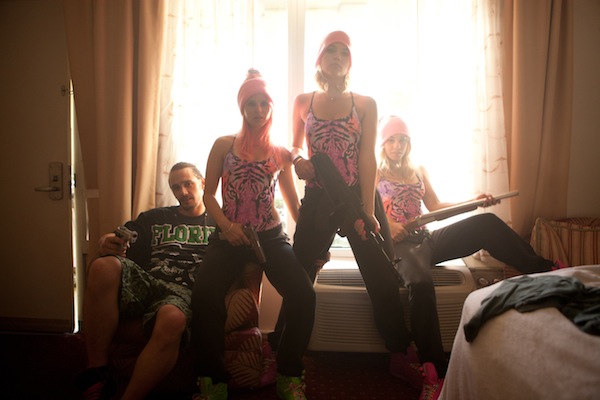
Eventually, once at home with the showboating Alien, and dwindling the numbers as they send one girl back home, the girls take their own agency and pick up Alien's guns as their own.  They play with the guns, and even use them as phalluses on Alien, as shown in the photo.  Here, women are taking control of their own agency and controlling the penis as well.  Is Korine trying to say that the penis/gun is the only way to get all power and agency?  Or that the penis is merely a collective cultural symbol for power and agency, and that any woman who wants to take control of their own destiny is free to do so?  Or, is Korine playing with heady fetish imagery and possibly inverting the gender for maximal impact?  Could it be all three?  Are we as turned on by women wielding a phallus at a guy as we are at a guy wielding a phallus at a woman? If this movie wasn't presented as pure fantasia - by way of repetitive dreamlike voice-overs, repeated footage, time lapses, and over lush cinematography - would we have less of a problem with it, or more?

Spring Breakers, has all of these messages, questions, and more compressed into a tight and electrifying 93 minutes.  If you want to see a statement on sexual politics in the mainstream, this is the movie you need to be watching.  It is as exploitative as all get out...but so is youth culture.

Wednesday, August 21, 2013

Peaches Does Herself (2012): Rock Show as Meta Examination

Peaches Does Herself (2012)
Dir: Peaches

Fuck the pain away...

So goes the chorus of Peaches' most famous song. Couple that with the knowledge that the frame next to this paragraph is the closest I could get to a provocative image without featuring frontal nudity, and you have an idea of what you're probably in for when you see Peaches Does Herself.

Peaches is an electroclash musician who is a provocateur and sexual pioneer and exploiter.  Her sexuality has always dominated her art, and her persona has always been about the liberation and acceptance of sexualities from all sexes and all walks of life  She's also lewd, crude, and in your face.  And, her fans wouldn't have it any other way.

In Peaches Does Herself, she doesn't disappoint with shock value, message, or music.  It's chock full of full frontal nudity, sex toys, simulated love and sex, giant vulva costumes, strippers, transexuals, and gender crossing.  Even as you're done being shocked, it still manages to give you one last twist of the knife.  It's a full on art show posing as a concert, or a concert posing as an art show.  And, Peaches Does Herself is the concert film of that show.

Peaches Does Herself is Peaches' life story.  She tells the story of her sexual and musical development from when she was a teenager learning how to diddle herself to the end when she's destroyed all her experimentations to become something new to show the world.  Along the way, we meet all sorts of people, from an aging stripper comfortable in her brazenness to a transsexual who had top surgery but not bottom.  All of these people have profound influences on how Peaches develops.

At one point, Peaches, in her discover, tries on a giant gold cock, and makes it part of her self.  She dons an outfit of gold, with a gold phallus, and exposed golden breasts.  She takes on this masculine and feminine sexuality in order to give possess the agency that she, and culture, perceives men as exclusively possessing.  She wants to be the objectifier.  She wants to be the one in control.  Peaches, thus modified, meets her mirror, the slim and graceful Danni Daniels, whose height is accentuated by exceedingly tall heels, giving Danni an even greater difference of appearance.  She's the model for Peaches to embrace, until she isn't.

It's these combinations of breasts and cock that makes the most interesting commentary on society.  But, addressing female sexuality, male sexuality, and trying to give women the sexuality that men have without denigrating men or women is something profound.  It shouldn't be.  But, Peaches is saying that women have the power to embrace their own self and give themselves everything they see men as having, if they want it.  It's empowering without destroying.  Even in the ultimate scene of demasculinization, Peaches seems to be saying that one doesn't need to look like a man to have the agency of a man.  And, she hits the road, leaving the theater, while changing "fuck the pain away" showing off her new self to the wilds of Berlin.

Peacher Does Herself is hilarious, and rude.  And, it's everything you expect with a greater message of accepting non-traditional walks of life.  Its also of being comfortable and owning your own personhood and sexuality.  And, it's generally a blast.

But, it isn't perfect.  For a show that seemed to have amazing visuals designed for the stage, the cinematography only showed flashes of genius but was otherwise amateur to inept.  Most of the camerawork is flatly presented with the framing of a high school student.  Once in a blue moon, it has flashes of striking genius, but it really falls flat in a show that is designed to be heightened in visuals.  It ultimately distracts more than it stays invisible (which I think was the goal), and it definitely doesn't heighten the experience.

In the end, Peaches Does Herself is more like a purer, undiluted, less commodified, less commercial Lady Gaga that isn't ready for the masses, despite its need to be seen by the masses in its purest form.  

Friday, August 16, 2013

Kink (2013): Sexual Politics Documentary as Advertisement

Kink (2013)
dir: Christina Voros
pro: James Franco

San Francisco is home to The Armory, a Moorish Castle which now serves as home to Cybernet Entertainment, the proper name for the company that owns Kink.com, an internet-based adult film company which specializes in...wait for it...kinky videos.  They've owned the Armory since 2007, which had been empty since the '70s.  This movie isn't about The Armory itself, but the building itself is a fascinating creature.

Kink.com makes both hetero and gay oriented kinky films.  The majority of Kink.com's content is in the traditional female submissive oriented films, but there are categories for femdom and for gay male videos.  This is also a movie directed by a woman, Christina Voros, who is trying to seem interested in sexuality and the reasons behind why these models would want to be exploited or degraded.  Christina Voros mainly is interested in female sexuality, who dominate the film's all too short 79 minute run time.  More than that, Voros is interested in justifying kinky porn and female participation in it.

At one point in the middle of this female dominated documentary, a woman ironically comments, "I guess females have this sexuality thrust upon them."  She is implying that women in porn is completely taboo compared to it being acceptable for men, and this focus is a type of slut shaming.  Then, the movie proceeds to focus on women for the majority of its length, in an effort to say that women in porn shouldn't be so stigmatized.

Given that Kink wants to legitimize porn, for the most part it avoids the tough questions that linger around the whys and wherefores.  Some of the women are legitimately into kink, but some of the submissive models seem like they're OK with it but mainly doing it for the money.  And, the audience probably notices this up until a hard interview with an experienced dominatrix towards the end of the movie.

This interview, I believe it was with Matrisse Madeline, confessed that the industry runs through people fairly quickly.  Sometimes it is empowering to people who want to try it as a lark, and some people are doing it because they're down on their luck, but most, in the end, don't stick around for long.  She also confessed that if her children wanted to get into the industry, she would probably have a problem with it because it might mean they were in a tough place.

This was a fleeting moment of realism in an otherwise really shiny documentary about a company that pushes its image of being a porn studio that checks, double checks, and triple checks its validity with its models.  In certain videos that depict sex committed against the model's will, the videos are frequently preceded and followed by interviews with all models involved stating that they happily and willingly were participating in the videos. Kink.com is trying to go the extra step to say that these depictions are acceptable displays of sexuality and objectification of men and women by men and women is OK as long as it is wanted and accepted by all participants in said behaviors.

That's not to say that Kink is all about women.  The film is bookended by behind the scenes of gay BDSM videos, whose category is generally produced by, and sometimes starring, Van Darkholme.  There are some interviews with a hetero male submissive and a couple hetero male dominants. There is also an interview with a set construction guy, secretaries, and directors. The majority of these interviews are, obviously, supportive of the behaviors and justifying the morality of Kink.com.  And, many of these interviews are about the female submissive behavior that director Voros is so fascinated by.

Kink serves almost as a pro-sex primer into the world of female sexuality, BDSM, and porn.  It is practically made to tear down the sex-negative and objectification-negative aspects of some tenets of feminism.  Kink wants to show you that it is OK for women to own their sexuality and to willingly submit to men or women if that's what they really and truly want to do.  Whether it succeeds in these lofty goals is hard for me to judge, as I have always supported women in owning their sexuality and being able to act like men without the repercussions that women who act like men generally face.  But, what it does succeed in doing is being a great advertisement for Kink.com.

Final note, to those that were wondering, yes there is hardcore sexuality featured in this documentary.  There is full frontal nudity (male and female), some penetration, toys, and explicit kink in fair amounts.  If you are not able to handle homosexual sex, kinky sex, female nudity, male nudity, or graphic depictions of non-romanticized sexuality, this movie is not for you.

Fasinatingly, the only still of five in the press kit that has a woman as a submissive is the one shown below the break.  The other four stills are male submissive, and only one of those is male submissive in an explicitly femdom scene.

Ed's note: As of 8/16/2013, I believe that Kink has not found a distributor.  It is not a poorly made documentary, and should probably be seen by many people.  I believe that it's explicit content is what is keeping Kink from finding a theatrical, or even a VOD/streaming distribution.  Kink's official website seems to have been created exclusively for Sundance festival, and maintained through Sundance.  I saw the film at SIFF in 2013.


Wednesday, August 14, 2013

A Serbian Film (2010): Temper Tantrum as Critique


A Serbian Film (2010)
dir: Srdjan Spasojevic

When an artist throws a temper tantrum, sometimes the results can be amazing.  This is not that film.

A Serbian Film is a film created by a rich Serbian as a damning critique of the state of Serbian culture.  This isn't about the Balkan Wars, nor even allegorical for it, except to Western eyes trying to seek out some deeper meaning in a post-modern contextual manner.  If it is about the Balkan Wars, and the atrocities committed during the course of it, it is only in the most tangential of ways, in that they gave first-hand knowledge of the kind of horrors one human can commit against another.

Instead, A Serbian Film is a film directly commenting on the state of Serbian sociological culture in general, and film and arts culture in particular.  It is a film that is decrying the diminishing of Serbian cultures in order to fund and churn out art that is aimed directly at Western - read: American - audiences.  A Serbian Film is a torture porn film exaggerating what I call suffer porn.  

Suffer porn?  Huh?

Suffer porn is the genre of small foreign films which are all completely about somebody suffering at the hands of an evil culture or government, and either dying at the end or overcoming the atrocities.  It's all about emotional suffering under the guise that it teaches you something about the culture it is depicting.  The first time I noticed this was the American movie, Not Without My Daughter, which depicted the horrors of the Islamic culture against women, but was primarily about some woman who was suffering indignities in order to rescue her daughter.

The first link I selected from Wikipedia's Cinema of Serbia page under "Famous movies from Serbia", was When Father Was Away on Business, a story about a young boy trying to survive while his dad is sent to a labor camp, falls in love with a girl who is taken away by ambulance, and witnesses his father's mistress attempt suicide and his uncle is diagnosed with diabetes.  Life is a Miracle is about an engineer with a mentally unstable wife and a son who wants to play football, but is recruited for the Balkan wars...then the engineer falls in love with a Muslim hostage.  Every movie I've clicked on has been people suffering.

Which brings us back to A Serbian Film.  

A Serbian Film is about an aging porn star, Milos, with a huge "talent" that is married with a wife.  Milos, strapped for cash, gets one last well-paying gig, by a rich filmmaker, Vukmir, with Western interests, though Milos never hears what the film will entail.  

Milos' first shoot is at an abandoned orphanage, where he witnesses a mother physically and mentally abusing what looks like a fairly legal teenager.  Then, we get Milos' porn scene where he gets oral sex from the mother while watching the daughter lick a lollipop.  The scenes escalate from there, and include him physically abusing the mother, him killing the mother with a machete while having sex with her, him getting raped by a security guard, and more.  Yes, it's graphic, yes it tries for realism, and no it isn't sensational about any of it.  

At first, it is a straight-forward movie about one last gig, but by the end of the first hour, the movie firmly ensconces itself in Inland Empire territory, where things are half-remembered, half-dreamed, days are skipped, timelines go back and forth, and there is even video playback.  Basically, the film loses its mind with Milos, who goes crazier the longer he's involved with the movie.  

The movie is intended to shock.  The whole point of the movie is "I'm offended, why aren't you offended?"  It isn't a glib black comedy like Man Bites Dog or a facile torture porn movie like Hostel.  It isn't nearly as easily dismissable as either of those.  While the movie certainly does revel in the graphic depictions of gore, violence, sexual violence, sex, rape, and everything else, the movie is looking onto it with a bit of horror.  

And, I'd say its point was sledgehammer obvious, if I hadn't read so many opinions completely missing the point.  There are whole scenes where Milos is physically abusing women while the Westernized filmmaker is screaming "YES!  This is FILM!  This is ART!"  There are scenes where the filmmaker, even after being beaten, is saying how "this is TRUTH." There is a scene in the middle of the movie where a woman gives birth in a dark room, and a guy has sex with the newborn baby right out of the womb.  Milos storms out, disgusted, while the Vukmir is proudly proclaiming "NEWBORN PORN! NEWBORNS!"

On top of Spasojevic condemning the Westernization of Serbian film and culture, he is also condemning the government's participation of said film and culture.  *warning: spoilers and a description of the final scene* Milos' brother is a police officer who is ostensibly helping his brother out.  He promises to investigate Vukmir, and then tells his brother that Vukmir is a child psychologist with an interest in film.  You can trust him.  

The final scene has Milos being taken to a warehouse where he is told to have sex with a body that is laying under a sheet with a towel over its head.  And, then a masked man has sex with another covered body lying next to the first.  The masked man is uncovered, revealed to be his brother the cop, and then the bodies are revealed to be Milos' drugged son - with whom his is having sex - and his wife - with whom his brother is having sex.  This leads to a bloody blowout while the filmmaker is screaming this is TRUTH!  And encouraging the rampage, which includes a depiction of Milos penetrating the eye socket of the cinematographer.

Basically, Spasojevic is implying that the government (in the form of his brother) is very involved in the Western filmmakers' figurative raping and pillaging of Serbian culture, through financing, in order to find suffer porn for American audiences to feel bad about.  He wants the Serbs to have their own culture and their own film without having to kowtow to the needs of the wider global culture.  And, he laments that, because of the Serbian economy, that the Serbs cannot afford to have their own blossoming film industry independent of the West.

But, is the film good?

That question is not as easily answered.  Is a film good, if it shocks and it's intent is to shock?  Is a film that says "If you're not offended, you're not paying attention" successful if it offends the audience, possibly even beyond the point where they'll actually receive the message you're trying to send.  As I mentioned before, it is a temper tantrum of a film.  It's a primal scream parodying (not humorously) the suffer porn industry by turning it into torture porn.

One can pose the question as "is it art?"  But, that's almost like asking "Is Serrano's Immersion (Piss Christ) good?  Is it art?"  Is it valid if the point is missed?  What if the point is as explicit as one could possibly make it, and the point is still missed because you amped it way too loud, and people can't even understand it?  There is a whole scene where Milos is calling himself the victim, while everybody else suffers around him, kind of like the plot of When Father Was Away On Business, where the boy is there while everybody else suffers.  It can't possibly be any more direct without being a non-fiction essay.

So, that decision is up to you.

The one problem I have as a westerner, and as a human, is the sexual politics of the film.  The film is very brotastic in its mentality.  The biggest indignity that is suffered before the climax of the film is not Milos decapitating a woman while having sex with her.  It isn't the newborn porn, which actually almost has the humor of a dead baby joke.  It isn't teen rape, abuse, or any of the other indignities.  It is Milos getting raped, while drugged, by a security guard.  And, it is so offensive that we don't even get that in detail.  We only get a close-up of the security guards face close to Milos' face.

The women in A Serbian Film are violated the most often, the most graphically, and also are subjected to the majority of the graphic violence as well.  The one scene that is graphically depicted that isn't of a woman is the eye socket rape.  Everything else is violence against women.  One wonders if that is the point of the movie, and that was intended by the writer/director.  If the suffer porn frequently has women suffering around the male central character, and A Serbian Film just took that depiction to the extreme.  Or, if it really does have abominable sexual politics.  

In any case, A Serbian Film is not necessarily the evil that others make it out to be.  It is graphic, shocking, offensive, and it intends to be.  It isn't Chaos where it has nothing new to say about a topic.  It is moderately well filmed and made, even though I completely detested the Inland Empire style filmmaking of "is this reality, or is the main character going crazy?"  I feel that that was an attempt to lessen the blow of the violence, while still being able to keep it as depicted.  The pacing is decent.  But, the movie can even be quite dull.

So, is it good?  Is it bad?  Can it even be thought of that way?  

One thing it isn't, really, is dismissable.

American Availability: Uncensored on Youtube, Limited Edition Uncut DVD by Invincible Pictures, FlixFling, Censored DVD and Blu-Ray.